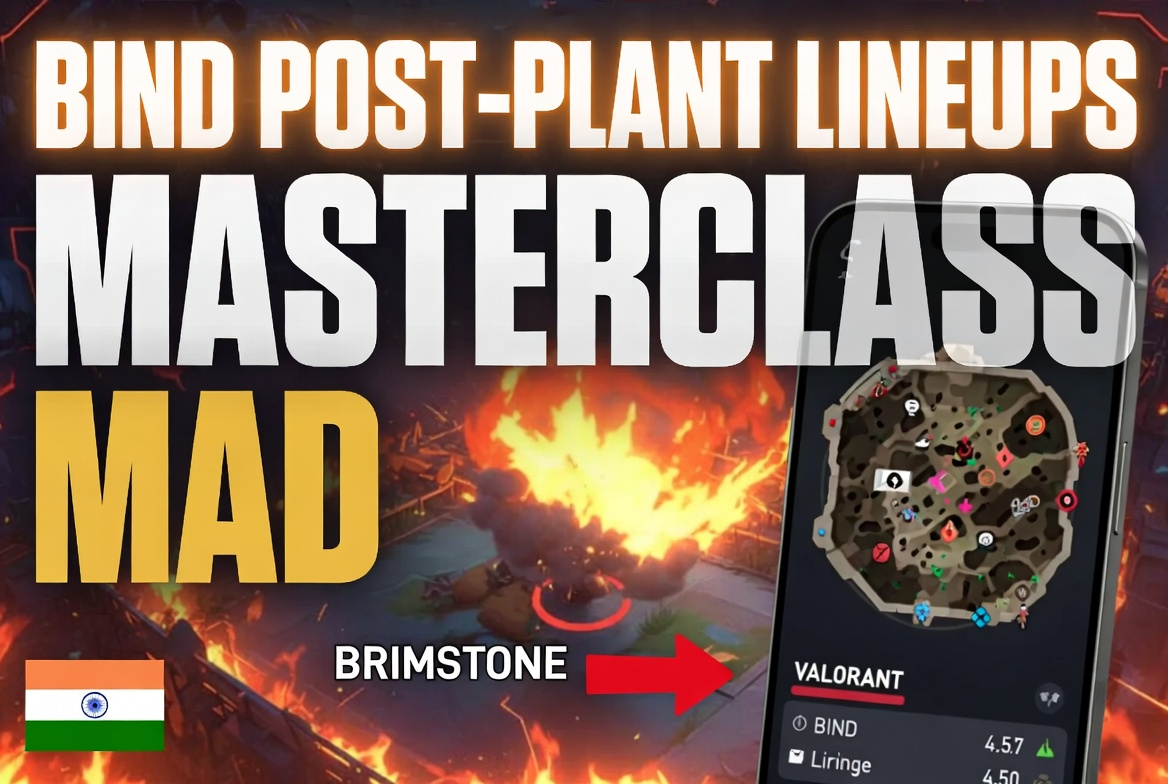
Updated for the latest Valorant Mobile Beta | Perfect for Indian Players on Any Device
In Valorant Mobile, planting the Spike is only half the battle. The real pressure kicks in during those intense final seconds when the enemy team rushes to defuse. This is exactly where post-plant lineups become your strongest weapon, transforming risky and stressful situations into confident, easy round wins with perfectly timed utility.
On Bind, with its confusing teleporters, tight corridors, and unpredictable rotations, these lineups turn into absolute game-changers. A single well-placed molly or smoke can completely deny the defuse and force the opponents into a disastrous retake.
This complete guide delivers full post-plant executes for Bind, Ascent, Lotus, Sunset, and Fracture, all carefully optimized for touchscreen and gyro controls. Whether you’re grinding ranked on a budget Redmi, a mid-range Poco, or a premium iPhone, these lineups use simple HUD landmarks and smooth drags that anyone can master quickly.
No more random throws or guessing. Just repeatable, reliable denies that feel completely natural on mobile. Master these setups and you’ll start winning rounds you used to lose, even when playing solo queue.
Why Post-Plant Lineups Matter So Much on Mobile
In Valorant Mobile, the pace of the game is incredibly fast. Every second counts. While planting the Spike feels like a victory, the real test begins the moment the defuse timer starts ticking. Defenders rotate much quicker than on PC, they peek angles aggressively, and they punish even the slightest hesitation without mercy.
This is exactly why post-plant lineups are one of the most powerful tools you can have in your arsenal. A perfectly timed molly, incendiary, or smoke thrown at the right moment can completely deny the defuse, burn the enemy team, or block their vision long enough for your team to secure the round. Instead of losing a planted spike and giving away free points, you turn those situations into guaranteed wins.
On Bind especially, these lineups become absolute game-changers. The map’s signature teleporters create total chaos during retakes. Attackers can appear from A Short or B Long in the blink of an eye, and one wrong rotation from your team can make the round slip away instantly. Mastering post-plant utility on this map gives you a massive advantage, especially in solo queue where you can’t always rely on teammates calling rotations or coordinating utility.
The best part? These lineups are actually easier to execute on mobile than most players think, once you understand the right technique.
Core Mobile Principles That Make These Lineups Easy:
- Use HUD landmarks for perfect alignment — Your HP bar, ability icons, minimap edges, and even the corners of your screen become reliable reference points. No need to memorize pixel-perfect spots like on PC.
- Always use fixed standing positions — Stand in the exact same corner or spot every time. This creates muscle memory that works consistently across different devices and ping levels.
- Master the smooth upward drag + gyro fine-tune — Perform one clean drag with your finger and let the gyro handle the final precision. This combination feels natural after just a few practices and gives you mouse-like accuracy.
- Keep setups super quick (2-3 seconds max) — Mobile players push fast. Your lineup must be fast to throw so you can reposition or rotate immediately after.
Pro Tip: Jump into Custom Games with unlimited abilities enabled. Spend just 10-15 minutes practicing 2-3 lineups per site. Record your screen, review your drags, and you will notice massive improvement in your next ranked session. Consistency beats perfection.
Bind: Mastering the Teleporter Chaos
Bind’s unique layout makes it one of the best maps for utility plays in Valorant Mobile. With only two sites and no traditional middle area, rotations are predictable in theory but become explosive in practice because of the teleporters. This map rewards players who can control default plant spots effectively.
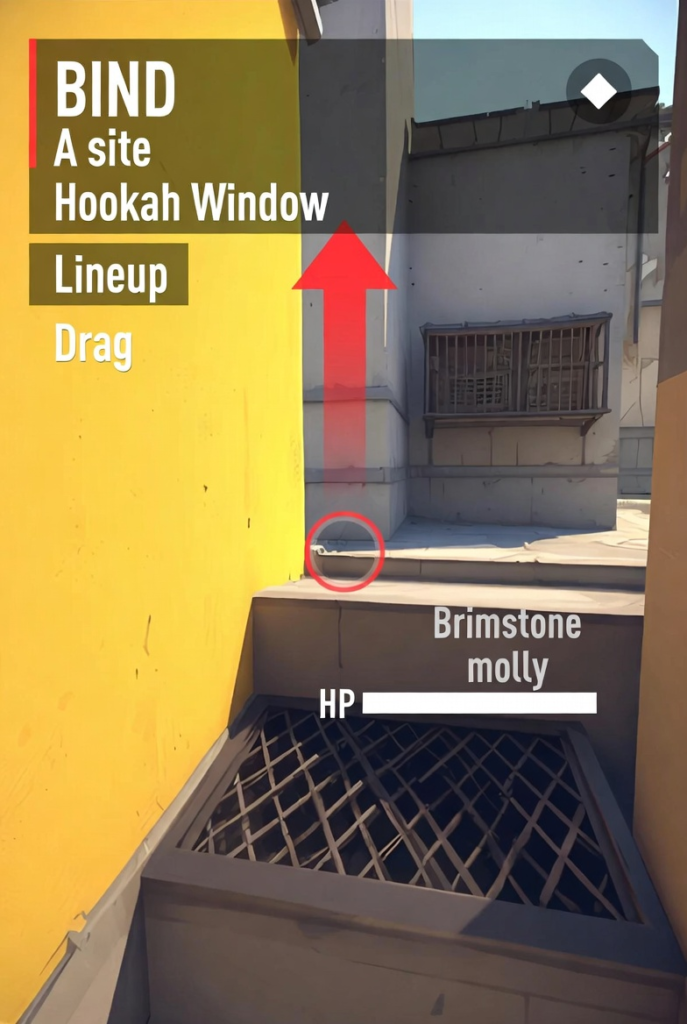
A Site Default (Hookah Side)
This is one of the most useful and frequently used lineups on the entire map.
Setup Steps: After planting the Spike near the default box by A Short, rotate immediately into the back-right corner of the Hookah window. Position yourself carefully so you’re hugging the wall. Face toward the site entrance and look up at the bright yellow wall section above the default plant spot.
How to Throw the Lineup: Align your left HP bar precisely with the small vent edge visible on the wall. Then perform a single, smooth upward drag covering approximately 55% of your screen height and release.
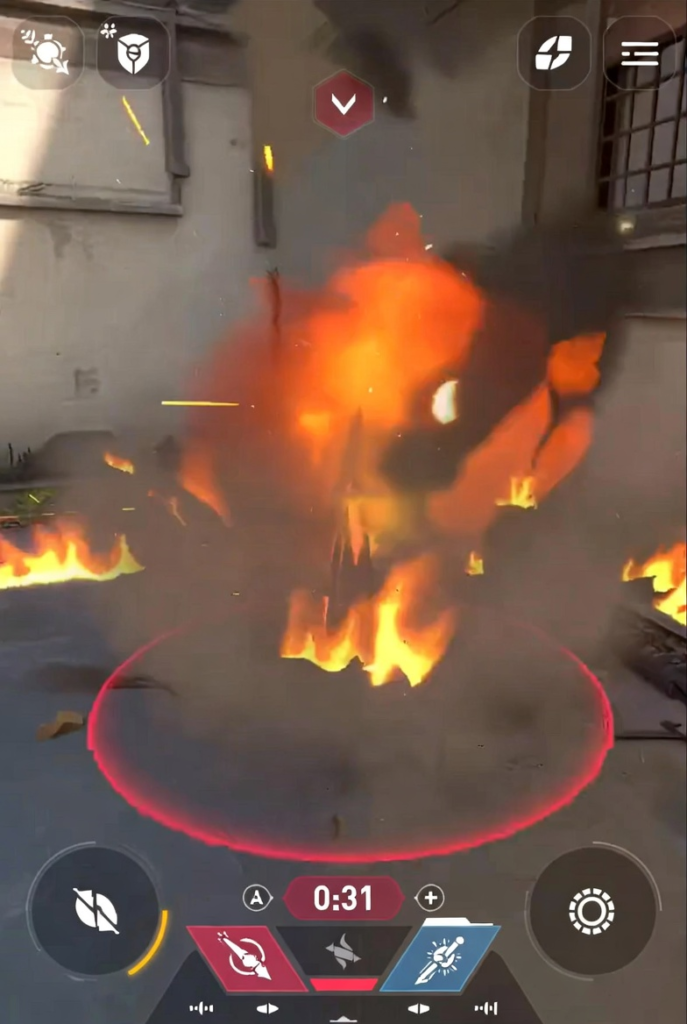
This Brimstone Incendiary (or any similar molly) lands perfectly on top of the default plant, covering the most common defuse position. The fire burns for a full 7 seconds, giving your team enough time to rotate back or hold aggressive angles.
Best timing: Throw it around the 0:31 to 0:28 mark on the timer. On higher ping (common when playing on China servers via VPN), release it 1 second earlier.
On mobile this lineup feels extremely satisfying because the gyro helps you correct any small mistake during the throw. Once you master it, you’ll start winning rounds even when the enemy has full numbers for the retake.
B Site Default (Garden/Platform)
Another extremely strong and frequently used lineup on Bind is the B Site Default post-plant.
Setup Position: After planting on the center platform in B Garden, quickly rotate back into the B Long corridor and hug the right corner wall. This position keeps you safe while giving you the perfect angle for the throw.
How to Execute the Lineup: Look up toward the ceiling and aim at the clear pipe junction where several pipes meet. Perform a stronger upward drag of approximately 65% of your screen height. The motion should feel smooth and confident. Release the incendiary and it will arc beautifully, landing directly on top of the default plant spot on the platform.
This molly covers the entire common defuse area, burning enemies who try to approach from any side. The best part is the safety it gives you — after throwing, you can immediately retreat through the teleporter to A Short or stay hidden in B Long depending on the situation. It buys your team crucial seconds to rotate back and retake control.
Timing Tip: Throw this around the 0:29 to 0:26 mark on the timer. On higher ping, release it slightly earlier.
These two Brimstone lineups alone (A Hookah and B Long) are incredibly powerful. In lower to mid ranks (Iron to Gold), most players plant randomly on default spots without thinking. On Indian servers, B Site defaults are especially common. If you master just these two setups, you will start winning a huge number of rounds that other players usually lose. They are simple, consistent, and extremely effective even when playing solo.
Expanding to Other Maps: The Same Mobile-Friendly Approach
The same principles you learn on Bind work beautifully across the entire map pool. Once you understand HUD alignment and the drag + gyro technique, you can adapt lineups to any map quickly.
Ascent offers much wider sightlines and open spaces. This favors long-range denies from Mid Market or Catwalk toward A Heaven. On B Site, the classic tree and pipe lineups feel very natural with touch controls because of the extra space to aim.
Lotus introduces verticality and multiple levels, which makes bounce lineups very strong. Try setups from C Link on A Site or use the waterfalls on B Site for elevated throws. A slight tilt of your phone with gyro makes these multi-level lineups much easier and more accurate.
Sunset, being one of the newer maps, rewards long-range Viper Snake Bites and Brimstone arcs thanks to its open mid area. The B Main default plant has an incredibly safe lineup you can throw directly from the attacker spawn side — it feels almost unfair once you learn it.
Fracture is more dynamic due to its destructible walls, but the key is focusing on stable, repeatable positions. Look for lineups through the doors on A or using the drop-down areas on B. Agents with wall-bang potential and strong utility shine here.
No matter which map you’re playing, the core technique stays the same: find a safe corner, use HUD landmarks, and execute a clean drag. This makes learning new maps much faster on mobile.
Mobile-Specific Tips Tailored for Indian Players
Playing on Indian servers or using VPN to access other regions comes with its own challenges. Here are practical tips that will make your post-plant lineups much more consistent:
On budget and mid-range phones (₹15,000 to ₹25,000 segment), lower your sensitivity to around 40, increase HUD scale to 115%, and turn off shadows and other graphic effects. This makes walls, vents, and pipes much clearer and easier to use as landmarks. Devices like Poco, Redmi, and Realme handle these lineups very smoothly even during peak hours.
If you’re playing on China servers through VPN and experiencing higher ping, always throw your utility 1 to 2 seconds earlier than usual. The best way to practice is to join a Custom Game with your exact ping and test the timing until it feels natural.
The most satisfying improvement comes when you combine touch drags for the main movement and gyro for fine precision. At first it may feel strange, but after 3–4 hours of practice it starts feeling closer to mouse control on PC. Many players report hitting lineups more consistently on mobile than they ever did on PC once they get comfortable with this combo.
Quick Practice Routine: Spend 15 minutes daily in Custom Games focusing on 2–3 lineups per map. Record your screen, watch the replays, and correct your drag percentage and positioning. You will see your win rate increase noticeably within a week.
Master these post-plant lineups and you’ll climb ranks much faster than you expect. They are by far one of the easiest and most effective ways to carry games in solo queue, especially when your team isn’t communicating well.
Which map or agent lineup do you want me to expand next? Sage walls on Ascent, Viper lineups on Lotus, full executes on Sunset, or maybe Phoenix and Omen setups on Bind?
Drop a comment below and I’ll create the next detailed guide for you.
Share this with your squad and start denying those defuses like a pro! 🔥