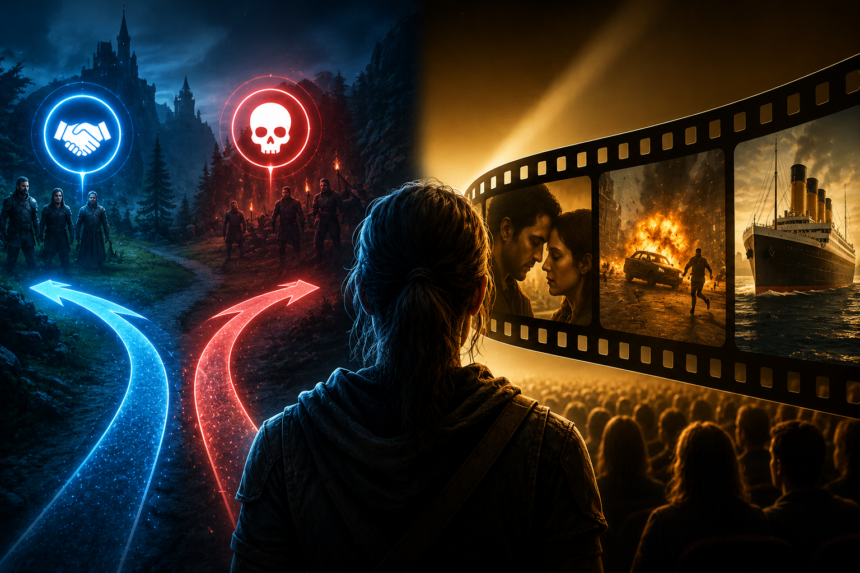
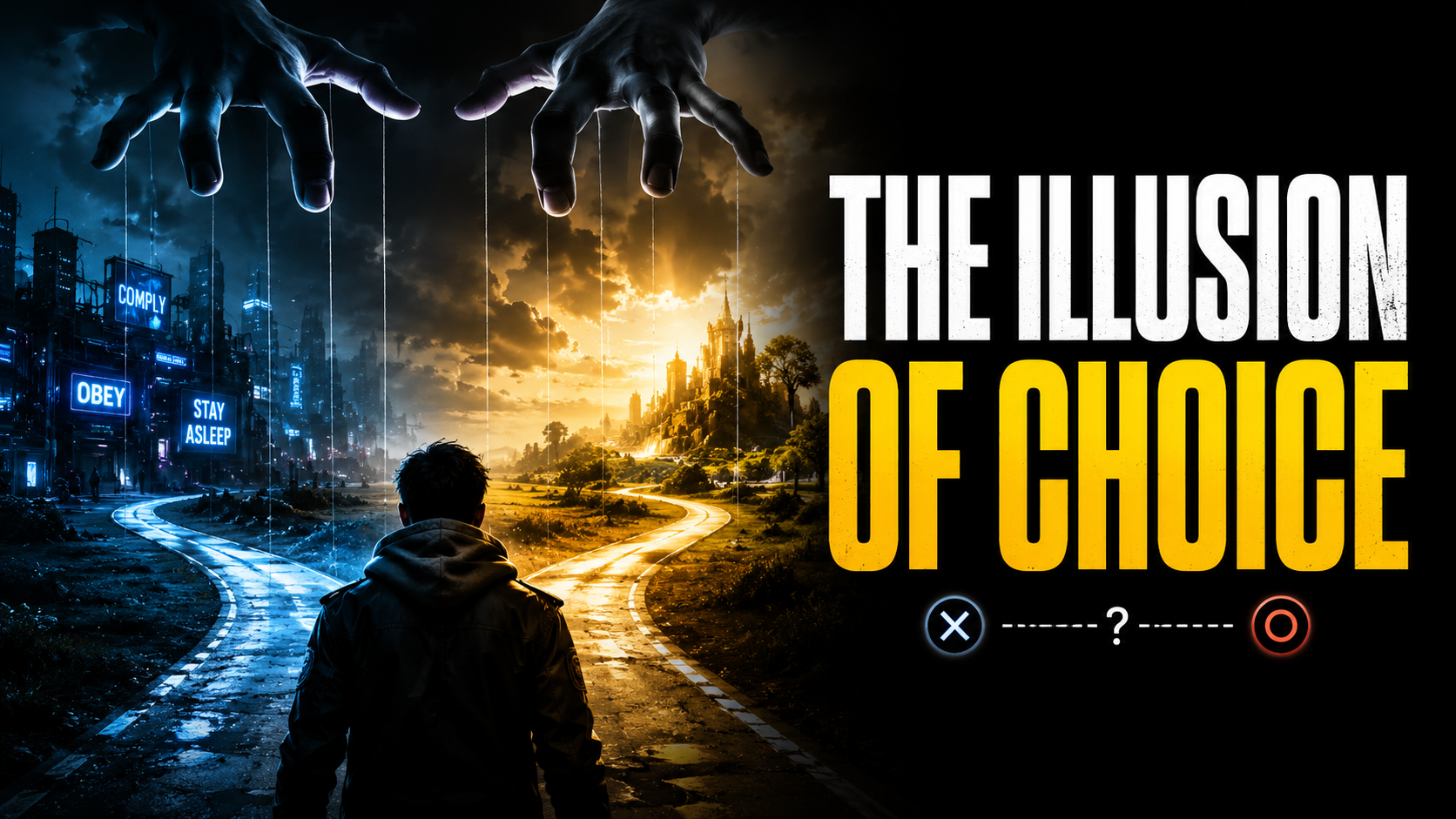

Every video game makes you a promise before you’ve pressed a single button: your choices matter here. It’s printed on the back of the box, implied by every branching dialogue tree, baked into the very idea of “player agency.” And yet almost every game that has ever made that promise has also, quietly, been lying to you about the size and shape of the choice on offer.
- Choice as a Mechanic, Not Just a Story Beat
- The Stanley Parable: Choice as a Beautifully Staged Illusion
- BioShock: Choice as a Trap You Didn’t Know You Walked Into
- Undertale: Choice as Something That Actually Remembers You
- Three Games, Three Philosophies
- The Role of Player Agency in How These Lessons Land
- What This Means Outside the Game
- Conclusion: Why Games Are an Underrated Space for Thinking About Free Will
That gap — between the choice you feel you’re making and the choice the system actually allows — turns out to be one of the richest places in all of game design to think about free will. Philosophers have argued for centuries about whether human choice is truly free or just the felt experience of a decision that was, in some sense, already determined. Video games can’t settle that debate. But they can simulate both sides of it, sometimes in the same afternoon, which is more than most philosophy seminars manage.
This essay looks at three very different games — The Stanley Parable, BioShock, and Undertale — not as reviews, but as three distinct philosophical positions on choice, disguised as game design. None of these games agree with each other. Read together, they form something close to a real philosophical debate.
Choice as a Mechanic, Not Just a Story Beat
Before getting into specific games, it’s worth pausing on something obvious that we rarely examine closely: most games don’t actually offer choice in the way a real decision in your own life does. A branching dialogue tree still only branches into paths a writer already wrote. A “moral choice” prompt still only ever resolves into one of a handful of pre-scored outcomes. The illusion of an open world is still, underneath, a closed set of possibilities with very good set dressing.
This isn’t a flaw unique to games — it’s arguably a more honest version of a problem every choice-based medium shares. What makes games different is that they let you feel the walls of the system while you’re pressing against them, rather than only noticing the walls afterward, the way you might notice, months later, that a decision you thought was entirely your own was shaped the whole time by circumstances you didn’t choose.
Why This Matters Philosophically
This tension mirrors one of the oldest disagreements in the philosophy of free will: the difference between libertarian free will, which holds that choices are genuinely undetermined and could have gone another way, and compatibilism, which holds that a choice can be meaningfully “free” even if it was, in some deeper sense, the only outcome a given set of causes could have produced. Games are an unusually good sandbox for this argument, because a designer can build a system where you feel the full weight of choosing, while knowing, as the author of the rules, exactly how much of that feeling was engineered.
This is the foundation that The Stanley Parable, BioShock, and Undertale each build on — but they take that foundation in three completely different directions.
The Stanley Parable: Choice as a Beautifully Staged Illusion
In The Stanley Parable, developed by Galactic Cafe, you play an office worker named Stanley who, one day, notices that everyone else in the building has disappeared. A narrator immediately begins describing what Stanley does next — and the entire game is built around whether you follow the narrator’s script or defy it.
What makes the game philosophically sharp isn’t just that you can disobey the narrator — it’s that disobedience is itself just another authored branch. Walk left when the narrator says “Stanley went right,” and the narrator simply adjusts, sometimes with visible irritation, sometimes with a joke that suggests he saw this coming. There is no path through The Stanley Parable that wasn’t already anticipated by its designers. The game doesn’t hide this. It practically dares you to find an option it hasn’t accounted for, and then delights in revealing that it has.
Practical Example: The Door You Were Always Going to Open
Early in a typical playthrough, the narrator describes Stanley entering a room through the door on his left. Walk through the door on the right instead, and the game doesn’t break — it simply has a pre-written reaction waiting, often more interesting than the “correct” path would have been. Play again, refuse differently, and the game has another response ready for that too. Eventually, a careful player starts to suspect that “rebellion” here was never actually outside the system. It was one of the more entertaining rooms inside it.
This mirrors something genuinely worth sitting with outside of gaming: the sense, common to a certain kind of adolescent (and occasionally adult) rebellion, that defying an expectation feels like freedom, even when the range of available defiances was itself anticipated by whoever set the expectation in the first place. The Stanley Parable doesn’t resolve whether that makes the rebellion meaningless. It just makes sure you notice the question.
BioShock: Choice as a Trap You Didn’t Know You Walked Into
If The Stanley Parable treats the illusion of choice as a puzzle to be poked at, BioShock, developed by Irrational Games, treats it as an ambush. For most of the game, you play a nameless protagonist navigating the underwater city of Rapture, guided by a friendly voice on the radio who frames every objective as your own idea, phrased with a particular, oddly formal politeness.
Without spoiling exactly how this unravels for players who haven’t experienced it, it’s enough to say that a substantial portion of what feels like “your” agency across the game’s first half turns out to have been engineered from the very first mission, using a mechanism embedded directly into the plot rather than merely implied by the UI. The reveal doesn’t just surprise the player narratively. It retroactively recontextualizes every prior button-press as something other than what it felt like in the moment.
Why the Twist Isn’t Just a Twist
It would be easy to file this under “clever plot twist” and move on. But the philosophical weight of BioShock comes from something more uncomfortable: the game doesn’t just tell you that your character’s choices were controlled. It makes you, the actual player sitting with a controller, realize that you followed the exact same instructions the character did, for the exact same reasons — because a friendly voice told you to, and the game rewarded you for compliance every step of the way.
This lands closer to real unease than most twist endings manage, because it isn’t only a story about a fictional character being manipulated. It’s a demonstration, using your own play session as the evidence, of how easily “doing what I chose to do” and “doing what I was directed to do” can feel identical from the inside.
A Real-World Parallel: Obedience and the Illusion of Consent
There’s a well-known line of research in social psychology, most associated with Stanley Milgram’s mid-twentieth-century obedience experiments, showing that ordinary people will comply with instructions from a perceived authority figure far more readily, and far further, than most predict about themselves in advance. BioShock essentially stages a playable version of that same discomfort: a friendly, authoritative voice, a series of small, reasonable-seeming requests, and a player who, in hindsight, never seriously questioned any of them until the game forced the question. Few pieces of interactive fiction manage to implicate the audience this directly in the mechanism they’re critiquing.
Undertale: Choice as Something That Actually Remembers You
The third game in this essay takes the sharpest turn. Undertale, created largely by Toby Fox, isn’t interested in exposing choice as an illusion or staging a clever ambush around it. It’s interested in making choice actually consequential — and then making sure you can’t pretend otherwise afterward.
You play a child who has fallen into an underground world of monsters, and at almost every encounter, you’re given a genuine option most games never offer seriously: resolve the conflict through violence, or through patience, mercy, and understanding. Unlike a typical morality meter that quietly resets or forgives you at a save point, Undertale tracks what you actually did, persistently, sometimes across playthroughs, and lets specific characters reference specific violence long after you’ve moved on from it, or long after you assumed a fresh save might let you start clean.
Practical Example: The Game That Won’t Let You Take It Back
Without detailing the specifics, there is a well-known moment late in certain playthroughs where a character directly addresses choices the player made hours earlier, choices that felt, at the time, like ordinary gameplay experimentation rather than decisions with lasting weight. The game does not scold in an obvious, moralizing way. It simply remembers, calmly, and lets the player sit with the fact that it remembered.
This is where Undertale diverges hardest from the other two games in this essay. Where The Stanley Parable shows you the walls of the system and BioShock shows you how easily you mistake obedience for choice, Undertale insists that, within its world at least, your choices were real enough to have consequences you don’t get to undo simply by wishing you’d chosen differently. That’s a much closer analogue to how choice actually functions in a life outside the game.
Three Games, Three Philosophies
Put side by side, these three titles form something close to a spectrum:
- The Stanley Parable treats choice as a fully authored illusion — closer to a maze where every hallway, including the secret ones, was drawn by the same architect.
- BioShock treats choice as a trap disguised as consent — closer to discovering, after the fact, that a request you agreed to was never really a request at all.
- Undertale treats choice as something with real memory and weight — closer to a relationship that keeps track of what you actually did, not just what you meant to do.
None of these approaches is “correct” in some objective sense. What’s interesting is that all three are legitimate, well-supported responses to the same basic human question: how free are we, really, when we choose? The philosophy of games doesn’t need to give a single answer here, and arguably shouldn’t. Its strength lies in offering multiple, playable perspectives on a question philosophy has debated for millennia without ever fully resolving.
Why Multiple Perspectives Matter More Than One “Right” Answer
This is worth sitting with for a moment. If only one of these games existed, players might mistake its particular stance on choice for the definitive gaming take on free will. But because The Stanley Parable, BioShock, and Undertale coexist, each with devoted communities still debating them years later, they demonstrate something valuable: video games, as a medium, are mature enough to hold contradictory truths about the same subject simultaneously. That’s not a weakness. It’s closer to how the debate over free will actually works in philosophy departments — nobody has landed on a single answer there either, and the disagreement itself is where most of the insight lives.
The Role of Player Agency in How These Lessons Land
There’s a detail that’s easy to overlook when comparing these three games: in every case, the player isn’t just observing a philosophy of choice unfold on a screen — they’re the one whose actual button-presses become the evidence for the argument. This distinction matters more than it might seem.
In The Stanley Parable, you personally try to outsmart the narrator, and your specific attempt becomes part of the joke. In BioShock, you personally follow the instructions that later turn out to have been coerced, and your own history of compliance becomes the twist’s supporting evidence. In Undertale, you personally decide, encounter by encounter, whether to fight or show mercy, and the game holds onto your specific pattern rather than an abstract “player” archetype.
This is a structural difference between games and other storytelling mediums that’s easy to underestimate. A novel can describe a character discovering their choices were illusory. A film can show a character being manipulated into false consent. A game can make the audience the one who was manipulated, using their real inputs as the proof — and because the discomfort partly depends on the player’s own history within the system, the lesson tends to feel earned rather than delivered secondhand.
A Small But Telling Detail: The Illusion Only Works Once
It’s worth noting that all three of these games lose a measure of their original force on repeat playthroughs, once the player already knows the trick. The Stanley Parable‘s narrator becomes a familiar voice rather than a genuine surprise; BioShock‘s twist can’t ambush you the same way twice; Undertale‘s consequences can be planned around rather than stumbled into. Whatever one makes of that, it highlights something philosophically interesting: for all three of these designers, the sensation of unexamined choice seems to require, at some level, an audience that doesn’t yet know how the system works. Once you can see the architecture, you’re no longer inside the experiment — you’re reading its blueprint.
What This Means Outside the Game
It’s tempting to treat these observations as interesting trivia about game design and stop there. But the reason this topic belongs in a broader conversation about gaming and philosophy is that these three approaches map fairly directly onto how people actually experience choice in real life.
Some decisions feel like The Stanley Parable — a sense of rebellion against an expectation that, in hindsight, was itself part of a narrower set of options than we assumed at the time. Others feel closer to BioShock, once we recognize, often only in retrospect, how much a “choice” was shaped by a trusted voice, an incentive structure, or a social expectation we never seriously questioned while we were inside it. And some choices function the way Undertale insists all choices should: genuinely ours, remembered by the people and relationships they affected, not erasable simply because we’d prefer a different history.
None of these approaches is universally correct, and few decisions fit neatly into just one. Most of us move between all three, often without noticing which frame we’re currently living in. What video games offer, uniquely among storytelling mediums, is the chance to rehearse the discomfort of each of these stances safely, one playthrough at a time, before life asks us to sit with the real version.
Conclusion: Why Games Are an Underrated Space for Thinking About Free Will
Free will is one of the few subjects every person has an opinion about and almost no one can fully defend under pressure. Video games, strangely, have become one of the more honest spaces for approaching it — not through lectures or grand philosophical statements, but through systems that let players feel the edges of their own agency before they have to reason about it in the abstract.
The Stanley Parable teaches that rebellion can be quietly pre-authored by the very system it appears to defy. BioShock teaches that consent can be manufactured so smoothly the person consenting never notices. Undertale teaches that some choices are real enough to be remembered, whether or not we’re ready for them to be. None of these lessons arrive as a lecture. They arrive through play — through the actual, personal experience of pressing a button and discovering, afterward, what that button-press really was.
That might be the quiet, underappreciated gift of gaming and philosophy as a genre: it doesn’t ask you to agree with a single conclusion about free will. It hands you a controller, and lets you find out, one choice at a time, how free you actually were.
None of these games will tell you how much of your own life is genuinely undetermined and how much was shaped long before you noticed you were choosing, and that’s probably the point. The value isn’t in the answer — it’s in having rehearsed the question, safely, before real life asked it of you without warning.
This essay is part of an ongoing series on the philosophy of video games — exploring power, identity, sacrifice, and the choices that define us, one title at a time.