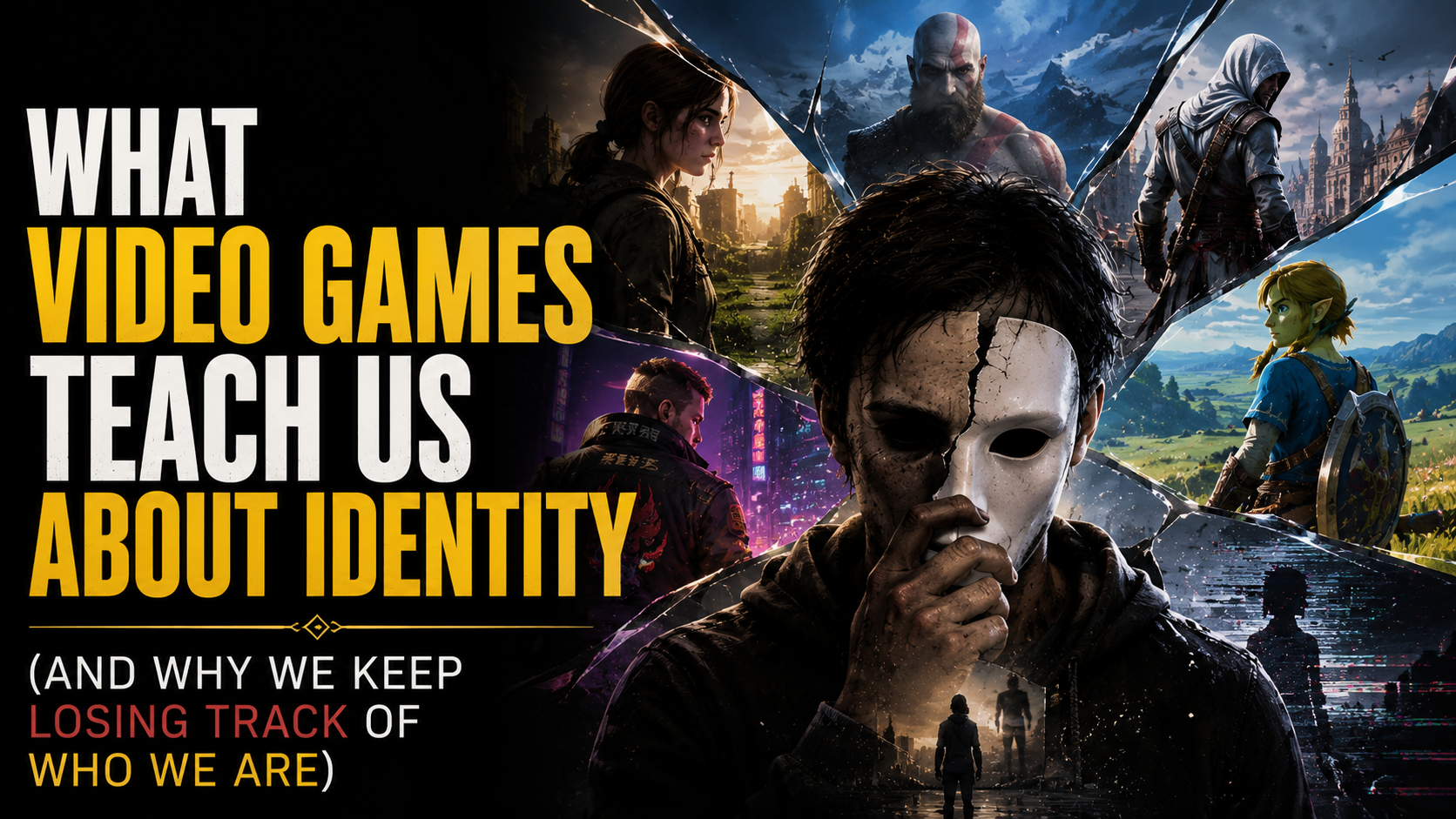

If every cell in your body is eventually replaced, if your memories are quietly rewritten every time you recall them, and if the person you were at seven years old shares almost nothing in common with the person reading this sentence — what, exactly, is it that makes you still you?
- Identity as a Mechanic, Not Just a Character Trait
- SOMA: Identity as Continuity of Mind
- NieR: Automata: Identity as Assigned Purpose
- Cyberpunk 2077: Identity as Something That Can Be Overwritten
- Three Games, Three Philosophies
- The Role of Player Agency in How These Lessons Land
- What This Means Outside the Game
- Conclusion: Why Games Are an Underrated Space for Thinking About the Self
This is one of philosophy’s oldest, least resolved questions, usually introduced through thought experiments like the Ship of Theseus or Derek Parfit’s teleportation puzzles. Video games, it turns out, are unusually well equipped to stage this question directly, because they routinely ask players to inhabit bodies, memories, and identities that aren’t stable in the way we normally assume our own is.
This essay looks at three games — SOMA, NieR: Automata, and Cyberpunk 2077 — not as reviews, but as three distinct philosophical positions on personal identity, disguised as game design. Like the essay on free will and choice published earlier in this series, none of these games agree with each other. Read together, they form something close to a genuine philosophical debate about what actually makes a self continuous over time.
Identity as a Mechanic, Not Just a Character Trait
Most games treat identity as background information — a character sheet, a backstory, a voice actor’s performance. What makes the three games in this essay different is that each one turns identity into something the mechanics interrogate directly, not just something the narrative describes.
This distinction matters because it changes what kind of claim the game is making. A story that simply tells you a character’s sense of self is fracturing is asking you to sympathize from the outside. A game that makes you, the player, inhabit that fracture — control a body that may or may not be the “real” one, or complete a task whose ownership is ambiguous — is asking you to test the philosophical question against your own felt experience of playing.
Why This Matters Philosophically
Personal identity theory has long been split between competing accounts of what makes someone the “same” person over time. Bodily continuity theories argue that identity tracks the physical body. Psychological continuity theories, most associated with philosophers like John Locke and later Derek Parfit, argue instead that identity tracks memory, personality, and psychological connectedness — meaning that, in principle, identity could survive a change of body, or fail to survive even while the original body persists. Games are a rare medium that can let a player play through both possibilities in the same afternoon, rather than just reading about them.
SOMA: Identity as Continuity of Mind
SOMA, developed by Frictional Games, drops players into an underwater research facility where human minds have been scanned, copied, and uploaded into robotic bodies following a catastrophe on the surface. The player character, Simon, wakes up in one of these facilities under circumstances that immediately complicate a question most of us never have to ask seriously: is the “Simon” currently walking around the same Simon who existed before the scan, or merely an extremely convincing copy who happens to remember being him?
The game doesn’t resolve this comfortably. Structural detail: throughout SOMA, characters undergo the scanning process more than once, and the game is explicit that scanning doesn’t move a mind from one body to another — it copies it, meaning that, immediately after certain key moments, two versions of the same person exist simultaneously, each with an equal claim to being the “real” one, each unaware that the other exists.
Practical Example: The Copy Problem
Without detailing the specific late-game sequence, it’s fair to describe its shape: the player is placed in a position where completing a copy of a mind and leaving the original behind, still conscious, still aware, still convinced of its own continuity, is treated by other characters as an acceptable, even successful outcome. The game refuses to let this feel comfortable. It doesn’t score the moment as a triumph. It simply lets the discomfort sit, unresolved, forcing the player to notice that “saving someone” and “creating a copy of someone while leaving the original to their fate” might not be the same act at all, however similar they look from the outside.
A Real-World Parallel: The Teletransportation Paradox
This mechanic dramatizes almost exactly a thought experiment philosophers have debated for decades: if a machine scanned your body, destroyed the original, and reconstructed an atom-for-atom copy elsewhere, would the person who stepped out the other end be you, or someone new who merely remembers being you and is fully convinced of the difference not mattering? SOMA doesn’t just pose this question abstractly. It makes the player personally responsible for decisions that hinge entirely on how that question gets answered, without ever confirming which answer the game itself endorses.
NieR: Automata: Identity as Assigned Purpose
Where SOMA interrogates identity through the physical and psychological continuity of a single mind, NieR: Automata, directed by Yoko Taro, approaches the question from almost the opposite direction: what happens to a sense of self built entirely around an assigned role, once that role’s purpose turns out to be hollow, or already fulfilled, or never quite what the character was told it was?
The game follows android combat units, 2B and 9S, fighting on behalf of a fractured remnant of humanity against machine lifeforms, in a war whose actual stakes are revealed, gradually and without much fanfare, to be far less stable than either character initially believes. Both androids define themselves almost entirely through their function — soldier, scanner, protector — and the game spends its considerable runtime quietly dismantling how much of that self-definition was actually theirs to begin with, versus assigned to them by a command structure with its own hidden motives.
Why the Multiple Playthroughs Aren’t a Gimmick
NieR: Automata is well known for requiring multiple full playthroughs to see its complete story, each one told from a different character’s perspective, revealing information the previous playthrough withheld. This structure isn’t simply a way to extend the game’s length. It’s a direct formal argument about identity: the same events, experienced through a different character’s assigned role and limited knowledge, produce a completely different understanding of who everyone involved actually is, including the player’s own avatar.
This mirrors a genuinely useful real-world insight, even outside any philosophical debate about personal identity: much of what feels like a stable, coherent sense of self is actually built from a partial, role-bound vantage point, and can look startlingly different once viewed from another position with access to information we didn’t have. NieR: Automata doesn’t just tell players this. It structurally requires them to sit through the same story twice, from two different roles, before the fuller picture becomes visible.
Cyberpunk 2077: Identity as Something That Can Be Overwritten
The third game in this essay pushes the question even further. Cyberpunk 2077, developed by CD Projekt Red, follows a mercenary named V who, over the course of the story, has the digital engram of a decades-dead rockstar-turned-terrorist named Johnny Silverhand accidentally embedded into their own brain. Over time, Johnny’s personality doesn’t just coexist with V’s — it begins, gradually and measurably, to overwrite it, with in-game systems tracking how much of V’s own identity remains intact as the story progresses.
This is the most literal version of identity-as-threat found in any of the three games discussed here. SOMA asks whether a copy counts as continuous with the original. NieR: Automata asks how much of a stable self was actually self-authored to begin with. Cyberpunk 2077 asks something more directly unsettling: what happens when another fully formed personality is actively, mechanically encroaching on the space your own identity occupies, with your continued cooperation required simply to survive the process?
Practical Example: A Voice That Isn’t Yours, Living in Your Head
Throughout the game, Johnny Silverhand appears as a hallucinatory presence only V can see and hear, commenting on decisions, occasionally taking partial control of dialogue, and — depending on choices made across the story — gradually shifting from an intrusive threat into something closer to an uneasy collaborator. The game never lets the player forget that this voice is not a metaphor for internal conflict in the way an angel-and-devil trope might suggest. It is functionally, mechanically, another mind sharing real estate with V’s own, with measurable consequences for how much of “V” is still present by the story’s end.
This turns Cyberpunk 2077 into something closer to a playable stress-test of psychological continuity theory: if enough of your memories, mannerisms, and decisions were gradually replaced by someone else’s, at what point would the person still walking around no longer meaningfully be you, even while still answering to your name?
Three Games, Three Philosophies
Put side by side, these three titles map onto genuinely distinct positions in the philosophy of personal identity:
- SOMA treats identity as a matter of continuity that can be duplicated but not truly transferred — closer to the view that a perfect copy, however convincing, doesn’t rescue the original from whatever the original is about to face.
- NieR: Automata treats identity as largely constructed from an assigned role and a limited vantage point — closer to the view that much of what feels like a coherent self is really a partial perspective mistaking itself for the whole picture.
- Cyberpunk 2077 treats identity as a space that can be genuinely contested and gradually overwritten — closer to the view that psychological continuity is fragile enough to be displaced by competing memories and personality, given enough time and proximity.
None of these positions definitively wins the argument, and none of the three games claims to have the final word. What’s valuable is that all three offer legitimate, well-constructed responses to a question philosophy has never fully settled: what, if anything, makes a person the same person over time?
Why Multiple Perspectives Matter More Than One “Right” Answer
As with the earlier essay on free will and choice, it’s worth resisting the urge to declare one of these three games “correct” about identity. If only one existed, players might assume its particular account was simply how identity works. Because SOMA, NieR: Automata, and Cyberpunk 2077 all take the question seriously and arrive at meaningfully different answers, they demonstrate something valuable about games as a medium: they’re mature enough to host a genuine, unresolved philosophical disagreement, rather than flattening it into a single tidy moral.
The Role of Player Agency in How These Lessons Land
As with the essay on choice, it matters that the player isn’t simply observing these philosophical positions unfold from a distance — their own actions become part of the argument. In SOMA, the player personally decides how to handle the copy problem, and has to live with which version of “saving someone” they chose. In NieR: Automata, the player personally experiences the same events from more than one limited vantage point, discovering firsthand how incomplete their earlier understanding was. In Cyberpunk 2077, the player personally chooses, across dozens of small dialogue decisions, how much ground to cede to Johnny Silverhand’s voice in their own head.
A Small But Telling Detail: You Can’t Opt Out of the Question
Unlike some philosophical themes in games, which can be engaged with or ignored depending on how deeply a player wants to dig, all three of these titles make identity impossible to opt out of. There’s no way to complete SOMA without personally making decisions about the copy problem. There’s no way to see NieR: Automata‘s full story without playing through the perspective shift the game requires. There’s no way to finish Cyberpunk 2077‘s main story without directly negotiating, dialogue choice by dialogue choice, how much of V survives the process. In each case, the philosophical question isn’t an optional side theme. It’s load-bearing.
What This Means Outside the Game
It’s tempting to file these observations under clever game design and leave it there. But the reason this belongs in a broader conversation about gaming and philosophy is that all three framings map onto ordinary, non-hypothetical experiences of identity most people have at some point.
Some experiences feel like SOMA — moments where we sense that a version of ourselves has effectively been left behind (an old ambition, an earlier relationship to our own body, a self we were before a major loss) even while something recognizably continuous with us keeps walking around, using the same name. Others feel like NieR: Automata — the slow realization that a role we built an entire sense of self around (a job, a family position, a community status) was only ever a partial vantage point, and that losing or changing that role forces a more complete picture into view. And some feel like Cyberpunk 2077 — the experience of another voice (a parent’s expectations, an old trauma, an ideology absorbed early and never fully examined) occupying more of our internal space than we’d like to admit, requiring active, ongoing effort to keep from quietly overwriting the rest.
None of these framings is universally correct, and most people move through all three at different points in their lives, often without a clean way to name which one they’re currently living through. What video games offer here, distinct from most other storytelling mediums, is the chance to rehearse each of these experiences of identity from the inside, one playthrough at a time, before life requires the harder version of the same question without a save file to fall back on.
Conclusion: Why Games Are an Underrated Space for Thinking About the Self
Personal identity is one of philosophy’s most persistently unresolved questions, in part because it’s nearly impossible to examine from a fully neutral vantage point — the thing doing the examining is also the thing in question. Video games offer something genuinely useful here: a way to inhabit multiple, competing answers to that question directly, through play, rather than only reasoning about them abstractly from the outside.
SOMA teaches that a convincing copy doesn’t necessarily rescue the original from what it’s about to face. NieR: Automata teaches that a stable sense of self is often a partial vantage point that hasn’t yet been forced to confront its own limits. Cyberpunk 2077 teaches that identity can be a contested space, gradually negotiated rather than permanently fixed. None of these lessons arrive through a lecture. They arrive through play — through the specific, personal experience of making a choice and discovering, afterward, what that choice actually revealed about the self making it.
That might be the quiet, underappreciated gift of gaming and philosophy as a genre: it doesn’t insist on a single account of what makes you you. It hands you a controller, puts you inside several competing answers in turn, and lets you notice which one feels most honest from the inside — long before anyone asks you to defend an answer out loud.
This essay is part of an ongoing series on the philosophy of video games — exploring power, choice, sacrifice, and the questions that define who we are, one title at a time.