
What if the person you were yesterday isn’t someone you need to forgive, or defeat, or redeem — but simply someone you no longer have to be?
- A Detective Who Doesn’t Remember Being a Person
- The Wreckage You Wake Up In
- The Trap of “Just Redeem Yourself”
- Every Voice in Your Head Gets a Seat at the Table
- The Political Compass Isn’t the Point
- Failing the Check Is Still Part of the Story
- It’s Not a Game “About” Redemption — It Feels Like Rebuilding
- Final Thoughts: What I Took Into Real Life
That question is the first thing Disco Elysium puts in front of you, before it gives you a weapon, a goal, or even your own name. You wake up on the floor of a ransacked hotel room with no memory of who you are, surrounded by the wreckage of a life you don’t recognize as yours. And the game never rushes to fix that. It lets you sit in the wreckage for a while, because that’s precisely where the real story begins. This is the strange power of the philosophy of games: sometimes the deepest lessons don’t arrive through a redemption arc at all, but through the slower, messier work of figuring out who you’re going to be next.
This article is part of an ongoing series exploring what video games can teach us about real life. If you’re interested in gaming and philosophy, in the psychology of games, or simply in why some titles linger in your head long after the credits roll, Disco Elysium might be the single clearest example of a game that refuses to let its player take the easy way out — the redemption fantasy — and offers something harder and more honest instead.
A Detective Who Doesn’t Remember Being a Person
On the surface, Disco Elysium is a detective story. You play a police officer sent to investigate a murder in the run-down district of Martinaise, a place soaked in failed revolutions, unpaid debts, and the general exhaustion of people who stopped expecting things to get better a long time ago. Except you can’t investigate anything yet, because you can’t even investigate yourself. You don’t know your name, your rank, your history, or why your tie is hanging from a ceiling fan. The murder case is the plot. The amnesia is the actual game.
What makes this premise so effective isn’t the mystery of the missing memories — it’s what the memories reveal once they start returning. You didn’t lose yourself in some heroic accident. You did this to yourself, over months, maybe years, through drinking, through choices you’re slowly forced to reconstruct one humiliating detail at a time. The amnesia isn’t a narrative device to create suspense. It’s a mercy the character granted himself, and one the game slowly, deliberately takes away.
Why Amnesia Is the Real Game Mechanic
Most games that use memory loss treat it as a gimmick: a twist to be resolved, a mystery box to unlock by the third act. Disco Elysium treats it as the actual philosophical engine of the experience. Every skill check, every conversation, every item you examine has a chance of surfacing another shard of who you used to be — and none of it arrives with the reassurance that you’ll like what you find.
This is a useful distinction for anyone thinking seriously about the philosophy of video games: sometimes the message isn’t delivered through a climactic revelation, but through the accumulation of small, uncomfortable facts you’re not allowed to skip past. You don’t get to choose which memories return. You only get to choose what you do once they have.
The Wreckage You Wake Up In
Before you’ve solved a single clue about the murder, you’ve already had to face a different kind of investigation: what kind of man were you, and what did that man do to the people around him? The answers are not flattering. You alienated your partner. You drank away money that wasn’t only yours to lose. You said and did things that the people of Martinaise still remember clearly, even if you don’t.
Disco Elysium refuses to soften this. There is no dramatic flashback explaining a tragic origin that excuses the damage. There’s just the damage, and the slow, unglamorous work of deciding what to do with it now that you’re standing in it, sober, for the first time in longer than you can measure.
A Rare Honesty About Self-Sabotage
Very few stories — in games, films, or novels — manage to depict this particular kind of self-destruction without either moralizing about it or romanticizing it. Self-sabotage is rarely staged as a dramatic villain to defeat. More often, it looks exactly like this: ordinary, embarrassing, and quietly persistent, long after the person doing it has stopped noticing.
Disco Elysium doesn’t offer the character — or the player — a clean villain to blame. There’s no external force that made him drink, made him fail, made him become someone unrecognizable to the people who loved him. There is only a series of small decisions, repeated until they hardened into a personality. The game trusts you to sit with that discomfort rather than resolving it for you.
The Trap of “Just Redeem Yourself”
Popular culture loves a redemption arc. The disgraced hero hits rock bottom, has one clarifying moment, and rises transformed — cleaner, wiser, forgiven by the story itself for everything that came before. It’s a satisfying shape, because it promises that damage is reversible if you just want it badly enough.
Disco Elysium quietly refuses that shape. However you play the detective — as someone trying to get sober, someone leaning further into the wreckage, someone chasing political fantasies to avoid looking at himself directly — the game never lets you erase what already happened. Your partner still remembers the man you were last week. The city still remembers. Redemption, in the classic sense, would require the past to stop counting. Disco Elysium insists that it always counts, and asks a more useful question instead: not “how do I undo this,” but “who am I choosing to become, starting from exactly where I am, wreckage included?”
There’s a meaningful difference — and I think this is the philosophical core of the game — between redeeming yourself and rebuilding yourself. Redemption implies a debt that can eventually be paid off, closing the account. Rebuilding implies an ongoing construction project with no final inspection, where the foundation includes every mistake you’re still standing on.
Practical Example: The Mirror in the Bathroom
Early in the game, without spoiling the exact dialogue, the detective can look at himself in a bathroom mirror and receive a flood of internal commentary — some of it cruel, some of it strangely tender, all of it from parts of his own mind arguing about what he sees. There’s no single “correct” reaction the game rewards. You can flinch from the reflection, mock it, try to reassure it, or simply describe what’s there without judgment.
Anyone who has done real self-reflective work, in therapy or otherwise, will recognize the emotional logic here immediately: the moment you actually look at yourself clearly, several competing voices show up at once, and the useful move isn’t silencing all but one of them. It’s learning to listen to the whole noisy chorus without letting any single voice cast the deciding vote. The game arrives at this insight through a mirror and a stat check, not through a therapist’s monologue.
This connects to ideas that have circulated in philosophy for centuries and resurface today in modern psychology: the notion, echoed across contemplative traditions, that the self is not one fixed narrator but a shifting assembly of competing impulses — and that maturity has less to do with silencing that assembly than with learning to chair the meeting.
Every Voice in Your Head Gets a Seat at the Table
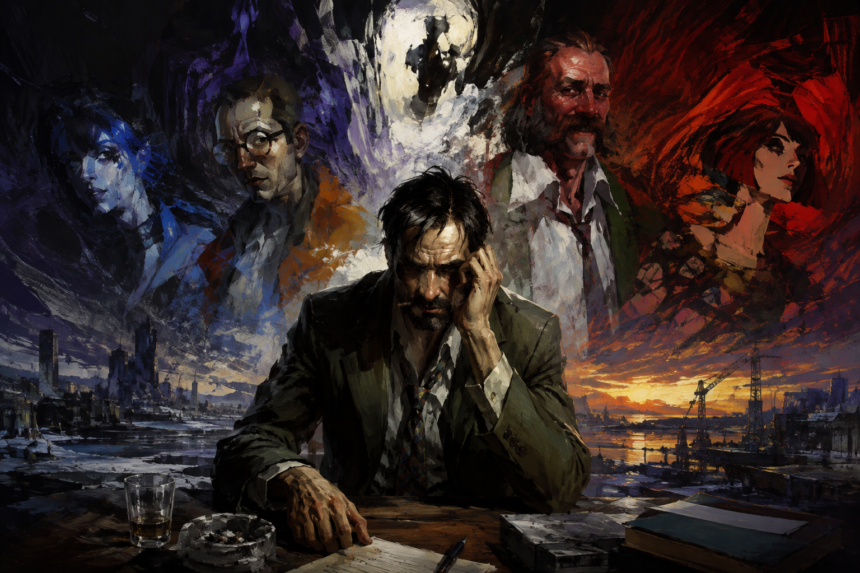
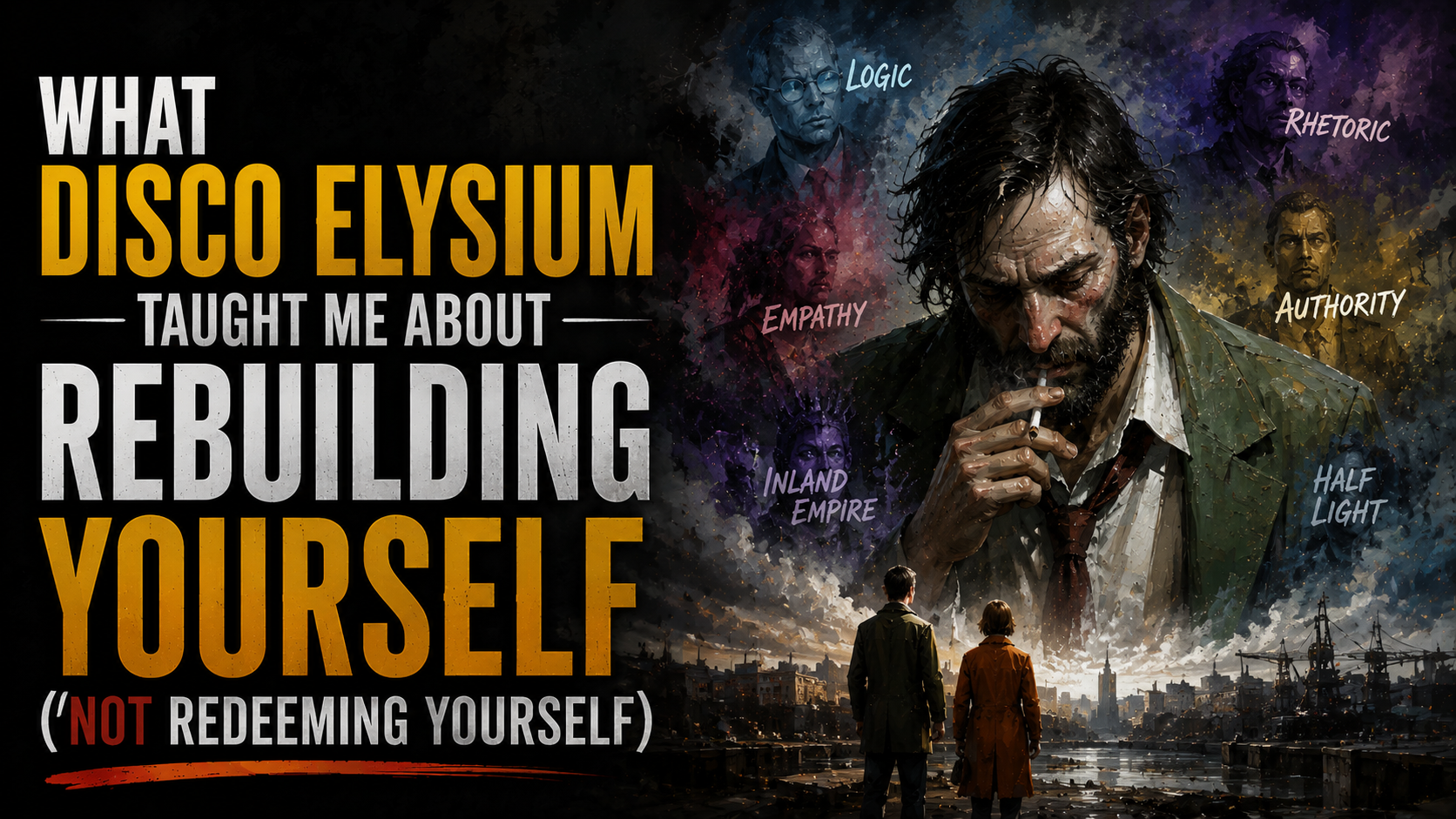
This is where Disco Elysium‘s most famous mechanic becomes philosophically inseparable from its story. Your skills — Logic, Empathy, Physical Instrument, Electrochemistry, Inland Empire, and dozens more — don’t function like typical RPG stats. They talk to you. Constantly, and often against each other. Logic wants cold clarity. Electrochemistry wants a drink. Empathy wants to understand the grieving widow across the street. Inland Empire wants to believe in things that clearly aren’t real, and sometimes it’s not entirely wrong to.
Rather than representing a single unified protagonist making calm, deliberate choices, the game represents something closer to how a real, damaged mind actually operates: a parliament of competing drives, several of which are actively working against your stated interests, none of which can simply be voted off the island. You don’t get to delete Electrochemistry because it keeps tempting you toward the bottle. You have to live alongside it, sometimes ignoring it, sometimes losing to it, and slowly learning which voice deserves how much authority in which moment.
Real-Life Parallel: The Committee, Not the Villain
Think about how often we talk about our own minds as though there’s a “true self” being sabotaged by a single bad influence — the addiction, the anxiety, the anger — as if removing that one villain would restore some pure, uncomplicated version of who we’re supposed to be. Disco Elysium, through pure game design, argues something more useful and considerably less comforting: there is no uncomplicated version waiting underneath. There is only the whole committee, permanently in session, and the ongoing work of deciding, meeting by meeting, who gets to speak first.
This is one of the clearest examples of how video games and psychology intersect in ways that go far beyond escapism. Some games don’t just depict an internal struggle from the outside — they hand you the actual controls of that struggle and make you feel, in real time, how exhausting and how strangely companionable it can be to negotiate with your own mind.
The Political Compass Isn’t the Point
A significant part of Disco Elysium invites the player to adopt a political or ideological identity — communism, fascism, moralism, ultraliberalism — and each carries its own internalized voice, complete with self-justifying logic and blind spots. It would be easy to read the game as being primarily about politics, and on one level, it clearly is: few games engage this directly and this intelligently with ideology, history, and the failures of a fictional but achingly familiar 20th century.
But underneath the politics, the deeper subject is identity construction itself. Each ideology the detective can adopt functions less like a belief system and more like a costume he tries on to avoid the harder work of building an identity from scratch. The game is remarkably clear-eyed about this: certainty, of any political flavor, is often just a faster, easier substitute for the slower process of actually knowing yourself. Ideological conviction can numb the same discomfort that Electrochemistry numbs, just through different chemistry.
Why This Matters for the Philosophy of Games as a Genre
This is exactly the kind of insight that separates surface-level “games as art” arguments from genuinely thoughtful video game philosophy. It’s not enough for a game to include serious themes in its writing. The theme has to live in the systems — in what the player is tempted to choose, and why, and what it costs them — for the philosophical weight to actually land. Disco Elysium is one of the clearest modern examples of this principle done well, alongside titles like Celeste (anxiety made mechanical) or Spiritfarer (grief made domestic), each of which uses mechanics, not just narrative, to carry its meaning.
Failing the Check Is Still Part of the Story
One more design choice worth highlighting: in most games, failing a skill check means nothing happens, or you simply try again until you succeed. Disco Elysium does something rarer. Failed checks often move the story forward anyway — sometimes into a worse, sadder, or more embarrassing version of the scene, but forward nonetheless. There is no clean “success” state that erases your failure and lets you pretend it never happened.
This mirrors something true about actually trying to change: you don’t get a clean retry on a conversation you already had badly, or a decision you already made drunk, or a year you already lost to something you’re still working through. The failed check stays canon. The story simply continues from there, scar and all, and asks you to keep playing the version of yourself that exists after the failure rather than the fantasy version that never failed at all.
It’s Not a Game “About” Redemption — It Feels Like Rebuilding
It’s worth being precise here, because it’s easy to oversimplify this reading: Disco Elysium isn’t a recovery pamphlet disguised as a detective story. There’s no single closed lesson, no one definitive takeaway everyone is meant to extract, and no guarantee your particular playthrough will even resemble anyone else’s. What’s remarkable is that the structure of the game itself — the returning memories you can’t control, the internal parliament of skills arguing in your ear, the failed checks that still count, the ideologies offered as tempting shortcuts around the real work — makes the experience feel like rebuilding an identity from the inside, without needing an explanatory speech to get there.
That, to me, is the real artistic achievement here: not illustrating an idea from the outside, like a diagram, but making the player inhabit it from within, one uncomfortable memory and one internal argument at a time.
Final Thoughts: What I Took Into Real Life
After finishing Disco Elysium, I stopped waiting for a single clarifying moment that would make me a finished, resolved version of myself. I stopped expecting the parts of my mind that push toward avoidance, or numbness, or easy certainty, to simply disappear once I’d made enough progress. Instead, I started thinking of myself the way the game quietly suggests: not as someone who needs to earn forgiveness for a past self before moving forward, but as someone continuously under construction, using whatever materials — including the mistakes — happen to be on hand.
I don’t know if this is exactly what the writers intended. Every player probably reconstructs a slightly different detective, depending on what they’re carrying when they wake up on that hotel floor. But that’s ultimately what makes a video game more than entertainment: when its mechanics, story, and emotional design align so well that the player doesn’t just watch someone rebuild themselves — they do it too, memory by memory, argument by argument, until they arrive, in their own way, at whoever comes next.
The wreckage doesn’t disappear. The question was never how to erase it. It’s how to keep building on top of it, one honest choice at a time, without pretending you’re starting from anywhere else.
This article is part of a series exploring the philosophy of video games — how stories, characters, and mechanics reflect real questions about identity, power, mortality, and the choices that define us. If gaming and philosophy is a topic you enjoy, more essays are on the way.