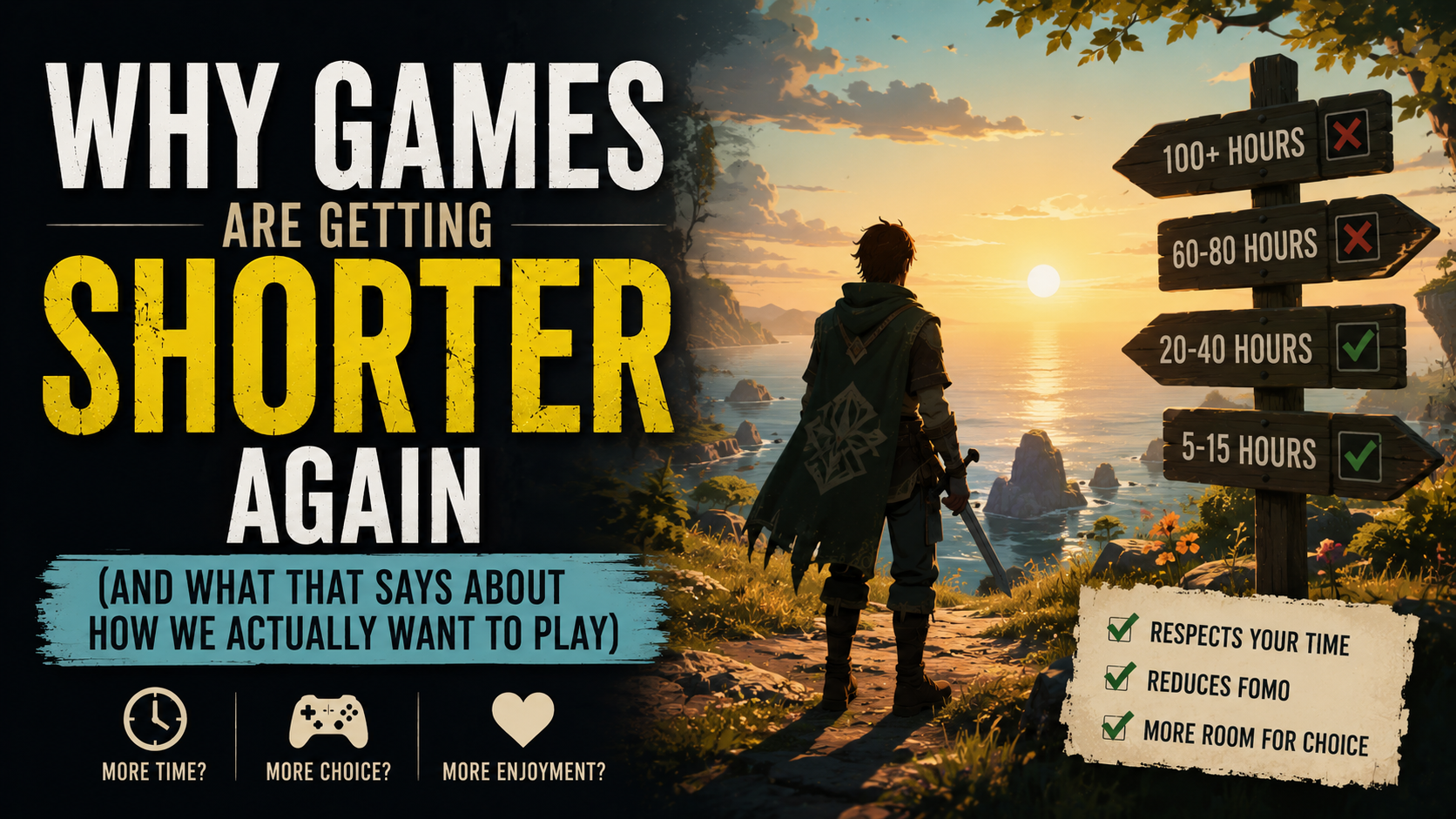

For most of the last decade, a game’s marketing pitch practically required a number attached to it: eighty hours of story, a hundred hours of open world, “more content than you could finish in a year.” Length wasn’t just a feature, it was the argument. Value meant volume, and volume meant hours.
- A Quiet Reversal
- The Question Nobody’s Really Asking
- What Studios Have Learned (Sometimes the Hard Way)
- The Economics Quietly Shaping the Trend
- A Wider Shift: Games Adjusting to Time, Not Just Attention
- The Uncomfortable Part: Are We Losing Our Patience, or Finally Being Honest About It?
- What This Trend Says About Us
- Conclusion: A Trend Worth Watching Honestly
That argument is starting to lose its grip. Across 2025 and into 2026, a growing number of the most talked-about releases have been notably, deliberately short — six, ten, maybe fifteen hours, tightly built and clearly finished rather than padded out to hit a number. Some of the year’s most praised titles are ones a player can actually complete in a single weekend, and finish feeling like they got the whole story rather than half of a longer one they’ll never return to.
This isn’t a retreat from ambition. If anything, it’s the opposite. But it is a real reversal of a design philosophy the industry spent years treating as settled, and it’s worth asking what changed — and what it says about how people actually want to spend their time inside a game, as opposed to how much time they’re technically willing to log.
A Quiet Reversal
It wasn’t long ago that “short game” was close to an insult in certain corners of the industry, a phrase usually followed by a complaint about price-per-hour. Open-world design, live-service structures, and sprawling RPGs pushed average completion times upward for years, and marketing followed the same logic: longer meant more ambitious, more ambitious meant more worth the asking price.
What’s changed is that a meaningful share of players, critics, and even publishers have started openly pushing back on that assumption. Shorter, tightly scoped single-player games have picked up outsized attention and goodwill relative to their length, while several notably long, systems-heavy releases have drawn criticism less for what they contain and more for how much unnecessary distance sits between the good parts. The complaint isn’t that these games are bad. It’s that they’re bigger than the story they’re actually telling.
Studios have noticed. Several developers who built their reputations on sprawling worlds have talked openly, in interviews and postmortems, about deliberately capping scope on newer projects — not because they ran out of ideas, but because they’d started to suspect that unlimited scope was quietly working against the experience they actually wanted players to have.
The Question Nobody’s Really Asking
Most of the coverage of this shift stays at the level of budgets and headcounts: shorter games cost less to make, take less time to finish, and are easier to ship on schedule. All true, and all a little beside the point. The more interesting question is why players — who spent years treating “more hours” as an unambiguous win — increasingly seem relieved, rather than shortchanged, when a game respects their time instead of consuming it.
It’s Not (Just) About Budgets
It would be easy to read this purely as a cost-cutting story: shorter games are cheaper, so of course studios are making more of them. But that doesn’t explain the player side of the equation, where the enthusiasm for tightly scoped games isn’t reluctant tolerance, it’s genuine preference. People aren’t settling for shorter experiences because that’s all that’s on offer. They’re actively choosing them over longer alternatives sitting right next to them in the same storefront.
That preference points toward something the budget explanation misses entirely: for a lot of players, the scarce resource was never money. It was attention, and more specifically, uninterrupted attention — the kind that a hundred-hour open world quietly demands and an increasingly time-poor adult life has less and less of to give.
The “Finishable” Backlog
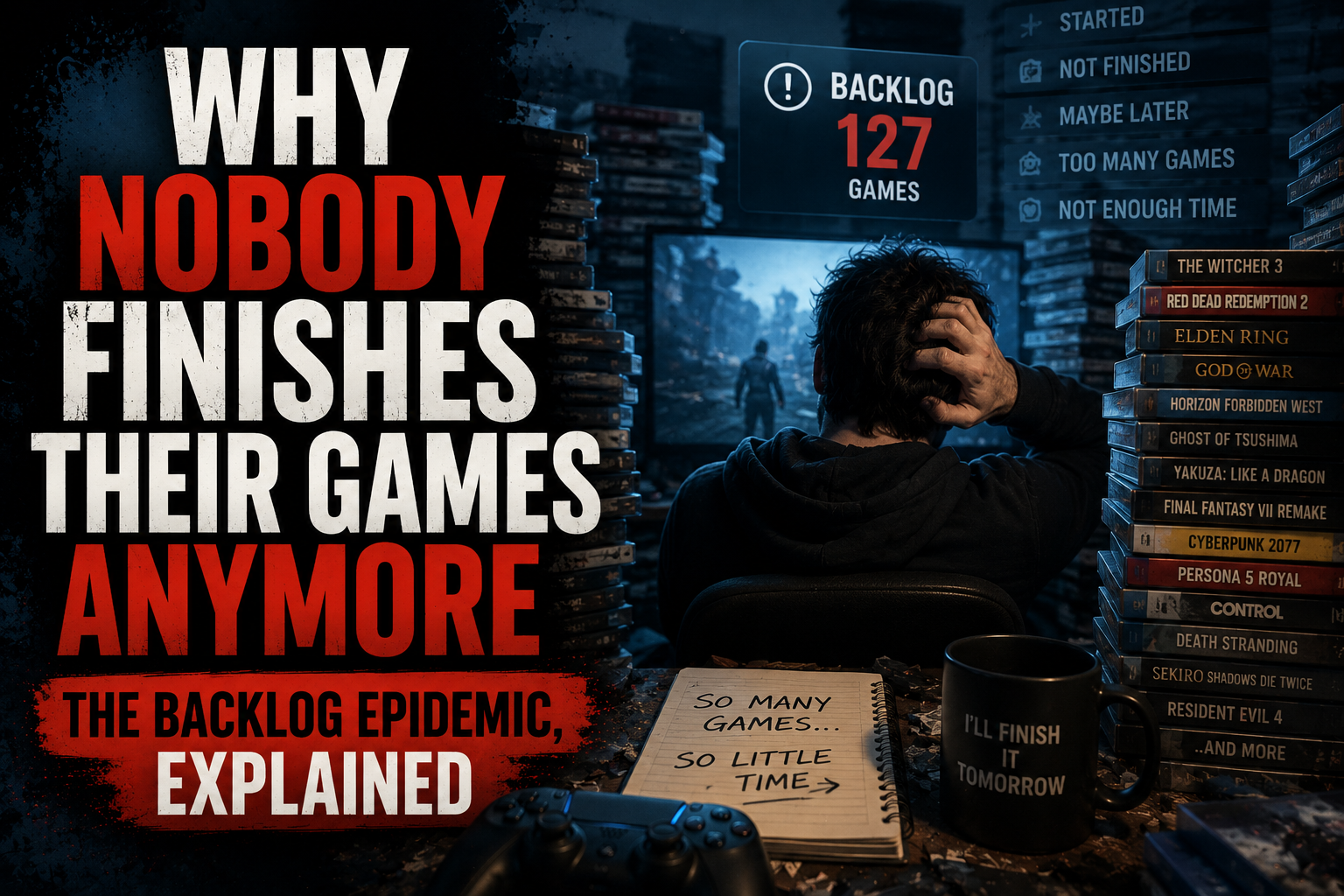
Anyone who’s used a modern game library has felt the specific, low-grade guilt of an unfinished backlog: dozens of purchased, half-played, open-world games sitting untouched, each one representing a debt of time nobody has actually budgeted for. A shorter game doesn’t ask a player to make that trade. It asks for a weekend, not a season, and it’s far more likely to actually get finished — which turns out to matter enormously to how a player remembers and recommends it afterward.
A completed ten-hour game and an abandoned eighty-hour one occupy very different places in a player’s memory, even if the abandoned game was, hour for hour, just as good. Finishing something creates a sense of closure that an open backlog never does, and studios chasing word-of-mouth are increasingly aware that a game people actually finish is worth more, reputationally, than one that’s merely long.
What Studios Have Learned (Sometimes the Hard Way)
Not every attempt to scope down has landed cleanly, and the industry’s missteps here are almost as instructive as its successes.
The Padding Problem
The clearest lesson has been about what length was actually made of in a lot of older, bigger releases: fetch quests, repeated map icons, combat encounters that existed to fill time rather than to say anything new. Cutting a game down doesn’t automatically make it better — it exposes how much of its previous runtime was never really adding anything, just delaying the ending. Several studios revisiting or remastering older, longer titles have quietly trimmed exactly this kind of filler, and the resulting versions are routinely described as improvements, not compromises.
That’s an uncomfortable finding for anyone who spent years treating total hours as a proxy for value, because it suggests a lot of that value was, in a fairly literal sense, manufactured — hours added not because the story needed them, but because the number needed to look a certain way on the back of the box.
Density Over Duration
The games earning the most goodwill in this shorter format tend to share one trait: almost nothing in them feels like filler. Every mechanic introduced gets used meaningfully before the credits roll, every location matters to the story rather than existing to pad the map, and very little of the runtime is spent waiting for something interesting to happen. That density is difficult and expensive to achieve — arguably harder than simply adding more content, since every single hour has to earn its place rather than blend into a much larger whole.
This inverts the old assumption in a similar way to what’s happened elsewhere in game design: bigger doesn’t automatically mean better-crafted. Often, it means the opposite — every additional hour is one more hour where the seams can show.
The Economics Quietly Shaping the Trend
Underneath the design conversation, there’s a business logic that helps explain why some publishers are embracing shorter games faster than others.
Why Completion, Not Playtime, Is the Real Metric
For years, playtime and hours-logged were treated as a rough proxy for a game’s success, especially in a live-service context. But for premium, story-driven single-player games, a different metric has started to matter more: completion rate, and the reviews, word-of-mouth, and franchise loyalty that come from a player who actually reached the ending satisfied, rather than one who quietly stopped playing forty hours in and never came back.
A shorter, tightly built game with a high completion rate can generate more sustained goodwill than a much longer one that most buyers never finish — and goodwill, unlike hours logged, compounds. It shows up in sequel pre-orders, in recommendations to friends, in the kind of reputation that outlasts any single title.
The Discounting Problem
There’s also a pricing tension underneath all of this that rarely makes it into the marketing conversation. A shorter game is harder to justify at a full, premium price point in a market that’s spent over a decade training players to think in price-per-hour terms. Some publishers have responded by pricing shorter titles noticeably lower, betting that a lower price and a higher completion rate will build more durable franchise value than a higher price attached to a game a smaller share of buyers ever finish.
It’s a real bet, and not a risk-free one — a lower price signals scope to a market conditioned to associate length with ambition, even when a shorter game required just as much design discipline, if not more. Whether players fully reward that discipline the way they reward sheer size is still an open question the industry is actively testing in real time.
A Wider Shift: Games Adjusting to Time, Not Just Attention
The move toward shorter games doesn’t sit in isolation. It’s part of a broader adjustment happening across the industry toward players’ actual, limited time rather than their theoretical, unlimited enthusiasm.
From Open Worlds to Focused Worlds
Open-world design hasn’t disappeared, but there’s a visible split forming between worlds built to be exhaustively explored and worlds built to be tightly experienced — smaller, denser spaces designed around a handful of ideas executed well, rather than dozens of systems spread thin across a huge map. Several recent, well-received titles have deliberately shrunk their scope from what a similar game might have attempted five years earlier, treating restraint itself as a design choice rather than a limitation.
The Handheld Effect
This connects to a related shift already reshaping the industry: the rise of handheld and hybrid devices built around shorter, interruptible play sessions rather than hours of uninterrupted attention on a couch. A game designed to be picked up on a commute or during a lunch break has different incentives than one designed to anchor an entire evening, and as more play happens in these shorter windows, game length itself starts to bend toward what actually fits inside a normal day, rather than what looks impressive in a trailer.
Put together with the completion-rate economics above, a clearer picture forms: the industry isn’t simply making shorter games because it’s cheaper. It’s adjusting to a player whose available time, not their appetite, was the actual constraint all along.
The Uncomfortable Part: Are We Losing Our Patience, or Finally Being Honest About It?
This is where the trend stops being simply a design story and becomes something worth sitting with a little longer.
It’s tempting to frame the shift toward shorter games purely as an industry maturing — finally admitting that bigger was never automatically better. There’s a real case for that. But it’s also fair to ask a harder question: is some of this enthusiasm less about craft, and more about a broader shrinking of patience for anything that asks for sustained, undivided attention?
The Case for Optimism
There’s a genuinely strong version of this trend that isn’t cause for concern at all. A shorter game that respects a player’s time isn’t a lesser experience — for busy adults balancing work, family, and everything else competing for their evenings, a well-made ten-hour game that can actually be finished is arguably a more honest, more respectful product than a two-hundred-hour world that quietly assumes a kind of free time most people no longer have. In this reading, the trend isn’t players losing patience. It’s the industry finally admitting how little uninterrupted time most of its audience actually has, and designing for that reality instead of an outdated assumption about it.
The Case for Caution
The less comfortable version deserves equal weight. Some of the same forces reshaping attention spans elsewhere — short-form video, algorithmic feeds engineered around constant novelty, a broader cultural discomfort with anything slow — are almost certainly part of what’s making longer, patient, slow-burn games a harder sell than they once were, independent of how well those longer games are actually made. If the appetite for sustained attention is shrinking industry-wide rather than being redirected toward more efficient storytelling, that’s a less flattering explanation for the same trend, and one worth being honest about rather than dressing up entirely as good design instincts.
Both explanations are probably true at once, in different proportions for different players. The uncomfortable part isn’t picking one. It’s admitting the industry itself may not fully know which force is doing more of the work.
What This Trend Says About Us
Step back from any single game, and a broader pattern comes into focus. Every major shift in how games are built has responded to something about how people were actually living, not just what they said they wanted. Open worlds responded to a hunger for freedom and scale. Live-service games responded to a desire for an ongoing place to belong to. Handheld devices responded to lives too fragmented for a console tethered to a living room.
Shorter, denser games fit into that same lineage. They’re responding to an audience that increasingly has less uninterrupted time than the industry spent years assuming it did — and that would rather finish something meaningful than abandon something merely large.
That’s not a small, cosmetic adjustment. It’s an industry quietly rewriting one of its oldest assumptions about what “value” actually means, and doing it in response to how players are really living, not how the marketing copy on the back of the box always pretended they were.
Conclusion: A Trend Worth Watching Honestly
Shorter games aren’t a retreat from ambition, and framing them that way misses what’s actually happening. If anything, building something tight, complete, and free of padding is a harder discipline than simply building more of everything and hoping it adds up to something worthwhile. The real story isn’t that games are getting smaller. It’s that the industry is finally being forced to reckon with the difference between a player’s theoretical enthusiasm and their actual, limited time.
Whether that reckoning is a sign of a healthier, more honest industry or a symptom of a culture growing less patient with anything that asks for sustained attention probably isn’t a question with one clean answer. Likely, it’s some of both. Either way, it’s worth watching this shift the way it deserves to be watched — not as a simple story about budgets getting smaller, but as a real signal about what players are actually asking games to be, once the marketing number on the box stops being the thing that matters most.
This article is part of an ongoing series looking at gaming industry trends through a reflective lens — not just what’s changing, but what those changes reveal about the people playing.