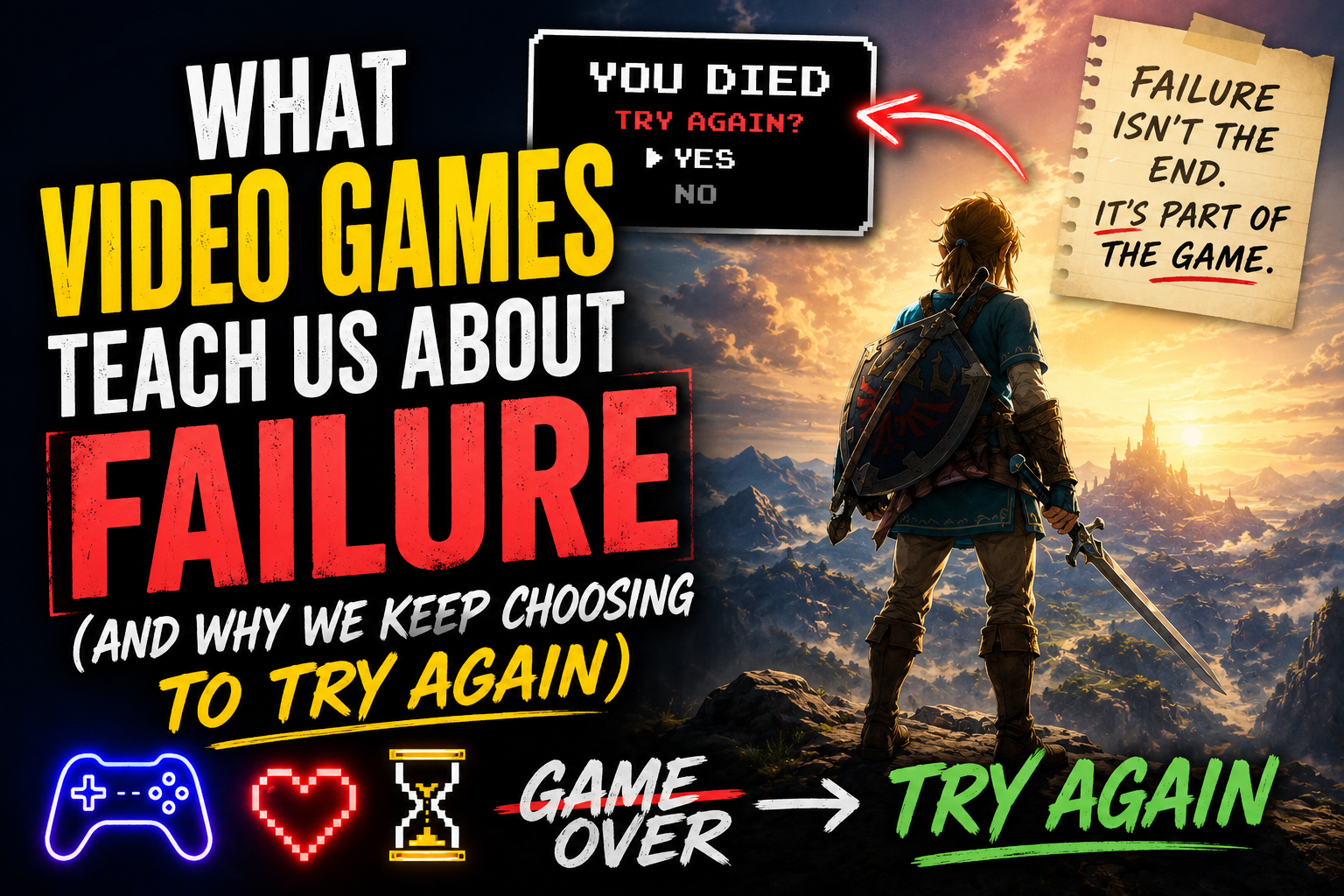

Most stories treat failure as something to avoid, correct, or overcome on the way to a better outcome. Video games, uniquely among storytelling mediums, often treat failure as something to repeat, again and again, on purpose, as the actual mechanism through which anything meaningful gets built. Nowhere else in fiction is a character’s defeat routinely handed back to the audience as a tool rather than a tragedy.
- Failure as a Mechanic, Not Just an Outcome
- Hades: Failure as the Engine of the Story
- Dark Souls: Failure as the Only Honest Teacher
- Getting Over It: Failure as the Entire Point
- Three Games, Three Philosophies
- The Role of Player Agency in How These Lessons Land
- What This Means Outside the Game
- Conclusion: Why Games Are an Underrated Space for Thinking About Failure
This essay looks at three very different games — Hades, Dark Souls, and Getting Over It with Bennett Foddy — not as reviews, but as three distinct philosophical positions on failure, disguised as game design. None of these games agree about what failure is for. Read together, they form something close to a real philosophical argument, conducted entirely through what happens the moment you die, fall, or lose.
Failure as a Mechanic, Not Just an Outcome
In most fiction, failure is a plot beat — the moment before the character regroups, learns their lesson off-screen, and returns transformed. The audience doesn’t experience the failure directly; they’re told about it, or shown a brief montage implying growth happened somewhere between scenes. In a meaningful number of video games, failure isn’t summarized. It’s lived, directly, by the player, over and over, in real time.
This is a strange thing to hand someone as entertainment. Outside of games, we go to considerable lengths to avoid repeating our failures in front of an audience. Games routinely ask players to do exactly that — to fail visibly, immediately, and often — and somehow this remains one of the medium’s most reliably compelling experiences rather than one of its most punishing.
Why This Matters Philosophically
Handing the player direct, repeated failure touches a debate philosophy has returned to for centuries: whether failure is primarily a deficit to be minimized, or a necessary condition for anything resembling mastery, character, or meaning to exist at all. Thinkers from the Stoics to modern existentialists have argued, in different vocabularies, that struggle isn’t an unfortunate side effect of a meaningful life but one of its actual ingredients. Games built around repeated failure don’t settle that argument, but they let a player live inside it, one death at a time, in a way reading about resilience never quite manages.
This is the foundation Hades, Dark Souls, and Getting Over It each build on — but they take it in three very different directions.
Hades: Failure as the Engine of the Story
In Hades, developed by Supergiant Games, you play Zagreus, a prince of the underworld attempting to escape his father’s realm by fighting through it, room by room, only to die and be sent right back to the beginning almost every single run. In most games, this would be a frustrating setback. In Hades, dying is the primary way the story moves forward at all.
Every failed escape attempt returns Zagreus to the House of Hades, where the cast of characters remembers what just happened, comments on it, and reveals new dialogue, new relationships, and new pieces of the game’s central mystery — all because he failed. The narrative doesn’t pause for death and resume after it. It’s built entirely out of the accumulation of deaths, structured so that losing is indistinguishable from progressing.
Practical Example: Dying Into the Plot
There’s a specific rhythm long-time players of Hades come to recognize: the moment right after a failed run, walking back through the House, isn’t experienced as a punishment lap. It’s often the part of the game players look forward to most, because it’s where the actual story — the family tension, the slowly unfolding relationships, the jokes characters make about how many times you’ve died this week — actually lives. The game quietly retrains the instinct that failure is dead time between the parts that matter. Here, failure is the part that matters.
This is a sharper, more literal version of an idea usually offered only as comfort after the fact: that a setback can be doing real work even while it feels like nothing but a setback. Hades doesn’t just tell you this. It structures hundreds of deaths around proving it.
Dark Souls: Failure as the Only Honest Teacher
Where Hades folds failure into an ongoing story, Dark Souls, developed by FromSoftware, treats failure as something closer to a curriculum. Death sends you back to the last bonfire you rested at, stripped of your accumulated currency unless you can fight your way back to the spot where you fell and reclaim it before dying again. There’s no narrator explaining what you did wrong. No difficulty slider offering an easier path. Just the same enemy, the same corridor, and the option to try again with slightly more information than you had the last time.
The philosophy here is close to uncompromising: the game will not adjust itself to spare you the experience of failing. It will, however, remain exactly consistent every time you return, which means every failure teaches you something real and durable about the specific threat in front of you, rather than something vague about effort in general.
Why the Game Refuses to Soften the Blow
Dark Souls is often described, sometimes admiringly and sometimes not, as unfair. It rarely is, in the technical sense — enemy patterns are fixed, telegraphed, and eventually learnable — but it withholds the reassurance most games offer that failure was circumstantial rather than earned. This is a deliberate design stance: softening the consequences of failure, even slightly, would blur the very feedback loop the game depends on to teach anything at all. A death that costs nothing teaches close to nothing. A death that costs your progress, and forces you to physically retrace your steps to reclaim it, makes the lesson impossible to skip past unexamined.
A Real-World Parallel: Desirable Difficulty
There’s a concept in learning research worth naming directly here: desirable difficulty, the well-documented finding that learning conditions which feel harder and slower in the moment often produce stronger, more durable understanding than conditions that feel smooth and easy. Dark Souls is close to a pure gameplay demonstration of this principle. The game that lets you fail without cost teaches you less, even though it feels better in the moment, than the game that makes you sit with the consequences of failure until the lesson actually sticks.
Getting Over It: Failure as the Entire Point
The third game in this essay takes the sharpest and most uncomfortable turn. Getting Over It with Bennett Foddy puts you in control of a man in a cauldron, climbing a mountain of scattered junk using nothing but a sledgehammer, with a physics system so unforgiving that a single mistimed swing can send you sliding back down past progress that took a genuine hour or more to build. There is no checkpoint. There is no partial credit. A bad enough fall can return you almost to the very beginning.
Where Hades makes failure part of an ongoing story and Dark Souls makes it a teacher, Getting Over It refuses to soften the premise at all: failure here is not secretly productive, and the game never pretends otherwise. Foddy’s own narration, which plays over the climb, explicitly frames the game as being about the experience of frustration itself, not a clever system for disguising frustration as growth.
Practical Example: The Fall That Costs You Everything
Ask almost anyone who’s played Getting Over It about their worst moment, and they’ll usually describe the exact same shape of experience: a fall, late in a long climb, that erases most of an hour’s careful progress in about four seconds, with no undo and no safety net. What’s notable is what players report feeling immediately afterward — not just anger, but something closer to a forced, unwilling honesty about how much of their identity had quietly attached itself to progress they didn’t actually own yet. The game doesn’t resolve that feeling for you. It simply hands it to you directly and lets you decide what to do with it.
This is Getting Over It‘s real argument, delivered through the exact discomfort it seems built to inflict: some failures aren’t secretly useful, don’t build character on a schedule, and don’t owe you a lesson in exchange for the time they cost. Sometimes failure is simply what happened, and the only real choice left is whether you climb again anyway.
Three Games, Three Philosophies
Put side by side, these three titles form something close to a spectrum:
- Hades treats failure as the raw material a story is built from — closer to a mentor who insists every setback is secretly a chapter, and keeps proving it by writing new pages out of exactly the moments you thought were wasted.
- Dark Souls treats failure as a strict but scrupulously fair teacher — closer to an instructor who refuses to grade on a curve, precisely because doing so would rob the lesson of the thing that makes it stick.
- Getting Over It treats failure as an experience with no guaranteed payoff — closer to a companion who refuses to promise you it’ll all be worth it, because that promise was never theirs to make.
None of these approaches is “correct” in some objective sense. What’s interesting is that all three are legitimate, well-supported responses to the same basic human question: what do we owe ourselves after we fail, and what, if anything, does failure actually owe us back? The philosophy of games doesn’t need to give a single answer here, and arguably shouldn’t. Its strength lies in offering multiple, playable perspectives on a question philosophy — and every person who has ever failed at something that mattered to them — has wrestled with directly.
Why Multiple Perspectives Matter More Than One “Right” Answer
This is worth sitting with for a moment. If only one of these games existed, players might mistake its particular stance on failure for the definitive gaming take on the subject. But because Hades, Dark Souls, and Getting Over It coexist, each with devoted communities that treat their game’s approach to failure as the truest one, they demonstrate something valuable: video games, as a medium, are mature enough to hold contradictory truths about failure simultaneously. That’s not a weakness. It’s closer to how failure actually feels in real life — sometimes secretly productive, sometimes a fair if painful teacher, and sometimes just a loss with no hidden lesson attached, that you choose to keep climbing past anyway.
The Role of Player Agency in How These Lessons Land
There’s a detail that’s easy to overlook when comparing these three games: in every case, the player isn’t just watching a philosophy of failure unfold — they’re the one absorbing its cost directly, run after run, fall after fall. This distinction matters more than it might seem.
In Hades, you choose, dozens of times, whether to push for one more room before the run inevitably ends. In Dark Souls, you choose whether to risk your accumulated currency chasing a redemption run or play it safe and accept a smaller loss. In Getting Over It, you choose, after a fall that erases an hour, whether to keep climbing or set the controller down. In every case, the philosophy isn’t delivered to you as a conclusion. It’s something you have to enact, over and over, before the game will let you feel it as true.
A novel can describe a character learning to keep going after failure. A film can show it happening to someone on screen. A game can put you in the exact position of choosing, right now, controller in hand, whether you’re willing to fail again — and because the outcome partly depends on that choice, the lesson tends to feel earned rather than delivered. This is arguably the single strongest argument for taking video game philosophy seriously as its own category of thought, rather than treating it as a secondhand version of ideas explored more “properly” elsewhere.
A Small But Telling Detail: The Games That Punish You for Avoiding Risk
It’s worth noting how many acclaimed games are deliberately designed so that playing it completely safe — avoiding every risky fight, never pushing past a comfortable checkpoint — actually produces a weaker, less interesting experience than taking the risk of failure head-on. Roguelikes that reward aggressive, higher-risk builds. Boss fights designed to be learned through repeated, informative deaths rather than cautious attrition. This is a quiet but consistent design philosophy: the attempt to eliminate failure entirely isn’t treated as the safest path through these games. It’s treated as its own kind of loss — the loss of whatever you would have learned by risking it.
What This Means Outside the Game
It’s tempting to treat these observations as interesting trivia about game design and stop there. But the reason this topic belongs in a broader conversation about gaming and philosophy is that these three approaches map fairly directly onto how people actually relate to failure in real life.
Some periods of life resemble Hades far more than anyone would like to admit — a stretch where every setback feels like nothing but wasted time until, much later, you realize the setback was quietly building toward something you couldn’t have reached any other way. Other periods resemble Dark Souls: a difficult stretch that refuses to get easier no matter how much you want it to, that punishes shortcuts and rewards nothing but paying closer attention next time. And some failures are honestly closer to Getting Over It — a loss with no secret lesson waiting on the other side of it, no guarantee the climb was worth it, where the only real choice left is whether to keep going anyway, without the reassurance that it’ll pay off.
None of these framings is universally correct, and few failures fit neatly into just one. What video games offer, uniquely among storytelling mediums, is the chance to rehearse all three responses safely, one death at a time, long before life hands us a failure we didn’t get to practice for.
Conclusion: Why Games Are an Underrated Space for Thinking About Failure
Failure is one of the few experiences every person is guaranteed to have repeatedly, and yet it remains one of the hardest subjects to think about clearly, precisely because we tend to look away from it as fast as we can once it’s over. Video games, strangely, have become one of the more honest spaces for approaching it — not through lectures or grand statements, but through systems that make players sit inside failure, repeatedly, until something true about it becomes impossible to avoid noticing.
Hades teaches that a setback can be quietly doing narrative work even while it feels like nothing but a dead end. Dark Souls teaches that failure without softened consequences is often the only kind that actually teaches anything durable. Getting Over It teaches that some failures don’t owe you a lesson at all, and that climbing again anyway, without that guarantee, is its own kind of answer. None of these lessons arrive as dialogue or exposition. They arrive through play — through the actual, repeated act of falling, and choosing, each time, whether to climb back up.
That might be the quiet, underappreciated gift of gaming and philosophy as a genre: it doesn’t ask you to agree with a single conclusion about failure. It hands you a controller, sends you back to the bottom of the mountain, and lets you find out, one attempt at a time, what you actually believe about starting again.
This essay is part of an ongoing series on the philosophy of video games — exploring death, power, identity, sacrifice, choice, and the questions that define us, one title at a time.