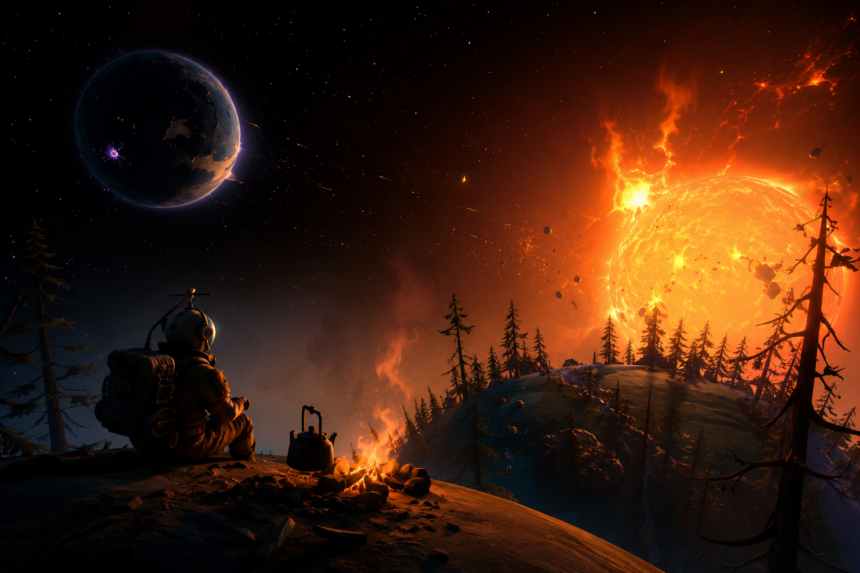

Very few games are built around an ending you cannot prevent. Outer Wilds is. Twenty-two minutes after you wake up on your home planet, the sun goes supernova and everything you know is annihilated. Then you wake up again, at the same campfire, with the same twenty-two minutes ahead of you. The universe is going to die, over and over, and there is nothing you can do to stop it. What you can do is understand it. And that turns out to be one of the most moving things a game has ever asked of a player.
This piece explores the Outer Wilds meaning beneath its time-loop puzzle box: why a game about inevitable death feels strangely peaceful, how curiosity becomes its only weapon, and what its ending says about facing the end of everything. Spoilers are discussed thoughtfully throughout.
Key Takeaways
- Outer Wilds is a mystery about a dying solar system where your only tools are curiosity and knowledge, not weapons or upgrades.
- The 22-minute time loop means progress is measured in understanding, since nothing physical carries over between loops.
- The game reframes mortality: because the end is fixed, the value shifts entirely to exploration and comprehension.
- Its ending argues for acceptance and for making room for what comes next, rather than clinging to a universe that has run its course.
- It is one of the strongest examples of a game whose entire progression system is the knowledge inside the player’s own head.
A Game Where Knowledge Is the Only Upgrade
In most adventure games you get stronger. You find better gear, unlock abilities, and open doors that were previously locked by a mechanical gate. Outer Wilds refuses all of this. Your ship, your jetpack, and your little translator tool are the same at the end as at the beginning. Nothing about your character improves.
What improves is you, the person holding the controller. The only thing that carries across the time loop is what you have learned. A locked door in Outer Wilds is never locked by a keycard you have to find. It is locked by a fact you do not yet understand: the pattern of a planet’s tides, the timing of a collapsing structure, the way a certain kind of sand drains from one world into another. Once you understand, the door was always open. This makes the game feel less like a power fantasy and more like genuine discovery, because the progress is real and non-transferable. You cannot look up a stat; you have to actually know.
The Time Loop as a Gift, Not a Punishment
Time loops in fiction are usually a nightmare to escape, a prison the hero must break out of. Outer Wilds quietly inverts this. The loop is what makes exploration safe. Death has no lasting sting because you always wake up at the campfire, so the game encourages the most reckless curiosity. Fly into a black hole to see what happens. Land on the surface of a star-swallowed planet. Ride a comet into the sun. The worst outcome is that you learn something and start again.
This design produces a rare emotional tone: fearless wonder. Because the stakes of any single death are low, the player is free to follow their curiosity into genuinely dangerous and beautiful places. The loop is not a cage. It is permission.
Why the marshmallows matter
One small detail captures the whole mood. At the campfire where you respawn, you can roast a marshmallow. It is pointless. It changes nothing. But it is the game telling you, gently, that even inside a doomed and repeating universe there is room for small, warm, human pleasures. That tension, catastrophe on a cosmic scale paired with a marshmallow on a stick, is the emotional signature of Outer Wilds.
Exploration Without a Map or a Marker
The game trusts you to an almost radical degree. There are no quest markers, no waypoints, no checklist telling you where to go. Instead there is a ship log that organizes the clues you have personally found and, crucially, notes where a thread is unfinished with the phrase “there is more to explore here.” The game never tells you the answer. It only reminds you which questions you left open.
This is exploration in its truest form, driven by your own sense of what is interesting. Two players will approach the solar system in completely different orders, chasing whatever caught their attention. That freedom is why the moment of understanding lands so hard when it comes: nobody handed it to you, you assembled it yourself from scattered pieces across a half-dozen worlds.
What the Ending Really Means
The late game reveals the shape of the tragedy. The supernova is not an attack or an accident you can fix. The universe is simply old, and it is ending. Your investigation of the ancient Nomai civilization, who tried and failed to escape a similar fate, slowly makes clear that survival was never on the table. The question was never how to stop the end. It was what to do in its presence.
Without spoiling the final sequence in detail, the resolution of Outer Wilds is about acceptance and release. Rather than desperately preserving a universe that has run its course, the ending chooses to let go and to make space for whatever comes next. It transforms the supernova from a horror into something closer to a natural, even beautiful, transition. The last moments are spent not fighting but sharing the experience, together, at a campfire.
It is hard to think of another game that treats death, cosmic and personal, with such tenderness. The message is not that death does not matter, but that a finite thing can still be complete, and that meaning is found in understanding and companionship rather than in permanence.
Why It Stays With People
Players often describe Outer Wilds as a game they can only play once, because its currency is discovery and you cannot un-know what you have learned. That grief, the wish to experience the wonder again for the first time, is itself a testament to the design. The game gave you real knowledge, and real knowledge changes you permanently.
It stays with people because it reframes something everyone lives with. We all know, somewhere, that the end is coming, for us and eventually for everything. Outer Wilds takes that fact and, instead of offering an escape, offers a way to hold it: with curiosity, with courage, with small comforts, and with someone beside you. That is a rare and generous thing for a puzzle game about a supernova to leave you with.
Conclusion
The Outer Wilds meaning is not hidden in a twist so much as it is built into every system: knowledge as progress, death as permission, the end as something to understand rather than defeat. It is a game that dares to make its central fact unchangeable and then shows you that the fact was never the point. The point was the twenty-two minutes, the worlds you flew to, and the marshmallow you roasted while the stars went out.
Frequently Asked Questions
What is the meaning of Outer Wilds?
Outer Wilds is about facing inevitable death with curiosity rather than fear. Set in a solar system doomed to end in a supernova, it argues that when the end cannot be prevented, meaning comes from understanding, exploration, and companionship. Its ending is about acceptance and making room for what comes next.
How does the time loop in Outer Wilds work?
Every loop lasts about 22 minutes, after which the sun goes supernova and you wake up again at the starting campfire. Nothing physical carries over between loops, so the only thing you keep is knowledge. Progress is measured entirely by what you have learned, which lets you solve puzzles you previously could not.
Is there combat in Outer Wilds?
No. Outer Wilds has no combat, weapons, or traditional upgrades. Your equipment never changes. The only thing that grows is your own understanding of the solar system, which is what allows you to reach new places and reveal the central mystery.
Can you stop the supernova in Outer Wilds?
No, and that is the point. The universe is ending because it is old, not because of a villain or a fixable problem. The game is not about preventing the end but about understanding it and choosing how to face it, which is why its resolution centers on acceptance rather than survival.
Why do people say you can only play Outer Wilds once?
Because the game’s core reward is discovery, and knowledge cannot be unlearned. Once you understand the solutions and the story, the sense of wonder that comes from figuring them out cannot be experienced fresh again. Many players describe wishing they could forget it just to play it once more.
Is Outer Wilds worth playing if you dislike hard puzzles?
Yes, though it rewards patience. The puzzles are based on observation and understanding rather than reflexes or obscure logic, and the ship log gently tracks your open questions. If you enjoy exploration and mystery and are willing to take notes and follow your curiosity, it is deeply rewarding.