
How much of what we call justice is really just grief that hasn’t found anywhere else to go?
- Who Is Ellie Williams, Really?
- Playing as Abby: When a Game Mechanic Becomes a Moral Argument
- Joel Miller: The Origin Ellie Is Still Arguing With
- An Ending Without Catharsis
- The Guitar: A Rare Window Into Video Game Interiority
- Ellie’s Relationships as Moral Evidence
- What Ellie Williams Teaches Us About Real Grief
- Conclusion: Why Ellie Remains One of Gaming’s Most Uncomfortable Characters
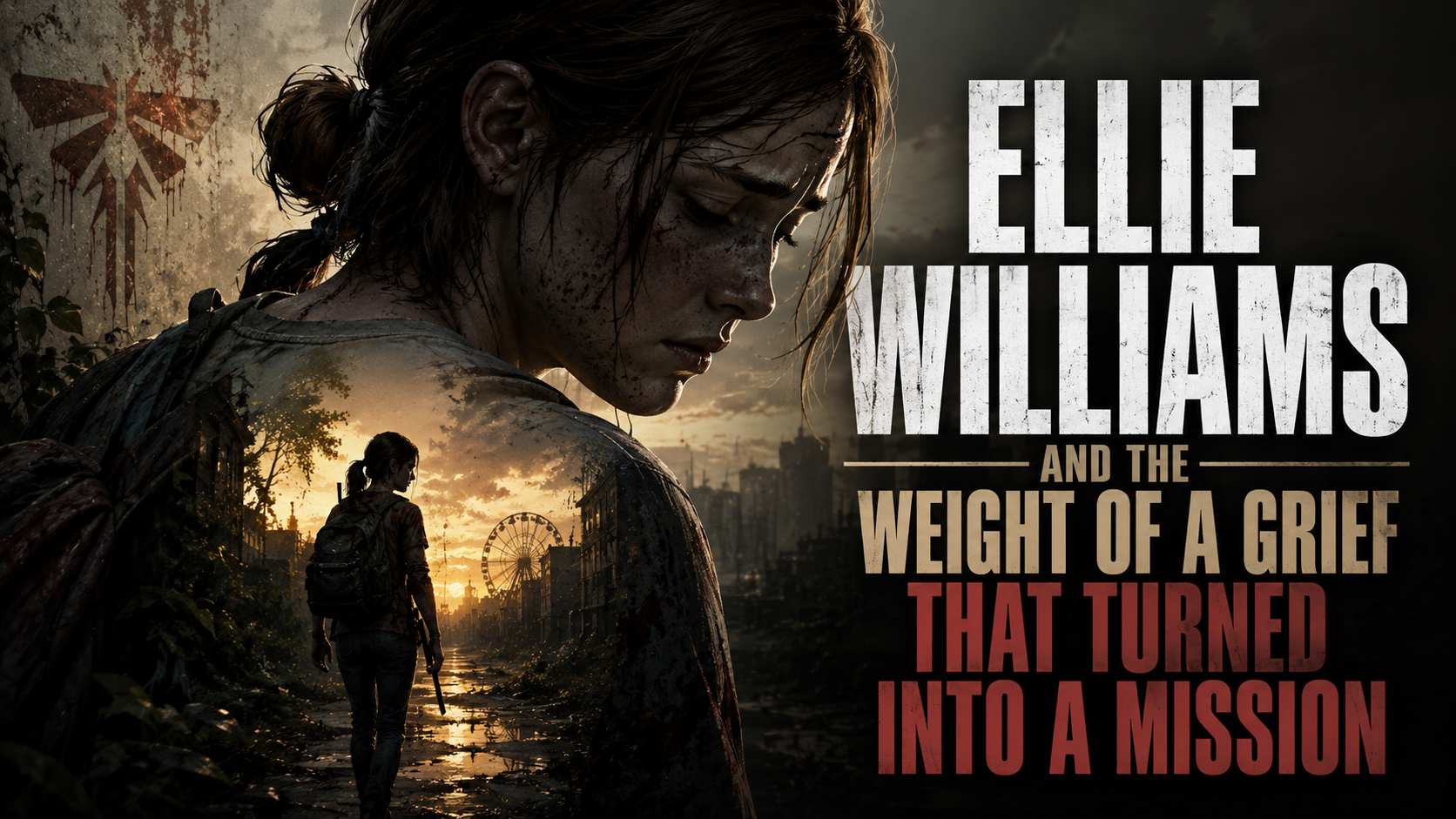
That’s the question underneath nearly every decision Ellie Williams makes in The Last of Us Part II, one of the most divisive protagonists modern gaming has produced. Ellie isn’t written as a hero on a righteous mission, and she isn’t quite a villain either — she’s something closer to a person whose grief has fully taken the wheel, mistaking momentum for purpose. Studying her arc is one of the clearest examples of video game character analysis colliding directly with real moral philosophy, because the game refuses to let the player settle comfortably into rooting for her.
This piece isn’t a review or a walkthrough. It’s a look at Ellie as a moral case study — the kind of character whose choices are worth sitting with long after the credits roll, whether or not you ever agreed with them.
Who Is Ellie Williams, Really?
On paper, Ellie is a survivor of a fungal apocalypse, immune to the infection that ended civilization, raised in the ruins of what used to be Wyoming and Wyoming-adjacent settlements by a man named Joel Miller, who chose her over the rest of humanity in the ending of the first game. By the time Part II begins, she has a life: a partner, a found family, a home in Jackson. She also has a wound she has never actually looked at directly — the choice Joel made on her behalf, and everything that choice cost.
What makes Ellie compelling isn’t the survivor part. It’s that the game spends dozens of hours showing the gap between the life she could still have and the one she chooses instead, the moment that wound is reopened. She has people who love her, skills that could build something, and a community that needs her. She walks away from nearly all of it, repeatedly, in pursuit of a target list that keeps growing the closer she gets to the end of it.
The Central Moral Tension: Grief vs. Vengeance
Ellie’s core conflict isn’t survivor versus killer. It’s grief versus vengeance — specifically, how easily unprocessed grief can disguise itself as a moral obligation, convincing the person carrying it that finishing the mission is the same thing as finding peace.
This is a genuinely old philosophical problem, one that shows up far outside of gaming: whether revenge can ever function as justice, or whether it only ever produces more of the harm it claims to answer. Philosophers from the Stoics to modern restorative justice theorists have argued that revenge, unlike justice, has no natural stopping point — it only ends when the person carrying it decides to stop, which is exactly the decision Ellie spends the entire game failing to make.
Playing as Abby: When a Game Mechanic Becomes a Moral Argument
One of the most controversial design choices in modern gaming is Part II‘s decision to hand the controller, roughly halfway through, to Abby — the woman Ellie has spent the entire story hunting down for killing Joel. For several hours, the player relives many of the same locations and days from Abby’s side, discovering her own reasons, her own grief, her own people worth protecting.
Why This Matters More Than It Sounds
It would be easy to dismiss this as a shock twist meant to provoke players, and plenty of players did initially receive it that way. But the structure does something more disciplined than provocation: it forces the exact empathy Ellie herself refuses to extend. The player, who has just spent hours inhabiting Ellie’s certainty that Abby is simply a monster to be erased, is now required to feel Abby’s fear, grief, and loyalty from the inside, using the same mechanics, the same camera, the same sense of investment.
This design choice quietly echoes an idea found across moral philosophy and conflict psychology: that dehumanizing an opponent is almost always easier from a distance, and becomes far harder once you’re made to occupy their specific, granular experience rather than their symbolic role in someone else’s story. Part II doesn’t argue this point through dialogue. It argues it structurally, by making the player do the work of humanizing someone they were, moments earlier, actively rooting to see hurt.
A Practical Example: The Theater
Without detailing the specific sequence, there’s a late confrontation staged in an abandoned theater that the game deliberately returns to from both women’s perspectives, separated by hours of playtime. Experiencing the same violent moment first as the one delivering harm and later as the one who caused it recontextualizes the entire game’s body count in a way no cutscene monologue could manage. It isn’t asking whether Ellie or Abby was right. It’s making the player sit with the fact that “right” was never really the operative question for either of them — grief was.
Joel Miller: The Origin Ellie Is Still Arguing With
It’s difficult to talk about Ellie’s arc without talking about Joel, because so much of her journey is really an argument with a decision he made and never got the chance to fully explain to her before he died.
Joel, across the first game, chooses Ellie’s life over a cure that might have saved humanity, and chooses to lie to her about it rather than let her decide for herself whether her death would have meant something. For most of Part II, Ellie is furious at Joel for that lie as much as for the choice itself — the sense that her own life-or-death decision was made entirely without her, by someone who loved her too much to trust her with the truth.
Why Joel Is a Case Study in Inherited Violence
Joel is a compelling example of something psychology and philosophy both examine closely: how the people who love us most can pass down their own violent patterns of protection, convinced they’re offering safety rather than replicating harm. Joel’s solution to nearly every threat across both games is decisive, often brutal, violence — and Ellie, despite her fury at him, ends up reaching for the same tool when her own grief demands an answer. It’s a pattern worth recognizing well outside post-apocalyptic fiction: children raised by people who solve pain through force often reach for force themselves, even while consciously believing they’re doing something entirely different from what was done to them.
What makes this effective is that the player, like Ellie, only fully understands the shape of Joel’s choice in fragments, revealed out of order, forcing a reassessment of a decision the player may have personally made, controller in hand, years earlier in the first game.
An Ending Without Catharsis
The Last of Us Part II resists giving Ellie a triumphant final confrontation, and this is arguably its most defining choice as a piece of writing. Without detailing specific plot points, it’s fair to say the game denies the player the satisfying, decisive ending revenge stories typically promise. There’s no moment where finishing the mission actually fixes what it was meant to fix.
Why a Hollow Victory Feels More Honest
This matters because it reflects something most revenge stories get wrong: the completion of a vendetta rarely delivers the relief it promises. Ellie can win, in the narrowest mechanical sense, and still lose nearly everything that made her life worth protecting in the first place — her relationship, her home, even, in a small but telling detail late in the game, her ability to play the guitar Joel taught her on, the clearest physical symbol of what grief has cost her hands and her memory alike.
This is a more mature and, frankly, more uncomfortable lesson than most revenge fiction offers. It suggests that finishing the mission and finding peace are not the same project, and that mistaking one for the other can cost far more than it recovers.
A Real-World Parallel: What Trauma Research Says About Revenge
This tension mirrors findings in psychological research on revenge and closure: contrary to popular belief, studies on retaliatory behavior have found that acting on revenge often prolongs a person’s focus on the original harm rather than resolving it, keeping the aggrieved party mentally tied to the event they were trying to move past. Ellie’s story dramatizes this almost exactly, without ever citing the research directly. The game seems less interested in whether Ellie’s targets deserved what was coming to them, and far more interested in what pursuing that outcome does to the person doing the pursuing.
The Guitar: A Rare Window Into Video Game Interiority
One of the more underappreciated tools Part II uses for character development is the guitar Joel gave Ellie and taught her to play — an optional, playable instrument scattered throughout the game as an interactive object rather than a cutscene prop.
Why This Design Choice Matters
Most games communicate grief through dialogue or flashback — moments other characters, or the plot itself, can witness and react to. The guitar does something different: it gives Ellie a private, wordless outlet that exists entirely outside the events other characters see, controlled directly by the player’s own hands on the actual controller. This is a subtle but significant tool for characterization, because it lets players perform Ellie’s memory of Joel rather than simply watching her grieve him.
This matters philosophically because so much of real grief is private and physical, not verbal — carried in a habit, an object, a specific motion the body remembers even when the mind is trying to move past it. A character who only grieves out loud, in dialogue, risks feeling explained rather than felt. A character whose grief lives in her hands, in an instrument the player themselves must play, feels considerably more embodied.
Ellie’s Relationships as Moral Evidence
If Joel represents the origin of Ellie’s inherited relationship to violence, the people still alive around her function almost like witnesses for a version of Ellie that vengeance keeps threatening to erase entirely.
Dina: The Life She Almost Chooses
Ellie’s relationship with Dina, her partner, is one of the clearest examples of how the game builds moral stakes through what’s actually at risk rather than through declaration. Dina rarely delivers speeches about the cost of Ellie’s obsession. Instead, the game shows the cost through small, accumulating absences — a shared home Ellie keeps leaving, a child Ellie is largely missing, a version of safety Dina offers that Ellie can’t fully accept because accepting it would mean putting the mission down.
This matters for a simple reason: it demonstrates that Ellie’s tragedy operates through what she’s willing to lose rather than through what she says she wants. She never articulates a philosophy of vengeance over love. Her priorities have to be inferred from what she consistently chooses to walk away from, especially when nobody is making her do it.
Tommy: The Voice That Keeps the Wound Open
Ellie’s relationship with Tommy, Joel’s brother, offers a useful contrast. Where Dina represents the pull toward putting the mission down, Tommy repeatedly represents the pull to keep going, framing the pursuit as duty rather than damage. It’s a small but telling detail: the two influences pulling hardest on Ellie by the story’s later chapters — Dina’s quiet offer of an ordinary life, and Tommy’s insistence that the debt still isn’t paid — mirror the exact tension between grief that’s ready to heal and grief that’s still looking for somewhere to land.
This distinction reinforces the game’s broader argument about vengeance: the people who validate our worst impulses are rarely villains themselves. They’re often just as wounded as we are, offering the only language for pain they know how to speak.
What Ellie Williams Teaches Us About Real Grief
Pulling these threads together, Ellie’s arc offers a few genuinely useful ideas about grief and vengeance that extend well past the world of the game:
Vengeance borrows the shape of purpose without the substance of peace. Ellie spends most of the story assuming that finishing her list will resolve what Joel’s death broke in her. Her arc slowly separates these two ideas, showing that a completed mission and a healed wound are not the same accomplishment, even when they look identical from the outside.
Empathy is easier to withhold from a distance. The structural choice to play as Abby reinforces something conflict psychology has long argued: understanding someone’s full interior experience makes cruelty toward them considerably harder to sustain, which is exactly why so few of us are ever forced to try.
Grief doesn’t end when the mission does. Ellie can succeed by every measurable standard the plot sets up for her and still lose the life that made success worth wanting. It’s a far more realistic, if considerably less satisfying, version of what happens after revenge than fiction usually offers.
Conclusion: Why Ellie Remains One of Gaming’s Most Uncomfortable Characters
Ellie Williams works as a moral case study precisely because the game refuses to let players resolve their feelings about her cleanly. She’s not a hero avenging a father figure in a way the story endorses, and she’s not simply a cautionary tale about the dangers of rage. She’s something closer to what most real people going through unprocessed grief actually look like: convinced, the entire time, that they’re doing something necessary, right up until the cost becomes impossible to ignore.
That refusal to simplify is, in many ways, the whole point. Video game character analysis is at its most valuable when a character resists easy categorization — when players are left arguing, long after finishing the story, whether Ellie’s targets deserved what was coming, whether her final choices actually settled anything, and whether grief and vengeance can ever be fully separated once one has fully disguised itself as the other.
Ellie never gets a clean answer to any of these questions. Neither, really, do we.
That, ultimately, may be the most useful thing a fictional survivor can offer: not a verdict, but a mirror. Most of us have never hunted anyone across a ruined country, but plenty of us have mistaken staying angry for staying loyal to someone we lost. Ellie’s long, costly failure to tell the difference is what makes her worth studying long after the game ends.
This article is part of an ongoing series analyzing video game characters through the lens of moral philosophy — examining the choices, contradictions, and quiet decisions that define who they really are.