
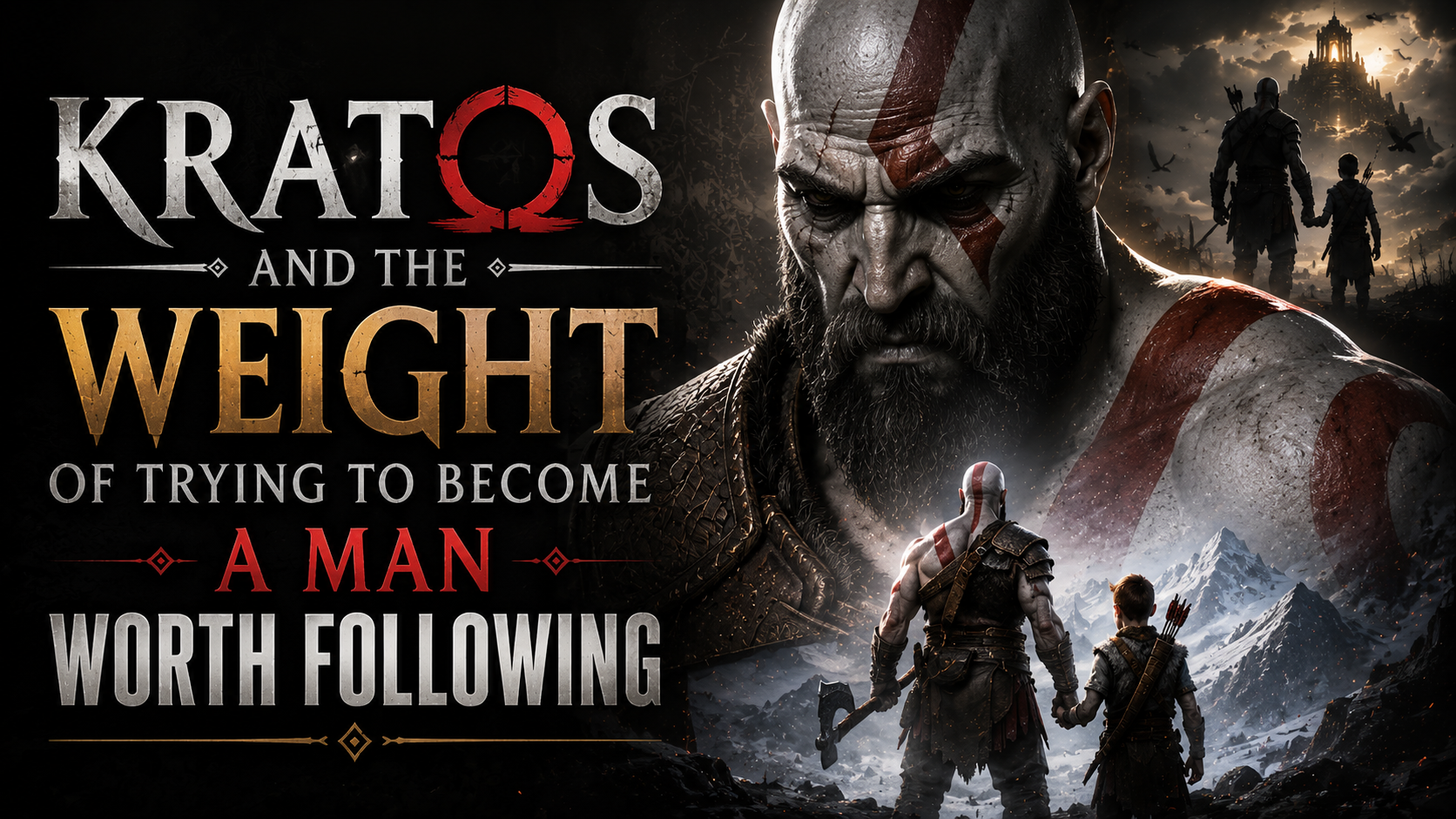

Can a person who spent most of his life solving every problem with violence actually become someone safe to be around, or does he just get better at hiding the part of himself that never really changed?
- Who Is Kratos, Really?
- The Leviathan Axe: When a Weapon Becomes a Moral Argument
- Baldur: The Mirror Kratos Refuses to Look Into
- A Restraint That Never Fully Resolves
- Mimir’s Head: A Rare Window Into a Silent Man’s Interiority
- Kratos’s Relationships as Moral Evidence
- What Kratos Teaches Us About Real Change
- Conclusion: Why Kratos Remains One of Gaming’s Most Quietly Radical Characters
That question sits underneath nearly every quiet moment in 2018’s God of War, a game that inherits one of gaming’s most notoriously violent protagonists — a character whose entire PS2-era legacy was built on rage, vengeance, and a body count numbering in the thousands — and asks players to watch him try, imperfectly and without any guarantee of success, to become a father his son won’t have to recover from. Studying Kratos here is a genuinely useful exercise in video game character analysis, because the game doesn’t ask you to forgive his past. It asks you to sit with how hard, and how incomplete, the work of changing actually is.
This piece isn’t a review. It’s a look at Kratos as a moral case study — a character whose quiet, mostly unspoken effort to become someone different is worth taking seriously, precisely because the game never lets him fully succeed at it.
Who Is Kratos, Really?
By the time 2018’s God of War begins, Kratos is an old man, remarried, and burying his second wife, Faye, alongside a son, Atreus, who barely knows him. He has left behind — deliberately, mostly silently — an entire mythology of violence: a Spartan general turned Ghost of Sparta, responsible for killing gods, monsters, and eventually most of the Greek pantheon across an earlier trilogy of games. None of that history is undone. It isn’t retconned or excused. It’s simply carried forward, mostly unspoken, into a quieter Norse setting where Kratos is trying, badly and without much practice, to be a father instead of a weapon.
What makes Kratos compelling in this chapter of his story isn’t the redemption arc itself — it’s how reluctant, halting, and frequently unsuccessful that arc actually is. He doesn’t arrive as a reformed man delivering wisdom. He arrives as someone who still, instinctively, reaches for violence and silence as his first tools, and who has to consciously, effortfully choose something else, over and over, often failing at it in front of the one person he’s trying hardest not to fail.
The Central Moral Tension: Rage vs. Restraint
Kratos’s core conflict isn’t good versus evil. It’s rage versus restraint — specifically, whether a man whose entire identity was built around unrestrained violence can genuinely learn restraint, or whether he can only ever perform it, moment to moment, through sheer effort that could collapse under enough pressure.
This is a real and difficult question well outside of mythology. Behavioral psychology and philosophy both take seriously the idea that character isn’t a fixed trait but a repeated practice — that a person doesn’t become patient or gentle in a single transformative moment, but through the accumulated weight of small, effortful choices, most of them invisible to anyone watching. God of War stages this idea directly, using Kratos’s white-knuckled self-control as its primary evidence.
The Leviathan Axe: When a Weapon Becomes a Moral Argument
One of the most quietly significant design choices in 2018’s God of War is its central weapon, the Leviathan Axe, and specifically the ability to throw it and recall it back to Kratos’s hand with a single button press.
Why This Matters More Than It Sounds
On the surface, this is simply a satisfying combat mechanic — a weapon that leaves your hand and returns to it, frost trailing behind it, timed for maximum impact. But the recall mechanic carries symbolic weight that the game leans on repeatedly: throughout the story, Kratos is a man defined by what he’s able to call back before it does permanent damage — his weapon, and, more importantly, his own rage. The axe’s core mechanic becomes a physical rehearsal of the exact discipline the story is asking Kratos to practice emotionally: release the force, but stay in control of where it lands, and be able to pull it back before it goes further than intended.
A Practical Example: The Return
There’s a recurring beat across the game where Kratos, mid-combat or mid-argument, visibly restrains a killing blow he could easily deliver, choosing a lesser response instead — sparing an enemy, holding back a blow aimed at his own son’s failures, biting down on a cutting remark he could easily make. These moments are rarely narrated with dialogue explaining the significance. They’re staged physically, the same way the axe’s throw-and-return mechanic is staged physically: a force sent out, then deliberately called back before it lands the way it easily could have.
This mirrors something worth taking seriously outside the game: self-control is rarely a permanent trait a person simply has. It’s closer to a physical motion practiced under pressure, over and over, that can be executed well one moment and fail the next, regardless of how many times it succeeded before.
Baldur: The Mirror Kratos Refuses to Look Into
Much of 2018’s God of War is shadowed by Baldur, a Norse god cursed by his mother, Freya, with invulnerability to protect him from harm — a curse that also stripped him of the ability to feel anything at all, leaving him numb, furious, and desperate to feel something, anything, even pain.
Why Baldur Is a Case Study in Inherited Rage
Baldur is a compelling foil precisely because his rage isn’t random. It’s the direct, traceable result of a parent’s overwhelming love curdling into control — Freya’s attempt to protect her son from every possible harm leaving him unable to feel anything, which he experiences not as safety but as a kind of living death. Baldur’s fury throughout the game is aimed almost entirely at his mother, the person who was trying, in her own way, to love him well and instead left him permanently damaged by that love’s excess.
This is where Baldur functions as Kratos’s mirror rather than simply his antagonist: Kratos, too, is a parent making decisions about how much to shield his son from, how much of his own violent history to disclose, how much silence to maintain in the name of protection. The game never states outright that Kratos risks becoming a version of Freya — overprotective in a way that eventually curdles into resentment — but the parallel is impossible to miss once Baldur’s backstory is fully understood. Kratos spends much of the game deciding, in real time, whether his own instinct toward silence and control is protecting Atreus or quietly damaging him in a different but equally serious way.
A Restraint That Never Fully Resolves
2018’s God of War, and its 2022 sequel Ragnarök, resist giving Kratos a clean, completed transformation. Without detailing specific plot points, it’s fair to say that even by the end of this chapter of his story, Kratos’s old instincts haven’t disappeared. He still defaults to violence under sufficient pressure. He still struggles, visibly, to say the things he feels rather than simply act on them.
Why an Unfinished Transformation Feels More Honest
This matters because it avoids a common and dishonest shortcut most redemption stories take: the idea that a character can undergo a single defining moment of change and emerge permanently transformed. God of War suggests something considerably more difficult and, ultimately, more believable — that becoming a different kind of man isn’t a destination Kratos arrives at, but an ongoing, effortful practice he has to keep choosing, indefinitely, with no guarantee that any given day’s effort will succeed.
A Real-World Parallel: What Psychology Says About Breaking Generational Patterns
This tension mirrors research on generational patterns of behavior, particularly around parenting and emotional regulation: psychologists studying intergenerational trauma have found that awareness of a harmful pattern doesn’t automatically prevent someone from repeating it, and that meaningfully changing an inherited pattern typically requires sustained, deliberate practice rather than a single moment of insight, precisely because old responses remain the brain’s default under stress long after a person has consciously decided to want something different. Kratos’s story dramatizes this almost exactly, without ever citing the research directly. The game seems less interested in whether Kratos has “fixed” himself, and far more interested in whether he keeps showing up to try, particularly on the days it’s hardest.
Mimir’s Head: A Rare Window Into a Silent Man’s Interiority
One of the more clever tools 2018’s God of War uses for character development is Mimir — a beheaded, still-living Norse figure who accompanies Kratos and Atreus for much of the journey, mounted on their boat, serving as narrator, historian, and occasional conscience.
Why This Design Choice Matters
Kratos is, by design and by history, an intensely uncommunicative character. Much of what he feels goes unspoken, sometimes for entire chapters at a time. Mimir solves a real storytelling problem this creates: rather than forcing Kratos to explain his own interiority out loud, which would contradict everything about who he is, the game gives players a narrator who can comment on the unspoken tension in a scene, ask the questions Kratos won’t ask himself, and reflect on Kratos’s growth from the outside, in a voice that feels observational rather than expository.
This matters because it solves a problem many stories about withdrawn, silent characters struggle with: how do you show a character’s internal change without breaking who they fundamentally are? Mimir’s presence lets the audience access Kratos’s development without requiring Kratos himself to become someone he isn’t — a man suddenly comfortable narrating his own feelings.
Kratos’s Relationships as Moral Evidence
If Baldur represents the mirror Kratos is trying not to become, the people closest to him function as the clearest evidence of how well his effort toward restraint is actually working.
Atreus: The Reason Restraint Has to Be Learned, Not Assumed
Kratos’s relationship with Atreus is where the game builds nearly all of its moral stakes, and it does so mostly through small, accumulating moments rather than speeches. Kratos rarely announces that he’s trying to be a better father than his own was. Instead, the game shows the effort through specific, repeated choices — biting back a harsh reaction, admitting a mistake instead of hiding it, choosing to explain a decision rather than simply issuing it as an order.
This matters because it demonstrates that Kratos’s growth has to be inferred from what he consistently does differently, not from what he says about himself. He rarely articulates a philosophy of fatherhood. His priorities have to be read in the specific moments he catches himself about to repeat an old pattern, and chooses, visibly and with real effort, not to.
Faye: The Voice That Shapes Him Without Ever Appearing
Kratos’s late wife Faye never appears as a living character across the main story, and yet her presence structures nearly the entire narrative. Her wish — that her ashes be scattered from the highest peak in all the realms — becomes the game’s literal quest structure, and her private letters and journal entries, discovered gradually throughout the story, reveal a woman who understood exactly who Kratos was and chose him anyway, believing in a version of him he hadn’t fully become yet.
This is a small but telling detail: the person whose faith in Kratos matters most to the story is one he can no longer speak to, meaning her influence on his behavior has to operate entirely through memory, inference, and the promises he made her — not through ongoing reassurance. It’s a structurally elegant way of showing that Kratos’s motivation to change was never contingent on someone watching him do it.
What Kratos Teaches Us About Real Change
Pulling these threads together, Kratos’s arc offers a few genuinely useful ideas about personal change and generational patterns that extend well beyond mythology:
Restraint is a practiced motion, not a fixed personality trait. The Leviathan Axe’s throw-and-recall mechanic dramatizes something real about self-control: it has to be executed, under pressure, again and again, and success on one occasion doesn’t guarantee success on the next.
Awareness of a harmful pattern doesn’t automatically break it. Kratos knows exactly what kind of father he doesn’t want to be, largely because of what he witnessed and became under his own father, Zeus. Knowing this doesn’t make the old instincts disappear — it just gives him a reason to keep interrupting them.
Change that isn’t witnessed is still real change. Much of Kratos’s transformation happens in small, private moments Atreus never sees and the game never dramatizes with fanfare. The lack of an audience doesn’t make the effort meaningless.
Conclusion: Why Kratos Remains One of Gaming’s Most Quietly Radical Characters
Kratos works as a moral case study precisely because 2018’s God of War refuses to let players see his transformation as complete or guaranteed. He isn’t rewritten into a gentle man who has moved past his history. He’s a man with a genuinely violent history who is, visibly and at real cost, trying to become someone his son can trust — someone he himself never had.
That refusal to simplify is the point. Video game character analysis is most valuable when a character resists an easy, comfortable arc — when the story insists that becoming better is effortful, incomplete, and never fully secured, rather than a single cathartic turning point followed by permanent change.
Kratos never gets to fully stop being the man who did what he did. Neither, in a much smaller and less mythic way, does anyone else carrying an inheritance they didn’t choose and are trying, imperfectly, not to pass on.
That, ultimately, may be the most useful thing an old, violent god can offer: not a promise that a person can fully outrun what they’ve done, but proof that the ongoing, unglamorous effort not to repeat it is worth making anyway, even when it never quite finishes.
This article is part of an ongoing series analyzing video game characters through the lens of moral philosophy — examining the choices, contradictions, and quiet decisions that define who they really are.







Gave 76xbet a shot, and I was pleasantly surprised. It’s got a good vibe, and I didn’t have any trouble figuring things out. Might be worth checking out: 76xbet