
What if knowing exactly how much time you have left isn’t the tragedy you’d expect it to be, but the thing that finally makes you look up?
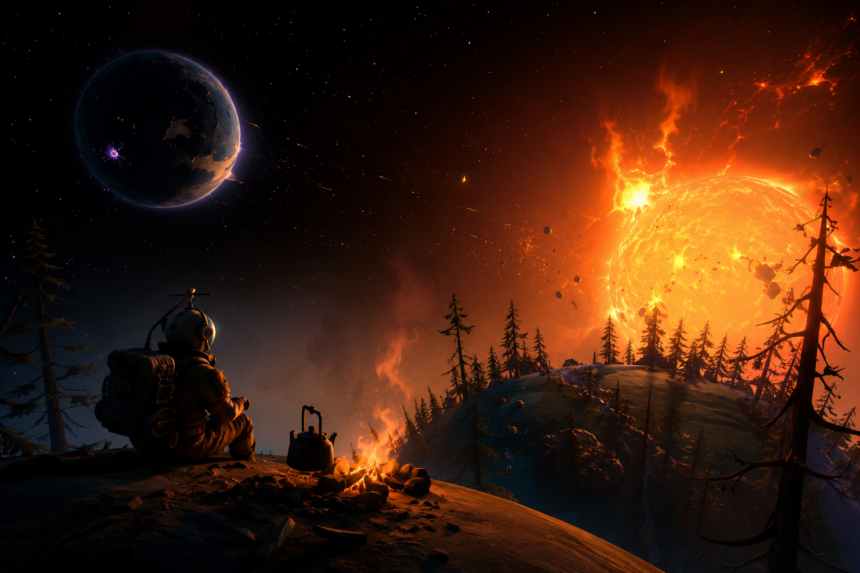
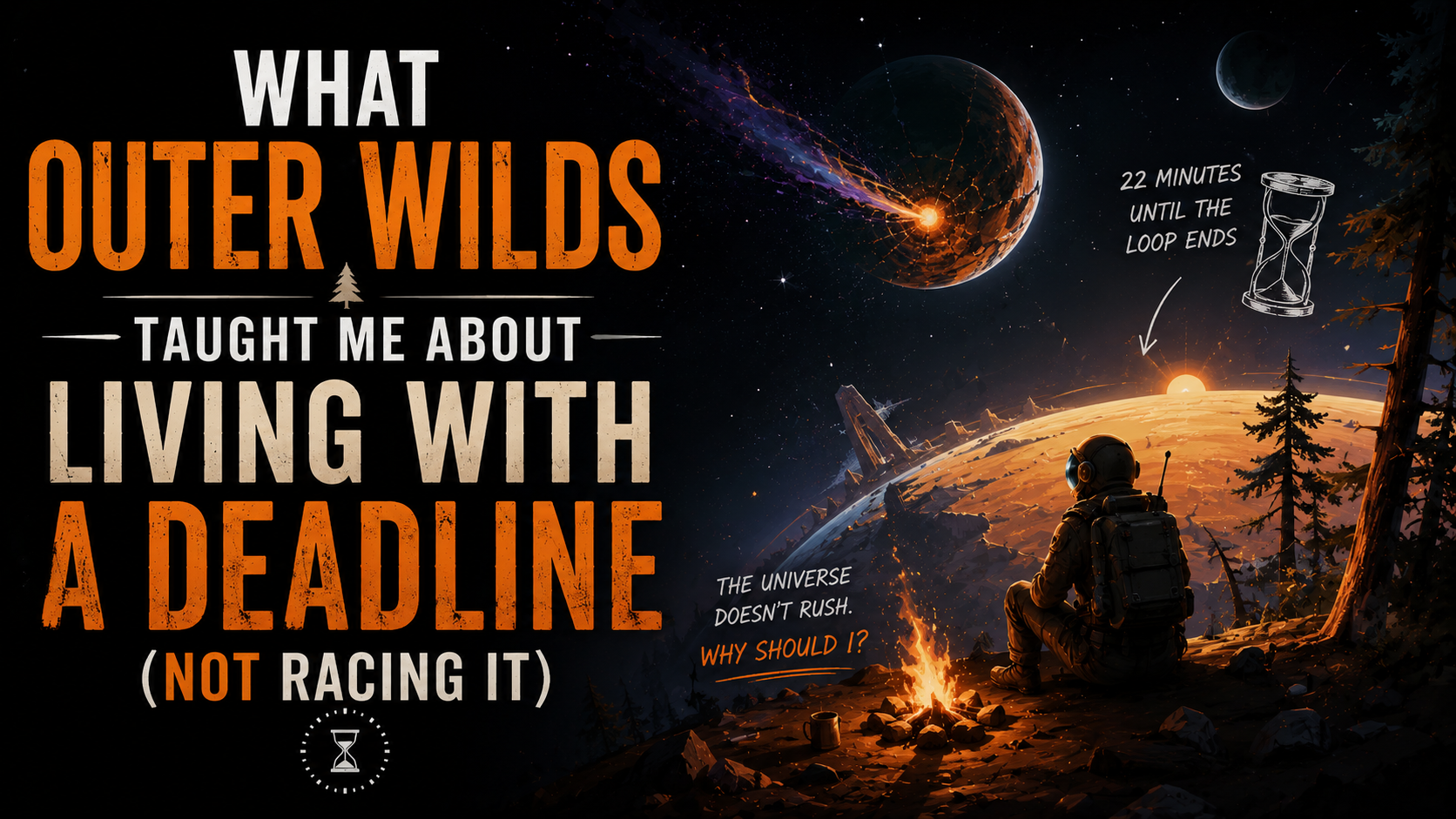
That’s the strange, quietly overwhelming premise Outer Wilds opens with, and never lets go of. You wake up as a new astronaut in a tiny, curious solar system, ready for your first launch. Twenty-two minutes later, the sun goes supernova, and everything ends. Then you wake up again, at the same campfire, twenty-two minutes before the end, with all your knowledge intact and nothing else carried over. The loop resets. The deadline doesn’t move. This is not a game about surviving the end of the world. It’s a game about what you do with the specific, fixed amount of time you’re given, once pretending you have more of it stops being an option.
This article is part of an ongoing series exploring what video games can teach us about real life. Outer Wilds belongs in any serious conversation about gaming and philosophy, not because it lectures the player about mortality, but because its central mechanic — the loop, the deadline, the total absence of a “more time” option — turns an abstract idea most of us spend our lives avoiding into something you have to sit inside for hours at a time.
Twenty-Two Minutes, Forever
Outer Wilds, developed by Mobius Digital, drops you into the role of a member of a scrappy, homemade space program on a planet called Timber Hearth. The technology is charming and a little rickety — your ship rattles, your jetpack sputters, your translator tool struggles to decode ancient alien writing. None of it feels like the start of an apocalypse story. It feels like the beginning of an adventure.
Then, twenty-two minutes in, the sun detonates. You die. And you wake up again, at the same campfire, twenty-two minutes before it happens, remembering everything.
Why the Loop Is the Actual Point
Most games that use a time loop treat it as a puzzle mechanic first and a metaphor second, if at all. Outer Wilds inverts that. The loop isn’t a clever gimmick layered onto an otherwise ordinary space exploration game — it’s the entire philosophical architecture the game is built around. You cannot out-fly the deadline, upgrade your way past it, or find a hidden ending where the sun simply doesn’t explode. The explosion is fixed. What changes, loop after loop, is only what you understand, and where you choose to spend the twenty-two minutes you’re given.
This distinction matters more than it might initially seem. A game that let you eventually “beat” the deadline would be reassuring in a completely different way — it would ultimately be about overcoming mortality. Outer Wilds is about something else: living well inside a boundary you cannot move, which turns out to be a much closer analogy to how time actually works for everyone playing it.
The Deadline You Can’t Bargain With
There’s a specific kind of discomfort that sets in once a new player realizes the sun really is going to explode again, no matter what they do this loop. Early attempts to “solve” the game often look like panic — rushing between locations, trying to see and do everything before time runs out, treating each loop like a countdown to be beaten rather than a fixed container to work inside.
Outer Wilds is patient with this reaction, but it doesn’t reward it. Rushing tends to produce less discovery, not more, because the galaxy’s secrets are woven into slow, careful observation — reading a plaque twice, noticing a shadow that shouldn’t be there, following a piece of music to its source. The game is quietly training the player out of urgency and into attention, using the one tool most games use to create urgency — a ticking clock — for the opposite purpose.
Practical Example: The Ash Twin Project
Without spoiling specific solutions, one of the game’s central locations is built around a mechanism that only makes sense once you understand the relationship between two specific planets and the order in which certain events unfold across a loop. Players who arrive expecting to power through it by trial and error, brute-forcing timing through repetition, tend to walk away more confused than when they started. Players who instead slow down, take notes, and treat each loop as a chance to understand rather than to finish, are the ones who eventually see how the whole mechanism fits together.
This mirrors something genuinely true about how understanding works under real time pressure: rushing toward an answer and actually arriving at one are frequently opposed activities. The urge to move faster when time feels short is completely understandable, and it is also, very often, exactly the instinct that produces less insight, not more.
Curiosity as the Opposite of Panic
Outer Wilds‘ central emotional argument is that curiosity and panic can’t really coexist — that the moment you become genuinely absorbed in a question, the anxious pressure of the ticking clock recedes, not because the clock stopped, but because your attention moved somewhere the clock can’t reach.
This isn’t a coincidence of good game design. It’s the game’s actual thesis, expressed almost entirely through play rather than dialogue. The soundtrack, the pacing, the way information is doled out across dozens of small discoveries rather than one central quest log — all of it is built to reward getting lost in a question rather than fixating on the countdown attached to it.
Real-Life Parallel: What Anxiety Does to Attention
This connects to something well documented in how anxiety actually functions: an anxious mind tends to narrow its attention toward the threat itself, which is useful for genuinely urgent physical danger but actively unhelpful for almost everything else, including the ordinary, finite deadlines everyone lives inside — a career, an aging parent, a body that won’t work the same way forever. The narrowed focus that panic produces makes it harder, not easier, to actually engage with the thing you’re anxious about.
Outer Wilds makes this dynamic playable. When you’re afraid of the loop ending, you rush, and the galaxy stays a mystery. When you get curious enough about a specific question — what happened to the Nomai civilization, what’s inside that moon, why that anglerfish reacts to light — the fear about the timer quietly stops being the loudest thing in the room. The game doesn’t ask you to stop being aware the deadline exists. It asks you to notice that curiosity is a completely different relationship to have with it than dread.
What Grief Looks Like When Nothing Can Be Saved
As the game continues, it becomes clear that the player isn’t the only one who’s noticed the loop, or the only one running out of time. Scattered throughout the solar system are records of an ancient civilization, long extinct, who were themselves searching for answers to questions about the universe they never got to finish asking. Their story isn’t presented as a tragedy to be reversed. By the time you’re piecing it together, it’s already finished, and nothing you do changes that.
This is a much harder note for a game to strike honestly than it sounds. Most stories dealing with loss offer the player, on some level, a chance to intervene — to save someone, to change an outcome, to earn a different ending through enough effort. Outer Wilds refuses this almost entirely. The dead stay dead. Their unfinished questions stay unfinished, except for whatever answers you manage to piece together long after they can no longer benefit from knowing them.
The Quantum Moon and the Comfort of Not Knowing Everything
One of the game’s strangest locations is a moon that behaves according to quantum rules — its exact location depends on whether or not it’s currently being observed, and reaching it at all requires learning to work with that uncertainty rather than around it. Without spoiling what’s found there, the location functions as a kind of thesis statement for the whole game: some things in this universe genuinely cannot be pinned down or fully resolved, no matter how many loops you spend trying, and the healthiest relationship to that fact isn’t more effort. It’s a kind of respectful acceptance that some mysteries are allowed to stay mysterious.
This is a rare thing for a game to model well. Most game design assumes every system exists to eventually be mastered. Outer Wilds includes at least one system that exists, in part, to teach the player that mastery isn’t always the appropriate goal — that some uncertainty is not a puzzle waiting for a solution, but simply the actual shape of the thing.
Letting Go Without Giving Up
By the final stretch of the game, the player typically understands most of what there is to know: why the loop exists, why the sun is behaving the way it is, and what, if anything, can actually be done about any of it. Without detailing the specifics, the game’s ending asks something quietly demanding of the player — not to prevent the deadline, but to meet it, clear-eyed, having done the work of understanding rather than avoiding it.
Practical Example: The Final Loop
The last loop a player experiences plays very differently from the panicked early attempts most people remember from their first hour with the game. There’s no additional trick to learn, no final system to master. What’s left is simply presence — choosing where to be and who to be with when the twenty-two minutes finally run out for good, informed by everything the earlier, more frantic loops taught you about what actually mattered in this strange little solar system.
This shift, from frantic information-gathering to deliberate presence, mirrors something genuinely useful about how people tend to describe meeting a real, fixed deadline well — whether that’s a terminal diagnosis, a closing chapter of a relationship, or simply the ordinary awareness that any given day is not, in fact, infinite. The goal was never to make the deadline disappear. It was to stop spending the available time running from it, so there’s something left over for actually living inside it.
Why This Isn’t a Game “About” Death
It would be easy to file Outer Wilds under “games about mortality” and leave it there, but that undersells what it’s actually doing. The game isn’t fixated on death as an event. It’s fixated on time as a resource that behaves the same way regardless of how anxious you feel about it — twenty-two minutes pass at the same rate whether you spend them panicking or paying attention, and the only real choice available is which of those two things you’d rather be doing when they run out.
This is a meaningfully different, and considerably more useful, question than “what happens when we die,” which is unanswerable and which most people spend enormous energy avoiding anyway. “What do I do with the specific amount of time I actually have” is answerable, repeatedly, in small everyday decisions — and Outer Wilds is structured entirely around giving the player twenty-two-minute-long chances to practice answering it differently.
Final Thoughts: What I Took Into Real Life
After finishing Outer Wilds, the thing that stayed with me wasn’t a lesson about death at all. It was a much smaller, much more practical realization about attention: that the anxious, clock-watching version of urgency I default to under pressure is almost never the version of me that actually gets anything meaningful done, understood, or noticed. The curious version does that. The panicked version just runs faster in circles around the same twenty-two minutes.
I don’t think the game is arguing that deadlines don’t matter, or that time pressure is imaginary. The sun really does explode. The loop really does end, eventually, for good. What the game seems to be arguing, instead, is that dread and curiosity are two different lenses for looking at the exact same fixed amount of time, and only one of them tends to leave you with anything worth having once the countdown finishes.
That’s a strange, quietly generous thing for a game about the end of a solar system to leave you with: not a way to stop the clock, but a better reason to look up while it’s still running.
This article is part of a series exploring what video games can teach us about real life. If you’re interested in gaming and philosophy, in the psychology of games, or in why certain titles keep surfacing in your thoughts long after the credits roll, more essays in this series are on the way.