
How much of who we are is actually a choice, and how much of it is just loyalty to people we never should have trusted in the first place?
- Who Is Arthur Morgan, Really?
- The Honor System: When a Game Mechanic Becomes a Moral Argument
- Dutch van der Linde: The Mirror Arthur Is Measured Against
- Redemption Without a Clean Ending
- The Journal: A Rare Window Into Video Game Interiority
- Arthur’s Relationships as Moral Evidence
- What Arthur Morgan Teaches Us About Real Moral Change
- Conclusion: Why Arthur Morgan Remains One of Gaming’s Most Honest Characters
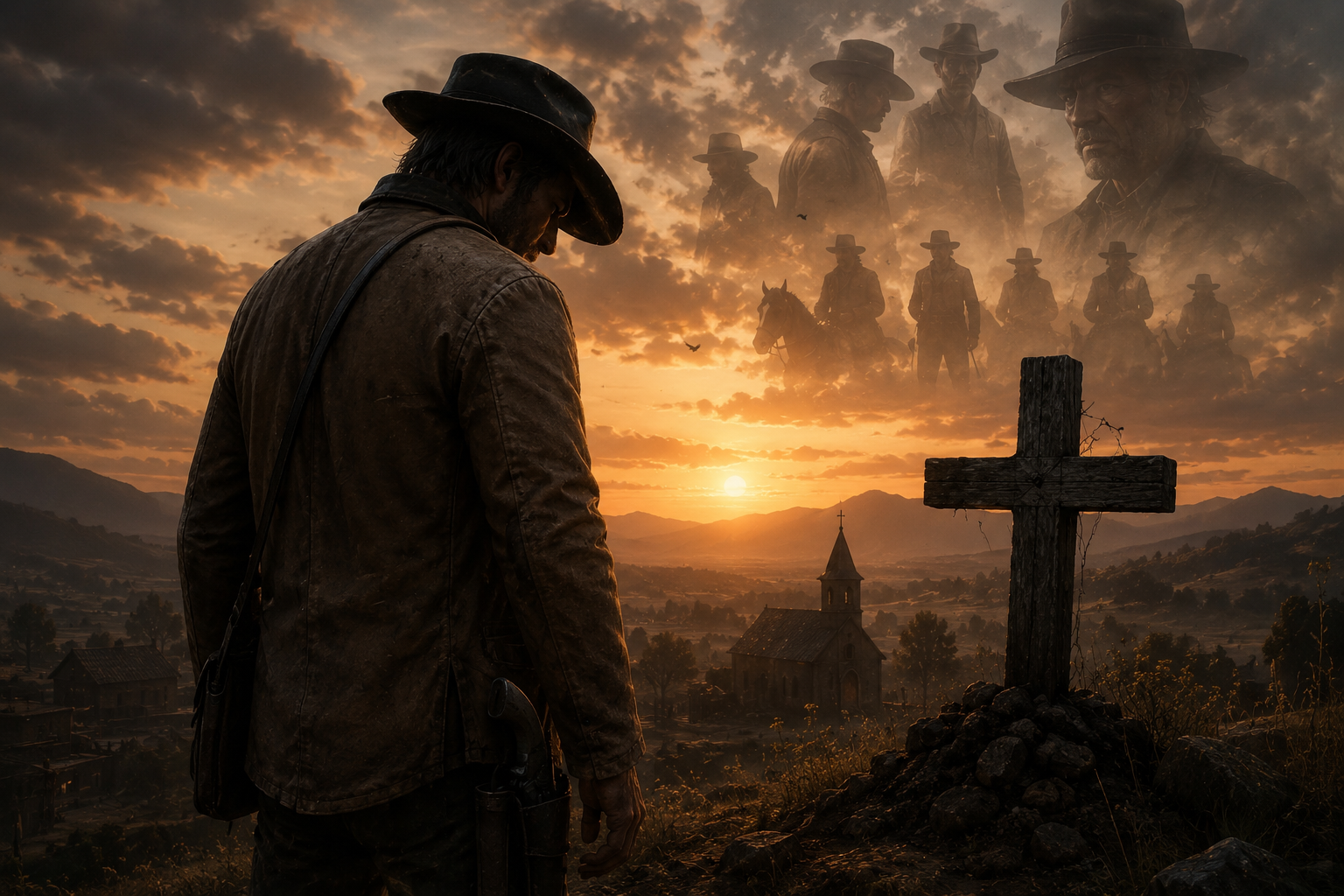
That’s the question sitting underneath almost every decision Arthur Morgan makes in Red Dead Redemption 2, one of the most morally complex protagonists modern gaming has produced. Arthur isn’t a hero in the traditional sense, and he isn’t quite an antihero either — he’s something closer to a man slowly waking up to the cost of a life he never fully chose for himself. Analyzing his arc isn’t just interesting from a storytelling perspective; it’s one of the clearest examples of video game character analysis intersecting with real moral philosophy, because the game refuses to give you easy answers about who Arthur is or what he deserves.
This piece isn’t a review or a walkthrough. It’s a look at Arthur Morgan as a moral case study — the kind of character whose decisions raise questions worth sitting with long after the credits roll.
Who Is Arthur Morgan, Really?
On paper, Arthur is an outlaw. He robs banks, trains, and stagecoaches. He intimidates people for money he’s owed. He’s spent roughly twenty years as the most loyal enforcer of the Van der Linde gang, a group led by a man named Dutch van der Linde, who preaches freedom, brotherhood, and resistance against a modernizing world — while quietly steering the people who trust him toward ruin.
What makes Arthur compelling isn’t the outlaw part. It’s that the game spends dozens of hours letting you see the gap between what Arthur does for a living and who he actually is underneath it. He helps strangers on the road who owe him nothing. He mentors younger gang members with real patience. He writes in a journal — a genuinely reflective, often self-critical habit that the player can read throughout the story — trying to make sense of a life that increasingly doesn’t make sense to him.
The Central Moral Tension: Loyalty vs. Conscience
Arthur’s core conflict isn’t really about outlaw life versus a “normal” life. It’s about loyalty versus conscience — and specifically, how long a person can keep choosing loyalty to a cause, or a leader, after the evidence starts piling up that the cause was never what it claimed to be.
This is a genuinely old philosophical problem, one that shows up far outside of gaming: how much moral responsibility does a follower carry for the harm caused by a leader they trusted? Philosophers have wrestled with versions of this question in contexts ranging from wartime obedience to corporate whistleblowing. Red Dead Redemption 2 doesn’t resolve it neatly. It just makes you watch Arthur wrestle with it, mission after mission, as the gap between Dutch’s rhetoric and Dutch’s actions grows too wide to ignore.
The Honor System: When a Game Mechanic Becomes a Moral Argument
One of the more interesting design choices in Red Dead Redemption 2 is its honor system. Nearly everything Arthur does — helping a stranded traveler, robbing a store, threatening a witness, donating money to the camp — shifts an invisible meter tracking his honor, which in turn subtly changes how other characters treat him, which missions become available, and even details of the story’s ending.
Why This Matters More Than It Sounds
It would be easy to dismiss this as a typical “good vs. evil” morality meter, the kind found in dozens of other games. But Red Dead Redemption 2 handles it with more nuance than most. The system doesn’t just track binary choices; it tracks a pattern of behavior over dozens of hours, closer to how moral character is actually built in real life — not through one dramatic decision, but through hundreds of small, mostly unremarkable ones.
This design choice quietly echoes an idea found in virtue ethics, most associated with Aristotle: that character isn’t defined by isolated acts, but by habits repeated consistently over time. Aristotle argued that a person becomes courageous by repeatedly acting courageously, not by making one brave choice and then reverting to old patterns. Arthur’s honor, in the game’s own mechanical logic, works almost exactly the same way. A single act of cruelty doesn’t define him. Neither does a single act of kindness. What defines him is the accumulated weight of thousands of small choices the player makes on his behalf.
A Practical Example: The Stranger on the Road
A recurring type of encounter in the game involves stumbling across a stranger in trouble — someone stuck under a wagon, being robbed, or lost in the wilderness. None of these encounters are required. None of them advance the main story in any meaningful way. And yet, over a full playthrough, they end up shaping the player’s — and Arthur’s — sense of identity more than almost any scripted story mission.
This is a subtle but important point about moral philosophy in video games: the game seems to be arguing that character isn’t built in the big, dramatic moments most stories focus on. It’s built in the unnecessary, unrewarded ones — the choices nobody would notice or judge you for skipping.
Dutch van der Linde: The Mirror Arthur Is Measured Against
It’s difficult to talk about Arthur’s moral arc without talking about Dutch, because so much of Arthur’s journey is really about slowly recognizing who Dutch actually is, as opposed to who Dutch has always claimed to be.
Dutch presents himself, for most of the story, as a philosopher-outlaw — a man fighting for freedom against an encroaching, corrupt system, someone who genuinely believes in the found family he’s built. For years, Arthur believes this too, or at least wants to. But across the story, cracks appear. Plans go wrong. People get hurt in ways that don’t match the ideals Dutch claims to be fighting for. And Dutch’s response to each failure isn’t reflection — it’s a new, more elaborate justification for why the next plan will finally work.
Why Dutch Is a Case Study in Charismatic Rationalization
Dutch is a compelling example of something psychology and philosophy both study closely: how charismatic leaders maintain loyalty even as their actions increasingly contradict their stated values, largely by reframing every failure as someone else’s fault, or as an unfortunate but necessary cost of a larger, still-justified goal. It’s a pattern worth recognizing far outside the world of outlaw gangs — in workplaces, political movements, and personal relationships, where a compelling narrative can keep people loyal long after the evidence suggests they shouldn’t be.
What makes Arthur’s arc so effective is that the player experiences this slow erosion of trust in real time, at roughly the same pace Arthur does. Early in the game, Dutch’s speeches feel inspiring. By the later chapters, the same kind of speech feels hollow, even manipulative — not because Dutch has changed his delivery, but because the player, like Arthur, has finally accumulated enough evidence to hear it differently.
Redemption Without a Clean Ending
Red Dead Redemption 2 resists the temptation to give Arthur a tidy redemption arc, and this is arguably its strongest moral choice as a piece of writing. Without detailing specific plot points, it’s fair to say the game doesn’t offer Arthur a chance to undo the harm he’s caused over two decades of outlaw life. There’s no final mission where all his past victims are made whole, no moment where the ledger is balanced back to zero.
Why an Incomplete Redemption Feels More Honest
This matters because it reflects something most redemption stories get wrong: real accountability rarely comes with a clean slate. Arthur can’t go back and un-rob the people he robbed, un-threaten the people he threatened, or bring back anyone hurt by his choices over the years. What he can do — and what the back half of the game increasingly focuses on — is decide how he treats the people still in front of him, right now, with whatever time and reputation he has left.
This is a more mature and, frankly, more useful moral lesson than the standard redemption arc offers. It suggests that meaningful change isn’t about erasing your past. It’s about what you choose to do with the remaining time you have, fully aware that some debts can never actually be repaid.
A Real-World Parallel: Restorative vs. Retributive Thinking
This tension mirrors an ongoing debate in real-world ethics and criminal justice between retributive approaches (focused on punishment matching the crime) and restorative approaches (focused on repairing harm and enabling positive future behavior, even when full repair is impossible). Arthur’s story leans heavily toward the restorative model, without ever using that language. The game seems less interested in whether Arthur “deserves” forgiveness in some cosmic sense, and far more interested in what he does with his remaining choices, regardless of whether he deserves anything at all.
The Journal: A Rare Window Into Video Game Interiority
One of the more underappreciated tools Red Dead Redemption 2 uses for character development is Arthur’s journal, an optional item players can read throughout the story. Unlike most in-game text, which tends to deliver lore or exposition, Arthur’s journal entries read like genuine, often uncertain self-reflection — closer to a real diary than a plot device.
Why This Design Choice Matters
Most games communicate character growth through dialogue or cutscenes — moments other characters, or the plot itself, can witness and react to. The journal does something different: it gives Arthur a private, interior voice that exists outside the events other characters see. This is a subtle but significant tool for moral characterization, because it lets players witness Arthur’s doubt and self-criticism in a space where he isn’t performing for anyone, gang member or player alike.
This matters philosophically because so much of real moral character exists in private — in the thoughts we have about our own actions when nobody else is watching or judging. A character who only reflects out loud, in front of others, risks feeling performative. A character who reflects privately, in a journal nobody in the story ever reads but him, feels considerably more honest.
Arthur’s Relationships as Moral Evidence
If Dutch represents the slow erosion of Arthur’s trust, other characters in his life function almost like witnesses for the defense — evidence that whatever Arthur has become through his years in the gang, it isn’t the whole story.
John Marston: The Debt of Mentorship
Arthur’s relationship with John Marston, a younger gang member he essentially helped raise, is one of the clearest examples of how the game builds moral character through obligation rather than declaration. Arthur rarely says out loud that he cares about John’s future. Instead, the game shows it through small, repeated acts — covering for John’s mistakes, pushing him toward a life outside the gang, quietly ensuring John’s family has a chance Arthur never gave himself.
This matters for a simple reason: it demonstrates that Arthur’s morality operates almost entirely through action rather than stated belief. He isn’t a character who articulates a philosophy of goodness. He’s a character whose goodness has to be inferred from what he consistently chooses to do, especially when nobody is asking him to do it.
Sadie Adler: A Different Kind of Loyalty
Arthur’s relationship with Sadie Adler, a woman the gang takes in after tragedy, offers a useful contrast. Where Arthur’s loyalty to Dutch is inherited — built over two decades of habit — his respect for Sadie develops in real time, based on what he actually witnesses her do, rather than what she claims about herself. It’s a small but telling detail: the two relationships Arthur trusts most by the story’s later chapters, John and Sadie, are both built on observed behavior rather than persuasive rhetoric, while the relationship built almost entirely on rhetoric — his loyalty to Dutch — is the one that ultimately fails him.
This distinction reinforces the game’s broader argument about character: trust built on consistent action tends to hold up under pressure. Trust built on charisma and promises tends to collapse the moment reality stops cooperating with the story being told.
What Arthur Morgan Teaches Us About Real Moral Change
Pulling these threads together, Arthur’s arc offers a few genuinely useful ideas about moral character that extend well past the world of the game:
Loyalty isn’t the same as morality. Arthur spends decades assuming that being loyal to Dutch and the gang is, by itself, a form of goodness. His arc slowly separates these two ideas, showing that loyalty to the wrong cause can quietly erode a person’s actual values, even while that person still thinks of themselves as fundamentally decent.
Character is built in unremarkable moments. The honor system’s design reinforces something Aristotle argued centuries ago: who we are isn’t determined by rare, dramatic choices, but by the accumulated weight of small, often unnoticed ones.
Redemption doesn’t require erasing the past. Arthur can’t undo what he’s done. What he can do is choose, deliberately, how he treats the people still around him with whatever time remains — a far more realistic and, arguably, more meaningful version of redemption than fiction usually offers.
Conclusion: Why Arthur Morgan Remains One of Gaming’s Most Honest Characters
Arthur Morgan works as a moral case study precisely because the game refuses to simplify him. He’s not a good man who did bad things for a good reason, and he’s not a bad man discovering he’s actually good underneath it all. He’s something closer to what most real people are: a person who spent a long time not looking too closely at the cost of his loyalty, until circumstances finally forced him to.
That refusal to simplify is, in many ways, the whole point. Video game character analysis is at its most valuable when a character resists easy categorization — when players are left debating, long after finishing the story, whether Arthur deserved more than he got, whether his final choices actually mattered, and whether loyalty to the wrong people can ever be fully separated from who we understand ourselves to be.
Arthur Morgan never gets a clean answer to any of these questions. Neither, really, do we.
That, ultimately, may be the most useful thing a fictional outlaw can offer: not a verdict, but a mirror. Most of us aren’t robbing trains or riding with an outlaw gang, but plenty of us have stayed loyal to a person, a job, or a story about ourselves for longer than the evidence justified. Arthur’s slow, uneven reckoning with that same pattern is what makes him worth studying long after the game ends.
This article is part of an ongoing series analyzing video game characters through the lens of moral philosophy — examining the choices, contradictions, and quiet decisions that define who they really are.