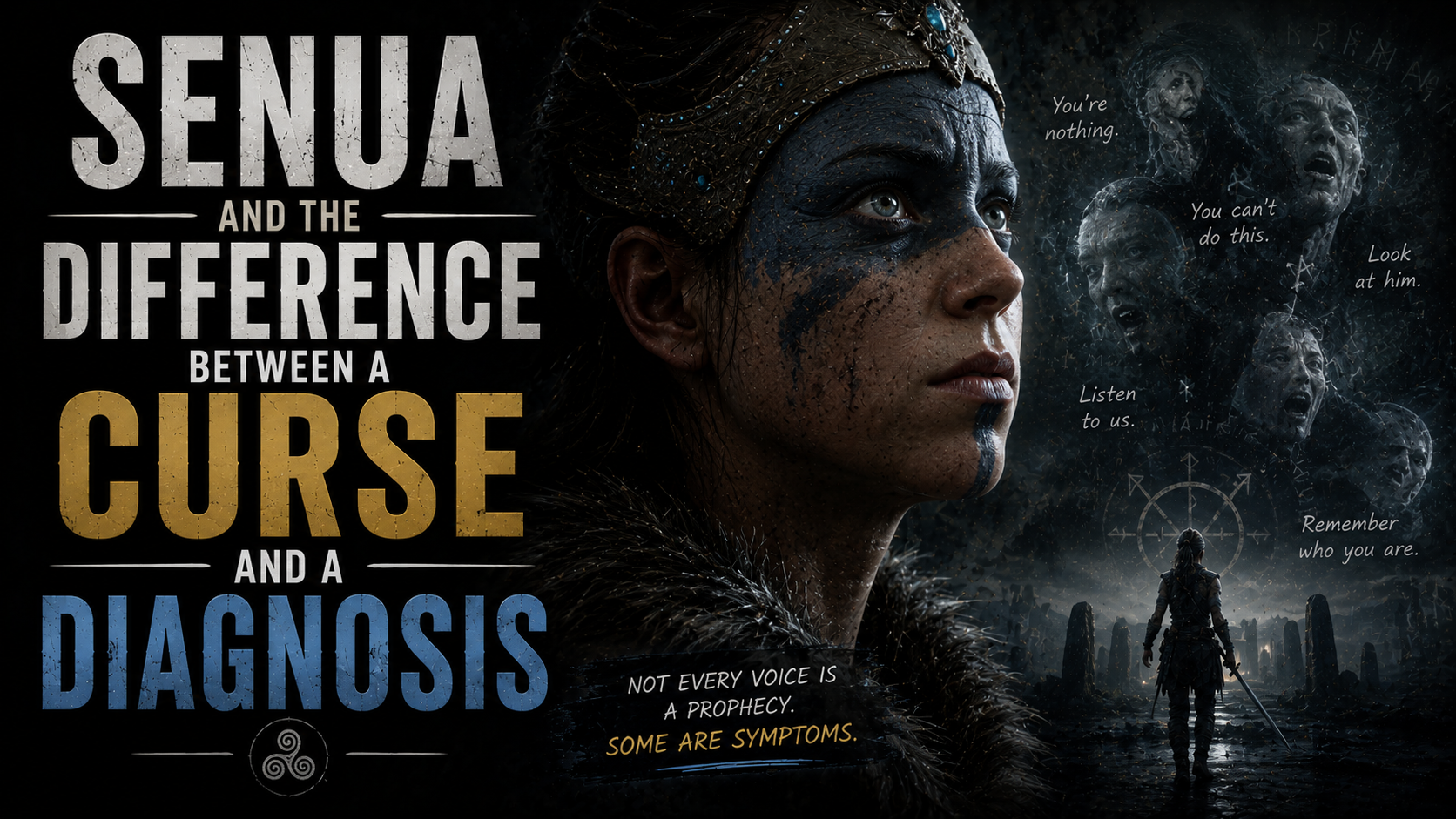

What happens when the story you’ve been told about your own suffering — that it’s a punishment, a curse, a moral failing — turns out to be the wrong story entirely, and nobody around you knows how to offer you a better one?
- Who Is Senua, Really?
- Psychosis as a Playable Mechanic, Not a Plot Twist
- The Permadeath Myth and What It Reveals About Shame
- Druth: The One Person Who Offers Her a Different Story
- Dillion: Grief, Guilt, and the Loop Senua Can’t Escape
- Why the Game Refuses to “Cure” Her
- What Senua Teaches Us About Living With, Not Defeating, an Altered Mind
- Conclusion: Why Senua Remains a Rare and Careful Kind of Character
That’s the question underneath Hellblade: Senua’s Sacrifice, and it belongs entirely to its protagonist, a Pictish warrior named Senua who journeys into a mythic version of the Norse underworld to bargain for the soul of her dead lover. On the surface, this is a story about grief and a quest into hell. Underneath it, told with unusual care and research, it’s a story about a woman who has spent her entire life being told that the voices she hears and the visions she experiences are evidence of a curse on her bloodline — and who has to travel through an entire underworld before anyone, including herself, considers a gentler, more accurate explanation for what she’s actually carrying.
This piece isn’t a review or a plot summary. It’s a look at Senua as a character study — specifically, at how the game translates lived experiences of psychosis into playable mechanics, and what her story reveals about the real difference between being told you’re cursed and being given room to understand what’s actually happening to you.
Who Is Senua, Really?
Senua is a Pictish woman living in a period the game renders as somewhere between historical Dark Ages Britain and full Norse mythology, and from childhood she has experienced what the game’s own internal logic frames as a curse: intrusive voices that comment on her constantly, visions that blur the line between what’s really in front of her and what isn’t, and a community that has, at various points, treated her as dangerous, unclean, or beyond help because of it.
By the time the story begins, Senua has lost her lover Dillion to a violent death, and travels alone into a mythologized version of the underworld — Hel’s realm, populated by figures and trials drawn from Norse legend — hoping to bargain for his soul’s return. This premise gives the game a clear narrative structure. What makes Senua herself worth examining closely is that her interior experience, not just her external quest, is treated as the actual subject of the story, rendered with unusual specificity and care.
The Central Moral Tension: A Curse Story vs. a Human Explanation
Senua’s core conflict isn’t really the underworld journey itself, mythologically dramatic as it is. It’s a quieter, more personal tension running underneath the whole quest: whether the voices and visions she’s lived with her entire life are a curse inflicted on her by dark forces, as she’s been told to believe since childhood, or something that has a different, more human explanation — one that doesn’t require her to see herself as fundamentally marked or broken.
This distinction matters enormously, because the story someone is given about their own suffering shapes how they respond to it. A curse implies guilt, inheritance, and inevitability. A more human explanation, even a difficult one, at least leaves room for understanding, support, and the possibility of living differently alongside it. Much of Senua’s arc is really about which of these two stories she’s going to end up believing about herself.
Psychosis as a Playable Mechanic, Not a Plot Twist
Hellblade: Senua’s Sacrifice, developed by Ninja Theory, is unusual among games dealing with mental health in that its depiction of psychosis isn’t a late reveal or a narrative gimmick. It’s present from the very first moments of the game and never goes away, expressed almost entirely through sound design and perspective rather than dialogue explaining what’s happening to her.
Why the Voices Were Built From Real Testimony
The development team worked directly with neuroscientists, mental health professionals, and people with lived experience of psychosis to construct Senua’s auditory experience, and it shows in the specificity of the result. Rather than a generic, spooky “voices in her head” effect, the game surrounds the player with a constant, layered chorus of commentary — some encouraging, some cruel, some contradictory, positioned spatially around the player through binaural audio so that the voices feel like they’re genuinely coming from just behind you, or just to your left, rather than from a speaker in front of a screen.
This is a meaningfully different design choice than simply depicting mental illness as a narrative device to explain a twist later on. The game commits to the experience being real and constant for Senua throughout, which asks the player to sit inside something closer to her actual perspective, rather than observing her condition from a clinical distance.
A Practical Example: The Whispering Chorus
At almost every moment of quiet exploration, a set of voices comments on Senua’s choices, her worth, and her chances of succeeding — sometimes offering genuine encouragement, more often circling back toward doubt, criticism, and warnings of failure. The game never mutes this chorus for long stretches to give the player, or Senua, a clean break from it. It’s simply there, a constant undercurrent to nearly everything she does.
This design choice illustrates something important about how intrusive, distressing thought patterns actually function for the people living with them: they rarely arrive as an occasional dramatic event. They’re closer to an ongoing background presence that has to be lived alongside, moment to moment, while still managing to function, make decisions, and keep moving forward.
The Permadeath Myth and What It Reveals About Shame
One of the more famous, and more misunderstood, aspects of Hellblade on release was a rumor, deliberately left ambiguous by the developers, that repeated failure in combat would eventually trigger a permanent, save-erasing death for Senua, with the corruption visibly creeping further up her arm each time she died. This threat, whether or not it was ever fully real in the game’s actual code, generated genuine anxiety among players during their playthroughs.
Why a Fake Threat Still Does Real Psychological Work
What’s philosophically interesting about this design choice isn’t whether the permadeath threat was technically real. It’s what the fear of it does to how players approach failure throughout the game. Many players describe becoming increasingly anxious about combat encounters as the corruption crept further up Senua’s arm, mirroring, in a small and deliberately engineered way, the same shame spiral that often accompanies living with a stigmatized condition: the fear that one more failure, one more visible symptom, will be the thing that finally costs you everything.
This mechanic doesn’t just represent Senua’s psychological state from the outside. It manufactures a version of that same anxious, high-stakes relationship to failure in the player directly, which is a much more visceral way of communicating what shame does to someone than any amount of dialogue could achieve on its own.
Druth: The One Person Who Offers Her a Different Story
Senua isn’t entirely alone on her journey. Early in the game, she recalls a mentor figure, Druth, a Christianized Northman who lived among the Picts and who offers Senua something almost nobody else in her life has: an alternative explanation for what she experiences, delivered without judgment or fear.
A Real-World Parallel: The Power of a Better Explanation
Without detailing the specific content of Druth’s teachings, his presence in Senua’s memory functions as a quiet counterpoint to the curse narrative she’s absorbed from everyone else around her. He offers context, historical framing, and a way of understanding her experiences that doesn’t require her to see herself as fundamentally cursed or dangerous. This mirrors something well documented in how people process difficult, stigmatized experiences in real life: having even one person offer a compassionate, non-judgmental framework for understanding what’s happening can meaningfully change how someone relates to their own suffering, even if it doesn’t remove the suffering itself.
Druth doesn’t cure Senua. He can’t. What he offers instead is a different lens — one that treats her experience as something to be understood rather than feared — and the game suggests, through how often Senua’s memory returns to him during her darkest moments, that this reframing matters more to her survival than any single victory in the underworld itself.
Dillion: Grief, Guilt, and the Loop Senua Can’t Escape
Senua’s relationship with Dillion, her deceased lover, is the emotional engine driving her entire quest, and the game gradually reveals, without spoiling specific plot mechanics, that her grief is entangled with guilt in ways that complicate any simple reading of her journey as a straightforward rescue mission.
Practical Example: The Nature of the Final Bargain
Without detailing the story’s specific resolution, the underworld journey Senua undertakes is structured around a bargain that mythological logic promises will restore what she’s lost, provided she proves herself capable and worthy along the way. The game slowly reveals, through environmental storytelling and fragmented memory, that this bargain is entangled with Senua’s own unprocessed guilt about circumstances surrounding Dillion’s death — guilt that has nothing to do with any actual curse, and everything to do with ordinary human grief refusing to accept an ending it wasn’t ready for.
This matters because it reframes the entire mythological quest as something psychologically grounded rather than purely fantastical: an underworld journey that mirrors the actual, often circular shape of unprocessed grief and guilt, which can trap a person in the same emotional loop long after the person they’ve lost is gone, regardless of whether any literal underworld exists to travel through.
Why the Game Refuses to “Cure” Her
Without detailing the game’s specific ending, it’s fair to say that Hellblade: Senua’s Sacrifice does not conclude with Senua’s voices disappearing, her visions ending, or her condition being resolved in any tidy, permanent sense. Whatever peace she arrives at by the story’s conclusion coexists with, rather than replaces, the experiences she’s carried the entire journey.
Why an Ending Without a Cure Feels More Honest
This is an important choice, and a considerably more honest one than the alternative. A story that concluded with Senua’s psychosis simply vanishing once she’d proven herself, or won a decisive victory, would have implied something false and, frankly, harmful: that experiences like hers are primarily obstacles to be defeated through willpower or heroism, rather than something that can be lived alongside, understood, and integrated into a full life without requiring their complete disappearance first.
By refusing this easy resolution, the game respects both its subject matter and the people who might recognize pieces of their own experience in Senua’s story. It suggests that the goal was never to “win” against her mind in some final, permanent sense. It was to arrive at a different relationship with what she carries — one shaped less by shame and curse mythology, and more by understanding, however incomplete that understanding remains by the credits.
What Senua Teaches Us About Living With, Not Defeating, an Altered Mind
Pulling these threads together, Senua’s story offers a few genuinely valuable ideas that extend well beyond Norse mythology and Pictish history:
The story you’re given about your own suffering shapes how you carry it. Senua’s lifelong belief that she’s cursed adds a layer of shame and isolation on top of experiences that, reframed, become something she can understand and live alongside rather than simply fear.
One compassionate, non-judgmental explanation can matter enormously, even without resolving anything. Druth doesn’t cure Senua, but his willingness to offer context instead of fear changes her relationship to her own mind in ways that carry her through her darkest moments.
Recovery, or something like it, doesn’t require symptoms to disappear entirely. The game’s refusal to grant Senua a clean cure reflects something true and important: living well alongside a difficult condition is a legitimate, meaningful outcome in its own right, not a consolation prize for failing to be fully “fixed.”
Conclusion: Why Senua Remains a Rare and Careful Kind of Character
Senua works as a character study precisely because the game refuses to treat her experience as either a simple curse to be lifted through heroism or a clinical case study to be observed from a safe distance. She is rendered, through sound design, structure, and collaboration with real mental health expertise, as a full person whose mind works differently than the people around her assume it should, and whose journey is ultimately less about defeating that difference than about finding a way to understand and carry it that doesn’t require constant shame.
That care is, in many ways, the entire achievement of the character. Video game character analysis is at its most valuable when a story resists an easy resolution — when a difficult, stigmatized experience gets treated with the same complexity and respect any other central human struggle would receive, rather than flattened into either a monster to defeat or a tragedy to simply pity.
Hellblade never gives Senua, or the player, a moment where her mind is simply fixed and the story can move on. Neither, in fairness, does real life offer that kind of clean resolution to most people navigating something similar.
That may be the most valuable thing Senua’s story leaves behind: not a triumph over her own mind, but quiet, hard-won evidence that a different, gentler story about your own suffering — one built on understanding rather than curse or shame — can change everything about how bearable that suffering becomes, even when it never fully disappears.
This article is part of an ongoing series analyzing video game characters through the lens of moral philosophy — examining the choices, contradictions, and quiet decisions that define who they really are.