
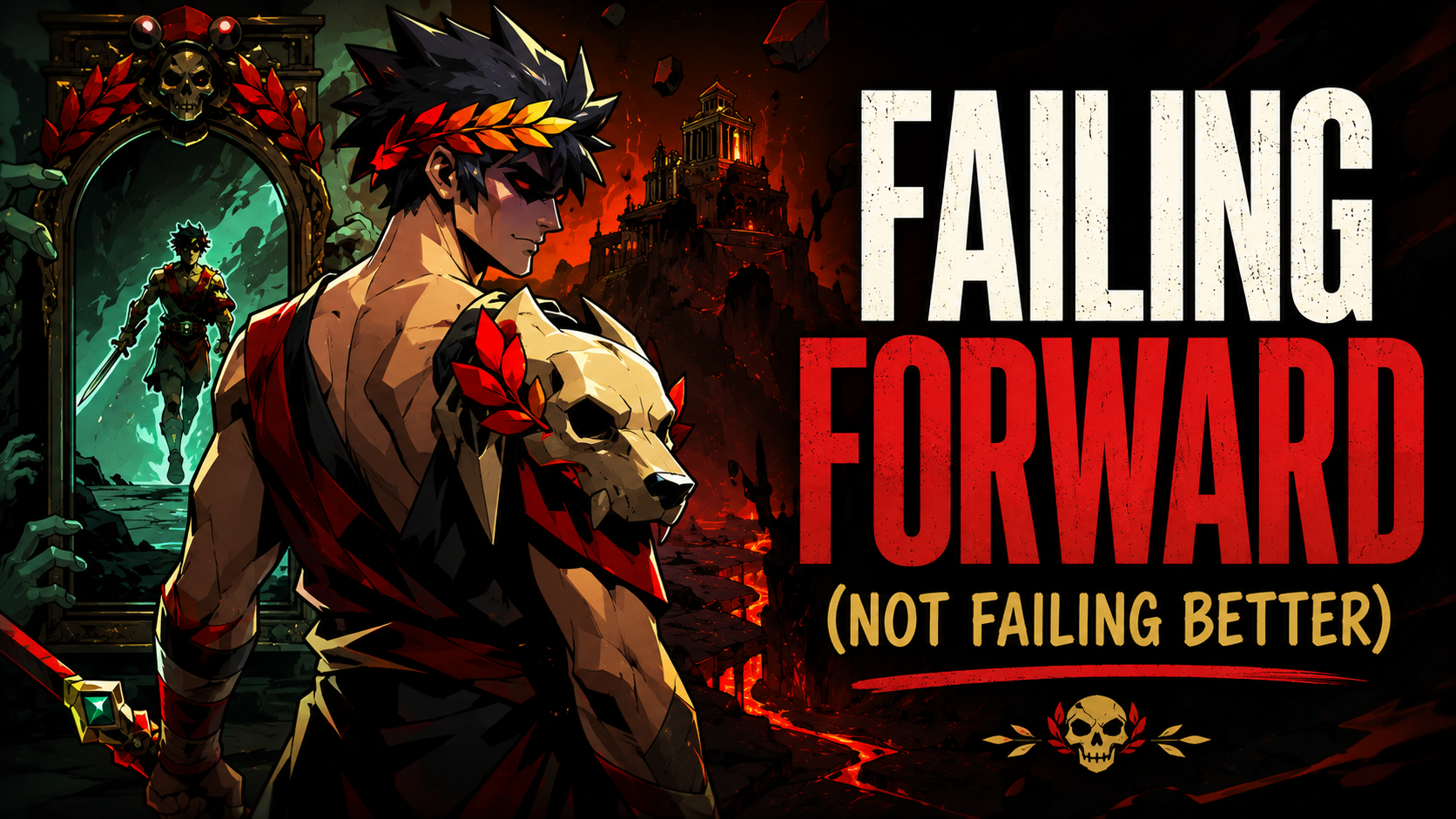

What if the number of times you fail at something was never actually evidence against you — just the receipt for the only kind of learning that was ever going to work?
- A Game Built Entirely on Dying
- Death Isn’t a Punishment Here — It’s a Commute
- The Trap of “Failing Better”
- Progress You Can’t See Isn’t the Same as No Progress
- The Family You Keep Returning To
- Getting Out Isn’t the Point — Coming Back Is
- The Codex Entries: Failure as Documentation, Not Shame
- It’s Not a Game “About” Failure — It Rehearses Failure
- Final Thoughts: What I Took Into Real Life
That question followed me out of Hades, Supergiant Games’ roguelike about Zagreus, the son of the Greek god of the underworld, trying — and failing, over and over, by design — to escape his father’s realm. I died to the same early-game enemies more times than I’d like to admit. I died to bosses I’d supposedly “figured out” two runs earlier. And somewhere around my thirtieth or fortieth death, I noticed that the game had never once treated any of those deaths as a problem. I had. This is one of those rare moments where a piece of game design quietly corrects a belief you didn’t know you were carrying around.
This article is part of an ongoing series exploring what video games can teach us about real life. If you’re interested in gaming and philosophy, in the psychology of games, or in why some titles change how you think long after you’ve put the controller down, Hades is one of the clearest examples of a game that turns repeated failure into its actual subject matter, rather than an obstacle standing in front of one.
A Game Built Entirely on Dying
Most games treat death as an interruption — a fail state that pauses the experience while you reload a save and try to pretend it didn’t happen. Hades takes the opposite approach. Dying isn’t an error message. It’s the primary loop of the entire game. Zagreus dies, wakes up back in the House of Hades, and sets out again, run after run, each one shaped a little differently by the boons, weapons, and relationships he’s accumulated along the way.
This isn’t a small structural choice — it’s the whole philosophical premise of the game, expressed entirely through mechanics rather than dialogue. A game that punished death the way most action games do would be teaching an entirely different lesson: that failure is a detour from the real progress. Hades instead builds its story, its character relationships, and its combat systems around the assumption that dying repeatedly is simply what trying looks like.
Why a Roguelike Was the Right Container
The philosophy of video games often points to genre as a meaningful design choice, not just an aesthetic one. A roguelike — a genre defined by repeated runs, permadeath, and randomized attempts — is uniquely suited to carrying a message about failure, because the entire genre is built on the assumption that you will not succeed most of the time, and that this isn’t a flaw in the design. Hades doesn’t just use this genre. It makes the genre’s core mechanic — dying and starting over — into the emotional and narrative engine of the whole story.
Death Isn’t a Punishment Here — It’s a Commute
In most games, dying sends you backward: lost progress, a reloaded checkpoint, a screen that says “you failed” in some form or another. In Hades, death sends you home. Every single death returns Zagreus to the House of Hades, where his family and household are waiting, roughly as they were before he left, ready to talk to him about how the run went.
This reframes death entirely. It isn’t a wall Zagreus hits and bounces off of. It’s closer to a commute between two versions of the same ongoing project — attempt, return, reflect, adjust, attempt again. The game never asks the player to forget a failed run happened. It asks them to walk back through the house and let that failed run become the context for the next conversation.
A Rare Kind of Honesty in Game Design
This matters because it mirrors something genuinely true about how skill actually develops, which most games — and most self-help framing around failure — get wrong. Growth rarely looks like a single triumphant leap. It looks like returning to the same starting point dozens of times, each time carrying slightly more information than the last, even when the run itself ended exactly the same way: in death. Hades doesn’t dress this up as a heroic training montage. It just repeats it, plainly, until the repetition itself becomes the substance of the story.
The Trap of “Failing Better”
There’s a popular piece of advice, often traced back to a line from Samuel Beckett, that gets repeated in productivity culture until it loses most of its meaning: fail better. On the surface, it sounds like exactly what Hades is about. Try, fail, adjust, try again, presumably failing in a slightly more sophisticated way each time until failure eventually becomes success.
Hades quietly complicates this framing. Not every run is a clean, legible improvement on the last one. Some runs go worse than the one before for no discernible reason — bad boon luck, an unfamiliar enemy combination, a mistimed dash at the wrong moment. The game doesn’t punish these regressions any differently than it treats a “good” failed run. It simply logs the attempt and sends Zagreus home again, whether or not the run demonstrated visible growth.
Practical Example: The Mirror of Night
One of the game’s core permanent-upgrade systems, the Mirror of Night, lets Zagreus invest currency earned across many runs — successful and unsuccessful alike — into permanent traits that carry forward no matter how any individual attempt ends. A run that ends in an early, embarrassing death still contributes to this pool. The game mechanically refuses to let any single attempt be graded as wasted, because the currency collected during it persists regardless of the outcome.
This is a rare and useful correction to how most of us actually talk to ourselves about setbacks. We tend to grade individual attempts — that meeting went badly, that interview didn’t land, that hard conversation blew up — as though each one exists in isolation, disconnected from whatever accumulated underneath it. Hades insists, mechanically, that this isn’t how any of it actually works.
Progress You Can’t See Isn’t the Same as No Progress
Much of Hades‘s permanent progression happens in ways the player can’t directly observe mid-run. Relationships deepen through repeated conversations across many attempts. Weapons unlock hidden aspects only after enough cumulative use. Some of the most meaningful character material in the game only surfaces after dozens of failed escape attempts, entirely independent of whether any particular run went well.
This is worth sitting with, because it directly contradicts the instinct most of us have when a string of attempts at something feels unproductive: the instinct to conclude that nothing is happening simply because nothing visible happened this time.
Real-Life Parallel: The Myth of the Clean Learning Curve
Anyone who has tried to learn a difficult skill — an instrument, a language, a physical practice, a new professional discipline — knows that progress rarely arrives as a smooth, visible upward line. It arrives in long stretches that feel exactly like standing still, punctuated by sudden jumps that only make sense in hindsight, once enough invisible repetition has accumulated underneath them. Hades doesn’t explain this idea through dialogue. It simply structures its entire progression system so that the player experiences it directly: dozens of runs that feel identical on the surface, quietly building toward a version of Zagreus who is, almost imperceptibly, further along than he was.
The Family You Keep Returning To
One of Hades‘s most distinctive choices is how much of its narrative weight sits not in the underworld’s chambers, but in the House of Hades itself — the place Zagreus returns to after every death. Gods, attendants, and household staff greet him after each failed escape attempt, sometimes with concern, sometimes with dry humor, occasionally with genuine tenderness, never with contempt for having failed again.
This detail does a lot of quiet work. It establishes, structurally, that failure doesn’t cost Zagreus his relationships. If anything, the relationships deepen specifically because of how often he returns, defeated, and chooses to try again anyway. The people around him aren’t measuring his worth by whether he’s escaped yet. They’re responding to the fact that he keeps coming back.
Getting Out Isn’t the Point — Coming Back Is
Without spoiling the specifics of how the game’s central arc resolves, it’s worth noting that Hades eventually complicates the entire premise of “escaping” as the actual goal. What the game slowly reveals, through its story and its structure alike, is that the real substance of Zagreus’s journey was never simply reaching the surface. It was the accumulation of everything that happened during the hundreds of attempts along the way — the relationships repaired, the family history uncovered, the person he became through the sheer volume of trying.
This is a meaningfully different lesson than “keep going and you’ll eventually succeed,” which is the version of this story most triumphant narratives settle for. Hades suggests something a little more honest: that the trying itself was where nearly all of the actual meaning lived, and that the final successful run was more of an epilogue to that process than its point.
Why This Matters for the Philosophy of Games as a Genre
This is where Hades distinguishes itself from a simple “practice makes perfect” parable. Most stories about repeated failure are structured so that failure is retroactively justified by an eventual success — implying that all the previous attempts only mattered because they led somewhere. Hades structures its systems so that the attempts mattered on their own terms, independent of whether the specific run in question succeeded. That’s a subtle but important difference, and it’s one only a medium built around repeated, mechanical attempts could really demonstrate rather than simply state.
The Codex Entries: Failure as Documentation, Not Shame
A small design detail worth highlighting: the game’s in-universe Codex — a growing archive of entries about characters, enemies, and locations — updates itself automatically as Zagreus encounters new information, regardless of whether the run that produced that information ended in success or death. A defeat to a particular enemy still adds detail to that enemy’s Codex entry. The game treats failed encounters as a legitimate source of information, not as a gap where information should have been.
This is a quiet but meaningful design philosophy: documenting what happened, rather than only documenting what worked. Plenty of real environments — workplaces, classrooms, training programs — could stand to borrow this instinct. A failed attempt still produced real data. Most of us just don’t have a Codex entry updating automatically to remind us of that.
It’s Not a Game “About” Failure — It Rehearses Failure
It’s worth being precise here, because it’s easy to flatten this reading into a simple platitude: Hades isn’t a motivational poster dressed up as a video game, and it doesn’t reduce its message to a single explicit moral about resilience. What’s remarkable is that its structure — the return home, the permanent currency that persists regardless of outcome, the relationships that deepen through repetition rather than through triumph — makes the player feel something close to a healthy relationship with failure, without ever needing a character to deliver a speech about it.
That, more than any single line of dialogue, is the real design achievement: not describing a better relationship with failure from the outside, but letting the player inhabit one, run after run, with their own hands on the controller.
Final Thoughts: What I Took Into Real Life
After enough hours with Hades, I noticed I’d started narrating my own setbacks differently, almost without meaning to. A missed deadline stopped registering as evidence I wasn’t cut out for something and started registering, more quietly, as a run that ended earlier than I’d hoped — one that still added something to whatever pool of experience I was drawing from the next time.
I don’t think the game set out to be a lesson in self-compassion. It’s a combat game about a Greek god’s son trying to escape his father’s underworld, dashing between rooms with a sword. But because its central mechanic is repeated failure, and because it never once treats that repetition as a shame to be hidden, it ended up teaching something a lot of well-intentioned advice about resilience talks around without ever quite landing: that the number of times you’ve failed at something was never the opposite of progress. Most of the time, it was the actual mechanism of it.
The House of Hades is still there waiting, every single time. The point was never to stop going back. It was to notice what you were carrying with you when you did.
This article is part of a series exploring the philosophy of video games — how stories, characters, and mechanics reflect real questions about identity, power, mortality, and the choices that define us. If gaming and philosophy is a topic you enjoy, more essays are on the way.








I absolutely love how lightweight and responsive their mobile application is for those of us who prefer betting on the move. Navigating through different markets feels effortless and I always get instant updates on my active wagers. The deposit and withdrawal processes are handled with such care that I never worry about my bankroll while enjoying the games. 189betapp