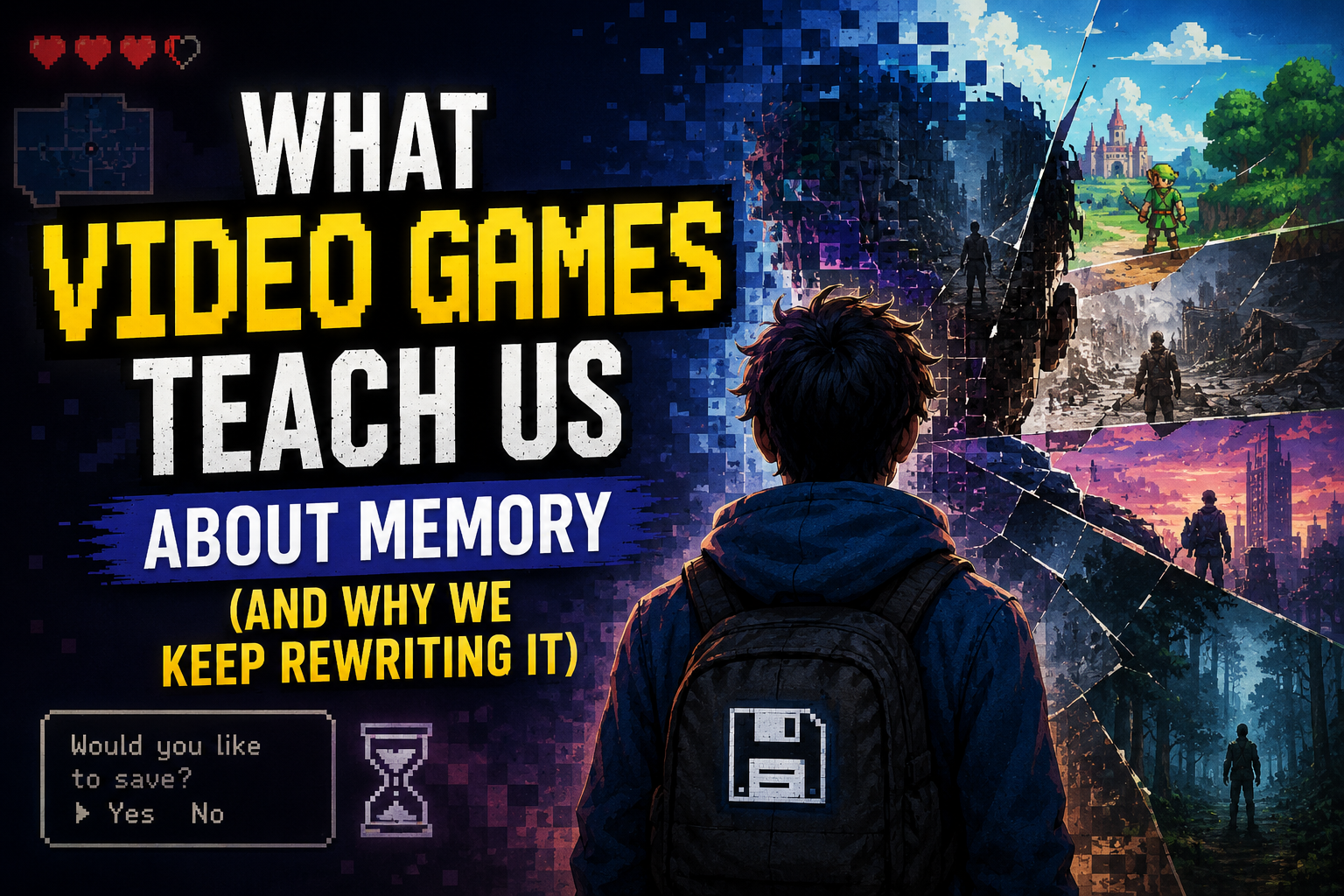

Memory is usually the subject fiction treats as fixed scenery — something a character simply has, mostly stable, occasionally jogged loose by a photograph or a smell, rarely interrogated as its own unreliable system. Novels can describe a flashback. Films can dissolve into one. But video games do something stranger: they let you act inside a memory, revise it, misread it, or piece it together wrong — and then live with the consequences of having done so.
- Memory as a Mechanic, Not Just a Story Beat
- Life is Strange: Memory as Something You Can Rewind — At a Cost
- Return of the Obra Dinn: Memory as Evidence to Be Earned
- What Remains of Edith Finch: Memory as Inheritance
- Three Games, Three Philosophies
- The Role of Player Agency in How These Lessons Land
- What This Means Outside the Game
- Conclusion: Why Games Are an Underrated Space for Thinking About Memory
That distinction matters more than it first appears. When you read about a character misremembering something, you’re told about the gap between what happened and what they believe happened. When you play a memory — reconstructing it, editing it, or simply living through someone else’s — you’re the one who has to close that gap, or fail to. Few mediums put the audience in that position. This is one of the more overlooked corners of the philosophy of video games: the idea that memory isn’t just content to be delivered, but a system that can be simulated, distorted, and handed to a player as something to work through firsthand.
This essay looks at three very different games — Life is Strange, Return of the Obra Dinn, and What Remains of Edith Finch — not as reviews, but as three distinct philosophical positions on what memory actually is, disguised as game design. None of these games agree with each other about whether memory is something you can fix, something you have to earn, or something you simply inherit. Read together, they form something close to a real philosophical debate about what it means to remember at all.
Memory as a Mechanic, Not Just a Story Beat
Before getting into specific games, it’s worth pausing on something we rarely examine closely: in most interactive fiction, memory isn’t just referenced — it’s operationalized. A game can turn “remembering” into a puzzle to solve, a resource to spend, or a place you can physically walk back into. That’s simply not available to a novel or a film, which can only ever gesture at memory from the outside.
This changes what memory feels like as a subject. It stops being a plot device that explains a character’s behavior and starts being something the player has to personally negotiate — deciding what to trust, what to revise, and what to simply carry forward, unresolved.
Why This Matters Philosophically
This mechanical framing echoes an old and still-unsettled philosophical question: is memory a recording, or a reconstruction? Philosophers going back to John Locke tied personal identity directly to memory — you are, in some sense, the continuity of what you remember. But contemporary cognitive science tells a messier story: memories aren’t played back like footage, they’re rebuilt each time we recall them, shaped by mood, by later events, by what we need them to mean now. Games are uniquely suited to dramatize this instability, because they can make the player do the rebuilding, rather than just describe it happening to someone else.
This is the foundation that Life is Strange, Return of the Obra Dinn, and What Remains of Edith Finch each build on — but they take that foundation in three very different directions.
Life is Strange: Memory as Something You Can Rewind — At a Cost
In Life is Strange, developed by Dontnod Entertainment, you play Max Caulfield, a teenager who discovers she can rewind time in short bursts — replaying a conversation, retrying a decision, undoing a mistake seconds after making it. On paper, this sounds like a wish-fulfillment power: a personal undo button for regret.
What makes the game philosophically interesting is how quickly it complicates that fantasy. The rewind never erases what happened so much as it lets Max carry the memory of the undone version forward, even as the world resets around her. She remembers the argument that technically never happened anymore. She remembers the choice she almost made. The power doesn’t grant a clean slate — it grants a second, private memory that nobody else in the world shares, one she has to live with alone.
Practical Example: The Rewind That Doesn’t Erase
Without spoiling specific plot turns, it’s worth noting how the game handles consequence: small rewinds accumulate into a version of events that increasingly feels engineered rather than lived, and the story makes clear, without lecturing, that editing the past doesn’t mean escaping it — it means adding another layer of memory on top of the one you tried to replace. The undone timeline doesn’t vanish from Max’s mind. It just becomes one more thing she remembers that nobody else does.
A Real-World Parallel: Rumination and the Illusion of a Redo
This maps onto something familiar from psychology: rumination, the habit of mentally replaying a past moment as though enough repetition might change the outcome. Life is Strange essentially gamifies that impulse and then shows its cost. Each rewind Max performs is satisfying in the moment and quietly exhausting in aggregate — much like real rumination, which feels like problem-solving but often just deepens the groove of the original memory rather than resolving it. The game’s argument, made mechanically rather than through dialogue, is blunt: you can revise a moment, but you can’t unmake having needed to.
Return of the Obra Dinn: Memory as Evidence to Be Earned
If Life is Strange treats memory as something dangerously editable, Return of the Obra Dinn, developed by Lucas Pope, treats it as something closer to a crime scene. You play an insurance investigator boarding a ship that returned to port with its entire crew dead or missing. Using a pocket watch that can revisit the exact moment of each person’s death, you don’t get a full memory — you get a single frozen tableau, silent, and have to work out everything else yourself.
There is no dialogue to replay, no rewind to fine-tune. Each memory is fixed, incomplete, and stubbornly resistant to interpretation until you’ve earned the right context. You cross-reference faces, accents, uniforms, and overheard fragments across dozens of these frozen moments to slowly reconstruct sixty individual fates — and the game refuses to confirm you’re right until you’ve committed to enough correct answers in a row.
Why the Frozen Moment Isn’t a Gimmick
It would be easy to read the frozen-tableau mechanic as a clever novelty. But its philosophical weight comes from what it withholds: certainty. Each scene shows you an effect — a body, a weapon, a expression — without ever handing you the cause. You have to build the cause yourself, out of inference, and sit with the discomfort of being wrong for long stretches before the picture resolves. This is close to how real memory of a traumatic or chaotic event often works for the people who lived through it: fragmented, sensory, resistant to a tidy narrative, requiring real effort — sometimes external corroboration — to become a coherent account at all.
Practical Example: Certainty You Have to Build Yourself
The game never simply tells you a character’s name and fate. You have to notice a signet ring in one frozen scene, match it to a name mentioned in passing three scenes earlier, cross-reference an accent with a muster roll, and only then commit to an answer — which the game will neither confirm nor deny until you’ve assembled enough of them together. This design choice mirrors something true about how memory actually gets verified in real life, whether in therapy, journalism, or simple family disagreements about “what really happened”: a single account, however vivid, is rarely enough on its own. It’s the corroboration across fragments that turns a memory into something closer to fact.
What Remains of Edith Finch: Memory as Inheritance
The third game in this essay takes the sharpest turn. What Remains of Edith Finch, developed by Giant Sparrow, isn’t about editing memory or earning it through deduction. It’s about inheriting it, whether you asked to or not.
You play Edith, the last surviving member of a family marked by a long, strange history of early deaths, returning to her childhood home to understand what happened to everyone who came before her. Each family member’s room becomes a short, playable vignette — you don’t just read about how they died, you briefly become them, living out their final memory from the inside, often filtered through their own imagination, superstition, or denial.
Practical Example: Living a Memory That Isn’t Yours
Without spoiling any specific vignette, it’s worth noting the game’s central formal trick: these aren’t objective recreations of what happened. They’re often stylized through the dead relative’s own state of mind at the time — a memory remembered the way that person needed to survive remembering it, sometimes literally rendered as fantasy or myth rather than plain fact. Edith, and the player alongside her, has to hold both things at once: the story as the family told it, and the likely, plainer truth underneath.
This captures something true about inherited memory in real families: the version passed down is rarely the raw event itself. It’s the event plus whatever meaning-making the teller needed to survive telling it — softened, mythologized, or sharpened into a lesson. Growing up inside a family often means growing up inside those retellings before you’re old enough to question them.
Three Games, Three Philosophies
Put side by side, these three titles form something close to a spectrum:
- Life is Strange treats memory as revisable, but never truly erasable — closer to an editor who can rewrite a draft but can’t unread the version that came before it.
- Return of the Obra Dinn treats memory as evidence that has to be earned — closer to a detective who trusts nothing until enough independent fragments line up into the same conclusion.
- What Remains of Edith Finch treats memory as inheritance, filtered by love and grief — closer to a family passing down a story that was never meant to be a transcript in the first place.
None of these approaches is “correct” in some objective sense. What’s interesting is that all three are legitimate, well-supported responses to the same basic human question: what actually happens when we remember something? The philosophy of games doesn’t need to settle this, and arguably shouldn’t. Its strength lies in offering multiple, playable models of memory instead of a single tidy definition.
Why Multiple Perspectives Matter More Than One “Right” Answer
This is worth sitting with for a moment. If only one of these games existed, players might mistake its particular model of memory for the definitive gaming take on the subject. But because Life is Strange, Obra Dinn, and Edith Finch coexist, each with devoted communities and very different mechanical languages, they demonstrate something valuable: memory isn’t one thing. It’s editable and stubborn, fragmentary and reconstructible, personal and inherited, sometimes all at once, depending on what you’re actually trying to remember.
The Role of Player Agency in How These Lessons Land
There’s a detail easy to overlook when comparing these three games: in every case, the player isn’t just observing a theory of memory — they’re the one doing the remembering. That distinction matters more than it might seem.
In Life is Strange, you personally choose which moments to rewind, and you personally carry the memory of the paths not taken. In Obra Dinn, you personally assemble fragments into a conclusion you have to commit to, right or wrong. In Edith Finch, you personally inhabit someone else’s final memory, rather than simply being told about it. A novel can describe a character reconstructing the past. A film can dramatize it. A game can put the actual cognitive labor — the doubt, the revision, the discomfort of an unconfirmed guess — directly into the player’s hands.
A Small But Telling Detail: Why None of These Games Let You Fully “Win” Against Memory
None of these three games offer a clean mechanical victory over memory itself. Max can’t rewind her way to a version of events with no cost at all. The investigator in Obra Dinn can correctly identify every fate and still be left with a ship full of irreversible deaths. Edith can understand her family’s history completely and still lose them. This shared refusal feels deliberate rather than accidental: each game seems to agree, despite their different mechanics, that mastering memory was never going to mean escaping what it contains.
What This Means Outside the Game
It’s tempting to treat these observations as interesting trivia about game design and stop there. But the reason this belongs in a broader conversation about gaming and philosophy is that these three approaches map fairly directly onto how people actually relate to their own memories in daily life.
Some people relate to a painful memory the way Life is Strange frames it — replaying it, adjusting it slightly in their head each time, hoping the next version will finally sit right, even though the original still lives underneath. Others approach uncertain memories the way Obra Dinn insists you must — refusing to settle on a story until enough independent evidence lines up, wary of trusting a single vivid impression on its own. And some memories, particularly the ones handed down by family, function exactly like Edith Finch: stories inherited before we could question them, softened or mythologized by whoever told them first, requiring real effort later in life to separate the plain fact from the love that shaped how it was told.
None of these approaches is universally correct, and few people fit neatly into just one. Most of us move between all three, depending on which memory we’re actually facing. What video games offer, uniquely among storytelling mediums, is the chance to rehearse each of these relationships to memory safely, one controller in hand, before life asks something harder of us.
Conclusion: Why Games Are an Underrated Space for Thinking About Memory
Memory is one of the few things every person relies on constantly and trusts far more than they probably should. Video games, strangely, have become one of the more honest spaces for examining that trust — not through lectures about cognitive bias, but through systems that let players practice editing, earning, and inheriting memory before life demands something similar of them for real.
Life is Strange teaches that revising the past doesn’t erase it, only adds to it. Return of the Obra Dinn teaches that certainty about what happened has to be built, fragment by fragment, not simply felt. What Remains of Edith Finch teaches that the memories we’re given were rarely neutral to begin with. None of these lessons arrive as exposition. They arrive through play — through the actual, repeated act of trying to hold on to something that was never going to sit perfectly still.
That might be the quiet, underappreciated gift of gaming and philosophy as a genre: it doesn’t ask you to agree on what memory is. It hands you a controller, and lets you find out, one recollection at a time, how much you can actually trust your own.
This essay is part of an ongoing series on the philosophy of video games — exploring death, power, identity, sacrifice, choice, and the systems that quietly shape how we think about being human, one title at a time.