
Every time the standard price of a big new game ticks upward, the discourse ignites. Some players feel a real sting, especially those on tight budgets for whom a single release now represents a meaningful expense. Others point out that games have actually been remarkably cheap for a very long time, and that a modest price rise is overdue. Both camps are looking at the same numbers and drawing opposite conclusions, and the disagreement reveals something interesting: the debate over video game prices is not really about the sticker price at all. It is about value, fairness, and what we believe we are owed by a hobby that has become central to modern life.
This piece looks at why game prices are rising, what the true cost of gaming actually is, whether games are worth their price, and what the whole conversation says about how we think about the hobby.
Key Takeaways
- Rising video game prices reflect soaring development costs and years of prices staying flat while everything else rose.
- The base price tells only part of the story; the real cost of gaming includes hardware, subscriptions, and extra spending.
- By cost-per-hour, many games remain among the cheapest entertainment available.
- Frustration often stems less from price itself than from monetization practices that feel exploitative.
- The debate is ultimately about value and trust, not just the number on the box.
Why Games Are Getting More Expensive
The most straightforward driver of rising prices is the exploding cost of making games. A major modern release can require hundreds of developers working for years, with budgets that have grown enormously as games have become larger, more detailed, and more technically demanding. The expectations placed on big-budget titles, sprawling worlds, cinematic production values, cutting-edge visuals, have pushed development costs to levels that would have been unimaginable in earlier eras.
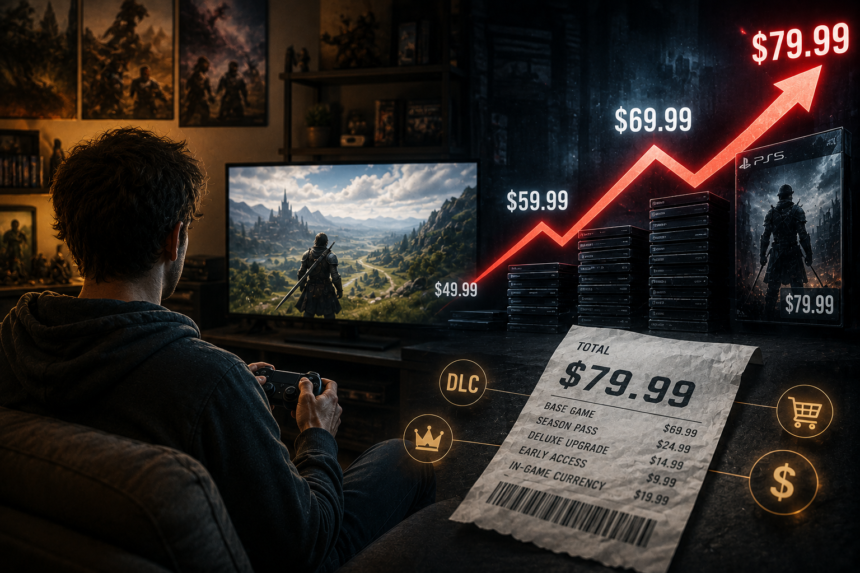
Against this backdrop, a striking fact often gets lost: the baseline price of premium games stayed remarkably stable for a very long time, even as the cost to make them multiplied and as inflation eroded the value of money across the wider economy. For years, publishers held prices steady, absorbing rising costs or offsetting them through other means. Viewed this way, recent price increases are less a sudden greed grab than a delayed correction, the base price finally moving after standing still while nearly every other cost rose around it. Whether or not that justifies any particular increase, it is important context. Games did not just get more expensive; they spent decades resisting getting more expensive at all.
The Base Price Is Not the Real Price
Focusing on the headline number of a single game obscures the larger picture, because the true cost of gaming extends well beyond that. To play at all, you need hardware, which represents a significant upfront and periodic expense. Many players also pay for online subscriptions to access multiplayer, for storefront memberships, and for the ever-present extras layered on top of games: cosmetic items, expansions, season passes, and in-game currencies.
For many players, these ongoing and supplementary costs dwarf the price of the game itself. A title with a modest sticker price can end up costing far more once its additional monetization is accounted for, while another with a higher base price might ask nothing further. This is why arguing purely about the base price can be misleading. The number on the box is only one input into a much larger equation, and a game’s advertised price often bears little relationship to what a player will actually spend engaging with it over time. Understanding the cost of the hobby means looking at the whole system, not just the initial purchase.
Are Games Actually Worth It?
Set against other entertainment, games make a strong case on pure value. Consider cost per hour, a rough but useful measure. A single cinema ticket buys a couple of hours of entertainment. A meal out, an evening. Many games, by contrast, offer dozens, sometimes hundreds, of hours of engagement for a one-time price. Measured by the sheer quantity of entertainment delivered per unit of money, games are among the most economical hobbies available, and even a higher-priced release can work out to a remarkably low cost per hour of enjoyment.
Of course, cost per hour is not the whole story. Not every hour is equally valuable, and a shorter game that moves you deeply may be worth more than a hundred hours of padding. Value is subjective, and what feels expensive to one person feels trivial to another depending on their income and how much the hobby means to them. But the common intuition that games are overpriced does not hold up well against the raw arithmetic. Compared with almost any other form of entertainment, the amount of experience a game provides for its price remains extraordinary. When people say a game is too expensive, they are usually expressing something other than a strict calculation of value.
What the Anger Is Really About
This is the heart of the matter. Much of the frustration around game prices is not actually about the base price being too high; it is about a breakdown of trust in how games are monetized. Players have grown wary because they have seen full-priced games arrive unfinished, ship with content carved out to sell separately, or lean on aggressive systems designed to extract continuous spending. When a game asks for a premium price and then keeps asking for more, or feels engineered to nudge players toward additional purchases, the resulting anger attaches itself to the price even though the price is not really the problem.
In other words, the discourse about video game prices is often a proxy for a deeper grievance about fairness and respect. Players do not mind paying for value; they mind feeling nickel-and-dimed, misled, or treated as a revenue stream to be optimized. A fairly priced, complete, respectfully sold game rarely provokes the same fury as a cheaper one riddled with manipulative monetization. The number matters far less than the sense of whether the transaction is honest. When trust is present, players pay gladly. When it is absent, every price feels like a provocation.
What the Debate Says About the Hobby
Step back, and the intensity of the price debate says something about how important gaming has become. People argue passionately about the cost of games because games matter to them, because for many the hobby is a central source of joy, community, and identity, not a trivial luxury. The heat is a sign of how much people care, and how much they have come to expect from a medium they love.
It also reflects a maturing relationship between players and an industry. As gaming has grown into a massive commercial enterprise, players have become more conscious of being customers, more attentive to how they are being sold to, and more willing to push back when practices feel exploitative. The price conversation is part of that larger negotiation over what a fair deal looks like between the people who make games and the people who love them. It is messy and often overheated, but underneath it is a healthy insistence that a hobby this meaningful deserves to be treated, and priced, with honesty.
Conclusion
Rising video game prices provoke fierce debate, but the sticker number is rarely the real issue. Prices are climbing largely because development costs have soared while base prices stood still for years, and by the measure of cost per hour, games remain among the best entertainment values around. The true cost of the hobby lies as much in hardware, subscriptions, and extra monetization as in any single purchase. Most importantly, the anger around prices is usually a proxy for a deeper concern about fairness and trust. Players will happily pay for games that respect them. What the price debate really reveals is how much they care, and how much they expect honesty in return.
Frequently Asked Questions
Why are video game prices going up?
Video game prices are rising mainly because development costs have exploded, with major titles requiring hundreds of developers and years of work. At the same time, base prices stayed flat for a very long time despite inflation, so recent increases are partly a delayed correction after decades of prices resisting any rise at all.
Are video games actually expensive compared to other entertainment?
By cost per hour, games are among the most economical forms of entertainment. A single game can provide dozens or hundreds of hours of engagement for a one-time price, far more than a cinema ticket or a meal out delivers. Even higher-priced releases often work out to a very low cost per hour of enjoyment.
What is the real cost of gaming beyond the game price?
The base price is only part of the cost. Gaming also involves hardware, online subscriptions, storefront memberships, and extras like cosmetics, expansions, and season passes. For many players these ongoing costs exceed the price of the game itself, so a game’s sticker price often bears little relation to total spending.
Why are players so angry about game prices?
Much of the frustration is not about the base price but about trust in how games are monetized. Players have seen full-priced games ship unfinished, sell carved-out content separately, or push aggressive spending systems. The anger attaches to price, but the real grievance is about fairness and feeling nickel-and-dimed.
Are games worth their price?
By raw value, most games are, given how much entertainment they provide per dollar. However, value is subjective, and a shorter, meaningful game can be worth more than a long, padded one. The common belief that games are overpriced usually reflects concerns about monetization and trust rather than a strict calculation of value.
What does the price debate reveal about gaming?
The intensity of the debate shows how important gaming has become, as a source of joy, community, and identity rather than a trivial luxury. It also reflects a maturing relationship in which players are more conscious of being customers and more willing to demand fair, honest treatment from the industry they support.