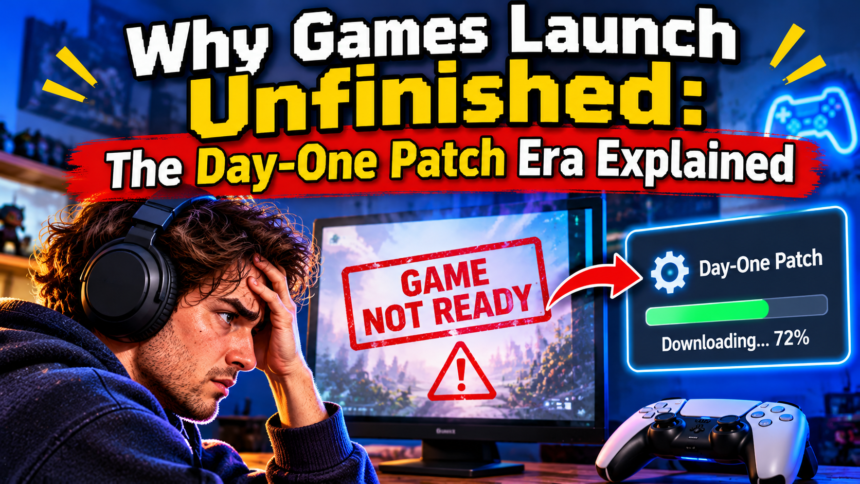

Games launch unfinished because modern development combines huge budgets, fixed release dates and the ability to patch problems later. Players now buy first and wait for fixes. Here is how that situation arose, who pays for it, and what could change it.
- What Does “Launching Unfinished” Actually Mean?
- How We Got Here: A Short History of Patching
- Why Games Launch Unfinished Today
- Who Pays the Price?
- Is Every Patch a Bad Sign?
- What Players Can Do About It
- What Could Change the Industry
- Frequently Asked Questions About Unfinished Game Launches
- Conclusion: Finished Is a Promise Worth Keeping
What Does “Launching Unfinished” Actually Mean?
Every player knows the feeling. You install a long-awaited game, and before you reach the main menu, a download bar appears. Then come the bugs: characters sliding across the floor, missing audio, a quest that refuses to progress.
Some of this is normal. No complex piece of software ships perfectly. But there is a difference between a few rough edges and a release that feels like a public beta with a price tag.
A Working Definition
A game launches unfinished when it is released with significant problems that the developer already knows about or should reasonably have expected. These can include crashes, broken systems, missing features, poor performance or content promised and not delivered.
The key word is significant. Minor glitches are a fact of life. A game that cannot be completed, or that runs so badly it spoils the experience, is a different matter.
Day-One Patches vs Genuine Fixes
Not every day-one patch signals a problem. Some are simply the last improvements made after the game was sent for physical manufacturing and certification. Others fix late-found issues that could not have been caught earlier.
The concern is when the patch becomes a crutch. If the disc or the initial download contains something that is not ready, and the patch is expected to rescue it, the process has stopped serving players.
Why This Is a Bigger Story Than It Seems
This is not just a complaint about bugs. It touches trust, pricing, consumer rights and the way games are made. It also shapes how players decide what to buy, when to buy it and whether to believe a trailer.
How We Got Here: A Short History of Patching
The present situation did not appear overnight. It grew from changes in technology, business and player expectations over several decades.
The Cartridge Era: One Shot Only
In the age of cartridges and early discs, a game had to be finished before release. There was no practical way to repair it afterwards. Once millions of copies were manufactured, the product was effectively fixed.
That constraint forced discipline. Teams tested heavily, cut ambitious features that could not be completed and accepted limits. Mistakes still happened, but they were permanent, so avoiding them mattered enormously.
Internet Connectivity Changes the Rules
When consoles gained reliable online connections, the economics shifted. Developers could distribute updates to everyone for almost nothing. A mistake that once meant a recall now meant a download.
That was a genuine benefit. Broken games could be repaired, balance could be adjusted and content could be added. The same flexibility, however, quietly weakened the pressure to be finished by a certain date.
Digital Distribution and Rolling Releases
Digital storefronts removed the last physical barrier. Updates could appear in hours, early access programmes invited players into unfinished builds, and the idea of a single launch moment softened.
In that world, “release” became less of a finish line and more of a milestone in a longer process. Some games now treat launch as the start of development in public.
Timeline Summary
| Era | Distribution | Fixing problems after launch | Effect on quality control |
|---|---|---|---|
| Cartridges | Physical only | Almost impossible | Strict, finished products |
| Early discs | Physical | Limited | Heavy testing, but errors persisted |
| Online consoles | Physical plus updates | Possible through patches | Gradual loosening of deadlines |
| Digital storefronts | Mostly digital | Fast and cheap | Launch seen as a stage |
| Live service era | Constant updates | Continuous | Ongoing development after release |
Why Games Launch Unfinished Today
Blaming laziness is easy and usually wrong. Most developers want to ship good work. The causes sit in the structure of the industry.
Rising Budgets and Larger Games
Big productions now involve hundreds of people, multiple studios and years of work. The scope of open worlds, detailed graphics and branching content multiplies the number of things that can break.
More content means more testing, and testing time does not scale as neatly as content does. A world ten times bigger does not simply need ten times the quality assurance. It needs far more because systems interact in unexpected ways.
Fixed Dates and Financial Pressure
Publishers plan around financial quarters, marketing campaigns and holiday seasons. A release date is often tied to shareholder expectations, retail agreements and advertising commitments that are expensive to move.
When a delay costs money and a patch is cheap, the arithmetic can push teams toward shipping. This is one of the main reasons that finished-enough can win over polished.
The Safety Net of Patches
Because fixes can be delivered quickly, risk feels smaller. A team may decide that a known problem is acceptable if it can be solved within weeks.
The flaw in this logic is that players do not experience the game in the future. They experience it on the day they pay, and first impressions are difficult to repair.
Crunch and Burnout
Long hours before launch are a well-known feature of the industry. Exhausted teams make more mistakes, and shipping under such conditions can leave bugs in place.
This is a human issue as much as a technical one. A rushed product is often the visible result of people being pushed past reasonable limits.
Marketing Outpaces Development
Trailers, previews and announcements frequently appear years before the game is complete. Once the public has been shown a vision, pressure builds to deliver it, even if the work is not ready.
This gap between promise and product is a recurring source of disappointment.
The Main Causes at a Glance
- Scale: bigger games contain more systems that can fail.
- Deadlines: release dates tied to money and marketing are hard to move.
- Patch culture: cheap updates reduce the fear of shipping imperfectly.
- Overwork: crunch increases errors and reduces polish.
- Early promotion: hype creates expectations before the game is ready.
Who Pays the Price?
When a game ships broken, the cost does not disappear. It is simply shifted, often onto the people least able to absorb it.
Players Become Testers
Customers who buy at launch often act as unpaid quality assurance. They find bugs, report them and wait for repairs, all after paying full price.
This changes the relationship. The buyer is no longer receiving a finished product but participating in the last stage of production.
Developers Absorb the Backlash
Teams are often blamed for decisions made far above them. Staff who spent years on a project may face harassment and disappointment when it launches in a poor state.
Meanwhile, post-launch repair work can mean even more long hours, continuing the cycle of pressure.
The Medium’s Reputation
Repeated rough launches erode confidence. Players become sceptical, wait for reviews, delay purchases or demand refunds. A single poor release can damage a studio’s name for years.
It can also affect the broader industry, because distrust spreads from one title to the next.
Smaller Studios and Honest Releases
Outside the biggest productions, many independent developers do the opposite. They release smaller games that are tightly scoped and carefully finished. This contrast shows that quality is a matter of choices and priorities, not just resources.
Is Every Patch a Bad Sign?
It would be unfair to condemn patching as a whole. The ability to fix games after release is one of the real advantages of the modern era.
The Good Side of Updates
Patches can repair mistakes, improve performance, add accessibility options and respond to community feedback. Several games have grown into far better experiences through years of attention.
The technology itself is not the villain. The question is how it is used and what promises are made.
When Early Access Is Honest
Early access can be a fair arrangement when it is clearly labelled, priced appropriately and supported with transparent communication. Players know they are joining a work in progress, and they choose to do so.
The problem arises when a fully priced release behaves like early access without admitting it.
Signs a Game Is Being Honest About Its State
- It clearly states what is and is not included.
- Its roadmap is specific and realistic.
- The developer communicates openly about problems.
- Refund or return options are easy to understand.
- Reviews from independent players match the marketing.
What Players Can Do About It
Individual players cannot change an industry alone, but collective habits matter. Spending is the strongest signal any audience has.
Smarter Buying Habits
- Wait for reviews. Give independent critics and early players a few days to report on the real state of the game.
- Check recent player feedback. Look for comments on performance and stability, not just opinions about the story.
- Be wary of pre-orders. Paying before release removes the incentive to prove quality.
- Know the refund policy. Understand what your store allows before you buy.
- Support finished games. Reward studios that deliver complete experiences.
- Give feedback constructively. Clear, specific bug reports help developers more than anger does.
Keeping Expectations Realistic
Patience has a limit. It is reasonable to expect some bugs in a large game, but it is not reasonable to accept a product that cannot be played. Knowing where that line sits helps you decide when to be forgiving and when to hold back.
Remembering the People Behind the Games
Criticise decisions, not individuals. Most developers are working within constraints they did not choose, and respectful feedback is more likely to be heard.
What Could Change the Industry
A better future is possible, and parts of it are already visible. Change will likely come from a mixture of business, culture and audience pressure.
Realistic Scheduling
Publishers that allow extra time for testing and polish often receive stronger reviews and healthier sales over the long term. Delays are painful in the short term, but a good reputation lasts.
Smaller, Better-Scoped Games
There is growing interest in games that do fewer things well. Tighter scope makes finishing easier and reduces the risk of a messy launch.
This trend fits a wider change in how players value their time, and it offers a practical alternative to the arms race of ever bigger worlds.
Better Transparency
Honest communication builds trust. Clear statements about what is ready, what is planned and what is uncertain give players the power to decide for themselves.
Healthier Working Conditions
Reducing crunch is both an ethical goal and a quality measure. Rested teams make fewer mistakes, and a sustainable schedule produces better games.
Frequently Asked Questions About Unfinished Game Launches
Why do so many games have bugs at launch?
Modern games are enormous and complex, with deadlines tied to business plans. The ability to patch later also makes teams more willing to ship with known problems.
What is a day-one patch?
It is an update released on or before the launch date. Some contain final improvements, while others fix serious problems that were not resolved in time for release.
Is it wrong to buy a game at launch?
Not necessarily. Many launches are smooth, and some players want to join the conversation early. The key is to check recent feedback and decide how much risk you are comfortable accepting.
Are unfinished launches a new problem?
Broken games have always existed, but the ease of patching has made it more common to ship with known issues. The scale and visibility of the problem are greater today.
Can I get a refund for a broken game?
It depends on the store and the region. Most major platforms have refund policies with conditions, so read them before purchasing.
Does early access mean a game is unfinished?
Yes, by definition. Early access is meant for games still in development, and a transparent programme explains what to expect.
What can developers do to avoid rough launches?
They can allow realistic testing time, limit scope, communicate openly and protect their teams from overwork. Many studios already follow these practices with positive results.
Conclusion: Finished Is a Promise Worth Keeping
Games launch unfinished because the incentives reward speed, the tools make fixes cheap and the audience has often been willing to wait. None of that is inevitable. Patches are valuable when they improve a good game, and harmful when they replace a missing one.
The practical takeaway: buy with information, reward honest releases and expect developers to be treated fairly. A finished game is a promise between makers and players, and the industry is stronger when it keeps it.