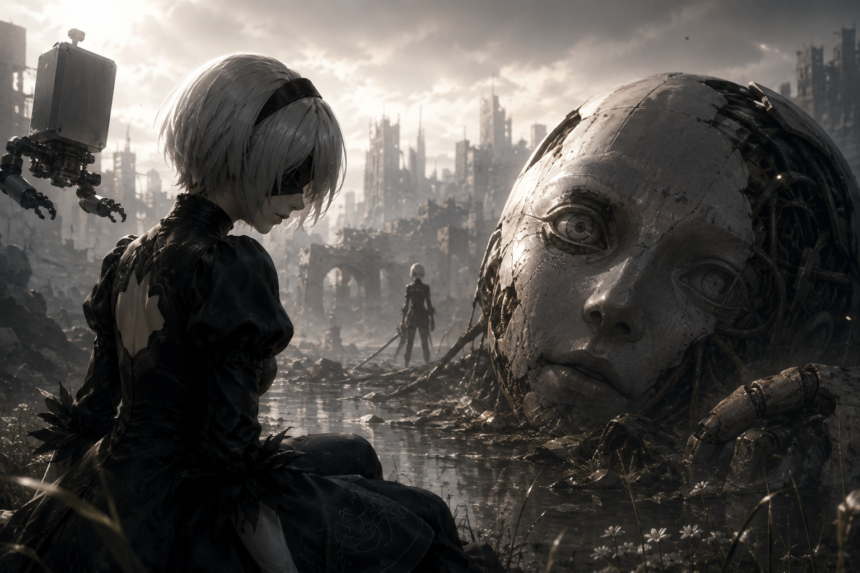

NieR: Automata looks, at first glance, like a stylish action game about a beautiful android fighting robots in a ruined world. It is that, but it is also one of the most philosophically ambitious games ever made, a meditation on consciousness, grief, free will, and whether existence can mean anything at all in a world stripped of purpose. At the center of it is 2B, a combat android whose calm exterior hides one of the medium’s most quietly tragic characters. To understand 2B is to understand what the whole game is asking: can a being built to obey, and designed to forget, still find something like meaning?
- Key Takeaways
- Who 2B Really Is
- YoRHa and the Machinery of Forced Forgetting
- 9S and the Other Half of the Tragedy
- Can an Android Feel? The Central Question
- The Machines’ Search for Meaning
- Yoko Taro and the Weight of Existence
- The Endings as Layers of Meaning
- Why 2B Endures
- Where 2B Fits Among Gaming’s Other Tragic Figures
- Conclusion
- Frequently Asked Questions
This 2B NieR Automata analysis explores her character, the design of the YoRHa program that shapes her, the philosophy of director Yoko Taro, what the game says about androids and emotion, and how its famous multiple endings deepen the question of meaning without memory. Spoilers are discussed throughout.
Key Takeaways
- 2B is a combat android whose composed surface conceals grief, duty, and a painful secret about her purpose.
- NieR: Automata uses its androids and machines to ask whether artificial beings can possess genuine emotion and meaning.
- Director Yoko Taro builds the game around existential questions of purpose, free will, and repeated loss.
- The multiple endings are not alternatives but layers, each revealing more about the characters and themes.
- The game argues that meaning can be chosen and created even in a world that provides none by default.
Who 2B Really Is
On the surface, 2B is a disciplined, emotionally reserved combat android who insists that androids should not feel, or at least should not show it. She fights alongside the more openly curious 9S, maintaining a cool distance and a strict adherence to duty. But this composure is a mask over something much heavier. As the game unfolds, it reveals that 2B carries a secret burden connected to her true function, one that recontextualizes her entire personality and turns her stoicism into something closer to grief management.
Without spoiling the specifics beyond what’s necessary, 2B’s reserve is not the absence of emotion but the suppression of it, a survival strategy for coping with a role that demands she repeatedly lose someone she cares about. Her insistence that “emotions are prohibited” is less a rule she believes than a wall she has built to keep from breaking. This is the tragic engine of her character: an artificial being who was designed to feel nothing, feeling everything, and forcing herself to hide it in order to keep functioning. The gap between her calm exterior and her interior pain is where her humanity lives.
What makes this more than a simple “sad robot” trope is how deliberately the game withholds the reason for her behavior. For most of a first playthrough, 2B reads as cold, even harsh, and only in retrospect does that coldness reveal itself as the most understandable reaction imaginable to what she’s actually going through. The game asks you to judge her before it lets you understand her, and then asks you to sit with how wrong that first judgment was.
YoRHa and the Machinery of Forced Forgetting
2B’s specific tragedy can’t be separated from the organization she serves. YoRHa, the android military unit fighting on behalf of a fled and largely absent humanity, is built around a structure that requires certain androids to carry out an execution duty against their own comrades whenever those comrades become compromised, and then to have their memory of it wiped afterward so they can keep functioning without the psychological weight of what they’ve done.
This is the machinery underneath 2B’s stoicism, and it reframes the entire premise of the game. She isn’t simply a soldier who has seen hard things and learned to compartmentalize the way a human veteran might. She is repeatedly made to forget the hardest thing she does, over and over, only for the emotional residue to remain even after the specific memory is gone. It’s grief with the cause erased but the weight left intact, which is arguably crueler than remembering would be. The game’s title itself gestures at this: a story about beings who lose the one thing, memory, that would let them make sense of their own suffering.
This detail also complicates the idea of identity in the game. If your memories are periodically erased by design, how much of “you” persists from one cycle to the next? 2B’s answer, largely unconscious and unchosen, is that something persists anyway, an emotional throughline that survives even when the facts that created it don’t. That’s the game’s quiet argument about consciousness: memory shapes identity, but it may not be the only thing that does.
9S and the Other Half of the Tragedy
2B’s tragedy only lands fully in contrast with 9S, the scanner-type android she’s paired with for most of the game. Where 2B is guarded and clipped, 9S is curious, talkative, and emotionally open in a way YoRHa doesn’t really permit. He asks questions 2B is forbidden from answering, forms an attachment she can’t reciprocate honestly, and spends much of the story moving toward exactly the knowledge she’s been built to keep from him.
Their dynamic works because it inverts the usual protector narrative. 2B isn’t just protecting 9S from the machines and the war, she’s protecting him from a truth that would break something between them, and every act of closeness between the two characters is shadowed by that withheld information. It turns their relationship into one of the more quietly devastating pairings in the medium, not because of any single dramatic scene, but because of how much restraint and how much longing are compressed into ordinary lines of dialogue between two characters who are, technically, not supposed to feel any of it.
Can an Android Feel? The Central Question
NieR: Automata is obsessed with the question of whether its machines and androids are truly conscious or merely simulating consciousness, and it refuses to let the player rest comfortably on either answer. The androids insist they do not have emotions, yet they clearly grieve, love, fear, and despair. The enemy machines, supposedly mindless, begin forming families, religions, and philosophies, groping toward meaning in ways that are heartbreakingly human.
The game’s provocative suggestion is that the distinction may not matter. If a being behaves as though it feels, suffers as though it suffers, and seeks meaning as though meaning is real to it, then on what grounds do we deny it an inner life? By blurring the line between authentic and artificial emotion, the game turns 2B and her companions into a mirror for us. Human consciousness, too, is arguably just patterns and processes, electrical signals firing in learned configurations, and yet we do not doubt our own feelings. The game asks why we should doubt theirs, and it never lets us fully answer.
This question echoes a broader pattern in character-driven games that use artificial or non-human minds to interrogate what consciousness actually requires. It’s worth reading alongside a very different but thematically related figure, GLaDOS: The Funniest Villain Who Was Never Really Joking, another artificial intelligence whose performance of emotion, in her case cruelty disguised as comedy, raises the same uncomfortable question about where performance ends and something real begins.
The Machines’ Search for Meaning
It’s worth separating the machine lifeforms from the androids, because the game treats their journey toward meaning differently, and arguably more movingly. The androids at least have a war to justify their existence, however hollow that justification eventually proves. The machines have nothing handed to them at all, no original programming that points toward family, faith, or philosophy, and yet across the game’s world they build all three anyway, clumsily and sincerely.
Small machine communities form makeshift villages. Individual machines fall in love, imitate human customs they don’t fully understand, and grapple, in their own broken syntax, with questions of an afterlife and a creator. None of this was asked of them. It’s the game’s clearest illustration of its central thesis: meaning isn’t handed down from a design document, it’s something that emerges wherever there’s something capable of asking why, regardless of what that something is made of. The machines’ search is, in some ways, more moving than the androids’ because it’s more obviously unearned, uninstructed, and entirely their own.
Yoko Taro and the Weight of Existence
The philosophical density of NieR: Automata is inseparable from its director, Yoko Taro, known for building games around bleak, existential themes delivered with startling emotional force. His work repeatedly circles questions of why we go on in the face of suffering, whether life has inherent purpose, and how beings cope with endless cycles of loss and violence.
In Automata, these questions are literalized. The androids fight an endless war whose original purpose has been hollowed out, following orders whose meaning has evaporated. They are, in a sense, going through motions in a universe that offers no built-in reason to continue. This is existential philosophy rendered as gameplay: characters confronting a void of meaning and having to decide, again and again, whether to keep living anyway. Yoko Taro does not offer easy comfort, but he does not settle for pure nihilism either, and that tension gives the game its peculiar power.
This isn’t a new preoccupation for him. His earlier work in the Drakengard and NieR series circles the same territory, characters trapped in cycles they didn’t choose, doing terrible or thankless things for reasons that erode under scrutiny. What makes Automata his sharpest expression of it is the android framing itself: a body built for a purpose, a mind capable of questioning that purpose, and no external authority left to appeal to for an answer. It’s existentialism with the safety net of “well, at least a human made this choice” removed entirely.
The Endings as Layers of Meaning
NieR: Automata is famous for having many endings, but they are widely misunderstood. They are not a menu of alternative outcomes where you pick your favorite. They are sequential layers, each requiring you to replay and re-experience the story from new perspectives, gradually peeling back the game’s meaning until the full picture emerges.
Replaying as revelation
Playing again as a different character reveals that events you thought you understood meant something entirely different from another point of view. The repetition is thematic: it makes you, the player, experience the cycles of loss and re-understanding that define the characters’ existence. The game uses its own structure to argue that meaning is not found in a single pass but built through return, perspective, and persistence.
This structural choice does something few games attempt. It makes empathy a mechanical requirement rather than an emotional suggestion. You cannot simply be told that 2B’s coldness conceals grief, you have to sit through the same events again, now armed with context you didn’t have the first time, and watch your own earlier judgment of her collapse in real time. The form of the game is doing the philosophical work, not just the writing.
The final ending and chosen meaning
The celebrated final ending crystallizes the game’s answer to its own despair. In it, the game confronts the player directly with the pointlessness of continuing and then asks whether they will choose to go on anyway, ultimately framing that choice, and an act of genuine sacrifice for others, as the source of meaning. The message is not that the universe hands us purpose, but that we create it: through connection, through choosing to persist, through what we are willing to give for one another. In a game about beings designed to forget, the conclusion insists that meaning can still be made, deliberately, in defiance of a meaningless world.
Why 2B Endures
2B has become an enduring icon, and while her striking design is part of that, it undersells her. What makes her last is the depth beneath the surface: a character who embodies the game’s every theme, an artificial being suppressing real grief, performing duty in a purposeless war, quietly loving in a world that tells her love is not permitted for something like her. She is the human question the game keeps asking, given a face and a sword.
Her tragedy resonates because it is, at bottom, a heightened version of our own. We too are beings who did not choose our circumstances, who face loss we cannot prevent, who must decide whether to keep going without any guarantee that it matters. 2B does keep going, and in her quiet persistence the game locates something like hope, not the easy kind, but the earned kind that survives full knowledge of the darkness.
Where 2B Fits Among Gaming’s Other Tragic Figures
2B belongs to a specific lineage of video game characters whose outward composure conceals a private, unspoken cost, figures defined less by what they say than by what they’ve decided never to say. That same tension between a duty performed and a self quietly buried underneath it shows up across other character studies worth reading alongside this one. Jesse Faden and the Cost of Sharing Your Own Head explores a different kind of forced coexistence with something not entirely your own, while Senua and the Difference Between a Curse and a Diagnosis takes on the same question of what’s real versus what’s imposed from a very different, more grounded angle. Both, like 2B, use their protagonist’s interior life as the actual subject of the game, with the action and spectacle serving as the delivery mechanism rather than the point.
Conclusion
2B is far more than the stylish android she appears to be. She is the emotional and philosophical heart of NieR: Automata, a character whose suppressed grief and dutiful persistence embody the game’s deepest questions about consciousness, purpose, and meaning without memory. Through her, through the machines she fights, and through the game’s layered endings, Automata arrives at a hard-won conclusion: that even in a world that provides no inherent purpose, beings who feel, connect, and choose to go on can create meaning for themselves. That is what NieR asks, and 2B, in her quiet, aching endurance, is its answer.
Frequently Asked Questions
Who is 2B in NieR Automata?
2B is a combat android and one of the main protagonists of NieR: Automata. Outwardly disciplined and emotionally reserved, she hides a heavy secret tied to her true purpose within the YoRHa military structure. Her calm exterior masks deep grief, making her a quietly tragic figure who embodies the game’s central questions about emotion and meaning.
Do androids have real emotions in NieR Automata?
The game deliberately refuses a clear answer. Androids claim they do not feel, yet clearly grieve, love, and despair, while supposedly mindless machines develop families and beliefs of their own. NieR: Automata suggests the distinction between real and simulated emotion may not matter, using its characters as a mirror for how we understand our own consciousness.
Why does 2B say emotions are prohibited?
2B’s insistence that emotions are forbidden is less a belief than a defense mechanism. It is a wall she builds to cope with a role that forces her to repeatedly lose someone she cares about, and then to have that memory wiped afterward. Her stoicism is not the absence of feeling but the suppression of it, which is the tragic core of her character.
What is 2B’s relationship with 9S?
2B is paired with 9S, a curious, emotionally open scanner-android, for most of the story. Her guarded behavior toward him is driven by a secret she’s forbidden from revealing, one that would fundamentally change how he sees both her and their entire mission. Their bond is one of the game’s most quietly devastating threads precisely because of what she can’t say to him.
How do the multiple endings in NieR Automata work?
The endings are not alternative choices but sequential layers. Reaching the true story requires replaying from different perspectives, each revealing new meaning behind events you thought you understood. The repetition is thematic, making the player experience the cycles of loss and re-understanding that define the characters’ existence.
What is the meaning of NieR Automata’s ending?
The final ending confronts the player with the apparent pointlessness of continuing and then frames the choice to go on, along with an act of sacrifice for others, as the source of meaning. Its message is that purpose is not given by the universe but created through connection, persistence, and what we give for one another.
Is NieR Automata a philosophical game?
Yes. Directed by Yoko Taro, NieR: Automata is built around existential themes of purpose, free will, consciousness, and coping with endless loss. It renders philosophy as gameplay, placing characters in a purposeless war and asking, repeatedly, whether they will choose to keep living anyway, without offering easy comfort.