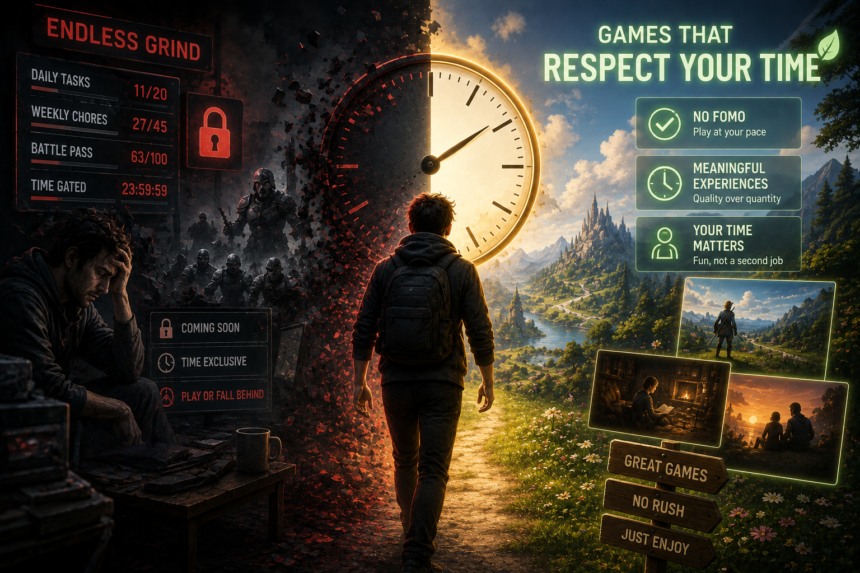

For years the dominant measure of a game’s worth was size. Bigger maps, longer campaigns, more hours of content, more collectibles to hunt, more boxes to check. “How long is it?” became one of the first questions players asked, and value was calculated in raw hours. But a quiet shift is underway. A growing number of players and developers are rediscovering the appeal of games that are shorter, tighter, and confident enough to end before they overstay their welcome. After a long era of bloat, games that respect your time are making a slow, welcome comeback, and the reasons why say a lot about how our relationship with the hobby is maturing.
This piece explores the shorter video games trend: why bloated games became the norm, what tighter design offers, why busy adults increasingly crave games they can actually finish, and what this shift reveals about how we measure a game’s worth.
Key Takeaways
- The shorter video games trend reflects growing appreciation for tight, focused design over sheer length.
- The obsession with length arose from equating hours of content with value for money.
- Bloated games often pad their runtime with filler that dilutes their best ideas.
- Busy adult players increasingly value games they can realistically start and finish.
- A game’s worth is better measured by the quality of its hours than by their quantity.
How Games Got So Long
The inflation of game length did not happen by accident. It grew out of a simple, persuasive idea: that a higher price demands more content to justify it. As games grew more expensive to make and to buy, “hours of gameplay” became a convenient way to signal value. A game that offered a hundred hours felt like a better deal than one that offered ten, regardless of whether those hundred hours were actually enjoyable. Length became a marketing point, and reviews and player discussions reinforced it by treating runtime as a core measure of worth.
The open-world formula accelerated this. Vast maps studded with icons, side quests, and collectibles could generate enormous amounts of “content” relatively efficiently, and they reliably produced the big hour counts players had learned to expect. The trouble is that quantity and quality are not the same thing, and much of this generated content amounted to busywork: repetitive tasks and map-clearing that inflated the runtime without deepening the experience. Games got longer, but not always richer. Length became a number to hit rather than a natural consequence of what the game had to say.
The Hidden Cost of Bloat
The problem with padding a game to reach an impressive length is that it dilutes the very things that make the game good. A tightly designed experience keeps every hour meaningful, with pacing that builds, ideas that develop, and no dead weight. A bloated one stretches its good ideas thin across a runtime they cannot support, filling the gaps with filler that players slog through rather than savor.
When more becomes less
This is how a longer game can end up being a worse one. The repetitive side content that pads out a sprawling adventure does not add to its best moments; it separates them, burying the memorable peaks under hours of forgettable valley. Players increasingly recognize the specific fatigue of a game that has stopped respecting their time, the tedium of clearing yet another samey objective, the sense of an experience that has outlived its ideas but refuses to end. A game can genuinely be too long, not because long games are inherently bad, but because padding actively degrades the parts that matter. When the goal becomes hitting an hour count rather than serving the experience, more becomes less.
Why Busy Players Want Games They Can Finish
Much of the appetite for shorter games comes from a simple demographic reality: the audience has grown up. Many players who once had endless free time now have jobs, families, and responsibilities that leave only a few hours a week for gaming. For these players, a hundred-hour game is not an exciting value proposition; it is a daunting, often impossible commitment, one they may never realistically finish.
For a time-constrained adult, a tight game that delivers a complete, satisfying experience in a modest number of hours is enormously appealing. It can actually be started and finished, savored and completed, within the constraints of a real life. There is a specific satisfaction, increasingly precious to busy players, in reaching the end of a game rather than abandoning it half-finished on the growing pile of things they meant to get to. Shorter games offer the full arc of an experience, the beginning, middle, and end, to people who simply do not have eighty hours to give. As this segment of the audience has grown, so has the demand for games that fit into the shape of an adult life, and developers have begun to notice.
The Case for Tight Design
Beyond convenience, there is a genuine artistic case for shorter, focused games. In most other art forms, we do not assume that longer is better. A tight, economical film is often superior to a bloated one; a lean novel can outclass a sprawling one; concision is widely recognized as a virtue. A work that says exactly what it needs to say and then stops demonstrates confidence and craft. Games are only now fully reclaiming this principle after years of pressure toward maximal length.
A shorter game can afford to make every moment count. It can maintain a level of quality and intentionality across its whole runtime that a longer game struggles to sustain. It can deliver a focused emotional or thematic experience without the dilution of filler. Many of the most acclaimed and beloved games of recent years have been relatively compact, precisely because their brevity let them stay sharp, memorable, and complete. Tight design is not a limitation to apologize for; it is often what makes an experience resonate, and its return is a sign of a medium growing more confident in the value of restraint.
Rethinking How We Measure Worth
Underneath the shorter video games trend is a healthier way of thinking about value. For too long, worth was measured in quantity: hours of content, size of map, number of things to do. This shift invites us to measure it in quality instead, by how good the hours are rather than how many. A ten-hour game that is excellent throughout offers more real value than a fifty-hour game that is mediocre for forty of them, even though the raw arithmetic of “cost per hour” would say otherwise.
This reframing matters because it changes what we ask of games and what developers are rewarded for making. When players prize quality over quantity, studios are freed to build tighter, more intentional experiences instead of padding to hit a number. It restores the idea that a game should be exactly as long as it needs to be, no more and no less, and that ending at the right moment is a strength rather than a shortfall. The comeback of shorter games is, at heart, the comeback of this more mature standard, one that values the experience over the metric.
Conclusion
The slow return of games that respect your time is one of the more encouraging developments in modern gaming. After years in which bigger was reflexively treated as better, players and developers are rediscovering the value of tight, focused design, of games confident enough to be exactly as long as they should be and then to end. Driven by an audience with less free time and a growing recognition that padding degrades rather than enhances, the shorter video games trend reflects a maturing hobby learning to measure worth by quality rather than quantity. A great game does not need to be enormous. It needs to be good, and to know when to stop.
Frequently Asked Questions
Why are shorter video games becoming popular?
The shorter video games trend is growing because players increasingly value tight, focused design over sheer length. Busy adults want games they can realistically finish, and many have recognized that padding degrades an experience. This has created strong demand for compact games that deliver a complete, satisfying arc without filler.
Why did video games become so long in the first place?
Games grew longer largely because length became a way to signal value for money, with more hours seeming like a better deal. The open-world formula accelerated this by generating large amounts of content efficiently through maps full of side quests and collectibles, pushing runtime up even when the extra content was repetitive busywork.
Can a video game be too long?
Yes. A game can be too long when it pads its runtime with filler that dilutes its best ideas. Repetitive side content separates and buries the memorable moments, creating fatigue rather than enjoyment. Length itself is not the problem, but padding that degrades the parts that matter genuinely makes a game worse.
Why do busy players prefer shorter games?
Players with jobs, families, and limited free time often find long games a daunting or impossible commitment. A tight game that delivers a complete experience in a modest number of hours can actually be started and finished within a real schedule, offering the full arc of a story without requiring dozens of hours they do not have.
Are shorter games worse value for money?
Not necessarily. Value is better measured by the quality of a game’s hours than their quantity. A shorter game that is excellent throughout can offer more genuine value than a much longer one that is mediocre for most of its runtime, even if a simple cost-per-hour calculation suggests otherwise.
Is tight, shorter design actually better?
It often is, for the same reasons concision is valued in film and literature. A shorter game can make every moment count, sustain quality across its whole runtime, and deliver a focused experience without dilution. Many acclaimed recent games are relatively compact precisely because their brevity keeps them sharp, memorable, and complete.