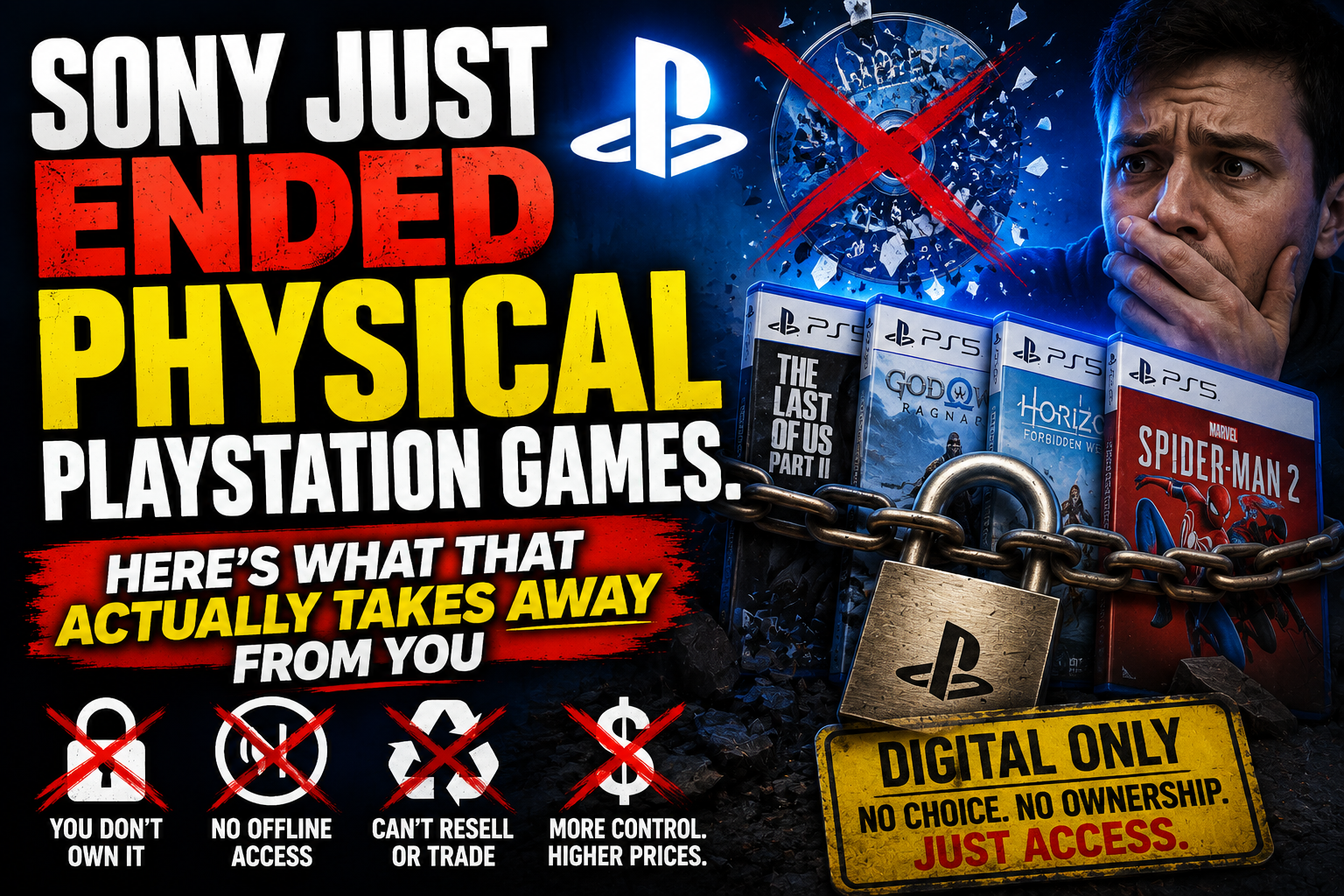

On July 1st, Sony confirmed something the industry had been quietly circling for years: starting in January 2028, no new PlayStation game will ship on a disc. Existing physical releases and titles already in development keep their planned disc versions, but from that date forward, buying a new PlayStation game will mean buying a license to access it, not an object that sits on a shelf.
- The Trend, Briefly
- The Question Nobody’s Really Asking
- What Happens to a Game With No Disc Left to Find
- The Economics Quietly Shaping the Trend
- A Wider Shift: Ownership Becomes Access
- The Uncomfortable Part: Preservation Was Never the Industry’s Problem to Solve Alone
- What This Trend Says About Us
- Conclusion: A Shelf That Stops Filling Up
The reaction split along a familiar line almost immediately. One side called it an overdue acknowledgment of how people actually buy games now. The other called it the quiet erasure of the only form of game ownership that’s ever been legally durable. Both reactions are grounded in something real, and the gap between them is worth sitting with, because this isn’t really a story about discs. It’s a story about what happens to a medium once nothing physical is left standing between a purchase and a publisher’s ability to take it back.
The Trend, Briefly
Sony’s own numbers are the clearest explanation for the timing: <cite index=”8-1″>nearly 80% of full-game sales on PS4 and PS5 are already digital, up from just 13% when the PS4 launched in 2013</cite>. Physical media hasn’t been the default way most people buy PlayStation games for years — this announcement is Sony formalizing a shift that had, by its own data, already happened.
That framing is accurate as far as it goes. It’s also incomplete, because <cite index=”10-1″>Sony’s decision was immediately characterized by preservation groups as anti-consumer, with genuine concern about the impact on retailers, publishers, and the historical record</cite>. The story isn’t just “physical media is dying because people stopped buying it.” It’s what specifically gets lost in the gap between a disc that will always run and a license that exists only as long as a company chooses to keep the lights on.
The Question Nobody’s Really Asking
Most of the coverage of Sony’s announcement has settled into a familiar shape: convenience versus nostalgia, digital natives versus collectors clinging to shelves. That framing misses the more interesting question underneath it — not whether physical media is disappearing, but what it was actually protecting against, and who’s left holding that risk once it’s gone.
It’s Not (Just) About Nostalgia for Shelves
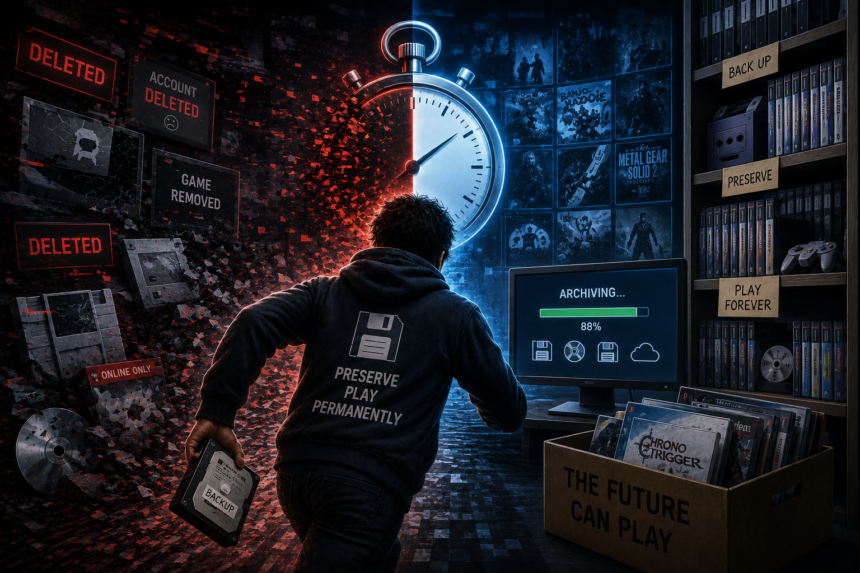
It’s tempting to file this under simple sentimentality — the same instinct that makes people miss cassette tapes or VHS clamshells. But a disc was never just an aesthetic object. It was, functionally, a guarantee. Once a game shipped on a disc, no later licensing dispute, server shutdown, or corporate decision could reach back and take that specific copy away from the person who bought it. <cite index=”9-1″>Games that received a physical release prior to a digital delisting can generally continue to be played legally, while titles without a physical release that get delisted are frequently only obtainable through piracy</cite>. The disc wasn’t nostalgia. It was the one part of the transaction a publisher couldn’t quietly reverse.
The Number Sony Is Actually Reacting To
It’s worth being fair to Sony’s actual position here, because the economics genuinely point one direction. A company optimizing for the audience it can measure — the 80% already buying digitally — has a straightforward business case for retiring a manufacturing and distribution pipeline that’s serving a shrinking minority. The problem isn’t that this logic is wrong. It’s that it treats physical media purely as a purchasing preference, when for a specific, smaller group — collectors, archivists, and anyone thinking decades rather than quarters ahead — it was functioning as something closer to infrastructure.
What Happens to a Game With No Disc Left to Find
This is where the story stops being about consumer convenience and starts being about what actually happens to a piece of creative work once every copy of it depends on a server, a license agreement, or a corporate decision that could change at any time.
The Delisting Problem Nobody Notices Until It’s Their Game
Digital delisting isn’t hypothetical or rare. <cite index=”9-1″>There’s an entire, actively maintained public record of video games that have been pulled from every digital storefront simultaneously, commonly due to expiring copyright licenses, with titles lacking a physical release often only recoverable through piracy afterward</cite>. <cite index=”11-1″>Every year, hundreds of games disappear from digital storefronts due to licensing disputes, server shutdowns, or platform removals — for preservationists, this represents nothing less than a cultural crisis, with entire chapters of gaming history disappearing overnight</cite>. None of this required Sony’s announcement to be true. What Sony’s announcement does is remove the one reliable safety net — a disc already in someone’s hands — that kept a delisted digital-only game from becoming genuinely, permanently unrecoverable through legal means.
When Preservationists Start Talking About Piracy Out Loud
The clearest signal of how seriously preservation organizations are taking this shift is what they’re now willing to say publicly. <cite index=”10-1″>Frank Cifaldi, founder of the Video Game History Foundation, has described piracy as effectively the only remaining form of media preservation available for games, after efforts to establish a legal path with publishers met sustained resistance</cite>. <cite index=”13-1″>The same organization has directly criticized industry trade groups, including the ESA, for repeatedly opposing legal reforms that would make preservation easier, arguing that asking a museum to download a copy of a major release and simply hope it still runs in fifty years isn’t a real preservation strategy</cite>. When the people whose actual job is legal archival start describing piracy as their most viable option, that’s a strong indication the current system was never built with long-term preservation in mind at all.
The Economics Quietly Shaping the Trend
None of this is happening because Sony wants to make games harder to preserve. There’s a specific business logic behind the shift, and it’s worth taking seriously rather than dismissing as pure corporate indifference.
Why 2028, Not Tomorrow
The eighteen-month runway matters. <cite index=”12-1″>Sony has confirmed that support for discs already released, and for titles currently in development, will continue rather than being immediately discontinued</cite> — this isn’t a decision to erase existing physical libraries, only to stop producing new ones. Manufacturing, packaging, and distributing physical discs is real infrastructure with real costs, serving a shrinking slice of a market that’s already overwhelmingly moved on. From a pure balance-sheet perspective, retiring that pipeline in favor of a channel 80% of customers already prefer isn’t an unreasonable call. The tension isn’t that this decision makes bad short-term business sense. It’s that the group absorbing the long-term cultural cost — future players, archivists, historians — isn’t the group whose preferences are driving the decision.
A Wider Shift: Ownership Becomes Access
Step back from PlayStation specifically, and this announcement looks less like an isolated policy change and more like gaming catching up to a shift that’s already reshaped how we relate to music, film, and television.
The Pattern This Fits Into
Nobody owns a physical copy of most of what they stream anymore, and the entertainment industry made peace with that shift years ago, largely because the convenience case was overwhelming and the average person wasn’t thinking about what happens when a title quietly disappears from a catalog. Games are arriving at the same place, just later, and with one meaningful difference: <cite index=”12-1″>the PlayStation Store has already deleted more than 550 movies from purchased libraries in a single sweep, a scale of removal that would be unthinkable for a physical shelf</cite>. A movie you streamed and lost access to is an inconvenience. A game you can no longer legally access, with no path back to it even for someone who paid for it in good faith, is a different kind of loss — closer to a piece of the medium’s history simply ceasing to exist for anyone who didn’t already download it somewhere unofficial.
The Uncomfortable Part: Preservation Was Never the Industry’s Problem to Solve Alone
This is where the story stops being just about one company’s decision and becomes worth sitting with a little longer.
The Case for Sony’s Position
There’s a real argument that Sony is being treated unfairly here for simply acknowledging where its market already is. The company isn’t retroactively deleting anyone’s existing physical library, and it’s giving the industry an eighteen-month window rather than an overnight cutoff. If the goal is matching supply to actual demand, this is a company doing exactly that, and doing it with more advance notice than several of its own past digital storefront closures received.
The Case for Concern
The harder argument is that Sony’s decision, whatever its internal logic, removes a safety net that the entire preservation ecosystem was quietly relying on without ever formally being responsible for maintaining it. <cite index=”13-1″>The Video Game History Foundation has been explicit that the industry needs to meaningfully engage with this problem, rather than leaving cultural heritage institutions to invent ad hoc technical workarounds for a challenge the industry itself created</cite>. Nobody designed the current system to preserve games long-term. It worked, imperfectly, because physical discs existed as a byproduct of how games used to be sold — not because anyone built preservation into the plan on purpose. Removing that byproduct doesn’t just end an old format. It exposes how little was actually built to replace what the format was quietly doing.
What This Trend Says About Us
Every shift toward digital-only access gets sold, reasonably, as a story about convenience — and for the overwhelming majority of players, in the overwhelming majority of moments, that’s exactly what it is. Nobody buying GTA VI at launch is thinking about whether a museum will be able to run it in 2076. That’s not a failure of attention. It’s just not the timescale most purchases are made on.
But the aggregate effect of an entire industry making decisions on that timescale, purchase by purchase, quarter by quarter, is a medium that’s remarkably bad at holding onto its own history compared to film, music, or print — not because games matter less, but because almost nothing about how they’re currently sold was built with permanence in mind. Sony’s announcement doesn’t create that problem. It just removes one of the last accidental protections against it.
Conclusion: A Shelf That Stops Filling Up
Sony’s decision is defensible on its own terms, and the backlash to it is justified on different terms entirely — both things can be true at once, and pretending otherwise flattens a genuinely complicated shift into a simpler story than it actually is. What’s really ending in 2028 isn’t a manufacturing process. It’s the last widely available, legally durable proof that a game you bought stays yours regardless of what happens to the company that sold it to you.
The disc was never really about the plastic. It was about being the one part of a purchase that a boardroom decision, years later, couldn’t quietly reach back and undo. Whatever replaces that guarantee — better preservation law, industry cooperation with archivists, or simply nothing at all — is being decided right now, mostly by default, mostly without anyone framing it as the decision it actually is.
This article is part of an ongoing series looking at gaming industry trends through a reflective lens — not just what’s changing, but what those changes reveal about the people playing.