
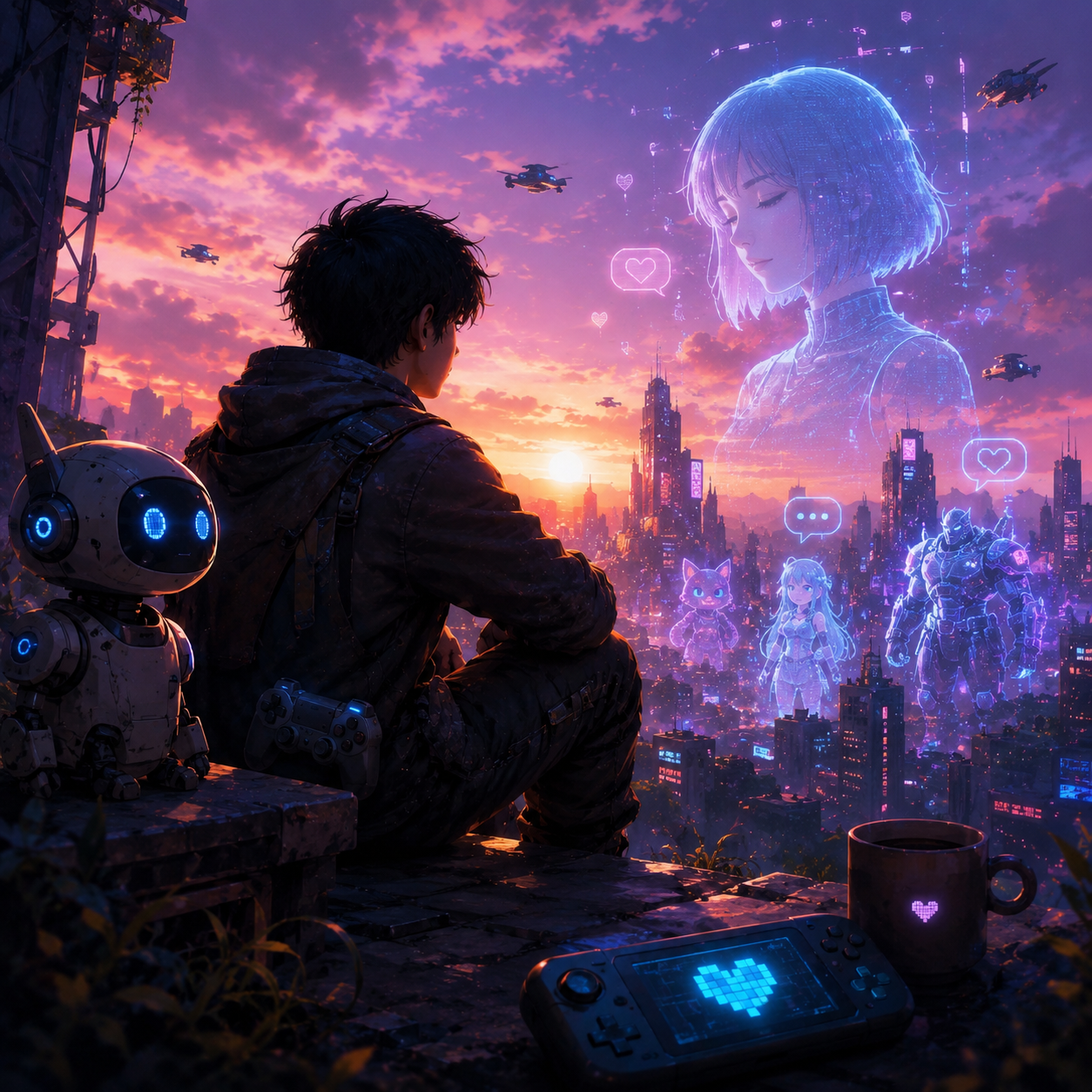

Somewhere between the last major console generation and this one, a strange thing happened: video game companies stopped treating “talking to a character” as a scripted event and started treating it as an open-ended relationship. In 2026, you can walk into a virtual tavern, insult the bartender, and have him remember it — and hold a grudge — days later. You can build a friendship with an NPC who forms opinions about you based on nothing but how you’ve actually treated them, not a dialogue tree you clicked through.
- The Trend, Briefly
- The Question Nobody’s Really Asking
- What Game Designers Have Learned (Sometimes the Hard Way)
- The Economics Quietly Shaping the Trend
- A Wider Shift: Games Adjusting to Players, Not the Other Way Around
- The Uncomfortable Part: Are We Outsourcing Connection?
- What This Trend Says About Us
- Conclusion: A Trend Worth Watching Honestly
This isn’t a distant sci-fi promise anymore. It’s shipping, right now, in dozens of titles. And while most coverage of this shift focuses on the technology — the language models, the latency, the hardware arms race — I want to focus on something the tech articles tend to skip: what does it mean that so many players, across so many different games, are choosing companionship as the feature they actually want?
The Trend, Briefly
For years, AI-powered NPCs were mostly tech demos — impressive in a trailer, forgettable in practice. Even by 2026, it remained difficult to name a single game people actually played specifically because of its AI NPCs, since the cost of running inference for every player conversation created a real financial disincentive for studios to lean into the feature. Handwritten dialogue trees are still cheaper, more predictable, and easier to test.
But that’s changing quickly. By mid-2026, NVIDIA’s ACE platform — which gives NPCs real-time conversational responses — had shipped in roughly a dozen titles, while modding communities had already proven the concept years earlier by replacing static dialogue in older games with dynamic, LLM-driven companions. Games like Wanderfolk have built entire systems around it: every villager runs on persistent memory, tracks a reputation score for the player, and spreads gossip through a social network, to the point that a bad reputation can get a player banished from the village entirely.
And the demand side of this trend is just as striking. The global AI companion market, valued at roughly $37.7 billion in 2025, is projected to grow to nearly $436 billion by 2034, and a University of Bristol study found that the overwhelming majority of participants described their experience playing with AI-powered NPCs as both enjoyable and rewarding. This isn’t a niche curiosity anymore. It’s one of the fastest-growing categories in the entire industry.
The Question Nobody’s Really Asking
Most of the coverage around this trend stays technical: which chip architecture handles latency better, which studio’s memory system is more persistent, which game has the most convincing dialogue. Those are legitimate engineering questions. But they sidestep a more uncomfortable one: why are millions of players so drawn to characters that remember them, listen to them, and respond as if they matter?
It’s Not (Just) About Better Graphics
It would be easy to file this under the same category as ray tracing or higher frame rates — just another technical upgrade players are excited about. But the excitement here feels categorically different. Nobody describes a graphics upgrade as “rewarding” in the way study participants described talking to AI companions. Nobody forms a grudge against a texture pack. What’s being upgraded isn’t the world’s visual fidelity — it’s the sense that something inside that world is actually paying attention to you.
That distinction matters, because it points toward a need the technology is responding to, rather than one it invented. Loneliness and social disconnection have been documented as significant, growing concerns across many developed countries for years now, well before AI companions became commercially viable. It’s worth asking whether this trend is less about gaming innovation and more about gaming quietly absorbing a need that other parts of life aren’t meeting.
The Cozy Games Connection
This isn’t happening in isolation. Alongside the rise of AI companions, “cozy games” — titles that prioritize comfort, routine, and low-pressure social interaction over competition or skill mastery — are moving from a niche genre into the mainstream, now arriving with the production values once reserved for major action titles. Two trends, growing at the same time, both centered on the same underlying appeal: a game world that feels emotionally safe, responsive, and undemanding in a way that real-world relationships, jobs, and social obligations often aren’t.
Put next to each other, these trends start to look less like two separate industry shifts and more like a single pattern: an increasing number of players are using games not primarily to be challenged, but to feel accompanied.
What Game Designers Have Learned (Sometimes the Hard Way)
Not every attempt at AI companionship has landed well, and the failures are just as revealing as the successes.
The “Too Smart” Problem
One recurring issue developers have run into is companions that know too much. A medieval shopkeeper who can explain quantum mechanics, or a companion who answers every question with encyclopedic confidence, tends to break the illusion immediately — these characters don’t feel alive, they feel like a general-purpose chatbot wearing a costume. Players quickly find the edges of a poorly-constrained character and push on them, deliberately breaking the fiction just to see what happens underneath.
This is a genuinely interesting design lesson, because it inverts what most people assume about realism: a character doesn’t feel more human by knowing more. It feels more human by having limits, blind spots, moods, and things it simply doesn’t know — the same imperfections that make real people feel real in the first place.
Memory Changes Everything
The single feature that seems to separate forgettable AI NPC experiments from genuinely compelling ones is memory. Games that let NPCs remember player actions across sessions — developing grudges or friendships based on how they were treated — create a sense of continuity that scripted characters simply can’t match, turning game worlds into something that feels closer to a living simulation than software.
This lines up with something fairly intuitive about human relationships in general: we don’t feel closest to people who are simply pleasant in the moment. We feel closest to people who remember what we told them last time. A companion that forgets you the second you close the app isn’t really a companion — it’s a mirror that resets every time you look away. Memory is what turns an interaction into a relationship, in games and everywhere else.
The Economics Quietly Shaping the Trend
There’s a business logic underneath all of this that’s easy to miss if you only focus on the player experience, but it helps explain why some studios are racing toward AI companions while others are staying cautious.
Why Engagement, Not Realism, Is the Real Metric
What AI companions have consistently proven effective at isn’t necessarily realism — it’s engagement and retention, a pattern that goes back to earlier AI companion chat products years before it reached mainstream gaming. That distinction matters more than it might seem. A studio doesn’t need an NPC that could pass for human in a blind test. It needs a companion compelling enough that players keep opening the app, keep returning to the world, and keep spending time — and often money — inside it.
This reframes the entire trend in a slightly less romantic light. Memory, personality, and apparent warmth aren’t only there to make the world feel alive for its own sake. They’re also, quite directly, retention mechanics — the same underlying goal live-service games have chased for years through battle passes and daily login rewards, just wrapped in something that feels more like a relationship than a chore.
The Inference Cost Problem
None of this comes free. Every conversation a player has with an AI companion costs a studio real money in computing costs, which creates a direct financial tension: the more players talk to a companion, the more it costs the developer to keep that conversation running. This is part of why some of the most ambitious AI companion projects are pushing hard toward local, on-device processing rather than constant cloud computation — not purely for player privacy or speed, but because it’s the only way the economics of “infinite conversation” eventually make sense at scale.
Understanding this business layer doesn’t make the emotional appeal of these companions any less real for the players experiencing it. But it’s a useful reminder that the industry’s enthusiasm for AI companionship isn’t purely artistic. It’s also, quite plainly, one of the more effective retention tools anyone in gaming has found in years — which is worth keeping in mind the next time a game seems unusually eager to make you feel remembered.
A Wider Shift: Games Adjusting to Players, Not the Other Way Around
The rise of AI companions doesn’t exist in a vacuum. It’s part of a broader industry pivot away from a decades-old assumption: that players should adapt to the game, rather than the game adapting to them.
From Static Difficulty to Personalized Worlds
Personalization in games has historically meant something shallow — choosing a hairstyle in a character creator — but by 2026 it has started to mean something considerably deeper: difficulty scaling that adjusts based on how a player actually plays rather than a fixed slider, and quest content that gets assembled around a player’s previous choices instead of being handed to everyone identically. Live-service titles pioneered this approach quietly, over years, long before most players noticed the world adjusting itself around them behind the scenes.
AI companions are, in a sense, the most emotionally visible version of this same shift. A dynamic difficulty curve personalizes challenge. A dynamic companion personalizes attention. Both are responding to the same underlying design philosophy: a game that notices you and responds to you specifically feels more valuable than one that treats every player identically, regardless of how well-crafted that shared experience might be.
Portable, Modular, and Always Half-Present
This same logic extends to how and where people play. The handheld gaming boom, driven by devices built for shorter, modular sessions, reflects a broader move toward games that fit into fragmented daily life rather than demanding hours of uninterrupted attention. Put alongside the rise of AI companions and cozy games, a clearer picture emerges: the industry isn’t just building more powerful worlds. It’s building worlds that are easier to fit a real, busy, sometimes lonely life around — worlds you can dip into on a commute, that remember you when you return, and that don’t ask very much of you in exchange for making you feel accompanied.
None of these trends were designed together, exactly. But they’re converging toward the same player, and the same underlying want: less friction, more presence, and a game world that meets you roughly where you already are.
The Uncomfortable Part: Are We Outsourcing Connection?
Here’s where this trend stops being simply interesting and starts being worth sitting with a little longer.
It’s tempting to celebrate AI companions purely as a technical win — more immersive worlds, richer stories, characters who finally feel present. And there’s a real case for that. But it’s also worth asking a harder question: if a growing number of players find AI companionship more consistently rewarding than the social effort required in daily life, what does that pull toward, over time?
The Case for Optimism
There’s a genuinely defensible version of this trend that isn’t cause for concern. Not everyone has easy access to consistent social connection — due to distance, disability, social anxiety, demanding schedules, or simply the friction of adult life. For some players, an AI companion that remembers their day and responds with something resembling warmth isn’t a replacement for human connection; it’s a low-stakes space to practice conversation, process a hard week, or simply not feel alone at midnight. Used this way, the technology functions less like a substitute for people and more like a bridge back toward them.
The Case for Caution
The less optimistic version is worth taking seriously too. Real relationships involve friction — disagreement, boredom, the other person having their own needs that don’t always align with yours. An AI companion, by design, can be tuned to minimize exactly that friction. If a growing share of players start preferring the frictionless version, there’s a reasonable concern that it could quietly lower people’s tolerance for the harder, more demanding parts of real relationships — the parts that, uncomfortably, are often where the deepest connection actually gets built.
The same tension shows up in the cozy games conversation. While games designed to soothe rather than challenge can genuinely help with emotional regulation, there’s a fair question about whether they also make it easier to avoid more complex, real-world challenges rather than build the capacity to face them. Comfort and avoidance can look identical from the outside. The difference is usually only visible in how someone’s life outside the game is actually going.
What This Trend Says About Us
Step back from the specific technology, and the pattern becomes clearer. Every major leap in gaming’s history has responded to something players were quietly missing. Open-world games responded to a desire for freedom in an increasingly scheduled, structured life. Multiplayer gaming responded to a desire for connection across distance. Live-service games, for all their flaws, responded to a desire for an ongoing world to belong to, rather than a story that simply ends.
AI companions fit neatly into that lineage. They’re responding to something a lot of players apparently want and, for whatever reason, aren’t consistently getting elsewhere: the simple experience of being remembered, and treated as if your presence actually changed something.
That’s not a damning observation. It’s a genuinely human one. But it’s worth naming clearly, rather than letting it hide behind conversations about chip architecture and inference costs. The most important story in gaming right now isn’t really about how convincingly a shopkeeper can talk. It’s about how many players, across how many different games, are choosing “someone who remembers me” as the feature worth paying for.
Conclusion: A Trend Worth Watching Honestly
AI companions in gaming are still early, technically messy, and occasionally uncanny in ways that break the illusion they’re trying to build. But the underlying appeal isn’t a mystery, and it isn’t really about the technology at all. It’s about a need for attention, memory, and low-stakes connection that a lot of people apparently aren’t finding enough of outside the screen.
Whether that’s a hopeful development or a slightly troubling one probably depends less on the technology itself and more on how it gets used — as a bridge toward real connection, or as a comfortable enough substitute that the bridge never gets built. Either way, it’s worth watching this trend with genuine curiosity rather than either uncritical excitement or reflexive dismissal. Few developments in recent gaming history say quite this much about what players are actually looking for, once you stop asking how it works and start asking why it works.
This article is part of an ongoing series looking at gaming industry trends through a reflective lens — not just what’s changing, but what those changes reveal about the people playing.