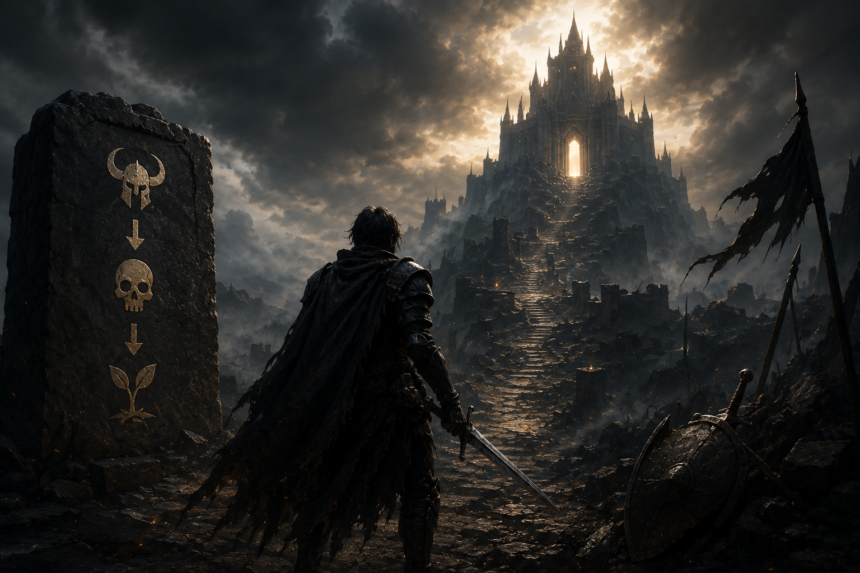
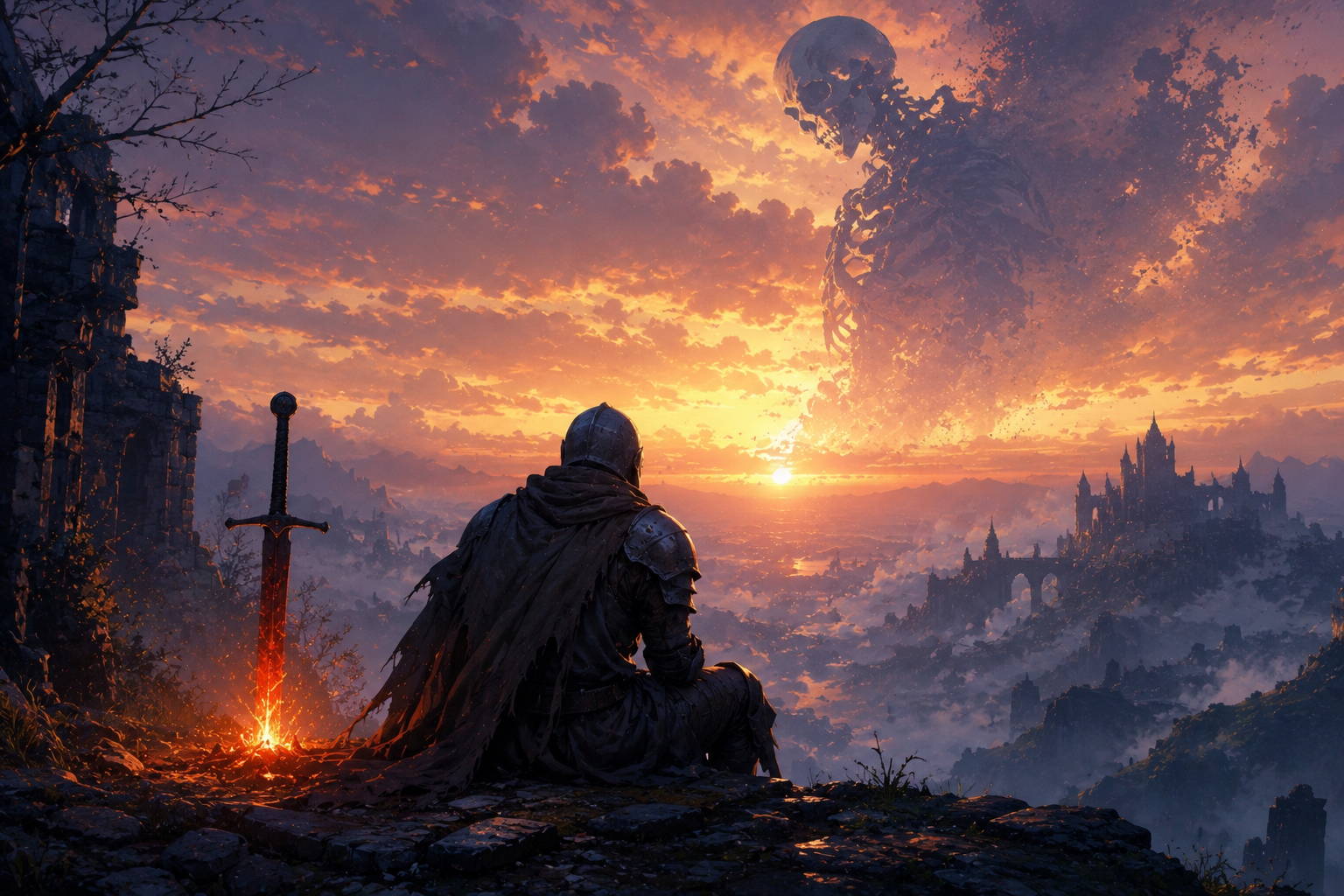

Death is usually the one subject fiction handles with the most caution. Novels tiptoe around it. Films often resolve it with a single dramatic scene and move on. But video games do something almost no other medium can: they make you die, over and over, as part of the actual experience — and then ask you to keep playing anyway.
- Death as a Mechanic, Not Just a Story Beat
- Hades: Death as a Loop You Can Grow From
- Dark Souls: Death as the Price of Meaning
- Spiritfarer: Death as Something to Sit With, Not Escape
- Three Games, Three Philosophies
- The Role of Player Agency in How These Lessons Land
- What This Means Outside the Game
- Conclusion: Why Games Are an Underrated Space for Thinking About Mortality
That repetition changes everything. When you read about a character’s death, you witness it once, from the outside. When you play a death — your own character’s death — you experience it from the inside, and then you’re given the strange, almost absurd task of trying again. Few art forms put the audience in that position. This is one of the reasons the philosophy of video games has become such fertile ground for thinking seriously about mortality, loss, and what it means to keep going.
This essay looks at three very different games — Hades, Dark Souls, and Spiritfarer — not as reviews, but as three distinct philosophical positions on death, disguised as game design. None of these games agree with each other. Read together, they form something close to a real philosophical debate.
Death as a Mechanic, Not Just a Story Beat
Before getting into specific games, it’s worth pausing on something obvious that we rarely examine closely: in most video games, dying isn’t the end of the story. It’s a gameplay state. You die, you respawn, you try again — sometimes with new information, sometimes with new gear, sometimes with nothing but stubbornness.
This is fundamentally different from how death works in literature or film, where it’s almost always final and symbolic. In games, death is often functional. It teaches you something about a boss pattern, a jump, a decision. It’s less like an ending and more like feedback.
Why This Matters Philosophically
Treating death as feedback rather than finality quietly echoes a very old philosophical idea: that death, or the fear of it, shapes how we act while alive — not as an abstract dread, but as information that adjusts behavior. Epicurus famously argued that death “is nothing to us,” since we never actually experience it directly; we only experience the anticipation of it. Games flip this on its head in a strange way: they let you experience death directly, constantly, and repeatedly, stripping away some of its mystery and replacing it with something closer to a lesson than a tragedy.
This is the foundation that Hades, Dark Souls, and Spiritfarer each build on — but they take that foundation in three completely different directions.
Hades: Death as a Loop You Can Grow From
In Hades, developed by Supergiant Games, you play Zagreus, the son of the Greek god of the underworld, attempting to escape his father’s realm. Every time you die — and you will die constantly — you simply return to the House of Hades, the underworld’s palace, slightly more equipped and slightly more informed than before.
What makes Hades philosophically interesting isn’t just the repetition itself, but what the game does with it narratively. Each death isn’t treated as a failure to be minimized or hidden. It’s treated as a chapter. Characters comment on your previous attempt. Relationships deepen with each return. The story doesn’t pause during your deaths — it happens because of them.
Practical Example: Death as Character Growth
There’s a moment fairly early in a typical playthrough where a character remarks, almost casually, on how many times you’ve died trying to escape — not with pity, but with something closer to familiarity, like a coworker who’s seen you struggle with the same task for weeks. That small shift in tone reframes the entire mechanic: dying isn’t shameful here. It’s simply part of who Zagreus is becoming.
This mirrors something genuinely useful outside of gaming: the idea that repeated failure, when it’s witnessed and acknowledged rather than hidden, can become part of a person’s identity in a constructive way, rather than a source of ongoing shame. Hades essentially argues that death — or failure, more broadly — doesn’t have to be an interruption to a story. It can be the story’s engine.
Dark Souls: Death as the Price of Meaning
If Hades treats death almost warmly, Dark Souls, developed by FromSoftware, treats it as something closer to a toll. The game is famous — some would say notorious — for its difficulty, and death here comes with real consequences: you drop the currency you were carrying, and you have one chance to reclaim it before it’s gone permanently.
This design choice has generated more discussion in gaming communities than almost any other mechanic of the last two decades, and for good reason. It forces a kind of seriousness onto every decision. You don’t casually walk into a new area in Dark Souls. You approach it the way you might approach an unfamiliar hiking trail at dusk — with a mix of curiosity and real caution, because the cost of a mistake is tangible.
Why Difficulty Isn’t Just a Gimmick
It would be easy to dismiss this as simple gatekeeping — difficulty for difficulty’s sake. But the philosophical weight of Dark Souls comes from something deeper: it asks players to find meaning despite the constant threat of loss, not by avoiding that threat. The world is bleak, the enemies are unforgiving, and yet the community around this game consistently describes finishing it as one of the more meaningful experiences they’ve had with any form of entertainment.
This echoes existentialist ideas more directly than almost any other major game franchise — particularly the notion, associated with thinkers like Albert Camus, that meaning isn’t handed to us by a comforting universe. It has to be built, deliberately, in spite of difficulty, and sometimes because of it. Dark Souls never tells you this. It makes you feel it every time you cautiously step past a bonfire — the game’s checkpoint — into unknown territory, knowing exactly what you stand to lose.
A Real-World Parallel: Loss Aversion and Motivation
There’s also a practical psychological angle worth mentioning. Behavioral economists have long studied “loss aversion” — the idea that people are more strongly motivated by the fear of losing something than by the promise of gaining something of equal value. Dark Souls essentially gamifies this principle. The threat of losing your currency doesn’t just add tension; it changes how carefully you play, how much attention you pay, how present you are in each moment. Few games manage to turn a well-known cognitive bias into a source of genuine tension and, eventually, catharsis.
Spiritfarer: Death as Something to Sit With, Not Escape
The third game in this essay takes the sharpest turn. Spiritfarer, developed by Thunder Lotus Games, isn’t about avoiding death or looping through it. It’s about accompanying it.
You play Stella, a ferrymaster for the recently deceased, tasked with caring for spirits — cooking their favorite meals, building them a home aboard your boat, listening to their stories — before eventually guiding them to the afterlife and letting them go. There is no combat here, no death mechanic in the traditional sense. The entire game is structured around a single, quiet, recurring event: saying goodbye.
Practical Example: The Ritual of Letting Go
Each spirit’s departure in Spiritfarer follows a similar emotional shape. You spend hours getting to know them — their quirks, their regrets, their small joys — and then, when they’re ready, you sail them to a literal gate at the edge of the world and release them. The game doesn’t rush this. It lingers on it, deliberately, letting the moment breathe instead of cutting quickly to the next objective.
This design choice puts Spiritfarer closer to grief literature than to traditional gaming. It reflects an idea common in modern grief psychology: that healthy grieving isn’t about “moving on” quickly, but about honoring a relationship fully before releasing it. Where Hades treats death as a loop to learn from and Dark Souls treats it as a cost that sharpens meaning, Spiritfarer treats it as a relationship that deserves patience and closure.
Three Games, Three Philosophies
Put side by side, these three titles form something close to a spectrum:
- Hades treats death as repetition with growth — closer to a coach who makes you run the same drill until you understand it.
- Dark Souls treats death as cost with consequence — closer to a teacher who makes every choice matter because nothing is handed to you for free.
- Spiritfarer treats death as relationship with closure — closer to a companion who reminds you that endings, handled with care, aren’t failures at all.
None of these approaches is “correct” in some objective sense. What’s interesting is that all three are legitimate, well-supported responses to the same basic human question: how do we relate to loss? The philosophy of games doesn’t need to give a single answer here, and arguably shouldn’t. Its strength lies in offering multiple, playable perspectives on a question philosophy has debated for millennia without ever fully resolving.
Why Multiple Perspectives Matter More Than One “Right” Answer
This is worth sitting with for a moment. If only one of these games existed, players might mistake its particular stance on death for the definitive gaming take on mortality. But because Hades, Dark Souls, and Spiritfarer coexist, each with millions of players and passionate communities, they demonstrate something valuable: video games, as a medium, are mature enough to hold contradictory truths about the same subject simultaneously. That’s not a weakness. It’s closer to how mortality actually works in real life — nobody experiences loss the same way twice, let alone the same way as everyone else.
The Role of Player Agency in How These Lessons Land
There’s a detail that’s easy to overlook when comparing these three games: in every case, the player isn’t just watching a philosophy of death unfold — they’re the one making the choices that enact it. This distinction matters more than it might seem.
In Hades, you choose which gods’ blessings to accept before each run, effectively deciding how you’ll approach the next attempt at the same failure. In Dark Souls, you choose when to push forward and when to retreat to safety, deciding for yourself how much risk a given moment is worth. In Spiritfarer, you choose how long to keep a spirit aboard your boat before guiding them to their final gate — some players linger for hours longer than necessary, unable to let go, which the game never punishes or rushes.
This is a structural difference between games and other storytelling mediums that’s easy to underestimate. A novel can describe someone learning to live with loss. A film can show it happening to a character on screen. A game can put you in the position of making the actual decisions that constitute that process — and because the outcome partly depends on your choices, the lesson tends to feel earned rather than delivered. This is arguably the single strongest argument for taking video game philosophy seriously as its own category of thought, rather than treating it as a secondhand version of ideas explored more “properly” elsewhere.
A Small But Telling Detail: Difficulty Settings and Meaning
It’s worth noting that all three of these games have faced public debate over difficulty options — particularly Dark Souls, whose developers have historically resisted adding an easy mode, arguing that the difficulty is inseparable from the intended experience. Whatever position one takes in that debate, it highlights something philosophically interesting: for at least some of these designers, difficulty isn’t a barrier to the meaning of the game. It is the meaning. Removing the risk of loss, in their view, would remove the thing the game is actually about.
This is a stronger, more literal echo of existentialist thought than most people expect from a boss-rush action game. The claim, essentially, is that meaning without risk is a different, lesser kind of meaning — a position philosophers have debated in far more abstract terms for centuries, here made concrete through a health bar and a checkpoint system.
What This Means Outside the Game
It’s tempting to treat these observations as interesting trivia about game design and stop there. But the reason this topic belongs in a broader conversation about gaming and philosophy is that these three approaches map fairly directly onto how people actually cope with loss in real life.
Some people process setbacks the way Hades frames death — as repetition that eventually produces growth, provided the failures are acknowledged rather than buried. Others live closer to the Dark Souls model, treating risk and potential loss as the very thing that makes an effort feel meaningful in the first place — a promotion that required real risk, a relationship that demanded vulnerability. And some situations, particularly actual grief, call for the patient, unhurried approach Spiritfarer insists on: sitting with someone, or something, before letting go, rather than rushing toward closure for its own sake.
None of these approaches is universally correct, and few people fit neatly into just one. Most of us move between all three, depending on what we’re actually facing. What video games offer, uniquely among storytelling mediums, is the chance to rehearse each of these stances safely, one controller in hand, before we need them for real.
Conclusion: Why Games Are an Underrated Space for Thinking About Mortality
Death is one of the few subjects every person will eventually have direct, personal experience with, and yet it remains one of the hardest topics to discuss openly. Video games, strangely, have become one of the more honest spaces for approaching it — not through lectures or grand statements, but through systems that let players practice different relationships with loss before life demands it of them for real.
Hades teaches that repetition, faced honestly, can become growth instead of shame. Dark Souls teaches that meaning is often built precisely where loss is possible, not in spite of it. Spiritfarer teaches that closure deserves patience, not speed. None of these lessons arrive as dialogue or exposition. They arrive through play — through the actual, repeated act of losing something and choosing, each time, to continue.
That might be the quiet, underappreciated gift of gaming and philosophy as a genre: it doesn’t ask you to agree with a single conclusion about death. It hands you a controller, and lets you find out, one attempt at a time, what you actually believe.
None of these games will tell you which stance is right for the loss you’re currently facing, and that’s probably the point. The value isn’t in the answer — it’s in having rehearsed the question, safely, before real life asked it of you without warning.
This essay is part of an ongoing series on the philosophy of video games — exploring power, identity, sacrifice, and the choices that define us, one title at a time.