
I still remember the exact spot on my couch where I sat, controller in hand, for almost ten full minutes, not because the game had frozen, but because I genuinely could not decide what to do next. A character I had grown attached to over twenty hours was standing in front of me, asking for something I did not want to give. Nobody was rushing me. The game just waited. And in that silence, I realized something a movie had never once made me feel: this was actually on me.
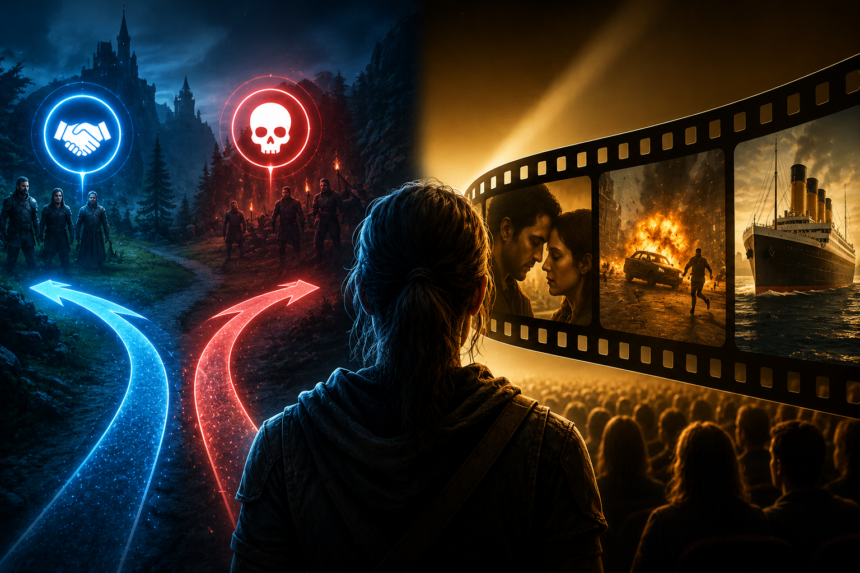
We have all watched a film and silently begged a character not to open the door, not to trust the stranger, not to make the obvious mistake. And we have all watched them do it anyway, because a film is a fixed thing and our wishes have no power over it. Games are different in one profound way: when the moment of decision arrives, the choice is genuinely ours. We open the door or we do not. That shift, from watching a choice to making one, is the single greatest thing games added to storytelling, and it explains why a decision in a game can weigh on us in a way a scene in a film, however brilliant, rarely does.
This essay examines player agency in games: what it means to make choices inside a story, why interactive narrative feels so personal, and the honest truth about how much of that choice is real versus illusion.
Key Takeaways
- Player agency is the sense that your choices genuinely shape the story, which distinguishes games from passive media.
- Because you act rather than watch, decisions in games carry personal responsibility and emotional weight.
- Branching narratives and consequences make players complicit in outcomes in a way film cannot replicate.
- Much game choice is partly an “illusion of choice,” yet the feeling of agency can be real even when the branches are limited.
- The most powerful moments often come from choices with no right answer, where the game refuses to absolve you.
The Difference Between Watching and Doing
In film and literature, we experience choices from the outside. We empathize with a character’s dilemma, we may even feel it intensely, but the decision is not ours to make. The author made it long ago, and we are witnesses to a conclusion already reached. This is not a weakness of those forms; the crafted inevitability of a great tragedy is part of its power. A film can make you weep for a choice you had no hand in. But it is a fundamentally different relationship to choice than what games offer, and no amount of directorial skill changes who is actually holding the decision.
When a game hands you a decision, you cross a line from witness to participant. The character’s dilemma becomes your dilemma. You are the one who must weigh the options, commit, and live with the result. This is player agency, and it transforms the emotional stakes. You cannot comfort yourself that a character made a foolish choice, because the choice was yours. The distance that protects us in passive media collapses, and the story implicates us directly. There is no character to blame anymore, and that missing buffer is exactly where the discomfort, and the meaning, lives.
Why Choice in Games Carries Weight
The emotional power of interactive choice comes from responsibility. In a game with meaningful decisions, you cannot hide behind the author. If a character you were meant to protect dies because of a call you made, the guilt is genuine, because you made the call. If you spare an enemy and they later betray you, the regret is yours to own. Ask anyone who has played through a long RPG about “that one choice,” and watch how quickly the tone of the conversation changes. People do not talk about it the way they talk about a plot twist in a film. They talk about it the way they talk about something they actually did.
Complicity, not observation
This is why games can produce moral discomfort that other media struggle to reach. A film can show you a terrible act and ask you to judge it. A game can make you commit the act yourself and then sit with what that says about you. The best narrative games use this deliberately, placing you in situations where every option costs something and then holding you accountable for whichever cost you chose to pay. You are not observing a moral question; you are answering it, with your own hands, and the game remembers your answer. This is the same territory explored in our piece on what video games teach us about sacrifice, where the “correct” option rarely feels like a win at all, only like the least unbearable loss.
Even small choices accumulate this weight. Deciding who to save, what to say, whether to be kind or cruel, whether to keep a promise, these are the fabric of a life, and stringing them together across a long game builds a character who feels like a version of you, shaped by decisions you can actually recall making. Over time, those accumulated choices start to blur the line between the character on screen and the person holding the controller, which is part of why we wrote separately about what video games teach us about identity: the more choices you make as a character, the harder it becomes to say where the roleplay ends and you begin.
The Honest Truth: The Illusion of Choice
Here it is worth being honest, because the reality of game choice is more complicated than the marketing suggests. Much of what feels like sweeping agency is, mechanically, quite constrained. Many branching stories funnel back to the same key events regardless of your decisions. Dialogue options often lead to similar outcomes with different flavor. The grand promise that “your choices matter” frequently means they matter at the edges while the spine of the story holds firm. Anyone who has replayed a heavily marketed choice-driven game a second time, picking the opposite options just to see what happens, has felt this deflation firsthand: the side character survives either way, the ending slide changes one sentence, the world keeps turning almost exactly as it would have.
This is the “illusion of choice,” and understanding it can feel deflating. But the striking thing is that the feeling of agency survives the illusion. Even when a game could not possibly account for every decision, the moment of choosing, the deliberation, the commitment, the ownership, produces a genuine emotional experience. You agonized over sparing a character. That agony was real, even if the game would have found its way to a similar place either way.
Why the illusion still works
The illusion works because agency is, in large part, a psychological state rather than a purely mechanical one. What matters emotionally is that you believed the choice was yours and invested yourself in making it. A well-designed game protects that belief, obscuring its constraints and reflecting your decisions back at you convincingly enough that the experience feels authored by you. The result is real feeling produced by partly artificial freedom, and that is not a cheat. It is the craft of interactive storytelling, and it works for the same reason a great film character’s fictional choice can still move us to tears: we invest belief, and belief is where the feeling actually lives.
It is worth noting this illusion has a cousin. Just as games let you choose your actions while quietly guiding you toward similar outcomes, they also let you fail and try again in a way film never allows, and that mechanic teaches its own kind of resilience. We explored that idea in more depth in what video games teach us about failure, where the ability to undo a bad decision and choose differently becomes, paradoxically, one of the most honest things a game can offer a player.
The Choices With No Right Answer
The most memorable exercises of player agency are often the ones that refuse to give you a clean option. A game that lets you pick the obviously good choice and rewards you for it is pleasant but forgettable. A game that hands you two paths, each with a genuine cost, and then declines to tell you which was correct, stays with you for years. Some of these choices even carry the same weight as the ultimate loss a story can offer, which is why so many of the hardest decisions in games sit right next to a character’s death, forcing you to decide not whether someone lives or dies, but how, and at what cost to you. Our essay on what video games teach us about death looks at this from the other side of the same coin: it is often the choices around dying, not the death itself, that stay lodged in a player’s memory.
These dilemmas work because they mirror real moral life, where the hardest decisions are not good versus evil but competing goods, or lesser evils, with no way to escape unscathed. When a game puts you in that position and then honors your choice without absolving you of its cost, it achieves something close to the emotional truth of actually having to decide. You leave not with the satisfaction of a puzzle solved but with the residue of a real decision made, which is a far rarer and more valuable thing.
Conclusion
Choice in games feels more real than in movies because it is, in the way that matters most: you are the one making it. Even when the branches are fewer than they appear and the story quietly steers you back to its path, the act of deciding, of taking responsibility, of living with a consequence you chose, produces an emotional weight no passive medium can match. Player agency is partly an illusion and entirely real at once, and that paradox is exactly why interactive storytelling can touch us so deeply. Games do not just show us hard choices. They make us make them, and then they let us carry that weight long after we have put the controller down.
Frequently Asked Questions
What is player agency in video games?
Player agency is the sense that your decisions genuinely shape the story and world. It is what separates games from passive media like film: rather than watching a character choose, you make the choice yourself, taking on the responsibility and emotional weight of the outcome.
Why do choices in games feel more meaningful than in films?
Choices in games carry more weight because you make them rather than observe them. This shift from witness to participant means you are responsible for the consequences, which can produce genuine guilt, regret, or pride. Film can show a difficult decision, but a game can make you commit it and hold you accountable.
What is the “illusion of choice” in games?
The illusion of choice refers to how many games present decisions that feel impactful but mechanically funnel back to the same key events. Branches often reconverge and dialogue options lead to similar outcomes. Despite this, the act of deliberating and committing still produces a real feeling of agency.
Does the illusion of choice make agency fake?
No. Agency is largely a psychological experience, not just a mechanical one. What matters emotionally is that you believed the choice was yours and invested in making it. A well-designed game preserves that belief, so the feeling of agency remains genuine even when the underlying branches are limited.
Why are choices with no right answer so powerful?
Dilemmas with no clean option mirror real moral life, where hard decisions involve competing goods or lesser evils rather than good versus evil. When a game presents such a choice, honors it, and refuses to absolve you of its cost, it captures the emotional truth of actually having to decide, which stays with players for years.
Can games tell better stories than films because of choice?
Not better or worse, but different. Interactivity gives games a unique storytelling tool that film lacks: the ability to make the audience responsible for outcomes. This produces forms of emotional and moral engagement passive media cannot replicate, though film retains its own strengths, such as authored inevitability and precise pacing.