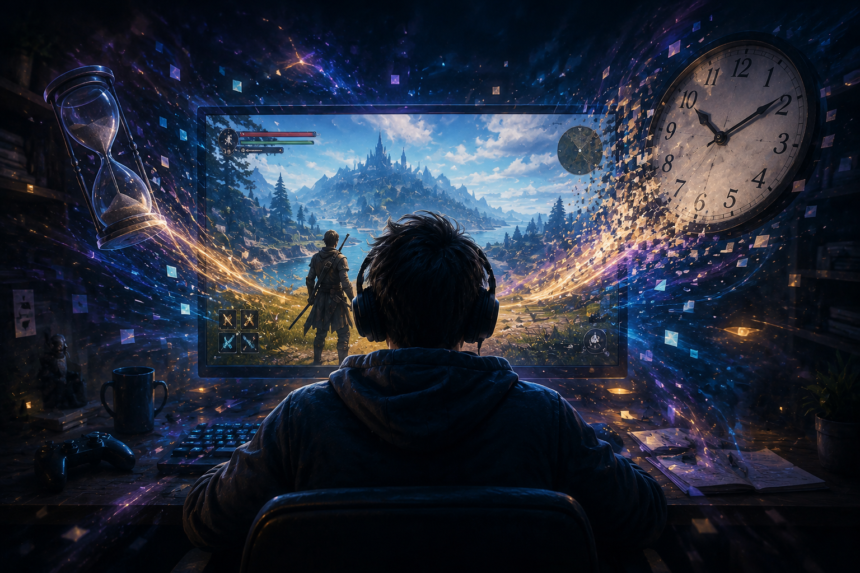

Almost everyone who plays games has experienced it. You sit down for “one quick match” or “just twenty minutes,” and when you next glance at the clock, two hours have evaporated. You were not bored, you were not checking your phone, you were simply gone, absorbed so completely that time stopped registering. This is not a trick or an addiction in the clinical sense. It is one of the most studied and rewarding states in psychology, and games happen to be almost perfectly engineered to produce it. It is called flow.
This essay explores flow state gaming: what flow is, why games trigger it so reliably, why time seems to vanish inside it, and what that says about why games hold us the way they do.
Key Takeaways
- Flow state gaming describes total absorption in a game, where self-awareness fades and time seems to disappear.
- Flow, defined by psychologist Mihaly Csikszentmihalyi, occurs when challenge and skill are closely matched.
- Games trigger flow reliably through clear goals, immediate feedback, and difficulty that scales with your ability.
- The loss of time is a natural byproduct of deep focus, not evidence of harm on its own.
- Understanding flow helps players enjoy games intentionally and recognize when absorption tips into avoidance.
What Flow Actually Is
The concept of flow comes from psychologist Mihaly Csikszentmihalyi, who spent decades studying people who were deeply, joyfully absorbed in what they were doing: painters, climbers, surgeons, athletes. Across these wildly different pursuits, he kept hearing the same description come back: full immersion, action and awareness merging into one, self-consciousness falling away, and time bending out of its normal shape. He named this optimal experience “flow” and treated it as one of the most fulfilling states a person can enter.
Flow is not passive relaxation, and it is not stress. It occupies a precise middle zone. A task that’s too easy lets your mind wander into boredom. A task that’s too hard tips you into anxiety. Flow lives in the narrow channel between the two, where the challenge asks for your full attention but stays matched closely enough to your skill that you can rise to meet it. In that channel, effort stops feeling like effort, and the doing simply carries you along.
It’s worth noting how much this framework echoes other essays on this site about what games quietly teach us. Just as failure in games becomes something we choose to face again rather than something to dread, flow reframes difficulty itself: not as an obstacle standing between you and enjoyment, but as the very ingredient that produces it.
Why Games Are Flow Machines
Csikszentmihalyi identified several conditions that reliably produce flow, and it’s striking how precisely well-designed games meet every one of them. This isn’t a coincidence. Games are, in a sense, purpose-built flow machines.
Clear goals and immediate feedback
Flow requires knowing exactly what you’re trying to do, and getting instant information about how you’re doing. Games excel at both. A game constantly tells you your objective — reach the exit, defeat the enemy, solve the puzzle — and it responds to every action at once. Press a button and something happens immediately: a jump, a hit, a score, a sound. This tight loop of intention and feedback is exactly what the mind needs to lock in, and few activities in ordinary life offer it so cleanly.
The perfect difficulty curve
The most important condition is the balance of challenge and skill, and this is where games become almost magical. A well-designed game constantly adjusts: introducing new mechanics as you master old ones, ramping up enemies as you get stronger, always keeping you in that channel between boredom and anxiety. Where real life dishes out challenge randomly, a good game engineers a smooth ascent that keeps you perpetually stretched but rarely overwhelmed.
This is really the same territory covered in the site’s piece on why “hard” games aren’t cruel — difficulty done well isn’t punishment, it’s a carefully tuned invitation into flow. A souls-like isn’t hard because the designers wanted to frustrate you; it’s hard because that resistance, calibrated against your growing skill, is what keeps you locked into the experience rather than drifting away from it.
Why Time Disappears
The vanishing of time is one of flow’s defining features, and it has a real cognitive basis. Our sense of time passing depends on attention. When part of the mind is monitoring the clock, noticing boredom, or tracking how long something is taking, time feels present and often slow. Flow consumes that spare attention entirely. Every scrap of focus goes into the activity, leaving nothing left over to track duration.
So the hours don’t really disappear; your awareness of them does. Without any attention devoted to the passage of time, you build no internal record of it accumulating, and you surface from a session genuinely surprised. This is the same reason a gripping book or an intense conversation can swallow an afternoon. Games simply produce the state more reliably than almost anything else, because they’re so good at commanding total attention.
The site’s essay on what games teach us about time explores an adjacent idea: our relationship with in-game clocks, deadlines, and mortality timers, and why we’re so drawn to systems that let us feel like we’re racing against or bending time itself. Flow and that fascination with in-game time are two sides of the same coin — one is about losing track of real time, the other about our strange relationship with fictional time.
Flow, Enjoyment, and Well-Being
It’s worth being clear that flow is, in itself, a healthy and desirable thing. Csikszentmihalyi considered it central to a well-lived life, and people who regularly experience flow tend to report greater satisfaction and engagement. The absorption you feel in a great game is the same fundamental state a musician feels in performance or a craftsperson feels at the workbench. There’s nothing wrong with seeking it, and games offer it generously to people who might not find it easily elsewhere.
This reframes gaming in a more generous light. The desire to play is often, at root, a desire for flow — for that rare and satisfying feeling of being fully absorbed and fully capable. In a fragmented, distraction-heavy world, an activity that can reliably deliver deep focus is genuinely valuable.
There’s a connection here, too, to the site’s essay on identity in games: flow involves a temporary dissolving of self-consciousness, a merging of “you” with the action itself. It’s a milder, more benign cousin of the identity-blurring these essays describe elsewhere — a controlled, enjoyable loosening of the boundary between self and activity, rather than anything destabilizing.
When Absorption Becomes Avoidance
None of this means flow is beyond examination. The same qualities that make games wonderful sources of flow can also make them easy places to hide. Because flow feels so good and time passes so painlessly, it’s possible to use games to avoid things that need attention, or to lose more hours than you intended and meant to spend elsewhere. The loss of time is neutral in itself, but it can quietly serve avoidance if we aren’t honest with ourselves.
The healthy relationship is not to fear flow but to be intentional about it. Choosing to enter a game’s flow for an evening of genuine enjoyment is very different from drifting into it to escape something you’d rather not face. Understanding the mechanism — knowing why the time vanished — gives you the awareness to enjoy games deliberately rather than being quietly carried off by them. Flow is a gift, and like most gifts it’s best received on purpose.
Conclusion
When a game makes an evening disappear, it isn’t casting a spell so much as satisfying a deep human need for absorbed, capable focus. Games are extraordinarily good at producing flow because they provide exactly what flow requires: clear goals, instant feedback, and a challenge tuned to your skill. The vanished time is simply the fingerprint of attention fully spent.
Understood this way, the pull of games becomes less mysterious and more human. We are not chasing the game. We are chasing the feeling of being wholly, happily present — and games are one of the most reliable doors to it we have ever built.
Related reading on The Ludic Mind:
- Difficulty Isn’t Cruelty: What “Hard” Games Actually Ask of Us
- What Video Games Teach Us About Failure
- What Video Games Teach Us About Time
- What Video Games Teach Us About Identity
(FAQ section can stay as-is from the original if you want to keep it — let me know if you’d like me to expand that too, or adjust the tone/length further.)