
Few subjects in gaming start an argument faster than difficulty. Mention that a punishing game could use an easy mode and you will summon two entrenched camps within minutes: one insisting that hardship is the whole point and must not be diluted, the other insisting that everyone deserves to see a game to its end. Both sides are arguing past each other, because both are missing what difficulty in games actually is. It is not cruelty, and it is not gatekeeping. It is a language, and different games are trying to say different things with it.
This essay untangles the debate over difficulty in video games: why hard games can be meaningful rather than merely mean, what the accessibility conversation gets right and wrong, and what challenge is really asking of the player.
Key Takeaways
- Difficulty in video games is a design language that shapes tension, meaning, and the emotional payoff of overcoming a challenge.
- Souls-like games use hardship deliberately, so that struggle and eventual triumph are the intended emotional core.
- The accessibility debate is often a false binary; many difficulty options can coexist without harming a game’s vision.
- Mastery provides a specific reward, earned competence, that easier paths deliver differently rather than not at all.
- The real question is not “should games be hard” but “what is this particular game trying to make me feel.”
Difficulty as a Design Language, Not a Punishment
The first thing to understand is that difficulty is never neutral. Every choice about how hard a game is, how much a mistake costs, how forgiving the timing windows are, communicates something and produces a feeling. A game that lets you breeze through wants you to feel powerful and immersed in its story. A game that makes you sweat wants you to feel tension, focus, and the earned relief of overcoming.
Framed this way, calling difficulty “cruelty” misses the point as badly as calling a horror movie “cruel” for trying to scare you. The discomfort is the intended experience. A tough boss is not the designer being unkind; it is the designer setting up an emotional payoff that only becomes possible after genuine struggle. The frustration and the triumph are two halves of a single designed feeling, and you cannot have the second without the first.
The Souls-Like and the Meaning of Struggle
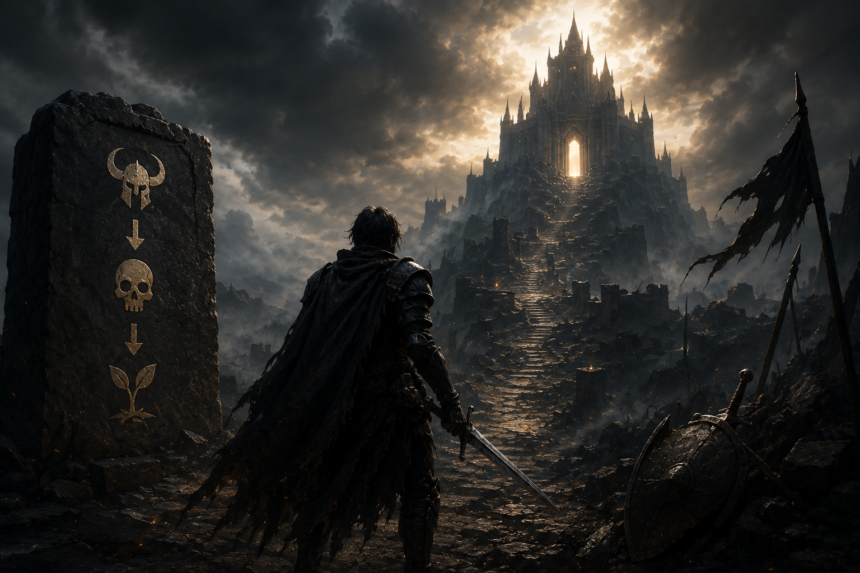
No games have crystallized this debate more than the souls-like, the demanding action RPGs known for tough enemies, steep learning, and frequent death. Their fans do not endure the difficulty despite wanting to enjoy the game; the difficulty is why they enjoy it.
Why the hard version means more
In these games, an early enemy that repeatedly kills you slowly transforms, through your own improvement, into something you can handle without a scratch. That transformation is the entire arc, and it happens inside you, not on a stat screen. The world feels genuinely dangerous, so exploring it feels genuinely brave, and defeating a boss you once thought impossible produces a specific, hard-won elation. Lower the difficulty and you do not just make the game easier; you change what it is about. The dread, the caution, the earned mastery all soften. For players who love these games, that would be trading away the very thing they came for.
This is the strongest version of the “difficulty is the point” argument, and it is correct on its own terms. Some experiences genuinely depend on real stakes and real struggle to mean anything.
Where the Accessibility Argument Gets It Right
And yet the other camp is also pointing at something true. “Accessibility” is often misheard as “make the game easy,” but that is not what it primarily means. Accessibility includes remappable controls, colorblind options, subtitle sizing, toggles instead of held buttons, and adjustable timing windows, things that let players with disabilities engage with the game at all. Opposing these on the grounds that “the game is meant to be hard” confuses a barrier with a challenge. A player who physically cannot execute an input is not being challenged; they are being excluded.
Even setting disability aside, the claim that a difficulty option “ruins” a game for people who do not use it does not hold up well. An optional easy mode, tucked in a menu, changes nothing about the experience of the player who ignores it. The purist can still play the intended way. The exhausted parent with an hour a night can still see the ending. Both can coexist, and many acclaimed games prove it by offering multiple difficulties without diluting anything for anyone.
The False Binary
Most of the heat in this debate comes from treating it as all-or-nothing: either every game must be brutally hard or every game must be trivially easy. Almost nobody actually believes either extreme. The real landscape is a spectrum, and different games sit at different points for good reasons.
A tightly authored challenge experience where difficulty is inseparable from meaning is a legitimate artistic choice, and a designer is allowed to say “this is the experience, take it or leave it.” A sprawling story-driven adventure that offers a story mode is also a legitimate choice, welcoming players who care more about the narrative than the combat. Neither approach is a betrayal of gaming. They are simply different works with different intentions, and demanding that all games conform to one philosophy would make the medium poorer.
What Mastery Actually Gives You
It is worth being honest about what hard games offer that easy ones cannot, because the accessibility conversation sometimes glosses over it. Mastery is a real and specific reward. The competence you build in a demanding game is genuinely yours, unearnable by shortcut, and the confidence it produces can be quietly profound. Players often describe how conquering a game they thought was beyond them changed how they saw their own capacity to learn hard things.
This does not mean easier modes are lesser. It means the reward is different. An accessible path trades some of the intensity of earned mastery for the reward of experiencing a story, a world, or a set of ideas that would otherwise be locked away. Both rewards are valuable. The mistake is pretending one does not exist, in either direction.
The Question Worth Asking
So the productive question is not “should games be hard.” It is “what is this particular game trying to make me feel, and does its difficulty serve that.” For a souls-like, brutal difficulty serves the vision perfectly. For a narrative adventure, a punishing combat wall might actually betray the experience by keeping players from its real strengths. Difficulty is a tool, and like any tool it is good or bad only in relation to the job.
When we argue as if difficulty were a moral issue, we lose the ability to see it as a craft issue, which is what it actually is. The best designers think carefully about what their game is for and tune its challenge to match. The best players, in turn, meet each game on its own terms rather than demanding it be the game they wish it were.
Conclusion
Difficulty in games is not cruelty and it is not gatekeeping. It is a language for creating feeling, and hardship, when it is chosen deliberately, can produce some of the most meaningful experiences the medium offers. At the same time, welcoming more players through thoughtful options rarely costs the purist anything. The mature position is not to pick a side in the culture war but to recognize that different games are saying different things, and that difficulty, used well, is one of the most expressive tools a designer has.
Frequently Asked Questions
Why are some video games intentionally so hard?
Some games are hard because struggle is central to their intended experience. In genres like the souls-like, real danger makes exploration feel brave and defeating a tough boss produces earned triumph. The difficulty creates tension and a specific emotional payoff that an easier version could not deliver, so it is a deliberate design choice rather than mere punishment.
Should every game have an easy mode?
Not necessarily. For games where difficulty is inseparable from meaning, a single tuned experience can be a valid artistic choice. For story-driven games, however, optional difficulty settings let more players reach the ending without harming those who prefer a challenge. It depends on what the specific game is trying to achieve.
Does adding an easy mode ruin a hard game?
Generally no. An optional easy mode tucked in a menu does not change the experience of players who ignore it. Purists can still play the intended way while others see more of the game. Many acclaimed titles offer multiple difficulties without diluting the experience for anyone.
What is the difference between difficulty and accessibility?
Difficulty is the intended challenge a game presents. Accessibility refers to features like remappable controls, colorblind modes, subtitles, and input toggles that let players, especially those with disabilities, engage with the game at all. Opposing accessibility on the grounds that a game is “meant to be hard” confuses a barrier with a challenge.
Why do players enjoy souls-like games despite the difficulty?
Players enjoy souls-like games because of, not despite, the difficulty. The steep challenge makes the world feel genuinely dangerous and turns personal improvement into the core reward. Enemies that once killed you become manageable through your own skill growth, producing a hard-won sense of mastery that defines the genre’s appeal.
Is mastery in hard games actually valuable?
Yes. Mastery provides a specific reward: genuine, earned competence that cannot be shortcut. Many players find that conquering a game they thought was beyond them builds real confidence. Easier modes offer different rewards, such as experiencing a story, so the value of mastery is distinct rather than superior or inferior.