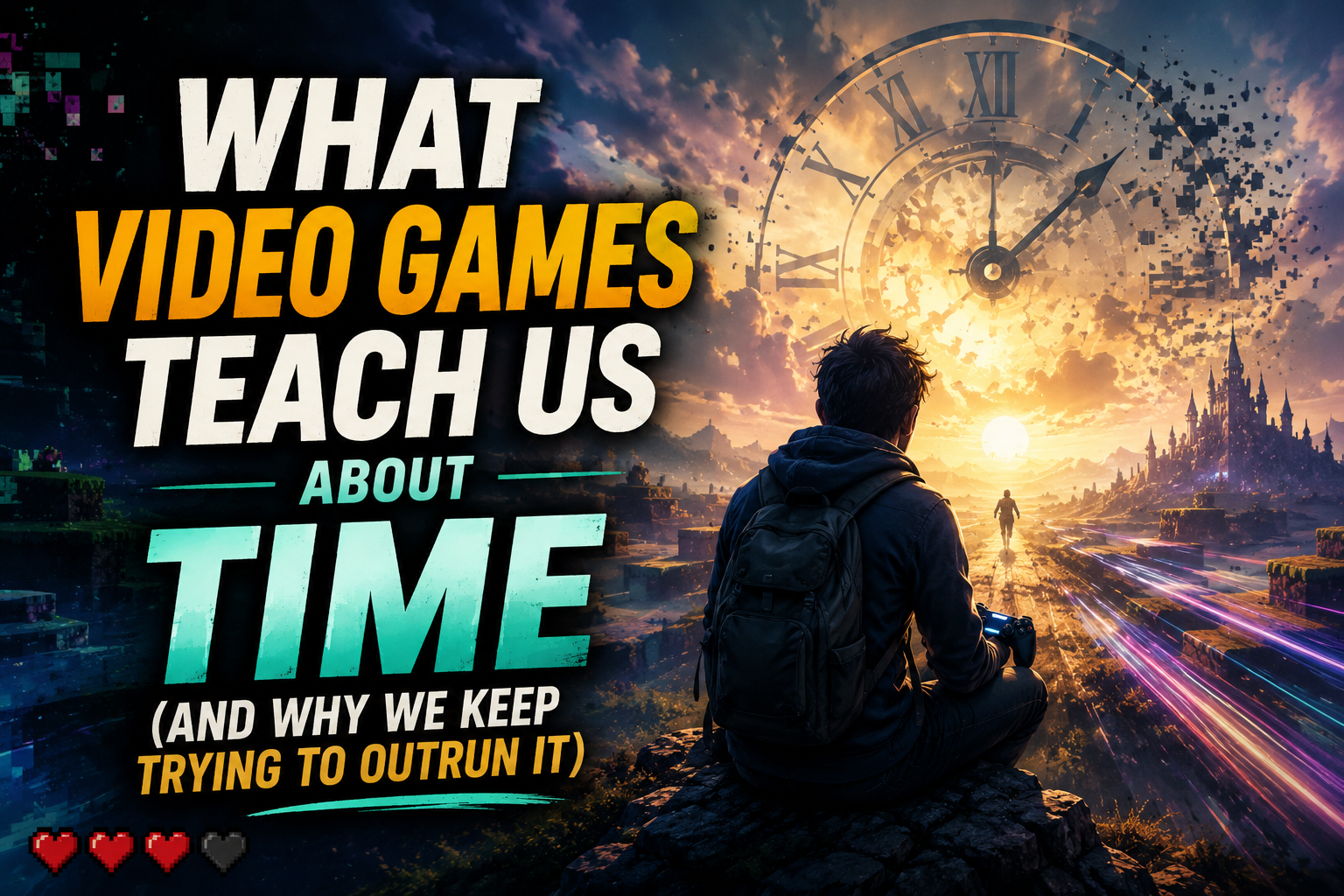

Time is usually the one thing fiction can only describe, never actually hand you. Novels can compress twenty years into a paragraph or stretch a single second across a chapter, but you, the reader, always experience the book at your own pace, safely outside the timeline being described. Video games are different. They can put the clock directly in your hands — sometimes literally — and make you feel the weight of every second you spend deciding what to do with it.
- Time as a Mechanic, Not Just a Setting
- Braid: Time as the Right to Undo Regret
- Outer Wilds: Time as a Loop You Learn to Accept
- Majora’s Mask: Time as a Countdown That Forces Presence
- Three Games, Three Philosophies
- The Role of Player Agency in How These Lessons Land
- What This Means Outside the Game
- Conclusion: Why Games Are an Underrated Space for Thinking About Time
That shift matters more than it first appears. When you read about a character running out of time, you understand it intellectually. When you play against a countdown, plan around a loop, or rewind a mistake with your own thumb, you experience something closer to what philosophers have spent centuries trying to describe in the abstract: what it actually feels like to be a finite creature inside time, rather than a spectator watching it pass someone else by.
This essay looks at three very different games — Braid, Outer Wilds, and The Legend of Zelda: Majora’s Mask — not as reviews, but as three distinct philosophical positions on time, disguised as game design. None of these games agree with each other about what time is for. Read together, they form something close to a real philosophical debate.
Time as a Mechanic, Not Just a Setting
Before getting into specific games, it’s worth pausing on something obvious that we rarely examine closely: in most video games, time isn’t just a backdrop the story happens inside. It’s frequently a system the player has to manage, manipulate, or survive — something with rules, limits, and consequences, in a way that clocks in everyday life almost never are.
This is fundamentally different from how time works in literature or film, where it’s usually a fixed structure the audience simply moves through. In games, time is often negotiable. You can rewind it, loop it, race it, or watch it reset entirely, and the story adjusts itself around whatever you decide to do with it.
Why This Matters Philosophically
Treating time as something negotiable rather than fixed quietly echoes a genuinely old philosophical tension: the difference between time as it’s measured by a clock — uniform, external, indifferent — and time as it’s actually experienced, which stretches, compresses, and loops depending on what we’re feeling and doing within it. Philosophers like Henri Bergson drew a sharp line between these two, arguing that lived time, what he called durée, has almost nothing in common with the neat, evenly spaced ticks on a clock face.
Games are unusually well suited to dramatizing this gap, because they can literally give the player two different clocks at once: the real one on the wall, and the one inside the game, which might race forward, freeze, or fold back on itself entirely. This is the foundation that Braid, Outer Wilds, and Majora’s Mask each build on — but they take that foundation in three completely different directions.
Braid: Time as the Right to Undo Regret
In Braid, developed almost entirely by Jonathan Blow, you play Tim, a man moving through a series of increasingly strange worlds in search of a princess. The headline mechanic is simple to describe and endlessly complicated to master: you can rewind time at almost any point, undoing deaths, missed jumps, and mistakes, with no real limit on how far back you go.
What makes Braid philosophically interesting isn’t the rewind mechanic on its own — plenty of games let you undo mistakes — but what the game insists on doing with it narratively. Every world reframes the rewind ability slightly differently, and by the game’s final stretch, it becomes clear that the entire mechanic has been building toward a single, devastating idea about regret: that the desire to undo a past mistake, taken far enough, can become its own kind of prison.
Practical Example: Rewinding the Mistake
Without spoiling the specific sequence, there’s a moment late in Braid where a puzzle the player has been solving throughout the entire game — using the rewind ability freely and without consequence — suddenly plays out completely differently once the true meaning of that ability is revealed. The mechanic hasn’t changed. What changes is the player’s understanding of what they were actually doing every time they pressed rewind. It’s one of the few instances in gaming where the same button press means something entirely different the second time you understand it.
This mirrors something genuinely useful outside of gaming: the idea that the impulse to endlessly revisit and “fix” a past mistake, rather than accepting it as part of a completed story, can quietly become the very thing that keeps a person stuck. Braid essentially argues that the ability to undo the past isn’t automatically a gift. Depending on how it’s used, it can just as easily become a refusal to let the past finish happening.
Outer Wilds: Time as a Loop You Learn to Accept
If Braid treats time as something to be corrected, Outer Wilds, developed by Mobius Digital, treats it as something to be understood before it’s accepted. You play a young astronaut exploring a tiny solar system, and every twenty-two minutes, without warning or mercy, the sun goes supernova and the loop resets — taking every physical object you were carrying with it, though never your memories.
This design choice turns the entire game into something closer to detective work than exploration. Nothing you build, collect, or unlock in the traditional sense carries over. The only thing that persists between loops is what you personally understood, which the game trusts you to remember without ever quizzing you on it directly.
Why Repetition Isn’t Punishment
It would be easy to read a hard twenty-two-minute reset as a punishing design choice, and some players do struggle with it at first. But the philosophical weight of Outer Wilds comes from something more specific: the loop is never framed as a failure state to escape. It’s framed as the actual shape of the world, something to be understood on its own terms rather than defeated. There’s no wrong way to spend a loop, only loops that teach you something and loops that don’t.
This echoes ideas found in several contemplative traditions more directly than most major games attempt: the notion that impermanence isn’t a problem to be solved but a condition to be met with attention. The solar system in Outer Wilds is, quite literally, always ending. The game’s entire emotional arc is about learning to explore something beautiful in full knowledge that it cannot, and eventually will not, last.
A Real-World Parallel: Anticipatory Grief and Acceptance
There’s also a practical psychological angle worth mentioning. Clinicians who work with anticipatory grief — the grief that arrives before a loss actually happens, common among caregivers of terminally ill family members — often describe a similar shift as Outer Wilds asks of its players: away from trying to prevent an ending, and toward being fully present for whatever time remains before it. The game never uses that language directly. It simply keeps resetting the sun, twenty-two minutes at a time, until the player stops treating the reset as a threat and starts treating it as a rhythm.
Majora’s Mask: Time as a Countdown That Forces Presence
The third game in this essay takes the sharpest turn toward urgency. The Legend of Zelda: Majora’s Mask, developed by Nintendo, gives the player exactly three in-game days before the moon crashes into the world of Termina, ending everything. You can reset the cycle at will using an ocarina, but every reset returns most of the world — and everyone in it — to exactly where they started, no matter how much you’ve helped them.
Unlike Braid‘s rewinds or Outer Wilds‘ automatic loop, Majora’s Mask puts the countdown front and center on screen for almost the entire game. You are never allowed to forget it’s there. And yet the philosophical heart of the game isn’t the threat of the moon at all — it’s what the player chooses to do with three days they know, for certain, they cannot keep.
Practical Example: The Three-Day Cycle
Across a typical playthrough, the player spends entire cycles solving one small personal crisis for a single side character — a shopkeeper’s grief, a couple’s broken engagement, a child’s fear — fully aware that resetting time will erase any material trace that the help ever happened. The character won’t remember being helped. The world won’t reflect the fix. And yet the game keeps presenting these small, temporary interventions as worth doing anyway, cycle after cycle, without ever suggesting the player is wasting their time.
This connects to a very old, very human question about whether an act of kindness still counts as meaningful if nobody remembers it afterward. Majora’s Mask answers, through pure repetition rather than dialogue, that it does — that presence and care have value in the moment they’re given, independent of whether the world keeps score.
Three Games, Three Philosophies
Put side by side, these three titles form something close to a spectrum:
- Braid treats time as a mistake you can chase — closer to someone replaying a single conversation in their head, searching for the version where they said the right thing.
- Outer Wilds treats time as a rhythm you learn to trust — closer to someone who stops fighting an ending and starts paying closer attention instead.
- Majora’s Mask treats time as a gift that resets, not a debt that accumulates — closer to someone who helps a stranger once, knowing they’ll never see them again, and does it anyway.
None of these approaches is “correct” in some objective sense. What’s interesting is that all three are legitimate, well-supported responses to the same basic human question: what do we owe the time we have, knowing we can’t keep it? The philosophy of games doesn’t need to give a single answer here, and arguably shouldn’t. Its strength lies in offering multiple, playable perspectives on a question philosophy has debated for millennia without ever fully resolving.
Why Multiple Perspectives Matter More Than One “Right” Answer
This is worth sitting with for a moment. If only one of these games existed, players might mistake its particular stance on time for the definitive gaming take on the subject. But because Braid, Outer Wilds, and Majora’s Mask coexist, each with dedicated communities still analyzing them years after release, they demonstrate something valuable: video games, as a medium, are mature enough to hold contradictory truths about the same subject simultaneously. That’s not a weakness. It’s closer to how time actually works in real life — nobody relates to their own past, present, and inevitable ending the same way twice, let alone the same way as everyone else.
The Role of Player Agency in How These Lessons Land
There’s a detail that’s easy to overlook when comparing these three games: in every case, the player isn’t just watching a philosophy of time unfold — they’re the one deciding how to spend it. This distinction matters more than it might seem.
In Braid, you choose exactly how far back to rewind, and how many times, effectively deciding for yourself how much of the past you’re willing to keep revisiting. In Outer Wilds, you choose what to investigate in the minutes you have before the loop resets, deciding what’s worth your limited attention this time around. In Majora’s Mask, you choose which of Termina’s many small crises to spend a given three-day cycle on, knowing full well you can’t fix everyone before the moon falls.
This is a structural difference between games and other storytelling mediums that’s easy to underestimate. A novel can describe someone learning to make peace with limited time. A film can show it happening to a character on screen. A game can put you in the position of making the actual decisions that constitute that process — deciding, again and again, what a finite stretch of time is for — and because the outcome partly depends on your choices, the lesson tends to feel earned rather than delivered. This is arguably the single strongest argument for taking video game philosophy seriously as its own category of thought, rather than treating it as a secondhand version of ideas explored more “properly” elsewhere.
A Small But Telling Detail: Why None of These Games Use a Simple Clock
It’s worth noting that none of these three games represent time with an ordinary, linear clock ticking steadily toward a single ending. Braid lets you move backward at will. Outer Wilds loops the same twenty-two minutes indefinitely. Majora’s Mask resets its three days over and over, with the countdown itself becoming familiar rather than merely threatening. In every case, the designers deliberately avoided the one structure that would have made their philosophical point hardest to feel: a clock that only ever moves forward, exactly once, the way real time does.
By bending or looping the clock, each game paradoxically makes the player more aware of time’s real weight, not less — because manipulating it directly forces you to notice what it’s actually made of, moment by moment, in a way that simply living inside an ordinary countdown rarely does.
What This Means Outside the Game
It’s tempting to treat these observations as interesting trivia about game design and stop there. But the reason this topic belongs in a broader conversation about gaming and philosophy is that these three approaches map fairly directly onto how people actually relate to their own limited time in real life.
Some people process regret the way Braid frames it — endlessly replaying a decision, searching for the version where it went differently, sometimes past the point where that searching still helps them. Others move closer to the Outer Wilds model, slowly learning to stop resisting an ending they can’t prevent and paying closer attention to what remains instead — a diagnosis, a move, a relationship winding down on its own schedule. And some situations call for the Majora’s Mask approach: doing something worthwhile for someone else, fully aware you may never see the outcome or get credit for it, and choosing to do it anyway.
None of these approaches is universally correct, and few people fit neatly into just one. Most of us move between all three, depending on what we’re actually facing. What video games offer, uniquely among storytelling mediums, is the chance to rehearse each of these stances safely, one controller in hand, before we need them for real.
Conclusion: Why Games Are an Underrated Space for Thinking About Time
Time is one of the few resources every person is guaranteed to run short on eventually, and yet it remains one of the hardest subjects to think about clearly, precisely because we’re always standing inside it while trying to examine it. Video games, strangely, have become one of the more honest spaces for approaching it — not through lectures or grand statements, but through systems that let players practice different relationships with time before life demands a real one from them.
Braid teaches that the ability to undo the past isn’t automatically a mercy. Outer Wilds teaches that an ending you can’t prevent can still be met with curiosity instead of dread. Majora’s Mask teaches that a kindness doesn’t need to be remembered by anyone to have mattered while it happened. None of these lessons arrive as dialogue or exposition. They arrive through play — through the actual, repeated act of watching a clock you don’t fully control, and choosing, each time, what to do with the time it gives you.
That might be the quiet, underappreciated gift of gaming and philosophy as a genre: it doesn’t ask you to agree with a single conclusion about time. It hands you a controller, and lets you find out, one loop at a time, what you actually believe.
None of these games will tell you how to spend the time you have left with the people or projects you care about, and that’s probably the point. The value isn’t in the answer — it’s in having rehearsed the question, safely, before real life asked it of you without warning.
This essay is part of an ongoing series on the philosophy of video games — exploring power, identity, sacrifice, death, and the choices that define us, one title at a time.