
There is a familiar story about video games and loneliness, and it usually casts games as the villain: the isolated player, alone in a dark room, retreating from real human contact into a screen. But for millions of people the truth is close to the opposite. Their online game is not where they hide from other people; it is where they find them. It is the place they log in each evening to see the same familiar faces, to talk, to belong. In a world that is steadily losing its casual gathering spots, online games have quietly become one of the last reliable places to simply be around others.
This essay makes the case for the online games community as a modern third place: what a third place is, why society keeps losing them, how virtual worlds have stepped into the gap, and what it actually feels like from the inside to be known somewhere that exists only on a screen.
Key Takeaways
- An online games community can function as a “third place,” a social space apart from home and work where people gather casually.
- Sociologist Ray Oldenburg described third places as vital to community and well-being, and society has been losing them for decades.
- Online games provide the key features of third places: regulars, low stakes, easy conversation, and a welcoming mood.
- The immersive, time-erasing quality of games isn’t a distraction from the social bond — it’s part of what makes the bond possible.
- For isolated, remote, or housebound people, these communities can be a genuine and meaningful source of connection.
- Recognizing games as social infrastructure reframes them as a response to loneliness rather than a cause of it.
What Is a Third Place?
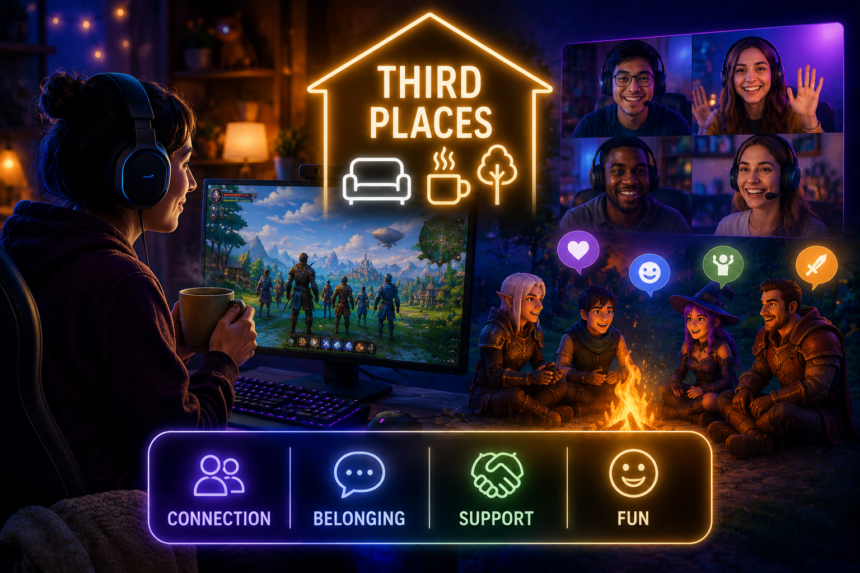
The term comes from sociologist Ray Oldenburg, who argued that a healthy social life rests on three kinds of places. The first place is home. The second place is work. And the third place is everything else: the cafe, the pub, the barbershop, the local park, the corner store where you linger and chat. Third places are where community actually happens, informally and without agenda, among people who are neither family nor colleagues.
Oldenburg identified what makes a third place work. It is neutral ground where anyone can come and go. It is a leveler, where status from the outside world matters less. Conversation is the main activity. There are regulars who give the place its character and warmth. The mood is playful and the tone is welcoming. Above all, a third place feels like a home away from home, somewhere you are known and glad to return to. These places, he argued, are not luxuries. They are essential to belonging, and their decline damages us in ways we barely notice.
The Great Vanishing of Gathering Spots
The trouble is that third places have been disappearing for decades. Suburban sprawl put distance between people and any walkable gathering spot. Rising costs made lingering somewhere without spending money harder. Longer working hours ate into free time. More recently, a general retreat indoors accelerated the trend. The casual, unplanned social contact that earlier generations took for granted, running into a neighbor, chatting with the regulars, being a familiar face somewhere, has grown scarce.
This matters because loneliness has become a widely recognized problem, serious enough that health authorities describe it in the language of a public health concern. Humans need casual, low-pressure contact with others, not just deep relationships and not just professional interaction, but the light, regular presence of a community. When the physical places that provided that presence vanish, the need does not vanish with them. It goes looking for somewhere else to be met.
How Online Games Became the New Third Place
This is where online games come in, and it is remarkable how completely certain games satisfy Oldenburg’s criteria. Consider a persistent online world, a guild in a long-running game, or even a nightly voice channel built around a game. Look at what it provides.
Regulars and a sense of belonging
The heart of a third place is its regulars, and online games are full of them. The same people log in at the same times, and over months and years they become a genuine social fabric. You notice when someone is absent. You catch up on their week. Newcomers are welcomed and slowly become regulars themselves. The guild or the server develops its own character, its inside jokes, its traditions, exactly like a beloved local pub.
Low stakes and easy conversation
Third places thrive on activity that keeps hands busy while mouths talk. A game is perfect for this. The shared task, running a dungeon, farming resources, playing a match, gives everyone something to do, which paradoxically makes conversation easier, not harder. There is no pressure to perform socially, no awkward silence to fill, because there is always the game to fall back on. People relax, and the real talk, about their lives, their worries, their days, happens naturally in the spaces between.
Why Immersion Is Part of What Makes It Work
There’s a piece of this that skeptics tend to miss entirely: the very quality of games that critics point to as evidence of unhealthy escapism, the way hours vanish while you’re playing, is actually load-bearing for the community that forms around them. A cafe conversation lasts as long as the coffee does. A game session, especially one built around flow state, the state where focus deepens and time seems to disappear, can hold a group together for hours without anyone consciously deciding to stay that long. We’ve written elsewhere about why games make time disappear in the first place, and that same absorption is exactly what gives a gaming third place more contact time, more shared history, and more chances for a real bond to form than a typical errand-length interaction at a physical third place ever could.
It’s worth being honest that this cuts both ways, and it’s part of a broader pattern in how games relate to time. Just as flow state stretches a single evening past where anyone meant to stop, the pull of a community you belong to can stretch years past where you expected to still be logging in. Our essay on what video games teach us about time digs into that tension directly: the same mechanic that builds belonging is the one that makes it hard to log off, and a healthy relationship with an online third place means being honest with yourself about which one you’re currently in.
Who You Are Where You’re Known
Third places have always done something else besides host conversation: they give people a version of themselves to be known as. The regular at the cafe isn’t performing their job title or their family role there; they’re just “the person who always orders the same thing and talks about football.” Online games do this too, often more deliberately, because a character, a guild rank, a reputation built over hundreds of hours is a genuinely separate identity from the one you carry through your workday.
For some people that’s exactly the appeal: a place where you’re known for who you choose to be, not for the role you’re stuck playing everywhere else. For others, the line between the two identities gets more complicated than that, and the game world starts asking real questions about which version of you is the more honest one. That tension is worth taking seriously rather than dismissing, and it’s the subject of our essay on what video games teach us about identity, which looks at what happens when the self you built inside a game starts to feel more real, or more yours, than the one waiting outside it.
Why This Connection Is Real
Skeptics sometimes dismiss online friendship as lesser, a pale imitation of the real thing. But the people inside these communities know better. The friendships formed in online games are frequently deep and durable. People have found their closest confidants, their partners, and lifelong friends through a shared virtual world. They have supported each other through illness, grief, job loss, and celebration. The medium of the connection does not make the connection fake.
Part of what deepens these bonds is something else third places rarely offer: shared failure. A cafe regular doesn’t usually watch you fumble something in front of everyone and try again anyway, but a raid group or a ranked team does, repeatedly, and stays. Losing together, badly, and choosing to queue up again is its own kind of intimacy, one we explore more fully in our essay on what games teach us about failure and why we keep choosing to try again. A community that has watched you fail and shown up the next night anyway is not a lesser community for having formed on a screen.
For some people, these communities are not merely convenient; they are essential. Someone who is housebound by disability, isolated in a remote area, working odd hours, or simply short on local options may find that an online game is their most reliable source of daily human contact. To tell such a person that their community “does not count” is to misunderstand both the community and the need it meets. For them, the online games community is not a substitute for a social life. It is their social life, and it is a good one.
Seeing Games Differently
Recognizing online games as third places flips the usual narrative. Instead of asking whether games are pulling people away from community, we can see that many games are providing community that the physical world increasingly fails to. The player logging in each night is often not retreating from connection but seeking it, in one of the few places still reliably offering it.
This does not mean online spaces are a perfect replacement for physical ones, or that we should stop caring about the loss of real-world gathering spots. Screens have limits, and a life lived entirely online misses much. But it does mean we should give games their due. At their best, they are not the cause of modern loneliness. They are one of the more creative and generous responses to it, a place to be known, to belong, and to come home to, built out of the very technology so often blamed for driving us apart.
Conclusion
The idea that online games isolate us tells only half the story. For countless players, the online games community is a genuine third place, meeting the same deep human need for casual belonging that cafes and pubs once did and increasingly cannot. As physical gathering spots continue to fade, these virtual worlds have quietly become social infrastructure, places where regulars gather, conversation flows, and people find themselves known. That is not an escape from real life. For many, it is one of the truest parts of it.
Frequently Asked Questions
Can online games really be a community?
Yes. Many online games function as genuine communities, complete with regulars who log in at set times, shared traditions, inside jokes, and real emotional support. Guilds, servers, and long-running virtual worlds develop a social fabric comparable to a neighborhood gathering spot, and the friendships formed there are often deep and lasting.
What is a “third place” and how do online games fit?
A third place, a term from sociologist Ray Oldenburg, is a social space apart from home and work where people gather casually, such as a cafe or pub. Online games fit because they offer neutral ground, regulars, easy conversation, low stakes, and a welcoming mood, satisfying the key features that define a third place.
Do online games help with loneliness?
For many people they do. Online games provide regular, low-pressure social contact that eases loneliness, especially for those who are housebound, remote, working odd hours, or short on local options. While not a total replacement for in-person contact, they meet a real human need for casual belonging and daily connection.
Are friendships made in online games genuine?
Yes. Friendships formed through online games are frequently deep and durable, with people finding close confidants, partners, and lifelong friends. Communities often support members through illness, grief, and major life events. The online medium of the connection does not make the relationship any less real.
Why have real-world gathering places declined?
Physical third places have declined due to suburban sprawl, rising costs of lingering somewhere, longer working hours, and a broader retreat indoors. As casual, walkable gathering spots have grown scarce, the human need for informal community has looked for new outlets, which is part of why online games have grown into that role.
Does the immersive, time-erasing quality of games help or hurt these communities?
Both, honestly. The same absorption that lets hours pass unnoticed is what gives a gaming community the extended, shared time that a real bond needs to form, but it’s also what can make it hard to know when you’ve been logging in for the community and when you’ve simply lost track of time. Being aware of which one is happening on a given night is part of having a healthy relationship with the space.
Are online communities a good substitute for in-person connection?
They are a valuable complement and, for some, an essential source of connection, but they are not a perfect substitute for physical contact. Screens have limits, and a fully online social life misses aspects of in-person presence. Still, for many people online communities provide genuine, meaningful belonging that the physical world no longer reliably offers.