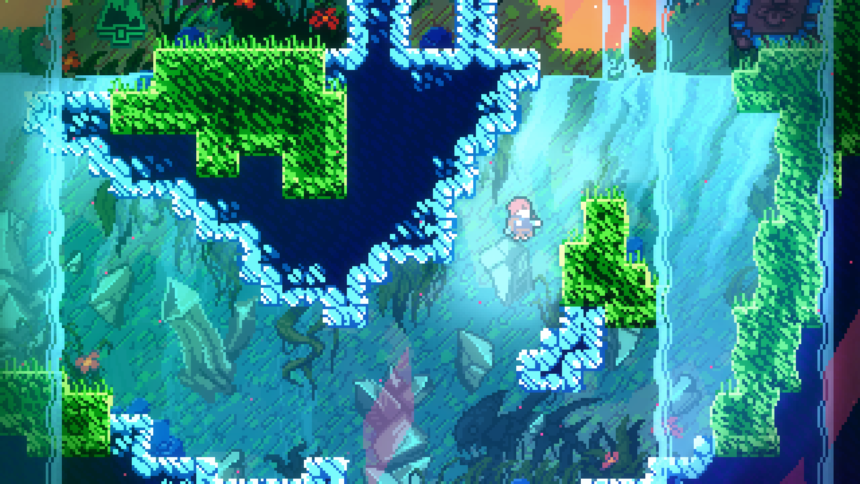


What if the mountain you’re climbing isn’t really an obstacle in front of you, but a mirror of everything you’re carrying inside?
- A Simple Game That Isn’t Simple At All
- The Mountain Isn’t the Enemy
- The Trap of “Just Be Strong”
- Dying a Thousand Times Isn’t Failing a Thousand Times
- The Weight We Carry Without Naming It
- The Summit Isn’t What You Expect
- Silence as Part of the Design
- It’s Not a Game “About” Overcoming Anxiety — It Feels Like Anxiety
- Final Thoughts: What I Took Into Real Life
That question followed me for days while I played Celeste, a small independent platformer built by a modest team of developers. I didn’t expect a pixel-art game about jumping between cliffs to teach me more about anxiety than most self-help books I’ve read. But it did — and it never once lectured me to get there. This is the strange power of the philosophy of games: sometimes the deepest lessons come not from a story told to you, but from an experience you’re forced to live through your own hands, your own failures, and your own reflexes.
This article is part of an ongoing series exploring what video games can teach us about real life. If you’re interested in gaming and philosophy, in the psychology of games, or simply in why some titles stay with us long after the credits roll, Celeste is one of the clearest examples of a game that turns mechanics into meaning.
A Simple Game That Isn’t Simple At All
On the surface, Celeste is a difficult platformer. You control Madeline, a young woman who decides, almost impulsively, to climb a mountain. You jump, grab ledges, dash through the air, and die. You die a lot. And then, almost instantly, you respawn at the same spot, ready to try again.
That single mechanic — dying and reappearing without punishment, without loading screens, without any real cost beyond trying once more — is the first clue that this game is about something bigger than climbing a mountain. Because that’s exactly how anxiety tends to work: it doesn’t destroy you all at once. It makes you fail at the same point, again and again, until you start wondering if the problem is the mountain — or you.
What makes Celeste remarkable isn’t just its tight controls or its punishing difficulty curve, both of which are genuinely well-crafted. It’s that the game translates the player’s mechanical frustration into an emotional mirror of what the character is going through. Every failed jump, every muttered curse after attempt number forty, puts you a little closer to what Madeline feels internally. The game doesn’t explain this to you. It makes you feel it.
Why Mechanics Matter More Than Dialogue
Video game philosophy often gets reduced to storytelling — cutscenes, dialogue trees, big dramatic monologues. But Celeste proves that mechanics themselves can carry philosophical weight. The rhythm of failure and retry, the low cost of dying, the immediacy of trying again: these design choices are not just about difficulty. They are the argument the game is making, delivered through your hands rather than through a script.
This is a useful distinction for anyone thinking seriously about the philosophy of video games: sometimes the message isn’t in what the characters say, but in what the systems make you do, over and over, until it becomes instinct.
The Mountain Isn’t the Enemy
Here is where Celeste breaks from the typical “overcoming adversity” narrative. In most stories about climbing a literal or metaphorical mountain, the mountain itself is the antagonist — indifferent nature, cruel fate, a challenge to be conquered through sheer willpower. Celeste takes a different, more honest approach.
At a certain point in the game, a dark mirror version of Madeline appears. She looks like Madeline, but she speaks with contempt, follows her up the mountain, and actively sabotages her progress. Without spoiling the details of the story for those who want to experience it firsthand, it’s enough to say this: that figure isn’t an external monster to defeat in combat. She is a part of Madeline. She is anxiety, self-criticism, and fear of failure, given a playable form.
This completely reframes the climb. The mountain stops being the real problem. The actual challenge — the one the entire game is built around — is learning how to relate to that other version of yourself who won’t leave your side, who can’t simply be knocked out or deleted, and who, at some point, you have to accept as part of who you are.
A Rare Kind of Honesty in Game Design
Very few stories — in games, films, or novels — manage to portray anxiety this accurately. It’s rarely an external villain you defeat in one final battle. More often, it’s an internal voice that may accompany you for a long time, maybe indefinitely. The relevant question isn’t “how do I get rid of it?” but “how do I keep climbing with it, instead of only in spite of it?”
This is where Celeste quietly aligns itself with real psychological insight, without ever using clinical language. It’s not selling a cure. It’s describing a relationship.
The Trap of “Just Be Strong”
We live surrounded by a well-intentioned but oversimplified conversation about mental health. Phrases like “just think positive,” “you can push through anything,” or “the mind is just an obstacle, overcome it” are common, motivating — and sometimes exhausting. They imply that if you’re still struggling after trying, something is wrong with you, some effort you haven’t made yet, some fix you haven’t found.
Celeste rejects that framing, subtly but firmly. Madeline doesn’t reach the summit because she becomes stronger than her anxiety, or because she stumbles on a motivational phrase that cures her overnight. She reaches it when she stops treating that dark part of herself as something to destroy, and starts treating it as something that needs to be heard, understood, and integrated.
There’s a meaningful difference — and I think this is the philosophical core of the game — between defeating something and coexisting with it. Defeating implies a war with a winner and a loser. Coexisting implies an ongoing relationship, with good days and bad days, and the acceptance that this part of you may keep showing up without that meaning you’ve failed.
Practical Example: The “Golden Feather” Moment
Without spoiling specific story beats, there’s a particular late-game sequence that mirrors a very real coping strategy used in cognitive behavioral therapy: instead of running from the anxious voice, the character is asked to face it directly, acknowledge it, and move forward anyway — not by silencing it, but by no longer letting it dictate every decision. Anyone who has done exposure-based therapy work, or simply sat with an uncomfortable feeling instead of avoiding it, will recognize the emotional logic here immediately. The game arrives at this insight through gameplay, not through a therapist’s monologue.
This connects to ideas that have circulated in philosophy for centuries and resurface today in modern psychology: the Stoic notion that we can’t control every thought or emotion, but we can choose how we relate to them. Or the more contemporary idea, common in acceptance-based therapeutic approaches, that acceptance isn’t passive resignation — it’s an active first step before real change becomes possible.
Dying a Thousand Times Isn’t Failing a Thousand Times
Another mechanical detail that becomes philosophical: in Celeste, dying carries almost no real penalty. You don’t lose significant progress, there’s no long “Game Over” screen, no harsh punishment. There is a death counter, visible at the end of the game — mine was embarrassingly high — but the game never frames dying as failure.
Dying, in Celeste, is simply part of learning the jump. It’s information. It’s “not yet, try again, you know a little more now than you did a second ago.” Stated abstractly, this sounds obvious. Experienced over dozens of hours, it feels completely different.
Real-Life Parallel: Reframing Setbacks
Think about how often we treat a mistake, a bad day, or a relapse — in a diet, a habit, a project, a relationship — as definitive proof that we’ve failed, instead of treating it as one data point in a much longer process. Celeste, without saying a single word about this directly, trains you over hours to normalize failure as part of the path rather than the end of it. And because that lesson is learned physically, through your fingers and reflexes rather than through reading, it tends to stick.
This is one of the clearest examples of how video games and mental health intersect in ways that go far beyond “relaxing” or “escapist” entertainment. Some games actively rehearse healthier emotional patterns, one attempt at a time.
The Weight We Carry Without Naming It
There’s a moment in the game — which I won’t describe in detail to avoid spoiling the experience — where Madeline has to speak honestly about what she’s really looking for by climbing this mountain. What becomes clear, without any grand speech, is that the mountain was never really about the mountain. It was about something else entirely, something she’d been carrying long before she started climbing, something with no physical form but plenty of weight.
I think most people understand this, even if they can’t always put it into words. We set goals — finishing a project, getting in shape, learning something new, moving to a new city — and assume the goal is the point. But often, underneath that goal, there’s something else: a need to prove something to ourselves, to escape something, to find something we can’t quite name yet. Celeste doesn’t solve that mystery for you. It simply shows that acknowledging it, even partially, is part of climbing the mountain — whatever your particular mountain happens to be.
The Summit Isn’t What You Expect
Without spoiling the ending, which deserves to be experienced rather than described, there’s something worth noting about the overall structure of the story: reaching the top doesn’t work like it would in a classic overcoming-adversity narrative, where arriving at the summit resolves every conflict and everything suddenly becomes perfect.
Getting to the top doesn’t erase the existence of that darker version of Madeline. It doesn’t delete her from the story. What changes is the relationship Madeline has with her. And I think that’s perhaps the most honest, least “marketable” lesson in the entire game: we don’t always “reach the summit” in the sense of permanently resolving whatever weighs on us. Sometimes reaching the summit simply means we now know how to walk alongside that weight, instead of being crushed by it.
This can sound discouraging if read too quickly, but I interpret it in the opposite way. It’s actually one of the most liberating ideas a video game has ever handed me: you don’t need to completely eliminate your anxiety, your fear, your inner critic, in order to live a full life, finish your own projects, or climb your own mountain. You need to learn how to climb with them.
Why This Matters for the Philosophy of Games as a Genre
This is exactly the kind of insight that separates surface-level “games as art” arguments from genuinely thoughtful video game philosophy. It’s not enough for a game to include a serious theme in its writing. The theme has to live in the systems — in what the player does, fails at, and repeats — for the philosophical weight to actually land. Celeste is one of the clearest modern examples of this principle done well, alongside titles like Hollow Knight (grief and isolation) or Journey (connection and impermanence), each of which uses mechanics, not just narrative, to carry its meaning.
Silence as Part of the Design
One more design choice worth highlighting before wrapping up: Celeste doesn’t explain its mechanics through long tutorial text boxes, and it doesn’t have characters lecture you about what you “should” be feeling. It puts you in front of the difficult jump, lets you fail, and trusts you to build meaning from the experience itself.
This restraint is, in itself, a philosophical stance. There’s a long tradition of thought — from certain strands of phenomenology to contemplative practices across various cultures — that holds some truths can’t be fully transmitted through direct explanation. They have to be lived to be understood. You can read a hundred articles about accepting anxiety instead of fighting it, and none of them may hit as hard as spending three hours on the same jump, failing, breathing, and finally clearing it — not because you “defeated” anything, but because you kept trying a little past the point where you wanted to quit.
This also explains why Celeste avoids heavy dramatic dialogue at its most important moments. The game trusts silence, gesture, and mechanics to say what words often ruin by over-explaining. There’s a lesson here that extends beyond the screen: not everything we feel needs a perfectly worded explanation for other people. Sometimes it’s enough to keep trying the jump, even before we know how to talk about it.
It’s Not a Game “About” Overcoming Anxiety — It Feels Like Anxiety
It’s worth being precise here, because it’s easy to oversimplify this reading: Celeste isn’t a mental health pamphlet disguised as a video game. There’s no single closed lesson, no one definitive takeaway everyone is meant to extract. What’s remarkable is that the structure of the game itself — its rhythm of failure and retry, its difficulty curve, the way it introduces that darker mirrored character as a playable part of the story rather than a generic final boss — makes the experience feel similar to what many people describe when talking about anxiety, without needing an explanatory speech to get there.
That, to me, is the real artistic achievement here: not illustrating an idea from the outside, like a diagram, but making the player inhabit it from the inside, with their body, their reflexes, the frustration and the relief that only register when you’re the one holding the controller.
Final Thoughts: What I Took Into Real Life
After finishing Celeste, I stopped seeing anxiety — mine, and that of people I care about — the same way. I stopped waiting for the day I’d “finally beat it for good,” as if it were an illness with a guaranteed cure and an expiration date. Instead, I started thinking in small jumps. Trying again after a failure, without turning that failure into a verdict on who I am. Recognizing that critical inner voice not as an enemy to destroy, but as a part of me that, maybe, just needs a little more patience.
I don’t know if this is exactly what the developers intended. Every player probably takes away something different, depending on what they’re carrying when they start the climb. But that’s ultimately what makes a video game more than entertainment: when its mechanics, story, and emotional design align so well that the player doesn’t just watch a lesson unfold — they live it, jump by jump, death by death, until they reach, in their own way, their own summit.
The mountain will still be there. The question was never how to make it disappear. It’s how to keep climbing it, one attempt at a time, without giving up on the way up.
This article is part of a series exploring the philosophy of video games — how stories, characters, and mechanics reflect real questions about identity, power, mortality, and the choices that define us. If gaming and philosophy is a topic you enjoy, more essays are on the way.