
Most games that call you a detective actually do the detecting for you. They highlight clues, connect the dots automatically, and reward you for walking to the right spot. Return of the Obra Dinn, the 2018 game from Lucas Pope, does something almost unheard of: it hands you a genuinely difficult mystery and then trusts you, completely, to solve it in your own head. There is no hint system nudging you forward. There is only a ship full of the dead, a magical pocket watch, and your own powers of observation. The result is one of the purest deduction experiences ever made.
This Obra Dinn analysis examines how the game turns the player into a real detective, why its stark monochrome art is a design masterstroke, and what makes the moment of solving each fate so uniquely satisfying.
Key Takeaways
- Return of the Obra Dinn is a deduction game where you identify the fate of 60 people using observation alone, with no hint system.
- The pocket watch lets you freeze the moment of each death, turning the ship into a puzzle of frozen scenes.
- Its 1-bit monochrome art both evokes old sea logs and cleverly focuses your attention on details that matter.
- The game verifies your answers only in batches of three, forcing genuine confidence rather than trial and error.
- Its lasting appeal is the rare feeling of solving something hard entirely with your own reasoning.
The Premise: A Ship of the Dead
You play an insurance investigator for the East India Company in the early 1800s. The merchant ship Obra Dinn, missing for years, has drifted back into port with no living soul aboard. Your job is to board her and determine what happened to all sixty souls who set sail: who died, how, and at whose hand if murder was involved. You must fill out a logbook accounting for every single person.
Your one tool is the Memento Mortem, a pocket watch that, when held near a corpse or its remains, transports you into a frozen three-dimensional tableau of the exact moment that person died. You hear a few seconds of audio leading up to the death, then step into the still scene to examine it from any angle. From these frozen moments, and only these, you must reconstruct the entire tragedy.
A Game That Refuses to Help You
The defining choice of Return of the Obra Dinn is what it withholds. There are no waypoints, no clue highlights, no character telling you what to think. The game presents the frozen scenes and steps back entirely. Whether you notice that a sailor’s tattoo matches a name in the crew manifest, or that an accent in the audio hints at someone’s nationality, or that two figures are standing in a way that reveals their relationship, is up to you.
This trust is thrilling precisely because it is so rare. When you correctly deduce that the third mate was killed by a specific crewmate, it is because you connected clues nobody pointed you toward. The game never robs you of that satisfaction by doing the reasoning on your behalf. It treats you as capable, and rises to meet you.
Verification in threes
There is one brilliant guardrail. You cannot brute-force your way through by guessing. The logbook only confirms your deductions once you have correctly identified three fates, and it confirms them as a set. This means you cannot test a single name against the game to see if it “dings.” You have to be genuinely confident about three separate people at once, which pushes you toward real reasoning rather than lucky guessing. It is a subtle, elegant way of protecting the integrity of the puzzle.
Why the Monochrome Art Is Genius

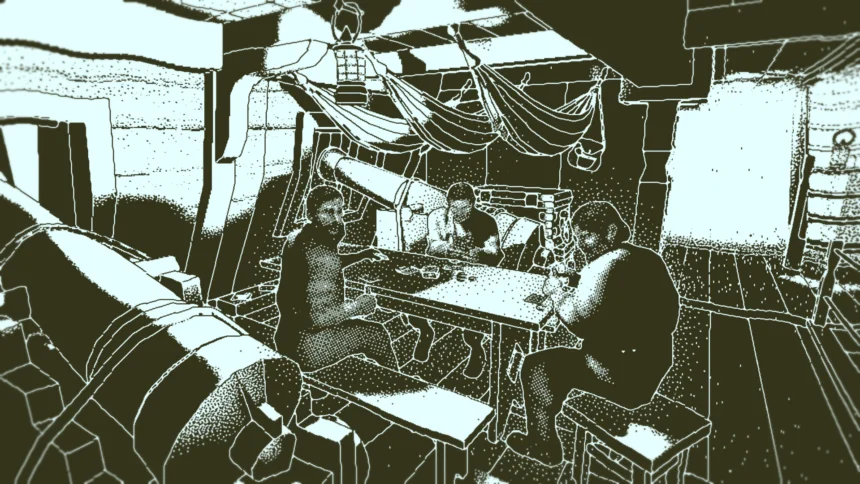
The most immediately striking thing about Obra Dinn is its look: a stark, high-contrast, 1-bit monochrome style reminiscent of early Macintosh graphics and old engraved illustrations. It is a bold aesthetic choice, but it is also a functional one.
By stripping color and detail down to dithered black and white, the game directs your attention. In a full-color, photorealistic scene, your eye would be overwhelmed by texture and lighting. In the abstracted monochrome, the things that matter, a face, a weapon, a posture, a piece of clothing, stand out with clarity. The art style is not just atmospheric window dressing; it is part of how the game teaches you to read a scene like a detective, filtering the world down to its meaningful features.
The style also does thematic work. It evokes the look of a period ledger or an old maritime engraving, grounding the supernatural premise in the dry, bureaucratic reality of an insurance claim. You are, after all, filling out paperwork about the dead, and the visuals make that eerie combination feel exactly right.
The Structure of Solving
The ship reveals itself in layers. Each death scene often contains, in its audio, a reference to another death, which unlocks a new memory to visit. So you move backward and outward through the ship’s final voyage, watching a sprawling catastrophe assemble itself out of order. Sixty people is a lot to track, and the game gives you a book with sketches of every frozen scene and a crew manifest with names and roles, but it never connects them for you.
The real gameplay happens in cross-referencing. You start with easy fates, someone clearly shot in front of witnesses, and use them to establish identities you can then apply elsewhere. If you can name three sailors in one scene, their positions might help you name a fourth in a completely different memory. Slowly the impossible becomes tractable, and the feeling of the fog lifting is the game’s central pleasure.
Why It Stays With You
What lingers about Return of the Obra Dinn is the authenticity of the accomplishment. Because the game never helped, the solution belongs entirely to you. You did not follow a marker or exhaust a dialogue tree; you looked, listened, reasoned, and concluded. In an age of games that carefully prevent you from ever being stuck, Obra Dinn dares to let you struggle, and trusts that the struggle is the reward.
It is also a quietly humane game. By the end you know sixty people by name, role, and manner of death. What began as a cold insurance ledger becomes an intimate act of witness, the restoration of identity and story to people the sea had swallowed anonymously. That transformation, from paperwork to remembrance, is the emotional undercurrent beneath the puzzle.
Conclusion
Return of the Obra Dinn is a landmark because it takes the fantasy of being a detective seriously enough to make it hard. Its frozen death scenes, its unhelpful trust, its clever verification, and its striking monochrome all serve one goal: to let you actually solve something. Few games make you feel as intelligent, and fewer still respect you enough to get out of your way and let you do the work. That respect is exactly why the solving feels so good.
Frequently Asked Questions
What kind of game is Return of the Obra Dinn?
Return of the Obra Dinn is a first-person deduction and mystery game. You play an insurance investigator using a magical pocket watch to view the frozen moments of death aboard a ghost ship, then deduce the identity and fate of all sixty crew members using observation alone, with no hint system.
How does the pocket watch work in Obra Dinn?
The Memento Mortem watch, when used near human remains, plays a few seconds of audio from the moment of that person’s death and then places you inside a frozen three-dimensional scene of that instant. You can walk around and examine the tableau from any angle to gather clues about who died and how.
Why is Obra Dinn in black and white?
The 1-bit monochrome art evokes old engravings and early computer graphics, fitting the period setting, but it is also functional. By stripping away color and clutter, it focuses your attention on the details that matter for deduction, like faces, weapons, and posture, helping you read each scene like a detective.
How do you know if your answers are correct in Obra Dinn?
The logbook confirms fates only in batches of three correct answers at once, rather than one at a time. This prevents brute-force guessing, because you cannot test a single name for a reaction. You must be genuinely confident about three separate people simultaneously, which encourages real reasoning.
Is Return of the Obra Dinn hard?
Yes, it is genuinely challenging because it offers no hints and expects you to reason through sixty interconnected fates yourself. However, it is fair: every deduction can be made from clues available in the frozen scenes, the audio, and the crew manifest, so the difficulty comes from careful observation rather than obscure logic.
How long does Return of the Obra Dinn take to finish?
Most players finish in roughly eight to twelve hours, though it varies widely with how quickly you make connections. Because the reward is the act of solving, many players prefer to work slowly and avoid guides to preserve the satisfaction of figuring it out themselves.