
What if the place you ran to was never actually far enough, because the thing you were running from was never really a place to begin with?
- A Game About Going Somewhere to Get Away From Something Else
- The Voice on the Radio
- The Trap of “A New Place Will Fix It”
- The Mystery That Isn’t Really the Point
- Henry Talks to Someone He’s Never Actually Met
- The Wilderness Doesn’t Care What You’re Running From
- An Ending That Refuses to Let You Skip the Return
- It’s Not a Game “About” Running Away — It Feels Like Realizing You Have Been
- Final Thoughts: What I Took Into Real Life
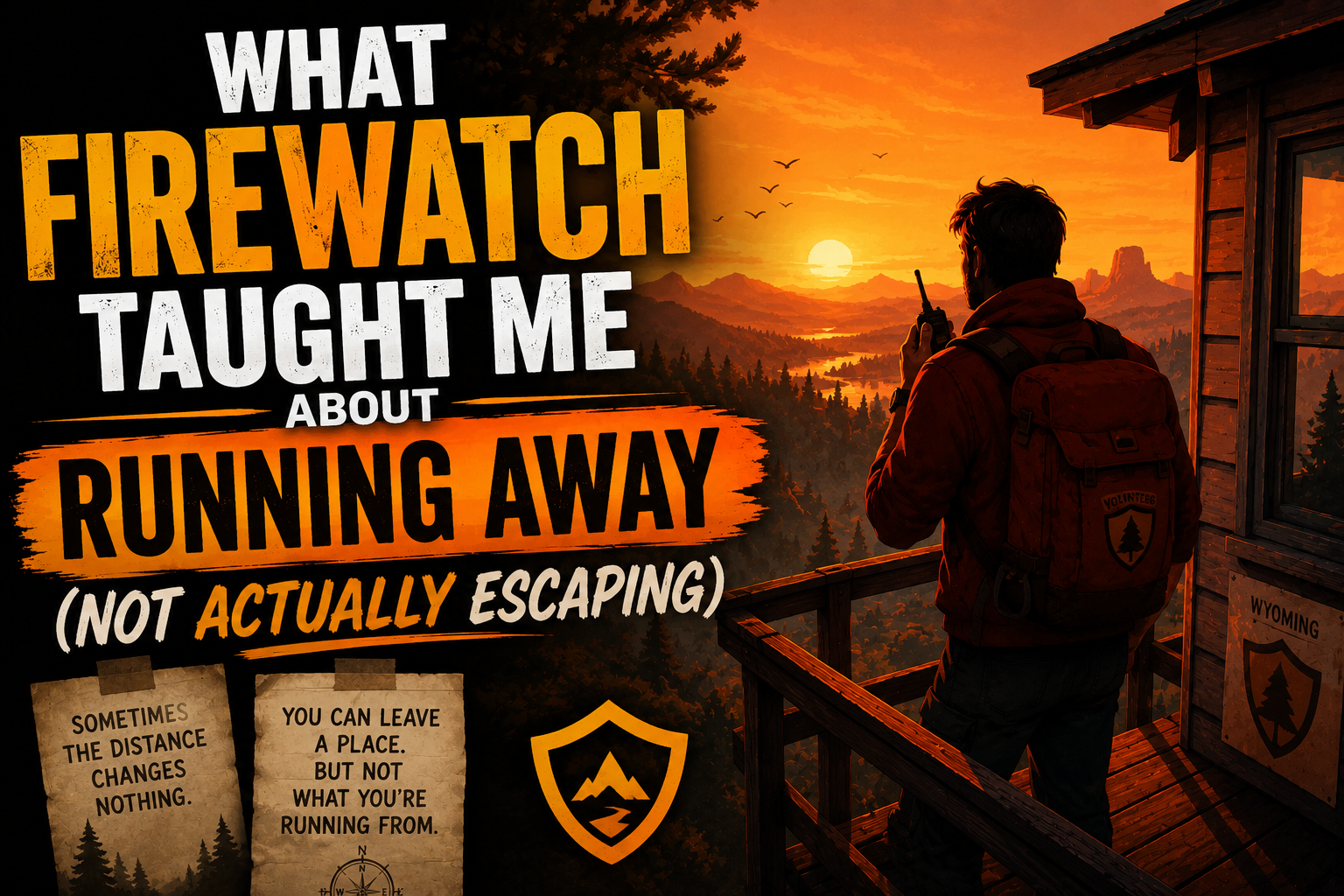
That question followed me for a long time after finishing Firewatch, a short, first-person game about Henry, a man who takes a summer job as a fire lookout in the Wyoming wilderness. On paper, it’s a mystery game — strange radio signals, a suspicious government listening post, someone possibly watching you from the trees. But underneath that mystery is a much quieter, much harder story about a man who took a job in the middle of nowhere specifically so he wouldn’t have to think about the thing he’d left behind, and who discovers, slowly, that distance was never going to be enough.
This article is part of an ongoing series exploring what video games can teach us about real life. If you’re interested in gaming and philosophy, in the psychology of games, or in why some titles stay with us long after the credits roll, Firewatch is one of the clearest examples of a game that uses genre — the mystery, the thriller — as a kind of decoy for something much more personal underneath.
A Game About Going Somewhere to Get Away From Something Else
On the surface, Firewatch looks like a straightforward premise: Henry spends a summer alone in a fire lookout tower, tasked with watching for wildfires and reporting back to his supervisor, Delilah, over a handheld radio. The wilderness is vast, quiet, and rendered with an almost aggressive warmth — golden light through pine trees, wide open ridgelines, the kind of scenery that markets itself as an escape.
The game opens, before any of this, with a short, devastating prologue delivered mostly through text: the story of how Henry got here, told through a series of choices about his life before the tower. Without spoiling the specifics, it’s fair to say that Henry didn’t take this job because he loves nature. He took it because something happened, something he couldn’t fix and could barely look at directly, and putting himself somewhere remote, somewhere with no reception, no visitors, and nothing familiar, felt like the only available response.
Why a Job in a Fire Tower Isn’t Really About Fire Towers
Most games that send a character into the wilderness treat the wilderness as the point — survival, discovery, self-reliance. Firewatch uses the wilderness as a backdrop for something else entirely: the specific, quiet delusion that changing your surroundings can substitute for changing anything about what’s actually wrong. Henry isn’t running toward a fire lookout career. He’s running away from a life he no longer knows how to be present in, and the tower is simply the farthest available option.
This is a useful distinction for anyone thinking seriously about the philosophy of video games: sometimes the message isn’t in the plot the game foregrounds, but in the quiet, structural fact of why the character is even in that plot to begin with.
The Voice on the Radio
Here is where Firewatch makes its most interesting choice: for nearly the entire game, your only real human contact is Delilah, Henry’s supervisor, whom you never actually meet in person. She exists entirely as a voice on a handheld radio, watching over her own section of the same wilderness from a different tower, miles away.
This isn’t just a budget-conscious way to deliver a two-character story. It’s the entire emotional architecture of the game. Henry and Delilah develop something real over the course of the summer — humor, trust, something that occasionally edges toward more — entirely through a device that keeps them permanently physically separate. They can talk about anything. They can never actually be in the same room. And the longer the game goes on, the more that distance starts to feel less like a limitation of the format and more like the exact thing both characters, for their own separate reasons, might actually prefer.
A Rare Kind of Honesty in Game Design
Very few games are willing to build an entire relationship on a foundation of controlled distance and let that distance remain the whole point, rather than something the story eventually resolves by bringing the characters together. Firewatch refuses that resolution almost entirely. It suggests, quietly and without lecturing, that some connections work specifically because of the distance built into them — and that recognizing this honestly is more useful than pretending every relationship is secretly working toward closeness.
This is where Firewatch quietly aligns itself with something close to real psychological insight, without ever using clinical language. Not every form of connection is incomplete just because it’s mediated, limited, or kept at arm’s length on purpose.
The Trap of “A New Place Will Fix It”
There’s a common, well-intentioned piece of advice that surfaces whenever someone is struggling: get away for a while, change your scenery, put some distance between yourself and whatever’s weighing on you. There’s real value in this, sometimes. But there’s also a quieter, more dangerous version of the same idea — the belief that distance alone, without anything else changing, will do the actual work of healing.
Firewatch spends its entire runtime testing that belief, and finds it wanting. Henry has physically removed himself about as far as a person reasonably can — no cell service, no neighbors, no reminders of his old life except the ones he brought with him in his own head. And despite all of that distance, what he’s avoiding follows him anyway, showing up in his short temper, his deflections when Delilah asks too direct a question, the way he throws himself into the tower’s minor dramas with an intensity that has very little to do with actual forest fires.
There’s a meaningful difference — and I think this is the philosophical core of the game — between distance and resolution. Distance is how far you’ve physically or emotionally put yourself from a problem. Resolution is whether you’ve actually done anything to address it. Firewatch keeps insisting, gently, that these are not the same thing, and that we default to confusing them far too often, especially when the distance feels dramatic enough to seem like progress on its own.
Practical Example: The Backstory You Choose, But Can’t Rewrite
The game’s opening sequence gives players a handful of choices about details of Henry’s life before the tower — small, specific decisions that shape how his prologue is told. What’s notable is that no matter what you choose, the outcome of that backstory arrives at roughly the same place: something happened that Henry couldn’t fix, and he left. The choices change texture, not destination. This mirrors something genuinely important about how a lot of real avoidance works: we can control plenty of details about how we tell the story of what we’re running from, but the fact of having run rarely changes based on those details. The tower is still the tower. The reason for being there doesn’t get smaller just because you got to choose how to phrase it to yourself.
The Mystery That Isn’t Really the Point
Without spoiling specific plot developments, it’s fair to say that Firewatch‘s central mystery — the strange occurrences in the woods, the sense of being watched, the increasingly tense radio conversations about who might be out there — resolves in a way that surprised, and for some players frustrated, expectations built up by the genre it borrows from. The game isn’t interested in delivering a thriller payoff for its own sake.
Real-Life Parallel: Building a Drama to Avoid a Feeling
What the mystery actually does, structurally, is give Henry and Delilah something urgent and external to focus on instead of the quieter, harder things happening internally to each of them. It’s a very recognizable pattern: manufacturing or magnifying an external crisis, consciously or not, because managing that crisis is considerably easier than sitting with whatever you actually came here to avoid. Firewatch doesn’t explain this connection out loud. It just lets players spend an entire summer chasing a mystery alongside Henry, only to notice, once it resolves, how much of the anxious energy driving it was never really about the mystery at all.
This is one of the clearer examples of how video games and mental health intersect in ways that go beyond “relaxing” or “escapist” entertainment. Some games use their own genre conventions as evidence of the exact avoidance they’re quietly critiquing.
Henry Talks to Someone He’s Never Actually Met
There’s something worth sitting with in the fact that the most emotionally honest relationship in Henry’s summer is the one conducted entirely at a distance, over a radio, with someone he has no visual confirmation of beyond her voice. Henry tells Delilah things across that radio that the game strongly implies he hasn’t told anyone else in a long time — not because the radio makes honesty easier in some magical sense, but because the specific safety of not being fully seen, not having to manage someone’s face while he says a hard thing, lowers the cost of saying it at all.
I think most people understand this instinct, even if they rarely name it directly. Sometimes it’s easier to tell a stranger something true than to tell the people closest to you, precisely because the stranger doesn’t carry the weight of everything else you’d have to manage if they reacted badly. Firewatch doesn’t moralize about whether this is a healthy long-term strategy. It just shows, with real tenderness, how much relief a person can find in it anyway.
The Wilderness Doesn’t Care What You’re Running From
Without spoiling the ending, there’s something worth noting about the overall structure of the game: the wilderness Henry retreats into never actually responds to his internal state. The fires start or don’t start regardless of what he’s avoiding. The forest doesn’t grow more beautiful when he’s finally honest with Delilah, or more threatening when he’s deflecting. It simply exists, indifferent, doing exactly what a real wilderness does regardless of who’s currently hiding in it.
This can sound like a small, almost obvious observation when read too quickly, but I interpret it as one of the more clarifying ideas a video game has ever handed me: the places we run to in order to escape a feeling were never actually going to meet us halfway. They’re not designed to heal us. They’re just there, and whatever healing happens, happens because of choices we make inside that space, not because of the space itself.
Why This Matters for the Philosophy of Games as a Genre
This is exactly the kind of insight that separates surface-level “games as art” arguments from genuinely thoughtful video game philosophy. It’s not enough for a game to include a serious theme in its marketing copy. The theme has to live in the systems — in what the game withholds, in what the environment refuses to acknowledge — for the philosophical weight to actually land. Firewatch is one of the clearer modern examples of this principle done well, alongside titles like Spiritfarer (grief and letting go) or Disco Elysium (rebuilding an identity you’re not sure you want back), each of which uses mechanics and structure, not just narrative, to carry its meaning.
An Ending That Refuses to Let You Skip the Return
One more design choice worth highlighting before wrapping up: without detailing specifics, the game’s conclusion does not allow Henry to simply remain in the wilderness indefinitely, having found peace in permanent isolation. The summer job has an end point. The season changes. Whatever Henry has or hasn’t resolved by that point, he has to actually leave the tower and return to a world he spent the entire game trying to put distance between himself and.
This refusal to offer permanent escape as a legitimate ending is, in itself, a philosophical stance. Distance was never going to be the destination — at some point, whatever anyone runs from is still going to be there when the running stops, whether that’s a season later or a lifetime later. Firewatch doesn’t pretend otherwise, and the quiet discomfort of that returning is part of what makes the ending linger.
It’s Not a Game “About” Running Away — It Feels Like Realizing You Have Been
It’s worth being precise here, because it’s easy to oversimplify this reading: Firewatch isn’t a lecture about the dangers of escapism disguised as a video game. There’s no single closed lesson, no one definitive takeaway everyone is meant to extract. What’s remarkable is that the structure of the game itself — the radio-only relationship, the mystery that quietly substitutes for a feeling, the wilderness that never once adjusts itself to Henry’s internal weather — makes the experience feel similar to what many people describe when they finally notice how much of their own “getting away from it all” was actually just delay, without needing a character to explain that realization out loud.
That, to me, is the real artistic achievement here: not illustrating an idea from the outside, like a diagram, but making the player inhabit it from the inside, through their own choices about what to say over the radio and what to keep to themselves, until the parallel becomes impossible not to notice.
Final Thoughts: What I Took Into Real Life
After finishing Firewatch, I started paying closer attention to the difference between actually processing something difficult and simply putting enough activity, distraction, or distance between myself and it that it stopped being loud for a while. Both can feel similar in the moment — the same sense of relief, the same feeling of having handled something. Firewatch taught me, gently and without ever saying so directly, that only one of those actually resolves anything, and that the other one is just borrowing time, however real and however necessary that borrowed time sometimes is.
I don’t know if this is exactly what the developers intended. Every player probably notices something a little different, depending on what they brought into the wilderness with them when they pressed start. But that’s ultimately what makes a video game more than entertainment: when its structure and its silences align so well that the player doesn’t just watch a lesson about avoidance unfold — they live it, radio call by radio call, until the season ends and they have to walk back out of the trees anyway.
The fire tower will still be there whether or not you ever go back to it. The question was never really whether the wilderness could fix what you brought into it. It’s whether you noticed, before the summer ended, what you’d actually been running from.
This article is part of a series exploring the philosophy of video games — how stories, characters, and mechanics reflect real questions about identity, power, mortality, and the choices that define us. If gaming and philosophy is a topic you enjoy, more essays are on the way.