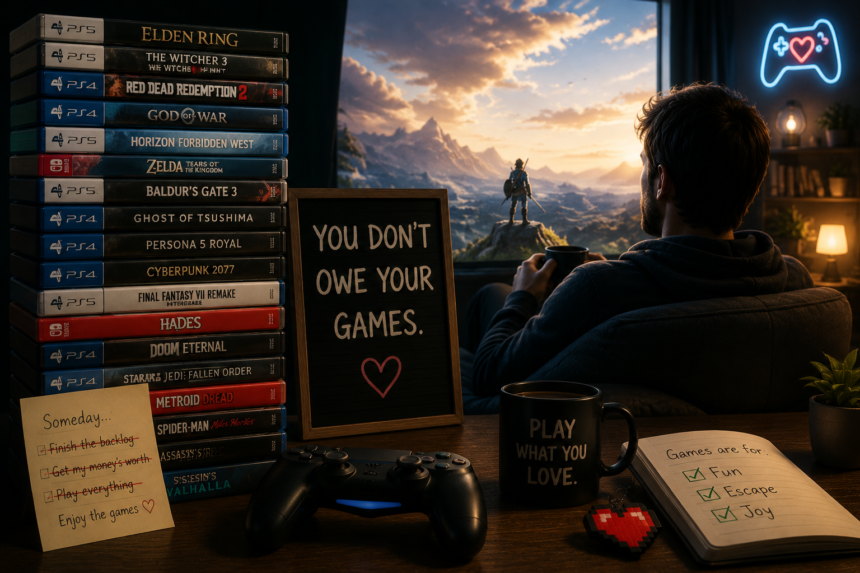

Open your game library and you will probably find it: a quiet crowd of titles you bought and never played, or started and never finished. Dozens of them, maybe hundreds, bought in sales with the best intentions and left untouched ever since. For many players this pile produces a low, persistent guilt, a sense of debt, as though each unplayed game were a small broken promise. But this guilt rests on a strange and mistaken idea about what we owe our games. The backlog is not a failure. It is a natural, even healthy, feature of loving a hobby, and it is time we stopped treating it like a moral burden.
This essay reframes the gaming backlog: why it grows, where the guilt comes from, what completionism gets wrong, how the backlog compares to piles in other media, and how to hold a mountain of unplayed games with peace instead of shame.
Key Takeaways
- The gaming backlog is a normal result of cheap sales, abundant releases, and limited time, not a personal failing.
- Backlog guilt often comes from treating games as tasks to complete rather than experiences to enjoy.
- Completionism can turn a hobby into an obligation, draining the fun it is supposed to provide.
- Buying a game can be a purchase of possibility and support, which has value even if you never play it.
- Every media hobby — books, film, television — produces the same pile, but gaming culture is unusually harsh about it.
- A healthier mindset treats the backlog as a library of options, not a to-do list of debts.
Why the Backlog Exists
The modern backlog is not a symptom of laziness or poor discipline. It is the predictable result of how gaming now works. Digital storefronts run enormous, frequent sales that make games astonishingly cheap, so buying five games for the price of one new release feels like simple good sense. Bundles and subscription services pour dozens more titles into our libraries at once. And the sheer volume of games being released, more in a single year now than most people could finish in a lifetime, means supply has vastly outstripped any individual’s capacity to consume it.
Meanwhile, the other side of the equation, our time, has not expanded at all. Adults with jobs, relationships, and responsibilities have the same limited handful of evening hours they always did. When cheap, abundant supply meets fixed, scarce time, a backlog is not just likely; it is mathematically inevitable. Everyone who takes the hobby seriously will accumulate one. There is nothing personal about it.
The Math Nobody Runs
It helps to actually run the numbers, because guilt tends to evaporate under arithmetic. Say a player buys, on average, one game a month during sales, a modest and even conservative estimate for anyone who follows storefront discounts. That’s twelve games a year. If the average game takes twenty hours to meaningfully experience, that’s 240 hours of content added annually, roughly ten full days. Against that, a working adult might realistically carve out five to eight hours a week for gaming, or 260 to 416 hours a year total, all of which also has to cover replays, live-service games, and multiplayer sessions with friends. The backlog doesn’t grow because a player is undisciplined. It grows because the hobby’s supply curve was never built to match one person’s finite hours in the first place.
Where the Guilt Comes From
If the backlog is inevitable, why does it make us feel bad? The guilt comes from a category error: we are treating leisure like labor. We look at unplayed games the way we look at an overflowing inbox or an unfinished chore list, as a set of tasks demanding completion. Each purchase becomes an obligation, and the growing pile becomes a growing debt of unfinished work.
But games are not chores, and buying one does not sign a contract to finish it. This framing imports the productivity mindset of our working lives into the one part of life that is supposed to be free of it. We start keeping score, measuring ourselves against the backlog and always coming up short. The hobby that was meant to be a refuge quietly becomes another arena for the feeling of not doing enough. The guilt is real, but it is built on a misunderstanding of what a game is for.
Digital storefronts and launchers make this worse without meaning to. A library screen that displays every unplayed title in one long grid functions, whether intended or not, as a visible ledger of unfinished business. Compare that to a physical bookshelf, where unread books sit quietly on a shelf rather than being tallied and sorted by “last played” date every time you open the app. The interface itself nudges players toward accounting rather than choosing.
What Completionism Gets Wrong
Closely tied to backlog guilt is the impulse toward completionism, the need to finish everything, to see all the content, to reach one hundred percent. In moderation this is harmless. But as a governing rule it can quietly corrupt the entire experience of play. For a deeper look at how difficulty and challenge interact with this same instinct, our essay on what “hard” games actually ask of us explores a closely related trap: chasing a metric instead of chasing the experience.
When Finishing Becomes the Goal
When completion becomes the point, the game stops being something you enjoy and becomes something you process. You stop asking “am I having fun right now” and start asking “how much is left.” Players trapped in this mindset describe grinding through content they no longer enjoy simply to be able to mark a game as done, or refusing to start a new game until they have finished the current one, as though the library were a queue that must be cleared in order.
This is the tail wagging the dog. The purpose of a game is the experience it provides, not the checkmark at the end. A game you played for ten happy hours and then set aside gave you exactly what it was for. A game you forced yourself to finish while bored gave you less, regardless of what your completion percentage says. Completionism confuses the map for the territory, mistaking the record of the experience for the experience itself.
Why Our Brains Fall for It So Easily
Part of what makes completionism so sticky is that leaving something unfinished genuinely feels uncomfortable — psychologists have long noted that people tend to remember and fixate on interrupted or incomplete tasks more than finished ones. Game design leans into this instinct constantly, through progress bars, percentage counters, and achievement lists that turn a subtle mental itch into an explicit, numeric target. None of that is an accident, and none of it is a reason to feel guilty when a bar stays at sixty percent forever. Recognizing the pull is often enough to loosen its grip; the discomfort is a design effect, not a verdict on your character.
The Value of a Game You Never Play
Here is a genuinely freeing idea: a game can have value even if you never play it. When you buy a game in a sale, you are often not really buying an obligation to complete it. You are buying possibility, the open option to play it whenever you like, a door that is now yours to walk through at any time. That optionality has real worth, the same way a well-stocked pantry has worth even though you will not eat everything in it tonight.
There is also the matter of support. Buying a game, especially from a smaller developer, is a small act of patronage that helps sustain the people making the art you love. That contribution is complete at the moment of purchase. Whether or not the game ever leaves your backlog, you helped it exist and helped its creators keep working. That is not wasted money; it is a modest investment in the medium itself.
There’s a third, quieter form of value too: a backlog is a record of who you were when you bought each game. The strategy title you picked up during a curious phase, the cozy farming sim you grabbed after a hard week, the acclaimed drama you meant to sit with properly — each purchase is a small artifact of a mood or an intention, even the ones that never got opened. Looked at that way, an unplayed library isn’t empty; it’s a kind of diary.
How This Compares to Other Media
Gaming is not actually unique in producing an unplayed pile. Readers keep towering “to be read” stacks. Streaming subscribers maintain watchlists hundreds of titles deep that they will realistically never clear. Music fans save thousands of songs to playlists they will never fully hear. Every hobby built on abundant, cheap, easily acquired content produces the same overflow, because the underlying math — abundant supply, fixed time — is identical across all of them.
| Medium | Common name for the pile | Typical size | Cultural attitude |
|---|---|---|---|
| Books | To-be-read (TBR) pile | Dozens to hundreds | Often romanticized, even aestheticized on social media |
| Film & TV | Watchlist | Hundreds | Mildly self-deprecating, rarely shameful |
| Music | Saved playlists | Thousands of tracks | Barely acknowledged as an issue at all |
| Video games | Backlog | Dozens to hundreds | Frequently treated as a personal failing or wasted money |
What’s striking is how differently gaming culture treats its version of the pile. A reader who admits to an enormous, growing TBR stack is often met with warmth, even envy, as a sign of good taste and curiosity. A gamer who admits the same thing about their library is far more likely to hear jokes about wasted money or lack of discipline. The behavior is identical across all four columns above; only the surrounding culture around gaming has decided to treat it as evidence of failure rather than evidence of enthusiasm.
A Healthier Way to Hold the Backlog
The shift that dissolves backlog guilt is simple to state and surprisingly powerful to practice: stop seeing your library as a to-do list and start seeing it as a collection of options. A backlog is not a debt you owe; it is a wealth of choices you get to enjoy. When you sit down to play, the pile is not accusing you of everything you have not finished. It is offering you a wonderful problem, the luxury of deciding what you are in the mood for tonight from an embarrassment of riches.
From this angle, a large backlog is a sign of a rich hobby, not a mismanaged one. It means you will never lack for something to play, that a game perfectly suited to any mood is always within reach. The unplayed games are not reproaches. They are promises the future is free to keep or not, entirely at your pleasure. And if some of them are never played at all, that is fine. A library, like a life, is allowed to contain more than any one person could ever get through.
Three Small Habits That Make the Pile Feel Lighter
None of these are productivity hacks in disguise — they’re just ways of relating to the library that stop it from feeling like an accusation:
- Play by mood, not by queue. Choose your next game the way you choose a meal, based on what sounds good right now, rather than working through the library in purchase order or “oldest first.”
- Let go of the sunk cost. A game that isn’t working for you after a few hours doesn’t owe you the rest of its runtime, and you don’t owe it your remaining evenings. Setting it back down is not a loss; it’s simply the experience you were meant to have with it.
- Stop counting. Completion trackers and percentage counters can be genuinely fun for some players, but if checking yours produces dread rather than curiosity, it’s a tool that has stopped serving you. There is no rule requiring you to keep score of your own hobby.
Interestingly, some of the deepest satisfaction in gaming doesn’t come from finishing at all, but from the state of total absorption while playing — the sense that time itself has slipped away. Our essay on flow state gaming and why games make time disappear digs into that feeling directly, and it’s worth noting that flow has almost nothing to do with completion percentages. A two-hour session that produces real flow is a better use of a backlog than twenty hours of obligated grinding ever could be.
Frequently Asked Questions
Why do gamers buy games they never play?
Players accumulate a gaming backlog mainly because of frequent, deep sales, bundles, and subscription services that make games cheap and abundant, combined with limited free time. When affordable supply vastly exceeds the hours available to play, a backlog becomes essentially inevitable rather than a sign of poor discipline.
Why do I feel guilty about my gaming backlog?
Backlog guilt usually comes from treating leisure like labor. When you view unplayed games as tasks demanding completion, each purchase feels like an obligation and the pile feels like debt. This imports a productivity mindset into a hobby meant for enjoyment, creating guilt based on a misunderstanding of what games are for.
Is completionism bad?
In moderation it is harmless, but as a strict rule it can drain the fun from gaming. When finishing becomes the goal, players grind through content they no longer enjoy just to mark a game as done. This confuses the record of an experience with the experience itself, undermining the purpose of play.
Does a game have value if I never finish it?
Yes. Buying a game purchases possibility, the open option to play it anytime, which has real worth much like a stocked pantry. It is also an act of support that helps developers keep creating, and it can function as a small record of the mood or curiosity that led you to buy it. That value is complete at purchase, regardless of whether the game is ever finished or even started.
How can I stop feeling bad about unplayed games?
Reframe your library as a collection of options rather than a to-do list. A backlog is not a debt you owe but a wealth of choices you get to enjoy, ensuring you always have something suited to your mood. Seen this way, a large backlog reflects a rich hobby, and leaving some games unplayed is perfectly fine.
Should I finish one game before buying another?
There is no rule that says you must. Treating your library as a queue to clear in order can turn a hobby into an obligation. It is healthier to play whatever you are in the mood for and to buy games that interest you without pressure, accepting that no one can play everything and that this is normal.
Is a backlog unique to gaming, or does this happen with books and movies too?
It happens everywhere. Readers keep to-be-read piles, streaming viewers keep watchlists hundreds of titles long, and playlists fill with songs that never get played. Every hobby with cheap, abundant content produces the same overflow. Gaming culture is simply unusual in treating its version of this pile as a personal failing rather than, as with books, a sign of curiosity and good taste.
Conclusion
The gaming backlog is not evidence of failure, weak willpower, or wasted money. It is the natural outcome of abundant, affordable games meeting the fixed limits of a full life, and the guilt it produces comes from wrongly treating play as work. Games are experiences to be enjoyed, not tasks to be completed, and a purchase can be worthwhile as possibility and as support even if the game is never touched. Let the pile grow without shame. It is not a debt. It is a library, and having more than you can read has always been one of the quiet joys of loving something.