
A Hero With No Face, No Name (Until You Give Them One)
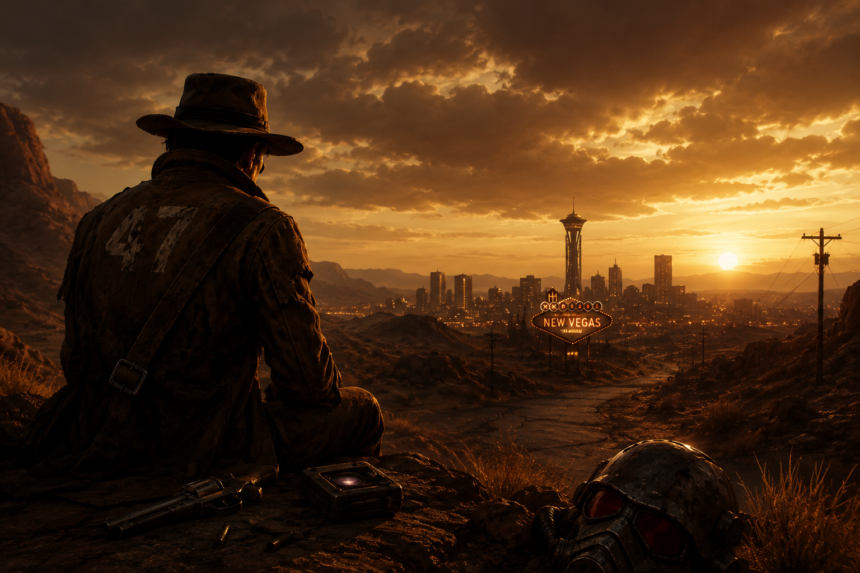
Ask ten Fallout: New Vegas players to describe their Courier, and you’ll get ten completely different people. One is a chem-addled gunslinger who shot their way across the Mojave. Another is a soft-spoken diplomat who never fired a single bullet outside self-defense. Another burned every faction to the ground and crowned themselves ruler of New Vegas. All of them will tell you, without irony, “that’s my Courier” — as if the character were a real person they knew intimately rather than a handful of stats and dialogue choices.
That reaction is the whole story. The Courier, the protagonist you control in Obsidian’s 2010 role-playing classic, begins the game shot in the head, left for dead in a shallow grave, and given essentially nothing else. No fixed personality. No scripted backstory beyond “you were delivering a package.” No voice, in the literal or figurative sense. And yet this near-blank slate is consistently ranked among the most compelling characters in gaming — not despite the emptiness, but because of it.
This piece digs into why that works: the power of the silent protagonist as a design choice, how New Vegas turns the player into the actual author of the character, why the game’s factions make that authorship mean something, and what all of this teaches us about roleplay as a medium. If you’re interested in how games build memorable protagonists more broadly, it’s worth comparing the Courier against other character studies in this series — from the imposed identity of Booker DeWitt’s fractured self across every version of himself to the quiet, obedience-shaped tragedy of Arthur Morgan’s life spent following orders. Each approaches the question of “who is this protagonist, really?” from a completely different angle.
Key Takeaways
- The Fallout New Vegas Courier is an intentionally blank protagonist the player defines through choices rather than scripted personality.
- The silent protagonist design shifts authorship away from the writers and onto the player.
- New Vegas’s richly built factions give the Courier’s decisions genuine weight, reshaping the fate of an entire region.
- The freedom to roleplay wildly different characters — saint, tyrant, mercenary, idealist — is the game’s central strength.
- A deliberately empty character can, counterintuitively, produce deeper personal attachment than a fully written one.
The Blank Slate That Isn’t Empty
The Courier arrives in the Mojave with almost nothing predefined. You get a rough starting point: a package to deliver, a bullet that nearly killed you, and a grudge waiting to be picked up or set down. Who was the Courier before that shot? Why do they keep walking into danger? Are they driven by revenge, curiosity, greed, idealism, or plain survival instinct? The game refuses to answer for you.
That refusal sounds like a lack of characterization, but in practice it’s the opposite. A blank slate isn’t empty — it’s an invitation. Because the writers won’t define the Courier, the player rushes to fill that space, and the character who emerges belongs entirely to them. One player’s Courier is a ruthless profiteer who works every angle for caps. Another’s is a wandering do-gooder trying to stitch a broken wasteland back together. A third trusts no faction and seizes the throne of New Vegas for themselves. All three are canonically “the Courier,” because the Courier is, by design, whoever you decide to make them.
This is a different kind of blankness than a truly empty character, though. It’s closer to the deliberately open frameworks used elsewhere in the medium — think of how Senua’s internal world in Hellblade is shaped as much by the player’s interpretation as by the script, or how 2B in NieR: Automata explores identity stripped of memory. The Courier sits at the far end of that spectrum: almost no imposed interiority at all, just a canvas and a set of tools.
The Silent Protagonist as a Design Choice
The Courier’s near-silence — expressed through selectable dialogue rather than a fully voiced, directed performance — is central to this effect, and it reflects a real design philosophy with genuine tradeoffs. A voiced, heavily written protagonist can deliver a more cinematic, emotionally directed story. But every line that character speaks is a line the player didn’t choose: a small imposition of someone else’s idea of who they are.
Projection Versus Performance
A silent or lightly voiced protagonist trades cinematic polish for something arguably more valuable in an RPG: room for projection. When the Courier doesn’t speak in a fixed voice, players imagine the tone, the intent, the personality behind every choice themselves. The character becomes a vessel the player inhabits, not a performance the player merely watches from the outside. This is exactly why roleplay purists tend to prefer this approach — it keeps authorship in their hands and sustains the fantasy that they aren’t playing a character so much as being one.
New Vegas leans hard into this idea. Dialogue options are gated by your skills, your reputation, and the background choices you made at the start of the game, so the words available to you reflect the character you’ve actually built. A Courier with high Intelligence, or a specific skill threshold, or a particular Wild Card trait unlocks lines nobody else can access — meaning identity here is expressed through what the game lets you say and do, not through a predetermined personality baked into a voice actor’s performance.
Compare that to a fully authored protagonist like Joel Miller in The Last of Us, whose defining moral choice is scripted and fixed regardless of what the player might have preferred. That’s not a flaw — it’s a different tool built for a different job. Joel’s story needs a specific, resonant ending; the Courier’s story needs a thousand possible ones.
Why the Factions Make It Matter
A blank protagonist would mean very little without meaningful choices to define them, and this is where New Vegas genuinely excels. The game builds its world around several major factions competing for control of the Mojave and Hoover Dam, each with a coherent ideology, real strengths, and real moral flaws:
- The New California Republic (NCR) — a democratic institution stretched thin by bureaucracy, corruption, and overextension, but still recognizably trying to rebuild civilization through consent rather than force.
- Caesar’s Legion — a brutal, slaving pseudo-Roman empire that offers order and stability purchased at an appalling human cost.
- Mr. House — a technocratic autocrat who wants to preserve New Vegas as his personal project, offering prosperity in exchange for near-total control.
- Independent New Vegas / Yes Man — the option to reject all existing power structures and hand New Vegas’s future to the Courier alone.
No side is obviously correct. Each faction presents a plausible vision for the future and asks you to weigh its promises against its costs. This is the arena where the Courier’s character is truly written. Deciding who to support, who to betray, and who to destroy isn’t cosmetic flavor text — it determines the fate of entire communities and reshapes the region’s future for good. Because the factions are so fully realized and so morally tangled, choosing between them forces you to decide what your Courier actually believes, and the game honors those beliefs with dramatically different, consequential outcomes.
It’s a similar mechanism, structurally, to how games explore obligation and inherited debt elsewhere — Aloy’s burden of being someone else’s second chance in Horizon Zero Dawn asks what you owe to a legacy you didn’t choose, while New Vegas asks what you owe to a region you stumbled into by accident. Both use consequence as a way of making abstract values concrete.
The Freedom to Be Anyone
The lasting appeal of the Fallout New Vegas Courier is the sheer breadth of who the game allows you to be. It supports radically different playstyles and moral stances without quietly punishing you for choosing an unconventional one. You can talk your way through nearly the entire main quest without firing a shot, or you can fight through everything with a machete and a grudge. You can play a savior, a tyrant, a neutral opportunist, or a pure agent of chaos. You can side with an authoritarian order in the name of stability, fight for messy freedom under the NCR banner, or reject every established power in favor of something entirely your own.
Crucially, the game takes each of these choices seriously and follows them through to distinct, reactive conclusions — reflected in the famous slideshow ending that tracks the consequences of nearly every major decision you made. This is what players actually mean when they praise New Vegas’s roleplay systems: not just that choices exist, but that the game respects the character those choices imply and reflects it back through the world itself. The Courier isn’t one story. They’re thousands of possible stories, and the freedom to author your own is the entire point.
What the Courier Teaches About Roleplay
The Courier is a case study in a particular theory of character: that in an interactive medium, the deepest attachment can come not from a brilliantly written protagonist, but from a deliberately open one the player fills in themselves. We tend to assume richer, more clearly defined characters are always the stronger choice. The Courier suggests that assumption doesn’t always hold. Players form fierce, personal bonds with their Couriers precisely because those characters are, in part, self-portraits — closer to a diary entry than a screenplay.
This doesn’t mean silent protagonists are categorically superior to written ones. They simply serve different goals. A defined character — a Joel, an Arthur Morgan, a Sephiroth — lets a writer tell a specific, emotionally resonant story with real narrative teeth. A blank character lets the player tell their own story instead. New Vegas chose the latter path and executed it well enough that its Courier remains a genre benchmark: proof that sometimes the most memorable character in a game is the one the game trusted you to build.
Conclusion: The Courier Was Always You
The Courier of Fallout: New Vegas is a masterclass in restraint. By refusing to define its protagonist, the game hands authorship over to the player, and — backed by richly realized factions and genuinely consequential choices — turns that freedom into some of the most meaningful roleplay the medium has ever produced. The Courier is a story written in silence, built out of your own decisions and beliefs, and the character who emerges belongs entirely to you.
That’s why, more than a decade later, players still talk about their Courier in the present tense, like an old friend or an old self. Because in the end, the Courier was never really a character at all. The Courier was you.
If you’re exploring how other games build protagonists worth remembering, browse more entries in our Characters series — including deep dives into Sephiroth’s enduring myth in Final Fantasy 7 and GLaDOS, gaming’s funniest villain who was never really joking.
Frequently Asked Questions
Who is the Courier in Fallout: New Vegas? The Fallout New Vegas Courier is the player-controlled protagonist, introduced being shot in the head and left for dead in the Mojave Desert. Deliberately undefined, the Courier has no fixed personality or motivation, letting the player author who they are entirely through choices, dialogue, skills, and which factions they ultimately support.
Why is the Courier a silent protagonist? The Courier’s near-silence is a deliberate design choice that keeps authorship with the player. Without a fully voiced, predetermined personality, players can project their own tone and intent onto the character, inhabiting the Courier rather than watching a scripted performance unfold. It’s a core part of the game’s deep role-playing focus.
How does Fallout: New Vegas let you roleplay so freely? New Vegas ties dialogue and available options to your skills, reputation, and background choices, so your character’s identity is expressed through what you’re actually able to say and do in the moment. Combined with morally complex factions and consequences that stick, this lets you play radically different characters — from savior to tyrant to neutral opportunist — and have the game take every one of them seriously.
Why are the factions in New Vegas so important to the Courier’s story? The factions give the Courier’s choices real weight. Each one — the NCR, Caesar’s Legion, Mr. House, and the Independent path — competes for control of the Mojave with a coherent ideology and genuine flaws, and none of them is clearly “correct.” Deciding who to support determines the fate of entire communities and the region’s future, which forces you to work out what your Courier actually believes.
Is a blank protagonist better than a fully written one? Neither approach is universally better — they serve different storytelling goals. A written protagonist lets developers tell one specific, tightly directed story. A blank protagonist like the Courier lets players author their own. New Vegas shows that a deliberately open character, backed by meaningful and consequential choices, can create attachment just as deep as — sometimes deeper than — a fully scripted hero.
Why do players love their Courier so much? Players form unusually strong bonds with their Courier because the character is partly a self-portrait, shaped by their own values and decisions rather than a writer’s script. Because the game respects those choices and reflects them back through distinct, personal outcomes, each Courier becomes its own private story — which is exactly why players remember their version of the character so vividly, years after finishing the game.