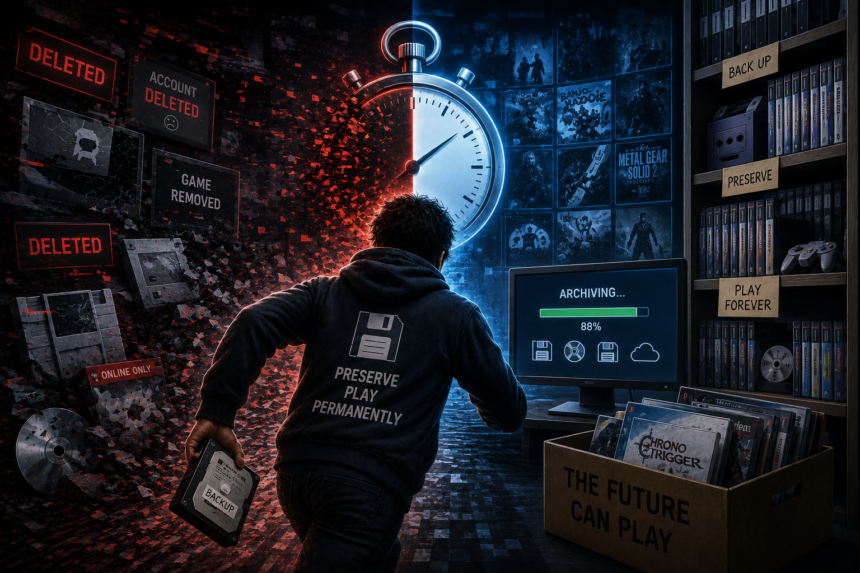

Imagine if a significant share of all films ever made were simply gone, not lost to some ancient catastrophe but deleted in living memory, unplayable on any current device, removed from every legal store, erased when a company decided they were no longer profitable. This would be recognized as a cultural disaster. Yet this is roughly the situation gaming faces right now. A large and growing portion of the medium’s history is difficult or impossible to access legally, and more of it disappears every year. Video game preservation is not a dusty archival concern; it is an active race against deletion, and at the moment, deletion is winning.
This piece examines the crisis of video game preservation: why so many games vanish, how digital ownership and server shutdowns accelerate the loss, and why saving gaming’s history is harder, and more urgent, than most people realize.
Key Takeaways
- Video game preservation is failing, with a large share of gaming history already difficult or impossible to access legally.
- Games are uniquely fragile because they depend on specific, perishable hardware, software, and licensing.
- The shift to digital distribution means players often license rather than own games, which can be revoked.
- Server shutdowns can render online games completely unplayable, erasing them entirely.
- Without deliberate preservation efforts, vast portions of the medium’s cultural history risk being lost forever.
Why Games Are So Fragile
Other art forms have durable, well-understood ways of surviving. A book can sit on a shelf for centuries and still be read. A painting endures as a physical object. Films and recordings, though more technically dependent, are actively archived and restored by institutions that recognize their value. Games have none of this stability by default, because they are uniquely bound to technology.
A game is not just content; it is software that requires specific hardware, operating systems, and sometimes online infrastructure to run at all. When that hardware becomes obsolete, when the operating environment changes, when the servers go dark, the game can stop functioning entirely. Layered on top of this technical fragility is a thicket of licensing: the music, the engine, the third-party components, all governed by agreements that expire and complicate any effort to keep a game available. A game is a delicate assembly of perishable parts held together by contracts, and when any critical piece fails, the whole thing can vanish. This fragility is inherent to the medium, and it means that games, left alone, do not survive. They rot.
The Problem With Digital Ownership
The industry’s shift from physical media to digital distribution brought real convenience, but it fundamentally changed what it means to own a game, and that change is central to the preservation crisis. When you bought a physical game, you owned a copy, a tangible object that remained yours regardless of what any company later decided. You could keep it, lend it, resell it, and play it as long as the hardware survived.
You are licensing, not owning
In the digital era, you typically do not own the games you buy in that older sense. You purchase a license, a permission to access the game under terms set by the storefront, and that permission can be limited or revoked. Games get delisted and removed from stores, sometimes disappearing even from the libraries of people who paid for them. The comforting assumption that a digital purchase is permanent turns out to be shaky. Because access depends on a company’s continued willingness and ability to provide it, a game you “bought” can become unavailable through no fault of your own. This dissolves the individual redundancy that physical copies once provided, where millions of durable objects in millions of homes quietly preserved a game even after its makers moved on. When everything routes through central, revocable digital access, that natural safety net disappears.
When the Servers Go Dark
The most absolute form of deletion afflicts online games. Many modern titles depend entirely on developer-run servers to function; without them, there is no game to play. When a company decides to shut those servers down, often because the game is no longer profitable enough to maintain, the game does not merely become inconvenient to access. It ceases to exist in any playable form.
This is a categorically harsher loss than an old single-player game gathering dust on obsolete hardware, because at least that game still exists somewhere and could, in principle, be revived. A server-dependent game that has been shut down is simply gone, and no amount of owning the disc or the download will bring it back. Entire worlds that millions of people inhabited, with their own communities, histories, and cultural significance, can be switched off and erased permanently at a corporate decision. As more of the industry moves toward always-online and live service designs, this vulnerability grows. We are building an ever-larger share of gaming culture on foundations that can be demolished at will, leaving nothing behind.
Why Preservation Is So Hard
If the stakes are this clear, why is preservation not simply handled? The obstacles are substantial. The technical work of keeping old games runnable, through emulation and other means, is genuinely difficult and requires ongoing effort and expertise. Legal barriers are even thornier: copyright and licensing law often make the very act of preserving a game, copying it, archiving it, making it accessible, legally fraught, even when no one is profiting and the game is otherwise unavailable. Institutions that would preserve games frequently find themselves hamstrung by rules written for other kinds of property.
There is also a problem of will and value. Much of the industry has historically treated games as products with a commercial shelf life rather than as cultural artifacts worth keeping, which means preservation is chronically underfunded and deprioritized. Dedicated archivists, libraries, and passionate communities do heroic work, but they are fighting against both the physical decay of the medium and a legal and commercial environment that often treats their efforts with suspicion. The result is that preservation depends heavily on the labor of people working at the margins, often without clear legal footing, to save what the system is happy to let disappear.
What We Lose
It is worth being clear about what is actually at stake, because “preservation” can sound abstract. Games are a major art form and an enormous part of contemporary culture. They are how countless people have played, connected, and made meaning; they reflect the technology, values, and creativity of their eras; they are studied, loved, and remembered. To lose them is to lose a genuine part of our shared cultural record, the way losing early films or recordings would be.
And the loss is not evenly distributed. The famous, profitable games have the best chance of survival through remasters and re-releases, but the vast body of smaller, stranger, niche, and simply unlucky games, many of which are historically or artistically important precisely because they were unusual, are the most likely to vanish without a trace. A history preserved only through commercial viability is a distorted history, remembering the blockbusters and forgetting everything else. Future generations may find that huge stretches of the medium’s story are simply blank, not because the games were unimportant, but because no one had the right or the resources to save them in time.
Conclusion
Video game preservation is one of the most urgent and least appreciated issues facing the medium. Games are inherently fragile, bound to perishable hardware and tangled licensing; the shift to digital distribution has replaced durable ownership with revocable access; and server shutdowns can erase entire online worlds completely. Against these forces stand only underfunded institutions and dedicated volunteers, often without clear legal support. This is a genuine race against deletion, and much has already been lost. Treating games as the cultural artifacts they are, and building the legal and institutional structures to save them broadly rather than selectively, is the only way to ensure that the history of this remarkable medium survives for the people who come after us.
Frequently Asked Questions
What is video game preservation?
Video game preservation is the effort to keep games playable and accessible over time, protecting them from being lost as hardware becomes obsolete, stores delist titles, and servers shut down. It treats games as cultural artifacts worth saving, much as libraries and archives preserve books and films, but it faces far greater technical and legal obstacles.
Why are video games so hard to preserve?
Games are uniquely fragile because they are software bound to specific hardware, operating systems, and sometimes online servers, all of which can become obsolete or disappear. They also involve complex licensing for music, engines, and components that complicates archiving. When any critical piece fails, a game can stop functioning entirely.
Do you really own digital games you buy?
Usually not in the traditional sense. Most digital purchases grant a license, a revocable permission to access the game under a storefront’s terms, rather than ownership of a permanent copy. Games can be delisted and removed, and access depends on a company’s continued willingness to provide it, so a purchased game can become unavailable.
What happens when game servers shut down?
For games that depend entirely on developer-run servers, a shutdown makes them completely unplayable, effectively erasing them. Unlike an old single-player game that still exists on obsolete hardware, a server-dependent game that is switched off is simply gone, and owning the disc or download cannot bring it back.
Why doesn’t the industry just preserve old games?
Preservation faces major obstacles. The technical work of keeping games runnable is difficult, copyright and licensing law often make archiving legally fraught even for unavailable games, and much of the industry treats games as products with a shelf life rather than cultural artifacts. As a result, preservation is chronically underfunded and left largely to volunteers.
What do we lose if games are not preserved?
We lose part of our shared cultural record. Games reflect the creativity and values of their eras and are loved, studied, and remembered by millions. The loss falls hardest on smaller, niche, and unusual games, which are often the most historically important, meaning a preservation system driven only by commercial viability would leave future generations with a distorted, incomplete history.