
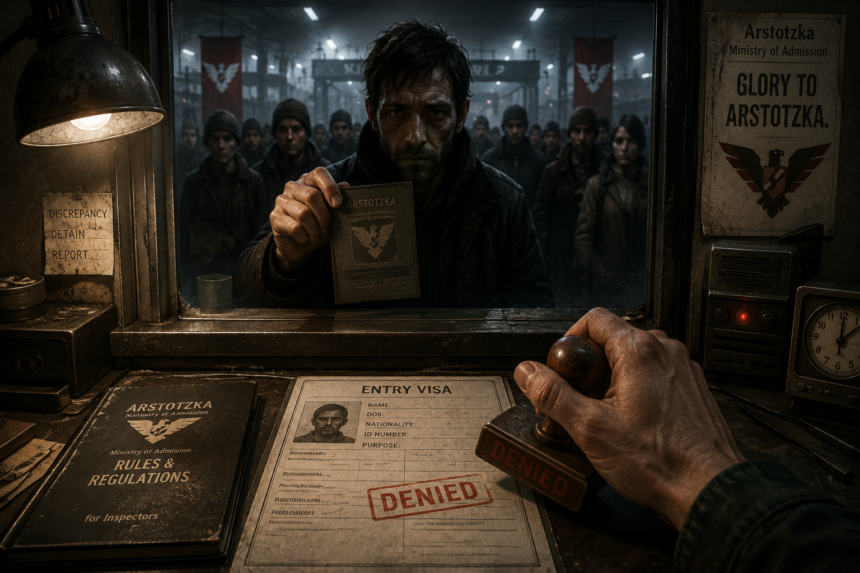

There is a particular kind of dread that Papers, Please manufactures out of almost nothing: a desk, a stamp, a stack of documents, and a queue of faces that never stops moving. You are Inspector, a border control officer for the fictional communist state of Arstotzka, and your job is simple in the way that only bureaucracy can make something simple: check the papers, compare the photo to the face, cross-reference the entry permit against the day’s ever-changing rulebook, and either stamp the passport with an approval or a denial. Do it well enough and your family eats. Do it badly, too slowly, or too generously, and they don’t.
- Key Takeaways
- A Job That Trains You Not to See People
- The Economics of Complicity
- A Rulebook That Grows Like a Living Thing
- Twenty Endings, and Almost None of Them Feel Like Winning
- The Discomfort Is the Point
- The Player Behind the Desk
- What the Game Asks of the Player After the Credits Roll
- How Papers, Please Talks to Other Games About Systems and Complicity
- A Genre of One, Still Unmatched
- Conclusion
- Frequently Asked Questions
What Lucas Pope built with this premise is not really a game about a border checkpoint. It is a game about how ordinary people become complicit in systems they know are wrong, delivered not through cutscenes or moral speeches but through the accumulated weight of a hundred small, tired decisions made under a countdown clock. This Papers, Please analysis looks at how the game turns paperwork into one of the most effective moral experiments gaming has ever produced, and why the discomfort it creates says more about the player than about Arstotzka.
Key Takeaways
- Papers, Please uses tedious, repetitive bureaucratic labor as its primary tool for moral commentary, rather than dialogue trees or dramatic set pieces.
- The game’s central tension is economic: every rule you break to help someone costs your family money you may not have, which makes complicity a survival strategy rather than a character flaw.
- Its rulebook grows more absurd and contradictory over time, mirroring how real authoritarian bureaucracies expand faster than any single official can track.
- The 20 possible endings are mostly variations on failure or quiet, unremarkable survival, which is itself the game’s argument about what “success” looks like inside an unjust system.
- The game’s greatest trick is making the player complicit in its politics through mechanics alone, proving that systems, not just villains, are what make atrocity possible.
A Job That Trains You Not to See People
The genius of Papers, Please begins with its interface. Every day at the checkpoint, a new document lands on your desk: a passport, sometimes an entry permit, sometimes a work visa or a diplomatic authorization, each with names, dates, photographs, and seals that must all line up correctly. Your job is to catch the discrepancies. A birth date that doesn’t match the ID card. A city of issue that no longer exists after a border redrawing. A photo where the applicant’s face is a few degrees off from their passport picture. You have a rulebook, and every day the rulebook gets a little longer.
What this design does, deliberately, is train you to stop looking at faces and start looking at documents. Early in the game, you might read a traveler’s face, notice they seem nervous, wonder about their story. By day eight or nine, with the line backing up and the clock ticking down toward your daily quota, you stop noticing faces almost entirely. You process paperwork. The person standing at the window becomes, functionally, a set of fields to verify: name, date of birth, issuing city, expiration date, next.
This is not a bug in the player experience. It is the entire thesis of the game, expressed through mechanics rather than narration. Hannah Arendt’s phrase “the banality of evil,” coined to describe how Adolf Eichmann organized genocide through paperwork and scheduling rather than personal hatred, is the obvious intellectual ancestor here, and Pope has said as much in interviews about the game’s inspiration. Papers, Please doesn’t ask you to imagine what it might feel like to become a small, willing gear in an authoritarian machine. It puts you at the desk, hands you the stamp, and lets the tedium do the rest.
The Economics of Complicity
If the paperwork is the game’s method, the family budget is its engine. At the end of every shift, you’re taken to a small apartment where you allocate your day’s wages toward rent, heat, food, and medicine for your wife, son, mother-in-law, and eventually a nephew and his family, all of whom depend on the money you make stamping passports. Miss too many discrepancies and your pay is docked. Detain someone incorrectly, or let a wanted criminal through, and the fines stack up. Run out of money and someone in your household gets sick, or cold, or simply doesn’t make it.
This is the mechanism that separates Papers, Please from a simple morality puzzle. The game never asks you, in the abstract, “would you deny an old woman entry because her papers are one day expired?” It asks you that question while your son has a cough that’s getting worse and you’re seventy credits short of the clinic fee. Every act of mercy, every bent rule to let a desperate traveler through, has a real and immediate cost that lands on people you’re nominally trying to protect. The game makes you choose, over and over, between the abstract good of a stranger and the concrete survival of your family, and it refuses to pretend that choice is easy or that either answer is clean.
This is where the game’s political argument sharpens into something genuinely uncomfortable. It would be simple to condemn a border guard who enforces cruel laws without hesitation. It is much harder to condemn one who is barely keeping his own children fed, and who has been told, correctly, that his job exists specifically because thousands of desperate people are trying to cross this border and someone has to decide who gets through. Papers, Please doesn’t let you feel superior to Inspector. It puts you in his chair and lets the rent come due.
A Rulebook That Grows Like a Living Thing
Part of what makes the moral pressure in Papers, Please so effective is how the rules themselves evolve. On day one, the requirements are simple: check the passport, confirm the photo matches, stamp it. By the middle of the game, you’re cross-referencing entry permits against work visas, checking vaccination certificates against a list of approved diseases, running fingerprint scans against a database of known criminals, and scanning bodies for smuggled contraband with an increasingly invasive set of tools, all while a new rule interrupts your shift roughly once a day.
This escalation is not just a difficulty curve. It’s a remarkably accurate simulation of how bureaucratic control tends to expand in the real world: incrementally, in response to specific crises, each addition justified on its own terms, until the cumulative system is so complex that no single official can hold the entire rulebook in their head at once, let alone question whether it still makes sense as a whole. A rule introduced to stop a specific terrorist plot stays in place long after the plot is resolved. A vaccination requirement meant to control an outbreak becomes a permanent checkpoint for citizens of an entire nation, regardless of their individual health.
The game never editorializes about this directly. It simply keeps handing you more forms, more cross-references, more reasons a stamp might be wrong, until the sheer cognitive load of the job becomes its own kind of moral anesthetic. You stop asking whether a rule makes sense and start asking only whether you’re applying it correctly, because that’s the only question you have time left to answer.
Twenty Endings, and Almost None of Them Feel Like Winning
Papers, Please has twenty possible endings, and the striking thing about nearly all of them is how little they resemble victory. Some are unambiguous tragedies: your family starves, your son dies of an illness you couldn’t afford to treat, you’re arrested for corruption, or you’re executed for aiding the wrong person at the wrong border crossing. Others are quieter and stranger: you’re recruited by a resistance organization plotting against the Arstotzkan government, or you defect across the border yourself and start a new, uncertain life elsewhere.
Even the “good” endings rarely feel like triumphs. Getting your family through the month with everyone fed and housed is presented with the same flat, understated tone as every other outcome in the game — a brief slideshow, a short caption, no fanfare. There’s no ending where Inspector dramatically dismantles the system, exposes its corruption, or is rewarded for moral courage with anything resembling justice. The best you can typically hope for is survival, unremarked and unrewarded, having done your job well enough within a system that was never designed to be beaten, only endured.
This design choice is, itself, an argument. Real bureaucratic complicity rarely ends in dramatic reckoning. Most people who participate in unjust systems don’t get a villain’s comeuppance or a hero’s redemption arc. They get by, month after month, and the system continues largely unchanged around them, adjusting its rules and its enemies but never fundamentally its structure. Papers, Please refuses to give the player a cathartic ending because catharsis would be a lie about how these systems actually work.
The Discomfort Is the Point
What separates Papers, Please from most games that attempt political commentary is that it never tells you what to think about Arstotzka, its government, or your own role within it. There’s no character who delivers a monologue about the evils of authoritarianism. There’s no clearly signposted “good” path that rewards you with better outcomes for taking moral stands. The game presents a system, hands you a functional role within it, and lets your own choices accumulate into whatever verdict you end up delivering on yourself.
This is precisely why the discomfort the game produces is so effective. Players who breeze through denying every questionable applicant, hitting their quota, and keeping their family comfortable often report a specific, unpleasant self-recognition partway through: a moment where they realize they’ve stopped hesitating before rejecting someone, stopped reading the small paragraph of context some travelers offer about why they need to cross, and started optimizing for throughput the way any tired worker eventually optimizes for throughput. The game doesn’t accuse you of this. It simply creates the conditions where it happens, and waits for you to notice.
Other players go the opposite direction, bending rules constantly to let sympathetic cases through, and find themselves bankrupting their own family in the process, unable to afford medicine or heat because they kept choosing strangers over their own household’s survival. Neither path is presented as correct. The game’s real subject isn’t Arstotzka’s politics; it’s the shape of the compromises ordinary people make when a system puts survival and ethics in direct, daily competition, and how quickly the calculus of “just this once” becomes a habit indistinguishable from policy.
The Player Behind the Desk
It’s worth dwelling on why this particular game gets under people’s skin in a way that more overtly dramatic political games often don’t. Games that want to say something about authoritarianism frequently reach for spectacle: a villain monologuing about order and control, a resistance movement with a charismatic leader, a climactic choice where you either join the uprising or crush it. Papers, Please has almost none of that. Its most memorable moments are things like realizing you’ve denied someone entry without reading their explanation, or noticing that you’ve started to feel irritated at travelers for slowing down your queue, rather than sympathetic toward whatever crisis brought them to your checkpoint in the first place.
That irritation is worth sitting with, because it’s not scripted. The game doesn’t force it on you through dialogue or a forced choice. It emerges naturally from the mechanical pressure of the quota system, the same way real burnout emerges from real jobs that ask people to process human beings as caseloads. Pope’s design insight here is genuinely uncomfortable: he understood that the fastest way to make a player complicit in something is not to explain why it’s wrong and then ask them to do it anyway, but to structure the incentives so that doing it becomes the path of least resistance, and let the player discover on their own, mid-shift, that they’ve stopped noticing.
This is also why Papers, Please resists being reduced to a simple statement like “authoritarian systems are bad” or “bureaucracy dehumanizes people.” Those are true, but they’re not really what the game is arguing. Its sharper, harder claim is that most people who participate in dehumanizing systems are not monsters and are not even, most of the time, making a conscious choice to be cruel. They are tired, underpaid, watching a clock, and trying to keep a roof over people they love. The system doesn’t need to convince anyone that cruelty is good. It only needs to make cruelty slightly more convenient than kindness, often enough, for long enough, that the difference stops registering.
What the Game Asks of the Player After the Credits Roll
There’s a specific kind of unease that follows players out of Papers, Please, one that outlasts the ending screen and the closing statistics. It’s the recognition that the choices which felt so weighted inside the game — deny this traveler, detain that one, look the other way just this once — were choices made under conditions engineered to be survivable only through some measure of moral compromise. And it’s the harder, quieter question the game leaves behind: how different, really, is that from the compromises made inside plenty of real institutions, where the stakes are lower but the underlying pattern, incentive structures nudging ordinary people toward small cruelties, is exactly the same.
Few games manage to turn a player’s own instinctive efficiency against them this precisely. Papers, Please doesn’t need you to be a bad person to make its point. It only needs you to be a competent one, doing your job reasonably well under pressure, and it lets that competence become the thing you have to reckon with once the shift finally ends.
How Papers, Please Talks to Other Games About Systems and Complicity
Papers, Please sits in an interesting conversation with other games that use mechanical repetition to make an emotional or moral point rather than relying on cutscenes to do the work. In our analysis of Hades, we looked at how Supergiant turned the roguelike death loop into the emotional spine of a story about persistence and family reconciliation — repetition there becomes warmth, because the world remembers you and rewards you for returning. Papers, Please uses the same fundamental tool, repeated daily labor, toward the opposite emotional end: repetition here becomes numbness, the slow erosion of empathy through sheer procedural fatigue. Both games understand something that a lot of interactive storytelling misses, which is that what you do, over and over, shapes you more than what you’re told.
There’s also a clear kinship with Disco Elysium’s interrogation of the self, another game that uses its systems to ask uncomfortable questions about ideology and complicity, though from almost the opposite angle: where Disco Elysium externalizes your internal contradictions into arguing voices in your own head, Papers, Please externalizes systemic contradiction into a rulebook that keeps growing beyond anyone’s ability to fully understand it. Both games trust the player to sit with ambiguity rather than resolving it neatly, and both are stronger for refusing easy answers.
And there’s a quieter connection to the observational, detective-like attention Papers, Please demands, which shares real DNA with the meticulous cross-referencing at the heart of Return of the Obra Dinn. Both games turn careful, patient scrutiny of documents and details into the primary verb of play. But where Obra Dinn makes that scrutiny feel like the satisfying click of a puzzle solving itself, Papers, Please makes the same kind of scrutiny feel like a trap slowly closing, because the thing you’re being asked to examine so carefully is another human being’s right to safety, and the stakes of getting it wrong are never abstract.
A Genre of One, Still Unmatched
Since Papers, Please released in 2013, plenty of games have borrowed its surface mechanics: the desk, the stamp, the stack of documents, the slow drip-feed of new rules. Very few have matched what made the original work, because the imitators often mistake the paperwork for the point, when the paperwork was always just the delivery mechanism for an argument about complicity, survival, and the moral compromises that bureaucratic systems quietly extract from the people who staff them.
What makes Lucas Pope’s design endure is how completely form follows function here. A game about the numbing power of repetitive procedural labor had to actually be repetitive and procedural to make its argument honestly, and that’s a genuinely difficult needle to thread: tedious enough to produce the intended numbness, but engaging enough that players stay with it long enough to feel that numbness set in and recognize it for what it is. Pull that thread too far in either direction and the whole experiment collapses, either into a boring chore nobody finishes or a slick puzzle game that never earns its moral weight. Papers, Please sits in exactly the narrow space where both halves of that equation work at once, and more than a decade later, that specific achievement remains largely unrepeated.
Conclusion
Papers, Please doesn’t ask you to imagine what it would be like to participate in an unjust system from a safe, hypothetical distance. It puts a stamp in your hand, a family’s survival on your desk, and a clock counting down over your shoulder, and it lets the accumulated weight of small daily decisions do what no cutscene or speech ever could: implicate you, quietly and specifically, in exactly the kind of compromise the game is examining. The horror it produces isn’t in Arstotzka’s dystopian politics. It’s in how quickly and unremarkably you might find yourself becoming good at your job.
Frequently Asked Questions
What is Papers, Please actually about? On the surface, Papers, Please is about working as a border control inspector in the fictional authoritarian state of Arstotzka, checking travelers’ documents against an expanding rulebook. Underneath, it’s an exploration of how ordinary people become complicit in unjust systems through the accumulation of small, survival-driven compromises rather than dramatic moral failures.
How many endings does Papers, Please have? The game has 20 possible endings, ranging from tragic outcomes like family illness or arrest to quieter, morally ambiguous paths like defection or recruitment by a resistance movement. Almost none of the endings feel like clear victories, which reflects the game’s broader argument about what survival within an unjust system actually looks like.
Is Papers, Please based on a real country? Arstotzka is fictional, but its aesthetic and political structure draw heavily on Soviet-era Eastern European bureaucracies, and the game’s themes of expanding surveillance, quota-driven labor, and moral compromise are deliberately applicable well beyond any single real-world regime.
Why does the game make you manage a family budget? The family budget mechanic ties every moral decision to a concrete economic cost, ensuring that acts of mercy toward strangers directly compete with your own family’s survival. This design choice is central to the game’s argument that complicity often arises from genuine constraint and fear, not simple cruelty or indifference.
Is Papers, Please difficult to play? Mechanically, the game is approachable: checking documents and stamping passports is simple to learn. The difficulty lies in the accumulating cognitive load of an ever-growing rulebook and the emotional weight of the choices it forces, rather than in traditional gameplay challenge like combat or reflexes.
What makes Papers, Please different from other narrative games about morality? Unlike games that deliver moral commentary through dialogue choices or scripted story beats, Papers, Please embeds its argument entirely in repetitive mechanical labor. The game never tells the player what to think; it creates conditions under which players observe their own choices accumulating into a verdict on themselves, which is what makes its commentary land as experience rather than instruction.
This piece reflects one writer’s interpretation of Papers, Please and its themes; other readings of the game are equally valid, and we’d genuinely like to hear yours. This article discusses story and thematic content in detail and may be considered spoiler-heavy for readers who haven’t finished the game. The Ludic Mind publishes critical and philosophical analysis of video games for informational and editorial purposes; views expressed are the author’s own and do not necessarily reflect the opinions of the game’s developers or publisher.