
What if the thing stopping you from resting was never a lack of time, but a quiet belief that you haven’t earned it yet?
- A Farm That Never Actually Asks You to Hurry
- The Myth of the Productive Day
- The Trap of “You Rest When You’ve Earned It”
- An Unfinished Field Isn’t a Failed Day
- A Town That Doesn’t Need You to Be Perfect
- The Season You Can’t Skip
- Slowness as Part of the Design
- It’s Not a Game “About” Rest — It Feels Like Permission
- Final Thoughts: What I Took Into Real Life
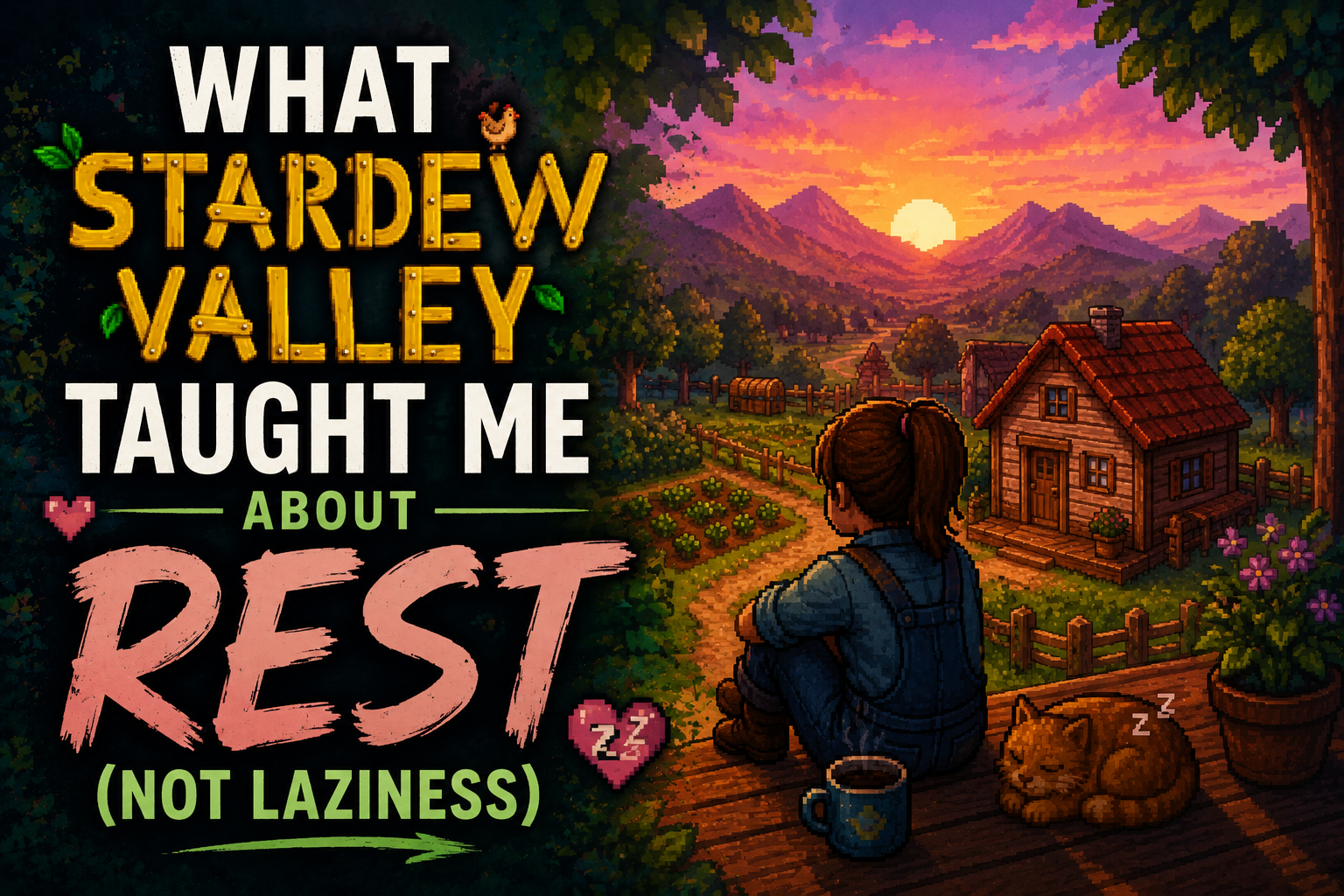
That question sat with me for an entire in-game year while I played Stardew Valley, a farming sim built almost single-handedly by one developer, ConcernedApe. I went in expecting a relaxing way to pass a few evenings. I didn’t expect a game about watering crops and fixing fences to quietly dismantle the way I think about productivity, worth, and rest. It never lectures you about it. It just hands you a clock, a farm, and lets your own habits do the talking. This is the strange power of the philosophy of games: sometimes the deepest lessons don’t arrive through dialogue, but through the small, repeated choices a system asks you to make, day after day.
This article is part of an ongoing series exploring what video games can teach us about real life. If you’re interested in gaming and philosophy, in the psychology of games, or simply in why some titles stay with you long after you’ve closed the app, Stardew Valley is one of the clearest examples of a game that turns a daily routine into a meditation on rest.
A Farm That Never Actually Asks You to Hurry
On the surface, Stardew Valley looks like a game about efficiency. You inherit a run-down farm, and the obvious goal seems to be turning it into a thriving operation as fast as possible: more crops, more animals, more upgrades, more gold. Every morning starts with a fresh set of hours on the clock, and every evening ends the same way — you pass out, either in bed or, if you pushed too far, face-down in a field.
That collapse mechanic is the first clue that this game is about something bigger than farming. Because that’s exactly how burnout tends to work: it doesn’t announce itself. It waits until you’ve quietly ignored every earlier signal, and then it simply takes the decision out of your hands.
What makes Stardew Valley remarkable isn’t its crop-growing mechanics on their own, satisfying as they are. It’s that the game translates your own instinct to optimize every minute into a genuine cost. Stay out too late chasing one more chore, and you lose energy, drop items, wake up depleted the next day. The game doesn’t explain this to you. It makes you feel the bill arrive.
Why the Clock Matters More Than the Harvest
Video game philosophy often gets reduced to story beats and dialogue choices. But Stardew Valley proves that a clock — a simple, ticking, unskippable clock — can carry philosophical weight on its own. The in-game day doesn’t stretch to fit your ambitions. It ends, whether or not you’re finished, whether or not you feel ready.
This is a useful distinction for anyone thinking seriously about the philosophy of video games: sometimes the message isn’t in what a character says, but in what the system quietly refuses to let you avoid, no matter how good your excuses are.
The Myth of the Productive Day
Here is where Stardew Valley breaks from the typical “hustle culture” simulation. In most life-sim or management games, more output is unambiguously good — bigger numbers, faster growth, no real downside to squeezing out one more task. Stardew Valley takes a quieter, more honest approach.
Push your character past their energy limit and you don’t get extra output. You get diminishing returns, then penalties, then a forced collapse that costs you money and steals the next morning from you entirely. The game never frames this as a moral failure. It simply, mechanically, shows you the price of ignoring your own limits — and lets you decide, the next day, whether you’ll do it again.
This completely reframes what “a good day” even means in the game. The actual challenge isn’t clearing every task on the farm before sundown. It’s learning to read your own energy bar the way you’d read any other honest signal, and choosing to stop before it forces you to.
A Rare Kind of Permission in Game Design
Very few systems — in games or in real life — actually reward stopping. Most productivity tools, most calendars, most jobs are built around the assumption that more is always better, that rest is what’s left over once everything else is done. Stardew Valley quietly disagrees. It builds rest into the architecture of the day itself, not as an afterthought, but as a resource you’re expected to manage with the same care as your gold or your crops.
This is where the game aligns with something closer to real behavioral science than to self-help slogans: rest isn’t the reward for finishing. It’s one of the conditions that makes finishing anything sustainable at all.
The Trap of “You Rest When You’ve Earned It”
We live surrounded by a well-intentioned but exhausting idea: that rest has to be earned, that stopping before everything is done is a kind of cheating. Phrases like “I’ll relax once this is over” or “there’s no time to slow down right now” are common, motivating in small doses — and quietly corrosive over months and years, because “everything” is rarely, truly done.
Stardew Valley rejects that framing without ever saying so directly. Your farm is never finished. There is always another field to till, another relationship to deepen, another mine level to explore, another season pulling everything you planted out from under you. If rest depended on completion, you would genuinely never rest at all.
There’s a meaningful difference — and I think this is the philosophical core of the game — between earning rest and scheduling rest. Earning implies a finish line that keeps moving. Scheduling implies treating rest as a fixed, non-negotiable part of the day, the same way you’d treat watering the crops or feeding the animals.
Practical Example: The “Bed You Can Just… Go To”
Without needing to spoil any specific storyline, there’s a mechanic worth calling out directly: at any point, on any day, you can simply walk home and go to sleep, task list unfinished, chores half-done. Nothing punishes you for choosing to stop early besides the mild, forgettable loss of a little unclaimed time. Anyone who has sat down at the end of a long day and felt guilty for closing the laptop before the inbox hit zero will recognize the emotional logic of that bed immediately. The game arrives at this insight through a menu option, not through a therapist’s monologue.
This connects to ideas that show up across both ancient and modern thinking about work: the Stoic distinction between what is and isn’t within our control, and the more contemporary idea, common in discussions of sustainable productivity, that rest isn’t the opposite of discipline — it’s one of its ingredients.
An Unfinished Field Isn’t a Failed Day
Another mechanical detail that becomes philosophical: in Stardew Valley, leaving tasks unfinished carries almost no narrative weight. The game doesn’t scold you. There’s no “Day Failed” screen for the crops you didn’t water or the fences you didn’t mend. Tomorrow simply arrives, and those same crops are usually still there, a little thirstier, entirely forgiving.
An unfinished field, in Stardew Valley, is just tomorrow’s task. It’s not evidence of falling behind. It’s just how a long season actually works. Stated plainly, this sounds obvious. Experienced over dozens of in-game days, it feels like something you have to unlearn.
Real-Life Parallel: The To-Do List That Never Empties
Think about how often we treat an unfinished to-do list, an unanswered email, or an unfolded pile of laundry as proof that we’re behind, instead of treating it as the ordinary residue of an ordinary life. Stardew Valley, without saying a single word about this directly, trains you over hours to stop expecting a day where everything is done — and to stop needing that in order to feel okay about how you spent your time.
This is one of the clearer examples of how video games and mental health intersect in ways that go beyond simple relaxation. Some games actively rehearse a healthier relationship with unfinished business, one ordinary evening at a time.
A Town That Doesn’t Need You to Be Perfect
There’s a quieter thread running through the game, separate from the farm itself: the town of Pelican Valley and its residents. You can befriend them, help them, ignore them for weeks at a time, or show up late to their events — and the world absorbs all of it. Relationships grow slowly, unevenly, in the gaps between farm work, not despite them.
I think most people recognize this pattern, even if they rarely say it out loud. We treat our own inconsistency — with friends, with hobbies, with rest itself — as a character flaw, something that needs fixing before we’re allowed to feel good about it. Stardew Valley doesn’t ask for consistency. It asks for return. Show up again tomorrow, imperfectly, and the relationship keeps building anyway.
The Season You Can’t Skip
Without spoiling the specifics of how the game’s calendar unfolds, there’s something worth noting about its overall structure: winter arrives every single year, and most crops simply can’t grow in it. The game doesn’t let you optimize your way out of a season built for less output.
That forced slowdown doesn’t ruin the farm. It doesn’t erase a single season of progress that came before it. What it does is quietly insist that a period of reduced output is not a crisis — it’s part of the same cycle that made the harvest possible in the first place. And I think that’s perhaps the least “hustle-friendly” lesson in the entire game: growth isn’t supposed to be constant. Some seasons are for planting. Some are for waiting.
This can sound discouraging if read too quickly, but I read it the opposite way. It’s one of the more liberating ideas a video game has ever handed me: you don’t need every month, every week, every day to be equally productive in order for the whole year to add up to something. You need to let winter be winter.
Why This Matters for the Philosophy of Games as a Genre
This is exactly the kind of insight that separates surface-level “games as art” arguments from genuinely thoughtful video game philosophy. It’s not enough for a game to mention rest or burnout in a line of dialogue. The theme has to live in the systems — in the clock, the energy bar, the forgiving fields, the unskippable winter — for the philosophical weight to actually land. Stardew Valley is one of the clearest modern examples of this principle done well, alongside titles like Animal Crossing (patience and impermanence) or Outer Wilds (living with a deadline), each of which uses mechanics, not just narrative, to carry its meaning.
Slowness as Part of the Design
One more design choice worth highlighting before wrapping up: Stardew Valley never rushes you through a tutorial explaining why rest matters, and it never has a character lecture you about self-care. It puts you on a farm, lets the days pass at their own pace, and trusts you to notice, eventually, what happens when you don’t.
This restraint is, in itself, a philosophical stance. There’s a long tradition of thought — from certain strands of Stoicism to contemplative practices across various cultures — that holds some truths can’t be fully transmitted through direct explanation. They have to be lived to be understood. You can read a hundred articles about the importance of rest, and none of them may land as clearly as watching your own character collapse in a field because you decided, one more time, that the last chore couldn’t wait.
This also explains why the game rarely draws attention to its own quieter mechanics. It trusts repetition, not speeches, to make its point. There’s a lesson here that extends beyond the screen: sometimes the thing you need to understand isn’t a sentence you read once, but a pattern you have to notice yourself, across enough ordinary days, before it actually changes anything.
It’s Not a Game “About” Rest — It Feels Like Permission
It’s worth being precise here, because it’s easy to oversimplify this reading: Stardew Valley isn’t a wellness pamphlet disguised as a farming sim. There’s no single closed lesson, no one definitive takeaway everyone is meant to extract. What’s remarkable is that the structure of the game itself — its ticking clock, its forgiving fields, its unskippable winter, its bed that’s always just a walk away — makes the experience feel like permission, without needing an explanatory speech to get there.
That, to me, is the real achievement here: not illustrating an idea from the outside, like a diagram, but letting the player arrive at it from the inside, through their own choices about when to stop, made and remade across dozens of ordinary in-game days.
Final Thoughts: What I Took Into Real Life
After a full year on that farm, I stopped treating rest as something I had to justify. I stopped waiting for the day my own list would finally be empty enough to deserve a break, as if that day were ever actually coming. Instead, I started thinking in seasons. Some weeks are for pushing. Some are for letting the field sit fallow, without turning that pause into evidence that I’m falling behind.
I don’t know if this is exactly what the developer intended. Every player probably takes away something different, depending on what they’re carrying when they pick up the hoe for the first time. But that’s ultimately what makes a video game more than entertainment: when its systems are honest enough that the player doesn’t just hear a lesson about rest — they live it, day by day, season by season, until stopping stops feeling like failure.
The farm will still be there tomorrow. It always is. The question was never how to finish it. It’s how to walk home before dark, even when you haven’t.
This article is part of a series exploring the philosophy of video games — how stories, characters, and mechanics reflect real questions about identity, power, mortality, and the choices that define us. If gaming and philosophy is a topic you enjoy, more essays are on the way.