
Is it actually possible to stay neutral in a world on fire, or is “staying neutral” just another word for choosing whoever benefits from you doing nothing?
- Who Is Geralt, Really?
- The Witcher’s Code as a Design Choice, Not Just a Backstory
- Ciri: The One Relationship Neutrality Can’t Survive
- An Ending Without a Clean Verdict
- Mutation as Metaphor: Being Feared for What Was Done to You
- Geralt’s Relationships as Moral Evidence
- What Geralt Teaches Us About the Limits of Staying Above It All
- Conclusion: Why Geralt Remains One of Gaming’s Most Quietly Radical Characters
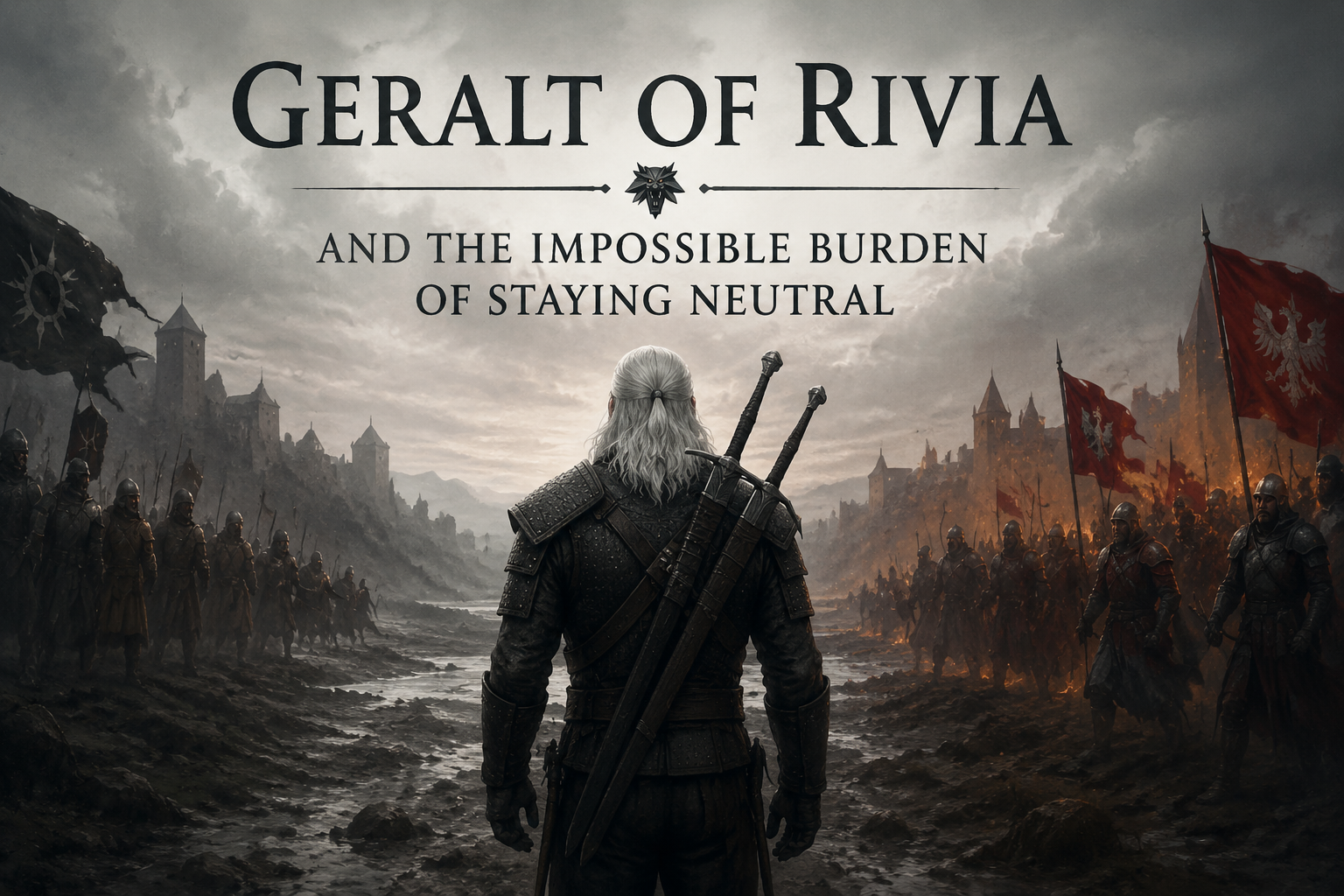
That’s the question The Witcher 3: Wild Hunt keeps circling back to through Geralt of Rivia, a mutant monster hunter who insists, constantly, that he doesn’t take sides in wars, politics, or the moral disputes of “ordinary” people. He’s just there for the monster, the coin, and the next contract. And yet almost every quest in the game exists specifically to prove that this stance is a fiction Geralt tells himself, one the world keeps refusing to let him keep.
This piece isn’t a review or a walkthrough. It’s a look at Geralt as a case study in what happens when a person builds an entire identity around refusing to choose, and life keeps handing him situations where refusing to choose is itself the choice.
Who Is Geralt, Really?
On the surface, Geralt is a Witcher: a genetically and alchemically mutated monster hunter, trained from childhood, feared by the very villagers who hire him, and bound by a professional code that supposedly keeps him out of human conflicts. Underneath that surface, he’s someone who has spent his entire adult life performing detachment as a survival strategy, in a world that punishes him socially for existing and would punish him further if he ever admitted how much he actually cares.
What makes Geralt compelling isn’t his swordsmanship or his monster-hunting expertise. It’s that nearly every meaningful choice in his story reveals the gap between the neutral mercenary he claims to be and the person who keeps, against his own stated principles, showing up for people he has no professional obligation to help.
The Central Tension: Can Neutrality Ever Actually Be Neutral?
Geralt’s core conflict isn’t monsters versus humans. It’s a much older and more uncomfortable question: whether choosing not to intervene in a conflict is itself a kind of intervention, one that quietly favors whoever already holds power.
This is a genuinely old philosophical problem, and The Witcher 3 doesn’t dress it up in fantasy language to soften it. Political philosophy has wrestled for centuries with the idea that declared neutrality in the face of injustice tends to protect the status quo, because doing nothing rarely affects everyone equally. Geralt’s story keeps testing this idea directly: he insists he’s neutral, and the game keeps constructing situations where his neutrality has a body count.
The Witcher’s Code as a Design Choice, Not Just a Backstory
One of the more overlooked design decisions in The Witcher 3 is how often the game gives Geralt dialogue options that let the player perform strict professional neutrality — refusing payment adjustments, declining to comment on local politics, insisting a contract is “just a job” — right alongside quest content that makes staying neutral almost impossible to sustain emotionally.
Why This Matters More Than It Sounds
It would be easy to read the Witcher’s code as simple worldbuilding, a professional ethics system invented to give Geralt a reason to accept quests. But the way it’s used mechanically does something more pointed: it lets players actively role-play detachment, choice by choice, while the writing keeps surrounding that detachment with morally messy situations that don’t resolve cleanly no matter which dialogue option is picked.
This mirrors something real about how professional codes of conduct function in high-stakes fields — medicine, law enforcement, journalism — where “staying objective” is often less a description of what’s actually happening internally and more a performance that helps the professional keep functioning. Geralt’s code isn’t really about monsters. It’s about giving him a script to recite so he doesn’t have to admit how much of what he does is driven by something closer to conscience.
A Practical Example: The Bloody Baron
Without detailing every plot beat, one of the game’s most discussed side stories involves Geralt investigating a local lord with a violent past and a fractured family, in a quest that starts as a straightforward monster-hunting contract and steadily turns into something closer to an intervention in generational abuse and grief. Geralt has every professional justification to solve the monster problem and leave. Instead, the quest structure keeps giving players the option to dig further, ask harder questions, and get involved in a family’s private catastrophe that has nothing to do with contract work.
The lesson isn’t subtle: Geralt’s “just here for the monster” stance keeps dissolving the moment a human problem is sitting directly in front of him, and the game never lets him — or the player — off the hook for noticing.
Ciri: The One Relationship Neutrality Can’t Survive
If there’s a single relationship in The Witcher 3 that makes Geralt’s professional detachment fully unsustainable, it’s his bond with Ciri, the girl he trained and raised as something between a ward and a daughter, and the person the entire main story is ultimately about protecting.
Why Ciri Breaks the Whole Premise
Ciri matters because she’s the one variable Geralt cannot treat as “just a job.” Every other contract in the game can, in theory, be walked away from. Ciri cannot. The moment she enters the story, Geralt’s carefully maintained neutrality collapses into something far more familiar and far less controlled: a parent’s specific, partial, entirely non-neutral love for one particular person in a world full of people he claims not to take sides for.
This matters because it exposes what neutrality was actually protecting all along. Geralt wasn’t indifferent to people. He was avoiding the exposure that comes with caring about anyone whose safety he couldn’t guarantee. Ciri makes that avoidance impossible, and the entire main quest is essentially Geralt learning to live with the vulnerability he spent decades trying to professionally opt out of.
An Ending Without a Clean Verdict
The Witcher 3 resists giving its central political conflicts a tidy resolution, and this is arguably its most defining choice as a piece of writing. Without detailing specific plot outcomes, it’s fair to say the game’s larger wars, power struggles, and monster-versus-human tensions don’t wrap up into anything resembling justice being served.
Why Ambiguity Feels More Honest Than Justice
This matters because it reflects something most fantasy stories about “chosen ones” get wrong: the assumption that enough heroism eventually produces a fair outcome. Geralt’s story suggests something more uncomfortable: that a single person, however skilled, operating inside systems of power he never built and can’t fully influence, can only ever affect the individuals directly in front of him. The kingdoms remain corrupt. The wars continue on their own logic. What actually changes are a handful of specific, personal outcomes Geralt chose to get involved in, one at a time.
A Real-World Parallel: What Moral Psychology Says About “The Lesser Evil”
This tension echoes a genuine and ongoing area of moral psychology research: the study of how people navigate decisions where every available option causes some harm, often described as “lesser evil” reasoning. Some researchers studying moral decision-making under constrained options have argued that insisting on a perfectly clean choice is often a way of avoiding responsibility altogether, while genuinely ethical action frequently means picking the least damaging option and living with the fact that it’s still a compromise. Geralt’s refusal to see any of his choices as heroic, paired with his consistent willingness to act anyway, dramatizes this idea almost exactly, without the game ever spelling it out in dialogue.
Mutation as Metaphor: Being Feared for What Was Done to You
Geralt’s Witcher mutations — the enhanced reflexes, the altered eyes, the reduced fertility, the process itself performed on children who never consented to it — function as one of the more quietly devastating design choices in the series, precisely because the game treats them as ordinary rather than tragic.
Why This Design Choice Matters
Villagers in The Witcher 3 routinely react to Geralt with a mix of relief and open disgust, sometimes in the same conversation, hiring him because they need his abilities while making it clear those same abilities mark him as something less than fully human in their eyes. This dynamic mirrors something real about how societies frequently treat people whose usefulness depends on a trait they were never given a choice about — soldiers, laborers, anyone altered or shaped by processes done to them for someone else’s benefit, then judged for the result.
Geralt never gets a scene where this injustice is corrected. He simply continues doing the work, aware that the same hands that pay him will rarely welcome him at their table, which reinforces the game’s broader argument: usefulness and belonging are not the same thing, and confusing them is exactly how people get exploited without anyone feeling responsible for it.
Geralt’s Relationships as Moral Evidence
If Ciri represents the relationship that makes Geralt’s neutrality untenable, his connections to Yennefer and Vesemir function almost like evidence for what his stated detachment was always covering for.
Yennefer: Love That Refuses to Be Simple
Geralt’s relationship with the sorceress Yennefer is deliberately messy, marked by an unresolved magical bond neither of them fully trusts, alongside affection that seems to exist independently of that bond. Rather than resolving whether their connection is “real” or magically imposed, the story lets that ambiguity sit unanswered, which mirrors something honest about long-term relationships generally: the impossibility of ever fully separating chosen love from circumstance, habit, and history.
Vesemir: The Only Person Who Never Asks Him to Pick a Side
Among the handful of people Geralt trusts completely, his mentor Vesemir stands out for a specific reason: he never asks Geralt to justify his neutrality or his exceptions to it. Vesemir simply understands, having lived the same contradictions himself, that the code was never meant to be followed perfectly — it was meant to give Witchers enough distance to survive a world that fears them, without pretending that distance was ever total.
This distinction matters because it reframes the entire Witcher code, retroactively, as something closer to a coping mechanism passed between generations than a genuine philosophy, and Vesemir is the one person allowed to say so out loud.
What Geralt Teaches Us About the Limits of Staying Above It All
Pulling these threads together, Geralt’s arc offers a few genuinely useful ideas about neutrality, professional detachment, and moral responsibility that extend well past the world of the game:
Declared neutrality still has consequences. Geralt’s insistence that he doesn’t take sides never actually prevents his choices from affecting who wins, who suffers, and who survives. The story treats “I’m not involved” as a claim the world simply won’t honor.
Detachment is often protection, not indifference. Geralt’s professional code looks like coldness from the outside, but the story reveals it as a way of managing exposure to a world that has given him every reason to protect himself from caring too visibly.
The people who break your rules reveal what the rules were for. Ciri doesn’t just complicate Geralt’s neutrality — she exposes that the neutrality was always conditional, built to hold up until something he genuinely couldn’t bear to lose showed up.
Conclusion: Why Geralt Remains One of Gaming’s Most Quietly Radical Characters
Geralt works as a character study precisely because the game refuses to let players resolve their feelings about his neutrality cleanly. He isn’t a mercenary who secretly has a heart of gold in a way the story sentimentally celebrates, and he isn’t a cynical operator who never actually cares, either. He’s something closer to what genuine moral fatigue can look like: a person who has learned, through decades of being feared and used in equal measure, to claim detachment as a survival strategy, while quietly, consistently, failing to actually live up to it whenever it matters most.
That failure is the whole point. Video game character analysis is at its most valuable when a character resists easy categorization — when players are left wondering, long after finishing the story, whether Geralt was ever really neutral at all, or whether “neutral” was simply the word he used to describe caring about people without having to admit it.
Geralt never gets a clean verdict on who he really is, and neither, in a sense, do we.
That may be the most useful thing a mutant monster hunter with a professional code he keeps breaking can offer: not proof that staying above the fray is possible, but a long, reluctant demonstration of how rarely it actually is, and how much it costs the people trying anyway.
This article is part of an ongoing series analyzing video game characters through the lens of moral philosophy — examining the choices, contradictions, and quiet decisions that define who they really are.