
What happens to a man who spends his entire career inventing danger for other people, the moment the danger turns out to be real and coming for him?
- A Writer Trapped Inside the Only Story He Knows How to Tell
- The Manuscript That Writes Him Back
- Darkness as a Metaphor That Refuses to Stay Metaphorical
- A Marriage Used as Raw Material
- Trading Control of the Story for a Chance to Finish It
- Still Writing, Years Later, From Somewhere No One Can Reach Him
- Final Thoughts: What Alan’s Story Actually Argues
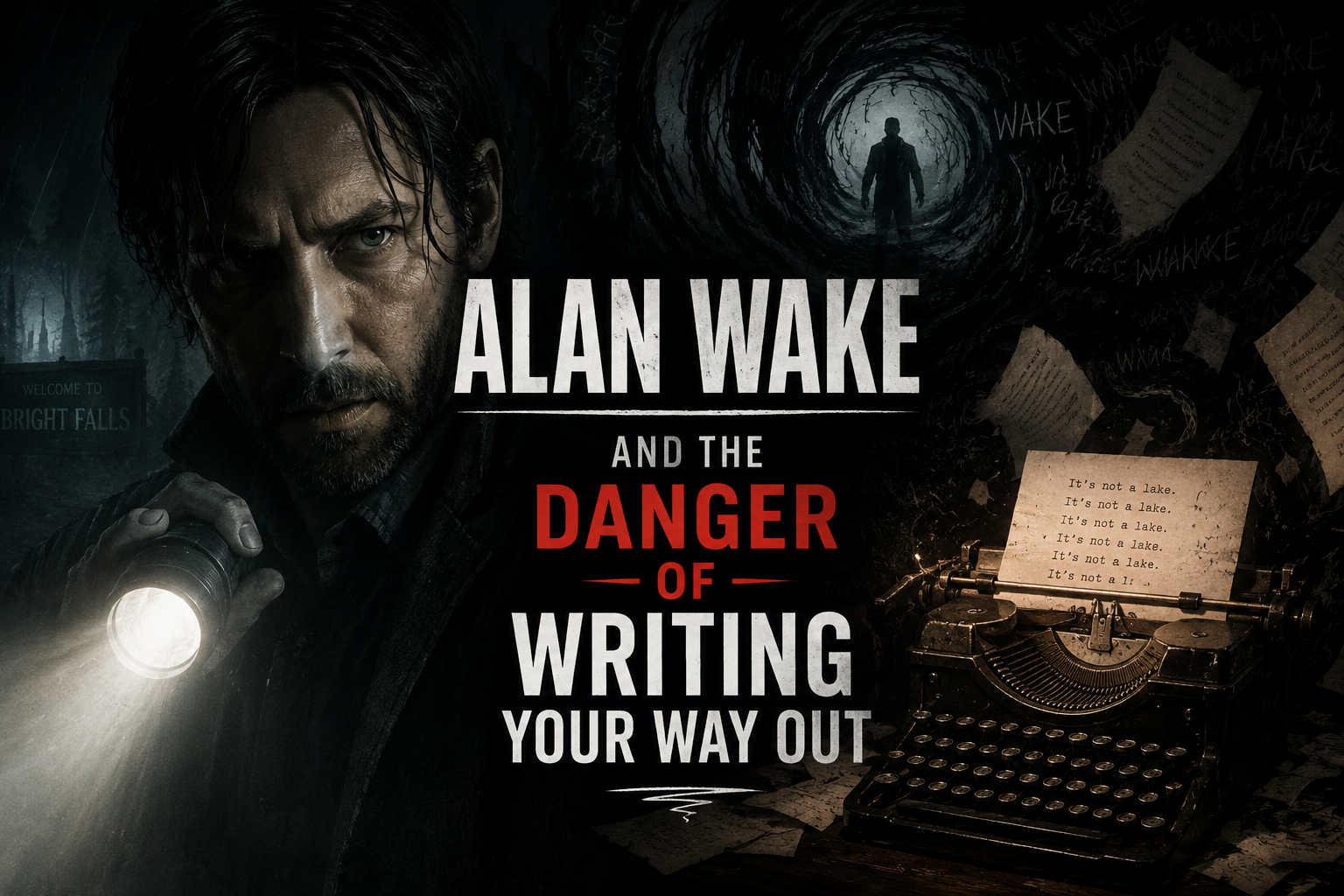
That’s the trap Alan Wake springs on its own protagonist almost immediately: a bestselling thriller writer who arrives in the small town of Bright Falls hoping a change of scenery will cure a stalled career, and instead finds himself living inside a horror plot with his own name on the cover, written by a version of himself he doesn’t remember becoming. The game’s central question isn’t whether Alan can defeat the darkness stalking the town. It’s whether a man who has spent his whole professional life imposing narrative order onto chaos can survive discovering that the story now has more control over him than he has over it.
Most horror protagonists are ordinary people thrown into extraordinary danger. Alan is unusual because his profession is danger — manufacturing it, pacing it, resolving it neatly by page three hundred — and the game uses that against him with real precision. Every storytelling instinct that made him successful becomes a liability the moment fiction stops staying inside the manuscript. He can’t out-write a threat that’s reading his drafts as fast as he produces them, sometimes faster, sometimes before he’s written them at all.
This article continues an ongoing series exploring what game characters reveal about identity, creativity, and the values that shape the choices we make when the story we’re telling stops obeying us. Alan belongs in it because few games have taken the specific anxiety of a creator losing authorship over his own work and turned it into a survival horror mechanic as literally as this one does.
A Writer Trapped Inside the Only Story He Knows How to Tell
Alan arrives in Bright Falls already stuck — not just on vacation, but on the page, unable to produce anything worth publishing for two years running. That block matters more than the game initially lets on, because it establishes exactly what Alan is missing when the actual crisis begins: control over his own narrative instincts. A writer who has lost the ability to finish a story is, in a very literal sense, a man who has lost his grip on cause and effect, on beginning and ending, on the basic promise that the thing he starts will resolve the way he intends it to.
The horror that follows doesn’t hand that control back to him. It takes what remains of it. Alan discovers a manuscript in his own handwriting that he has no memory of writing, describing events that then start happening to him in real time. The game never lets this feel like empowerment — the thriller writer finally living his own thriller. It plays, instead, like a violation: the one skill Alan has always trusted, shaping a story into something coherent, has been taken out of his hands entirely and handed to whatever wrote the manuscript instead.
Why This Matters for How the Game Uses Its Own Narration
This premise lets the game do something formally unusual: Alan narrates his own adventure in the third person, thriller-novel style, describing his actions as they happen almost as though he’s reading them off a page rather than living them. Most games would treat this as flavor, a stylistic wink at the character’s profession. Alan Wake uses it as dread. The narration isn’t just describing what Alan does. It’s uncomfortably close to dictating it — raising the possibility, never fully resolved, that Alan has stopped being the author of his own experience and become a character inside someone else’s manuscript, reciting lines he didn’t choose.
The Manuscript That Writes Him Back
The pages Alan finds scattered through Bright Falls are the game’s most unsettling device precisely because of what they do to the ordinary relationship between story and reader. In any other book, finding pages ahead of where you are in the plot would just be a spoiler. Here, finding them ahead of where Alan is in his own life is something closer to prophecy turning hostile — descriptions of danger that then manifest exactly as written, whether or not Alan has any say in preventing them.
Practical Example: Pages Found Before the Events They Describe
A page discovered early in a level might describe, in precise detail, an ambush that hasn’t happened yet — describing Alan’s fear, his specific movements, sometimes his exact thoughts, moments before he lives through exactly that scene. The game never fully explains whether these pages are causing the events or merely predicting them, and that ambiguity is the entire mechanism of the dread. If the manuscript is only predicting the future, Alan is trapped inside a story someone else already finished. If the manuscript is actively causing what it describes, then reading ahead is itself a kind of danger — knowledge that doesn’t protect him, because the story is going to happen to him regardless of whether he sees it coming.
Darkness as a Metaphor That Refuses to Stay Metaphorical
The game’s antagonist, the Dark Presence, functions on two levels simultaneously in a way few horror stories manage without one undercutting the other. It’s a literal, physical threat — shadow-creatures, possessed townsfolk, objects animated by malevolent will, all of it capable of killing Alan in the most direct video-game sense. It is also, unmistakably, a stand-in for creative block, depression, and the particular despair of a mind that has stopped producing anything except the conviction that it never will again.
What makes this work rather than feeling like an overwrought metaphor is that the game refuses to let the symbolic reading cancel out the literal one. The darkness isn’t simply Alan’s block dressed up in monster costume for dramatic effect. It behaves like an actual, external threat with its own goals, requiring an actual solution — light, in the most concrete gameplay sense, as the one weapon capable of harming it. The metaphor and the monster are the same thing at once, and the game never asks the player to choose between reading it as psychological or literal. It insists on both, simultaneously, without either canceling the other out.
Real-Life Parallel: The Story You Keep Telling Yourself About Your Own Life
There’s something recognizable in this doubling for anyone who has lived inside a genuinely bad stretch of their own life story — the sense that the darkness isn’t just a feeling, it’s actively rewriting what you’re capable of, actively producing the outcomes it predicts. A person convinced they’ll fail often behaves in ways that make failure more likely; a story told often enough about your own limitations starts to function less like description and more like instruction. Alan’s fight against a literal darkness that feeds on despair and grows stronger the more he believes he’s already lost isn’t subtle, but it’s honest about something real: the stories we tell about ourselves don’t stay confined to narration. They start shaping what actually happens next.
A Marriage Used as Raw Material
Alan’s wife, Alice, occupies a position in the story that the game handles with more self-awareness than it initially appears to. She’s the reason Alan came to Bright Falls, the person he’s ultimately trying to save, and — the game eventually reveals — someone whose real anxieties and private fears Alan has, in the past, mined directly for material in his fiction, without always asking first. The horror plot forces Alan to confront this pattern literally: his tendency to turn the people closest to him into raw material for a story is exactly the instinct the darkness exploits to trap them both.
Why This Matters for the Philosophy of Games as a Genre
This is a more self-critical move than most games attempt with a “damsel in danger” setup. A weaker script would let Alice exist purely as a rescue objective, motivation without interior life. Instead, Alan Wake quietly indicts its own protagonist’s professional habits — using the people he loves as inspiration, converting real fear into publishable material — as part of what got them both into this mess in the first place. Saving Alice isn’t framed simply as an act of heroism. It’s framed, at least in part, as an overdue reckoning with what it costs the people around a storyteller when their real lives keep getting treated as material.
Trading Control of the Story for a Chance to Finish It
By the game’s climax, Alan is forced into an impossible trade: he can only save Alice by giving up authorship of his own narrative entirely, accepting a bargain that traps him in the Dark Place — a space seemingly built from stories themselves — so that the manuscript can reach the ending it needs in order to release her. It’s the writer’s ultimate nightmare rendered as literal plot mechanics: the only way to finish the story is to stop being the one who controls how it ends.
The game doesn’t dress this up as triumph. Alan disappears, effectively, into whatever the Dark Place actually is, present in later material only through fragments, messages, and the unsettling sense that he’s still writing from somewhere the ordinary rules of authorship don’t apply. He gets Alice back. He does not get himself back, not fully, not in any form the story is willing to resolve neatly.
Still Writing, Years Later, From Somewhere No One Can Reach Him
Subsequent material set after the original game finds Alan still trapped, still writing, producing manuscripts under circumstances that suggest he has learned to survive inside the Dark Place by doing the one thing he’s always known how to do — but he does it now from a place of profound isolation, uncertain whether what he’s writing is fiction, prophecy, or a slow, ongoing negotiation with the thing that took him. The bargain that saved his wife left him permanently unresolved, which is precisely the point the game seems most committed to making.
Final Thoughts: What Alan’s Story Actually Argues
Alan Wake never gets a clean recovery from his creative block, because the game was never really about writer’s block to begin with. It was about what happens when someone whose entire identity rests on shaping stories discovers that a story can shape him back — can predict him, trap him, and eventually demand he disappear into it in exchange for someone else’s rescue. The game doesn’t offer Alan mastery over his own narrative by the end. It offers him something stranger: survival, of a kind, inside a story that was never fully his to control in the first place.
What the game actually tracks, underneath the shadow-creatures and the flashlight combat, is a portrait of authorship as a much less stable position than it looks from the outside — the unsettling possibility that the stories we tell, about ourselves or anyone else, can start writing back long before we notice we’ve lost the pen.
This article is part of a series exploring the philosophy of video games — how stories, characters, and mechanics reflect real questions about identity, power, mortality, and the choices that define us. If gaming and philosophy is a topic you enjoy, more essays are on the way.