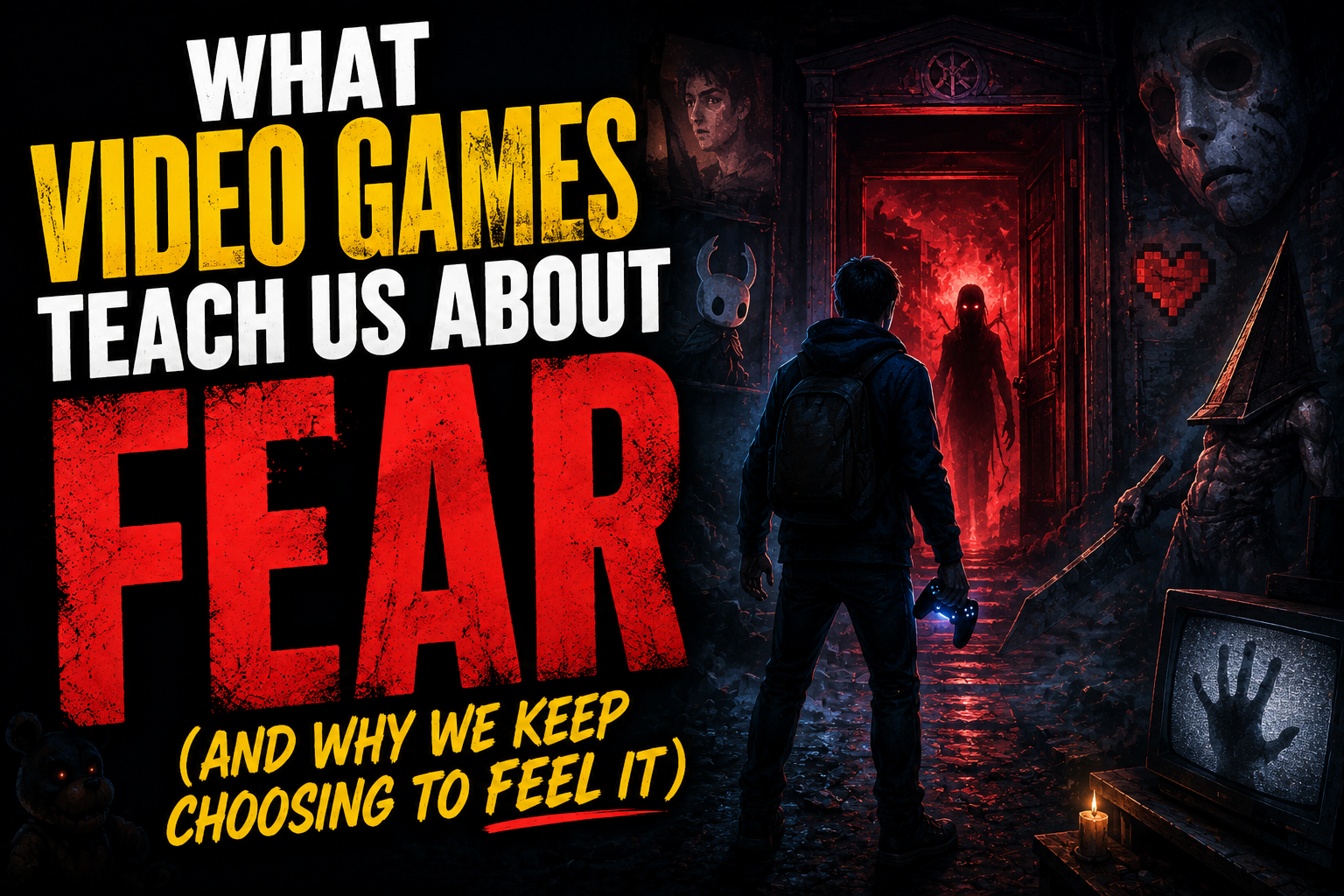

Fear is one of the only emotions people will pay money to feel on purpose. Nobody buys a ticket hoping to feel bored, or seeks out an experience specifically designed to make them anxious for no reason. And yet horror consistently ranks among the most enduring genres in both film and games, decade after decade, technology after technology. Video games take this a step further than almost any other medium: they don’t just show you something frightening happening to someone else. They put the fear directly in your hands, tied to your own choices, your own resources, your own failures to look away in time.
- Fear as a Mechanic, Not Just an Atmosphere
- Amnesia: Fear as the Removal of Control
- Resident Evil: Fear as Managed Scarcity
- Silent Hill 2: Fear as a Mirror You Can’t Look Away From
- Three Games, Three Philosophies
- The Role of Player Agency in How These Lessons Land
- What This Means Outside the Game
- Conclusion: Why Games Are an Underrated Space for Thinking About Fear
This essay looks at three very different games — Amnesia: The Dark Descent, Resident Evil, and Silent Hill 2 — not as reviews, but as three distinct philosophical positions on fear, disguised as game design. None of these games agree about what fear is actually for. Read together, they form something close to a real philosophical argument, conducted entirely through what happens in the dark, in the reload screen, and in the moment you finally understand what you’ve been running from.
Fear as a Mechanic, Not Just an Atmosphere
In most horror fiction, fear is something that happens to a character, and the audience experiences it secondhand, through empathy and craft — a well-placed cut, a rising score, a character’s face in close-up. In a meaningful number of horror games, fear isn’t secondhand at all. It’s the player’s own heart rate, their own hesitation before opening a door, their own decision about whether that resource is worth spending right now or saving for something worse.
This is a genuinely strange thing to build entertainment around. Outside of games, we spend enormous effort trying to minimize fear in our actual lives — securing our homes, avoiding unnecessary risk, building routines specifically to reduce uncertainty. Games routinely ask players to seek fear out voluntarily, submit to it repeatedly, and somehow this remains one of the medium’s most durable and commercially successful genres rather than something people avoid on principle.
Why This Matters Philosophically
Handing the player direct, chosen fear touches a debate that runs through philosophy and psychology alike: whether fear is purely a signal to be eliminated, or whether controlled exposure to it serves some necessary function — building tolerance, revealing something true about ourselves, or simply reminding us what safety actually feels like by contrast. Aristotle’s discussion of catharsis in tragedy argued that experiencing difficult emotions in a contained, fictional setting could be purifying rather than harmful. Games built around fear don’t resolve that argument, but they let a player live inside it, choice by choice, in a way watching someone else’s fear on a screen never quite manages.
This is the foundation Amnesia, Resident Evil, and Silent Hill 2 each build on — but they take it in three very different directions.
Amnesia: Fear as the Removal of Control
In Amnesia: The Dark Descent, developed by Frictional Games, you play Daniel, a man exploring a decaying castle with no weapons, no means of fighting back against the creatures that hunt him, and a sanity meter that deteriorates the longer he stays in darkness or looks directly at something horrifying. The only real tools available are running, hiding, and closing doors behind you.
What makes Amnesia philosophically distinct is how deliberately it strips away every tool a player might normally use to feel in control of a frightening situation. There’s no combat to master, no skill tree to grind, no weapon upgrade that eventually makes the threat manageable. The game’s entire design philosophy rests on a single, uncomfortable premise: fear intensifies almost exactly in proportion to how much control you’re denied, and the moment a player is given a way to fight back, most of that fear quietly evaporates.
Practical Example: The Sanity System That Punishes Looking
Amnesia‘s sanity mechanic penalizes players for directly viewing monsters or lingering too long in darkness, causing vision to blur and Daniel’s grip on reality to visibly deteriorate. The intuitive response — stare down the threat, understand it, master it through observation — is precisely the response the game punishes. The only reliable way to survive is to look away, to trust that something terrible is there without confirming exactly what it is.
This inverts a habit most other games train into players: that understanding a threat is how you defeat it. Amnesia argues something closer to the opposite — that some forms of fear are actually made worse by full comprehension, and that the willingness to remain deliberately uncertain, to not look too closely, is sometimes the more survivable response. It’s a genuinely uncomfortable lesson to build a game around, because it withholds the one thing most fear-based media eventually offers as relief: a clear look at the thing you were afraid of.
Resident Evil: Fear as Managed Scarcity
Where Amnesia removes control entirely, the original Resident Evil games, developed by Capcom, take a different approach: they give you a gun, but almost never enough ammunition to feel comfortable using it. Herbs heal you, but not fully, and not without being combined correctly. Save points cost a limited resource. Every encounter becomes less about “can I survive this” and more about “what will surviving this cost me for the encounter after it.”
Why Counting Bullets Is Scarier Than Fighting Monsters
This is Resident Evil‘s central insight, and it’s a subtler one than it first appears: the monsters themselves are rarely the source of the game’s tension. The tension comes from resource math — the quiet, ongoing calculation of whether you can afford to fight, or whether fighting now means being defenseless three rooms later. Fear, in this framing, isn’t a reaction to a jump scare. It’s a slow-building, cumulative anxiety produced by scarcity, one that persists even in rooms with nothing dangerous in them at all, because the player is still doing the math.
This is a meaningfully different philosophy of fear than Amnesia‘s. Where Amnesia argues fear comes from powerlessness, Resident Evil argues fear comes from constrained, incomplete power — just enough capability to feel responsible for the outcome, but never quite enough to feel safe.
A Real-World Parallel: Anxiety as a Resource Problem
There’s a useful parallel here to how anxiety often actually functions outside of games: not as a response to one single overwhelming threat, but as an ongoing, low-grade calculation about limited resources — time, money, energy — and whether there will be enough left over for whatever comes next. Resident Evil gamifies this almost exactly. The specific monster in front of you is rarely the real problem. The real problem is the running total in the back of your mind, tallying what you have left for everything still ahead.
Silent Hill 2: Fear as a Mirror You Can’t Look Away From
The third game in this essay takes the sharpest turn. Silent Hill 2, developed by Konami, follows James Sunderland into a fog-shrouded town in search of his deceased wife, who has apparently written to him. Without detailing the specifics of the story’s revelations, it’s fair to say the game gradually makes clear that the monsters James encounters aren’t simply obstacles placed in his path. They’re manifestations of something about James himself — his guilt, his denial, the parts of his own history he’s been unable to face directly.
Where Amnesia locates fear in powerlessness and Resident Evil locates it in scarcity, Silent Hill 2 locates fear somewhere far more uncomfortable: inside the player character himself, and by extension, inside the player controlling him. The town isn’t frightening because of what it might do to James. It’s frightening because of what it keeps forcing him, and the player, to recognize.
Practical Example: The Monster That Only Makes Sense in Hindsight
One of the game’s most discussed antagonists is a hulking, restrained figure whose design and behavior, on a first playthrough, simply reads as unsettling and strange. It’s only in retrospect — often after finishing the game and learning more about James’s backstory — that many players recognize the figure as a direct symbolic representation of something specific and painful in James’s own psychology, deliberately withheld from being obvious in the moment.
This is a fundamentally different use of fear than either of the other two games in this essay. Silent Hill 2 isn’t asking players to fear an external threat, managed through avoidance or resource conservation. It’s asking them to sit with something closer to dread — the specific, creeping discomfort of realizing that the monster was never really separate from the person being chased by it. The horror isn’t in the town. It’s in what the town keeps reflecting back.
Three Games, Three Philosophies
Put side by side, these three titles form something close to a spectrum:
- Amnesia treats fear as a product of powerlessness — closer to an argument that removing every tool of control is what makes an experience frightening, and that understanding a threat too fully can sometimes make it worse rather than better.
- Resident Evil treats fear as a product of scarcity — closer to an argument that fear isn’t really about the monster in the room, but about the ongoing, quiet math of whether you’ll have enough left for the one after it.
- Silent Hill 2 treats fear as a product of self-recognition — closer to an argument that the most difficult fear to survive isn’t external at all, but the moment a threat turns out to be a mirror you weren’t ready to look into.
None of these approaches is “correct” in some objective sense. What’s interesting is that all three are legitimate, well-supported responses to the same basic human question: where does fear actually come from, and what is it actually telling us when we feel it? The philosophy of games doesn’t need to give a single answer here, and arguably shouldn’t. Its strength lies in offering multiple, playable perspectives on a question every person who has ever been genuinely afraid has had to answer for themselves, at least once.
Why Multiple Perspectives Matter More Than One “Right” Answer
This is worth sitting with for a moment. If only one of these games existed, players might mistake its particular stance on fear for the definitive gaming take on the subject. But because Amnesia, Resident Evil, and Silent Hill 2 coexist, each with devoted communities that treat their game’s approach as the truest one, they demonstrate something valuable: video games, as a medium, are mature enough to hold contradictory truths about fear simultaneously. That’s not a weakness. It’s closer to how fear actually feels in real life — sometimes about powerlessness, sometimes about scarcity, and sometimes about a truth we’ve been avoiding that finally catches up with us.
The Role of Player Agency in How These Lessons Land
There’s a detail that’s easy to overlook when comparing these three games: in every case, the player isn’t just watching a philosophy of fear unfold — they’re the one who has to decide, in real time, whether to look, whether to spend the bullet, whether to keep walking toward the thing they’d rather avoid. This distinction matters more than it might seem.
In Amnesia, you choose, repeatedly, whether to peek at the thing chasing you or trust the darkness and run blind. In Resident Evil, you choose whether this fight is worth the ammunition, knowing you can’t fully know what’s still ahead. In Silent Hill 2, you choose, controller in hand, to keep walking James toward a truth the game is visibly building toward, one that a passive viewer could simply look away from but a player has to actively continue enacting. In every case, the philosophy isn’t delivered to you as a conclusion. It’s something you have to choose your way into, moment by moment, before the game will let you feel it as true.
A film can show a character’s fear, filtered entirely through direction, framing, and score. A game can put you in the exact position of deciding, right now, whether you’re willing to keep going toward the source of it — and because the outcome partly depends on that choice, the fear tends to feel earned rather than delivered. This is arguably the single strongest argument for taking video game horror seriously as its own category of thought, rather than treating it as a secondhand version of ideas explored more “properly” in film.
A Small But Telling Detail: The Games That Refuse to Show You the Monster
It’s worth noting how many acclaimed horror games are built specifically around withholding a clear view of their central threat for as long as possible, understanding that a fully visible monster is almost always less frightening than an implied one. This is a quiet but consistent design philosophy across the genre: the imagination, given just enough information to start filling in gaps on its own, tends to produce something more unsettling than anything a design team could render directly. Fear, in this reading, isn’t something a game gives the player. It’s something the game creates the conditions for the player to generate themselves.
What This Means Outside the Game
It’s tempting to treat these observations as interesting trivia about game design and stop there. But the reason this topic belongs in a broader conversation about gaming and philosophy is that these three approaches map fairly directly onto how people actually experience fear in real life.
Some fears genuinely are about powerlessness, closer to Amnesia‘s model — situations where the only real option is to endure rather than control, and where too much scrutiny of the threat only makes it harder to bear. Others are closer to Resident Evil‘s ongoing resource anxiety — not one dramatic threat, but a persistent, quiet calculation about whether there will be enough of something left over for what’s still coming. And some of the hardest fears to sit with resemble Silent Hill 2 far more than anyone would like to admit: not an external danger at all, but a truth about ourselves we’ve been avoiding, that eventually stops being avoidable.
None of these framings is universally correct, and few real fears fit neatly into just one. What video games offer, uniquely among storytelling mediums, is the chance to rehearse all three kinds of fear safely, controller in hand, long before life asks us to face a version of them that doesn’t come with a reload option.
Conclusion: Why Games Are an Underrated Space for Thinking About Fear
Fear is one of the oldest and most universal human experiences, and yet it remains one of the hardest subjects to examine clearly, precisely because our instinct is almost always to look away from its source as quickly as possible. Video games, strangely, have become one of the more honest spaces for approaching it — not through lectures or grand statements, but through systems that make players choose, over and over, whether to keep looking, keep spending, or keep walking toward the thing they’d rather not face.
Amnesia teaches that some fears are made worse, not better, by full understanding. Resident Evil teaches that fear is often less about a single threat and more about an ongoing scarcity we’re quietly tracking the whole time. Silent Hill 2 teaches that the most difficult fear to survive is sometimes the one that turns out to be about us all along. None of these lessons arrive as dialogue or exposition. They arrive through play — through the actual, repeated act of choosing whether to look, whether to fight, whether to keep walking into the fog.
That might be the quiet, underappreciated gift of gaming and philosophy as a genre: it doesn’t ask you to agree with a single conclusion about fear. It hands you a controller, turns down the lights, and lets you find out, one closed door at a time, what you actually do when you’re afraid.
This essay is part of an ongoing series on the philosophy of video games — exploring death, power, identity, sacrifice, choice, time, failure, and the questions that define us, one title at a time.