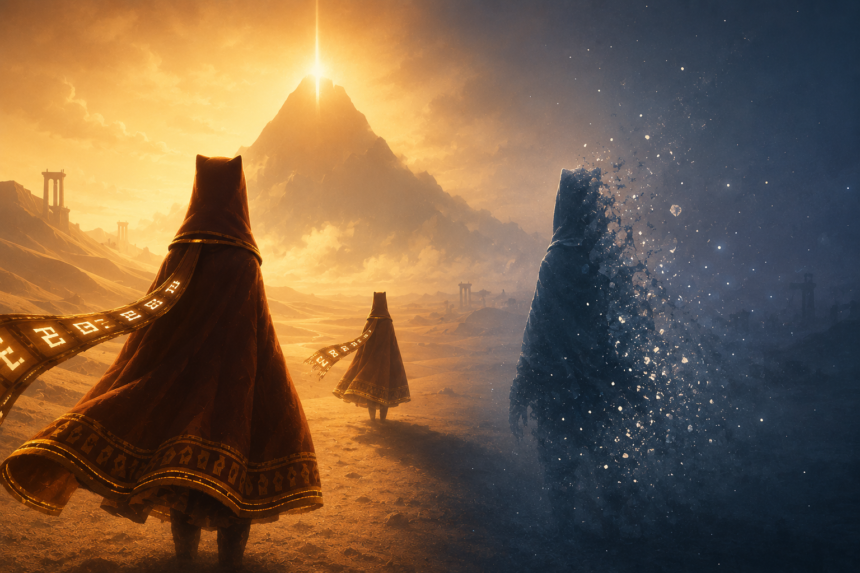

Most multiplayer games are built on identity. You have a name, a rank, a voice channel, a scoreboard that tells everyone exactly who did well and who let the team down. Journey, thatgamecompany’s 2012 masterpiece, strips all of that away and, in doing so, produces one of the most emotionally direct experiences in games. You are a robed figure in a vast desert, walking toward a distant mountain. Somewhere along the way, a second robed figure may appear. You cannot speak to them. You do not know their name. And yet, by the end, losing them can feel like a small grief.
This Journey game analysis looks at how a two to three hour game with no dialogue, no combat, and no names became a landmark in emotional design, and why its model of anonymous connection still feels radical more than a decade later.
Key Takeaways
- Journey uses wordless, anonymous multiplayer to create connection without ego, competition, or social pressure.
- Its single musical “chirp” is the entire communication system, forcing players to express care through action rather than language.
- The game’s structure mirrors a life cycle, using the classic hero’s journey and the seasons to build meaning.
- The ending reframes the whole trip as being about the walk and the companion, not the destination.
- Journey proves that emotional depth in games comes from restraint and design, not from more mechanics or more words.
A Multiplayer Game With the Ego Removed
The central design decision in Journey is what it leaves out. There is no lobby, no friend invite, no chat. When another player drops into your game, they simply appear beside you, indistinguishable from an AI companion except that they behave like a person. You cannot learn their gamertag until the credits roll. You cannot argue, boast, insult, or coordinate with words.
Strip away identity and competition, and something surprising happens: cooperation becomes its own reward. There is no reason to help the stranger except that helping feels good. There is no scoreboard measuring who carried whom. The relationship is pure because the game has removed every incentive to make it anything else. In an era of toxic voice chat and status-obsessed ranked ladders, Journey demonstrated that a lot of online friction is not human nature but design.
How a Single Sound Becomes a Whole Language
Your only means of expression is a musical chirp, a single note you can sing out. That is it. And yet players develop an entire vocabulary from it. A quick series of chirps means “over here, look at this.” A long, warm tone can mean “thank you” or “I am still with you.” Frantic chirping in a storm means “stay close, do not get lost.”
This restriction is the game’s genius. Because the tool is so limited, every use of it carries weight. You cannot spam meaningless chatter. You have to communicate through movement, timing, and presence. When your companion waits at the top of a hill for you to catch up, it says more than any voice line could. Journey understands that intimacy is often built not through words but through small, wordless acts of attention.
Care expressed as action
The chirp also has a mechanical function: it recharges the scarf that lets you fly, and singing near your companion recharges both of you. Kindness is literally built into the physics. Staying close to another player makes both of you more capable. The game does not have to lecture you about the value of togetherness. It makes togetherness feel like flight.
The Structure: A Life in Miniature
Journey is deliberately shaped like a life. It follows the arc that Joseph Campbell called the hero’s journey, and it maps that arc onto a progression of moods and landscapes that feel like the passage from birth to death and beyond.
From warmth to cold to light
You begin in warm, golden sand, playful and free, sliding down dunes as light as a child. The middle of the game darkens. You descend into underground tunnels and then into a frozen, wind-blasted mountain where malevolent stone creatures hunt you and the cold slows every step. The scarf that let you soar gets shorter. Your companion’s chirps grow weaker. The climb up the mountain becomes a genuine struggle against exhaustion, and then, near the summit, you fall.
What follows is the game’s emotional masterstroke, a transition from that lowest point into blinding white light and effortless flight toward the mountain’s peak. Read as a life cycle, it is unmistakable: youth, struggle, decline, death, and a transcendent release. The game never states any of this. It lets the imagery and the music carry it.
Austin Wintory’s Score as a Second Companion
No analysis of Journey is complete without its music. Austin Wintory’s score, the first video game soundtrack nominated for a Grammy, functions almost like a second companion. A solo cello threads through the whole game, representing the player, swelling and receding with the emotional tide. The music responds to what you do, so the score you hear is partly authored by your own pace and choices. It is one of the purest examples of how sound can turn mechanics into feeling.
Why Losing the Stranger Hurts
Here is the quiet grief the title of this piece points to. Because the game’s networking is seamless, your companion can disconnect at any time, and there is no notification, no goodbye. One moment they are chirping beside you, the next you are alone in the snow. You may never learn whether they finished, whether they were called away to dinner, whether their console crashed.
And if you do make it to the end together, the credits finally reveal the stranger’s name, a single line of text for the person who walked an entire journey at your side. For many players this is the moment the tears come. You spent hours in a wordless relationship of pure mutual care, and only at the very end do you learn they were a real person, somewhere in the world, who chose to stay with you. Then they are gone, and you will almost certainly never share a game with them again.
This is grief in miniature, and it is not accidental. Journey is, among other things, a game about the temporary nature of every companionship. People walk with us for a stretch of road and then the road diverges. The game compresses that truth into two hours and makes you feel it directly.
What Journey Teaches About Connection
The lasting lesson of Journey is that connection does not require the things we usually think it requires. It does not need language, identity, shared history, or even the promise of a future. It needs presence and attention. Two strangers who cannot even tell each other their names can still care for one another, protect one another from the cold, and share something that neither will forget.
In a medium often obsessed with adding more, Journey argues for the power of less. It is proof that the deepest feelings in games are engineered through restraint, and that sometimes the most moving thing a designer can do is take a companion away.
Conclusion
More than a decade on, Journey remains a touchstone for anyone interested in how games make us feel. It turned anonymity into intimacy, a single sound into a language, and a walk toward a mountain into a meditation on living and dying. Most of all, it gave millions of players the experience of loving a stranger for a couple of hours and then letting them go, which may be the most honest thing a multiplayer game has ever done.
Frequently Asked Questions
What is the meaning of the game Journey?
Journey is widely read as an allegory for the cycle of life, moving from carefree youth through struggle and decline to death and transcendence, mirrored in its landscapes and music. On a second level, it is about human connection: the way strangers can care for one another deeply and temporarily, without words, names, or the promise of meeting again.
Can you really play Journey with a stranger?
Yes. Journey features anonymous online multiplayer where a second real player can seamlessly join your game. You cannot chat or see their name until the end credits, so the entire relationship is built through movement and a single musical chirp. Their name is only revealed after you finish.
Why can’t you talk to other players in Journey?
The lack of text or voice chat is a deliberate design choice. By removing language, names, and competition, thatgamecompany prevented the toxicity common in online games and forced players to communicate through presence and small acts of care, which creates a purer, more emotional form of cooperation.
What does the ending of Journey mean?
After the player collapses on the frozen mountain, they are reborn into brilliant light and fly effortlessly to the summit before a shooting star returns to the desert where the game began. It is commonly interpreted as death and renewal, suggesting that the journey itself, and the companion who shared it, mattered more than the destination.
How long does it take to beat Journey?
Journey is short by design, taking most players roughly two to three hours to complete in a single sitting. That brevity is central to its impact, allowing the whole emotional arc from birth to transcendence to be experienced in one uninterrupted stretch.
Why is Journey considered so emotional?
Journey achieves emotion through restraint rather than spectacle. Its wordless connection with a stranger, its life-cycle structure, and Austin Wintory’s Grammy-nominated score work together so that simple moments, like a companion waiting for you or disappearing in a storm, land with surprising force.