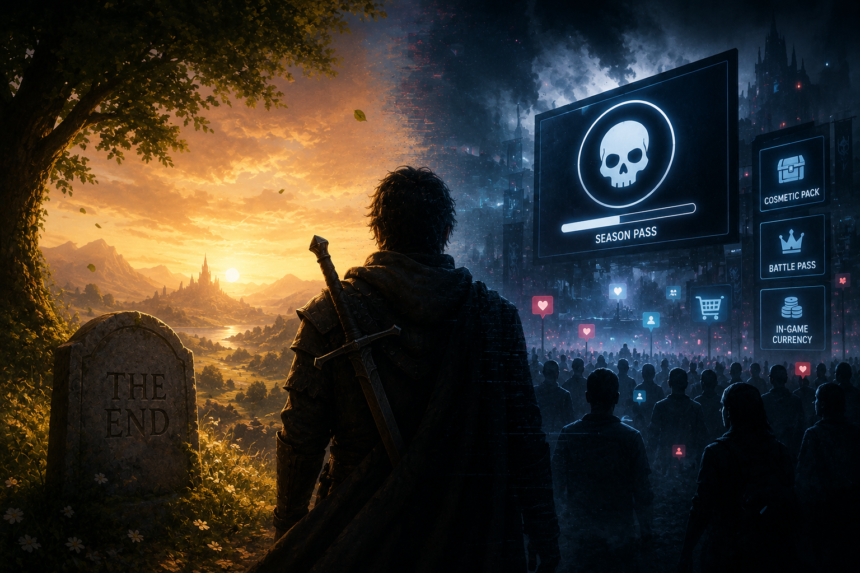

There was a time when finishing a game meant something. The credits rolled, the story resolved, and you set the controller down with the specific satisfaction of a journey completed. Increasingly, that experience is under threat. The industry has poured its resources into live service games, titles designed never to end, engineered to keep you playing and paying indefinitely. The ending, once the natural destination of a game, is quietly disappearing. And while endless games have their pleasures, something valuable is being lost in their rise, something worth naming before we forget we ever had it.
This piece examines the tension of live service vs single player design: why the endless model took over, what a proper ending gives us that a perpetual game cannot, and why a revival of finite, authored stories may be exactly what many players are hungry for.
Key Takeaways
- The live service vs single player debate reflects a shift from finite, authored stories toward endless, monetized games.
- Live service games rose because recurring revenue is far more lucrative than one-time purchases.
- Endings give stories meaning, and a game designed never to end sacrifices narrative resolution.
- Perpetual games can foster community and ongoing enjoyment but often prioritize retention over craft.
- A renewed appetite for finite single-player experiences suggests the ending is far from obsolete.
Why the Endless Game Took Over
The shift toward live service was driven less by creative ambition than by economics. A traditional single-player game is sold once. A player buys it, finishes it, and the transaction is complete. A live service game, by contrast, is designed to generate revenue continuously, through subscriptions, battle passes, cosmetics, and other ongoing purchases. When a single successful live service title can earn more over years than dozens of premium releases, the financial logic becomes overwhelming.
This is why so many major studios reoriented around the model. The goal shifted from crafting a complete experience to building a platform players return to daily, ideally forever. Retention became the guiding metric, and design decisions began to serve engagement and spending as much as, or more than, storytelling. None of this is inherently sinister; companies exist to make money, and players clearly enjoy many of these games. But it is important to be clear that the disappearance of the ending is primarily a business outcome, not a creative one. We did not decide endings were bad art. We discovered that games without them make more money.
What an Ending Actually Gives Us
To understand what is at stake, it helps to remember what endings do. An ending is not merely the point where a game stops. It is the moment that gives everything before it meaning. Stories derive much of their power from their shape, from the way a beginning, middle, and end fit together into a whole that can be reflected on and understood.
Meaning requires a boundary
A finite story can make an argument, complete an emotional arc, and leave you changed, precisely because it concludes. The ending is where themes resolve, where a character’s journey reaches its destination, where the player is invited to step back and consider what it all meant. A game engineered to continue forever cannot offer this. It must always dangle the next objective, the next season, the next reason to return, and so it can never fully resolve, never let its story land with the weight that only conclusion provides. Endless content is not the same as a complete work, any more than a television show that never ends is the same as a finished novel. Without a boundary, meaning has nowhere to gather.
The Real Pleasures, and Costs, of Live Service
It would be unfair to dismiss live service games entirely, because they offer real things that finite games cannot. A persistent world that evolves over years can become a genuine community, a place players inhabit together and return to for the social bonds as much as the gameplay. The ongoing stream of new content can keep a beloved game fresh, and the shared, evolving experience of a live game can create memories a static game never would. For many players, these pleasures are substantial and sincere.
But the costs are equally real. When retention is the goal, design often bends toward compulsion rather than satisfaction, using daily rewards, time-limited events, and psychological hooks to keep players logging in whether or not they are truly enjoying themselves. Monetization can shade into exploitation. And the sheer time demand of a live service game, which wants to be your primary or only game, crowds out the varied diet of complete experiences that a healthy relationship with the medium might include. There is a difference between a game you love to return to and a game engineered so that you cannot comfortably leave, and that difference is worth watching closely.
The Ending Refuses to Die
Despite the industry’s tilt toward the endless, the finite single-player game has proven remarkably resilient, and this resilience tells us something. Again and again, major single-player titles with clear beginnings, middles, and ends have achieved enormous critical and commercial success, often to the evident surprise of an industry convinced that live service was the only viable future. Players turned out in huge numbers for complete, authored stories that respected their time and gave them the satisfaction of an ending.
This suggests that the appetite for finite experiences never went away; it was merely underserved. Many players are hungry for games they can start, finish, and carry with them, precisely because so much of the market now offers the opposite. The success of these titles is a market signal as much as an artistic one: there is real demand for the ending, for the complete work, for the game that has the confidence to conclude and let you move on. The endless model has not killed the single-player ending. It has, if anything, made people appreciate it more.
Why This Matters
The stakes here are not just commercial. Games are one of our great storytelling forms, and storytelling depends on the ability to complete a thought. If the industry optimizes entirely for engagement, it risks losing its capacity to say things that only finite works can say, to move us with resolution, to give us the reflective satisfaction of a journey that actually ends. A medium made only of endless games would be a medium that had forgotten how to finish a sentence.
The healthiest future is not the triumph of one model over the other but a balance. There is room for the sprawling, evolving live game and for the tight, complete story, and players are well served by having both. The danger is not that live service exists; it is that its economics could crowd out the finite experience entirely. Recognizing what the ending gives us is the first step to making sure we keep it.
Conclusion
The quiet disappearance of the single-player ending is one of the most consequential shifts in modern gaming, driven by the powerful economics of the endless, monetized game. But endings are not a relic; they are where stories find their meaning, and their loss would impoverish the medium. Live service games offer genuine community and ongoing joy, yet they cannot provide the reflective satisfaction of a complete work. The enduring success of finite single-player titles proves the appetite for endings never died. In the ongoing contest of live service vs single player, the wisest outcome is not a winner but a balance, one that keeps the confidence to conclude alive in a medium increasingly built never to stop.
Frequently Asked Questions
What is the difference between live service and single-player games?
The live service vs single player distinction is about structure and business model. Single-player games are typically finite, authored experiences sold once with a clear ending. Live service games are designed to run indefinitely, generating ongoing revenue through subscriptions, battle passes, and microtransactions while continually adding content to keep players returning.
Why did the game industry shift toward live service?
The shift was driven mainly by economics. A live service game can generate continuous revenue over years, far exceeding the one-time income of a traditional release. This financial incentive led many studios to prioritize retention and engagement, reorienting design around keeping players active and spending rather than delivering a complete, finite experience.
Why are endings important in games?
Endings give stories meaning by providing shape and resolution. A finite game can complete an emotional arc, resolve its themes, and invite reflection precisely because it concludes. A game designed never to end cannot fully resolve, since it must always dangle the next objective, sacrificing the reflective satisfaction that only a boundary provides.
Are live service games bad?
Not inherently. Live service games can foster genuine communities, keep beloved worlds fresh with new content, and create shared, evolving experiences. However, their focus on retention can bend design toward compulsion and monetization toward exploitation, and their time demands can crowd out finite games. The concern is balance, not the model’s mere existence.
Are single-player games making a comeback?
Many finite single-player titles have achieved major critical and commercial success, suggesting strong ongoing demand for complete, authored stories. This indicates the appetite for endings never disappeared but was underserved. The success of these games signals that players still value experiences they can start, finish, and reflect on.
Can live service and single-player games coexist?
Yes, and a healthy medium likely needs both. There is room for sprawling, evolving live games and for tight, complete stories, and players benefit from variety. The real risk is not that live service exists but that its economics could crowd out finite experiences entirely, which is why preserving the single-player ending matters.