
Look at any release calendar and you will notice how much of the past is on it. Remakes of classic games, remasters of recent ones, definitive editions and anniversary collections crowd the schedule alongside the new. The industry is spending an enormous share of its energy revisiting its own history, and opinions are sharply split. To some, this is a golden age of preservation, keeping great games playable for new audiences. To others, it is a creative retreat, a risk-averse industry mining nostalgia rather than making anything new. Both readings contain truth, and together they point at a deeper issue: gaming has a memory problem, and remakes are how it is trying, imperfectly, to solve it.
This piece unpacks the video game remakes trend: the difference between a remaster and a remake, why nostalgia has become such a reliable business, what drives the flood of revived titles, and what it reveals about how the medium remembers itself.
Key Takeaways
- The video game remakes trend reflects both genuine preservation and a risk-averse reliance on proven properties.
- A remaster updates an existing game modestly, while a remake rebuilds it substantially from the ground up.
- Nostalgia is commercially powerful because it offers lower risk and a built-in audience.
- Remakes exist partly because older games become unplayable as hardware and platforms move on.
- The trend exposes gaming’s poor track record on preservation, making commercial remakes the default way old games survive.
Remaster or Remake? The Distinction Matters
The two terms are often used interchangeably, but they describe genuinely different things, and the confusion muddies the conversation. A remaster is a relatively modest update of an existing game. It takes the original and improves it, higher resolution, smoother performance, cleaner textures, perhaps quality-of-life tweaks, while leaving the core largely intact. You are playing essentially the same game, polished for modern hardware.
A remake is a far more ambitious undertaking. It rebuilds the game substantially or entirely from the ground up, often with new engines, new assets, reworked mechanics, and sometimes significant changes to content and structure. A true remake is closer to a reinterpretation than a restoration, taking the ideas of the original and realizing them anew. The distinction matters because the two serve different purposes and deserve different scrutiny. A remaster asks whether an old game deserves to keep running on new systems; a remake asks whether it deserves to be reimagined, and how faithful that reimagining should be. Lumping them together makes it hard to judge either fairly.
Why Nostalgia Is Such Good Business
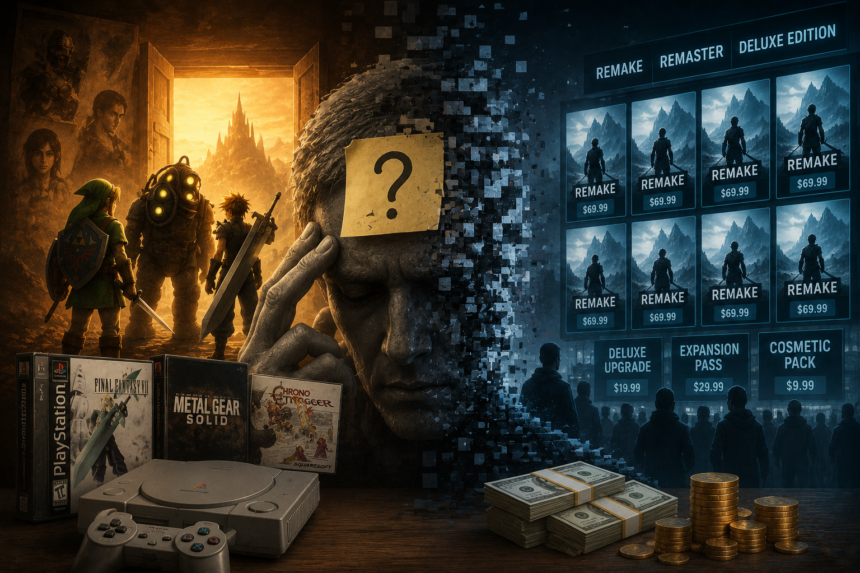
The commercial engine behind the trend is nostalgia, and it is easy to see why the industry leans on it. Making a brand-new game is expensive and risky. A new property has no established audience, no proven appeal, and no guarantee that years of costly development will find a market. A remake or remaster of a beloved classic dramatically reduces that uncertainty. The concept is already validated, the audience already exists, and the affection people hold for the original translates into pre-existing demand.
This lower-risk profile is enormously attractive in an industry where development budgets have ballooned and a single failure can be catastrophic. Revisiting a proven success is simply safer than betting on something untested. Add to this the fact that nostalgia is a powerful emotional force, capable of moving people to buy a game they already played decades ago, and the appeal becomes obvious. The nostalgia economy works because it sells not just a game but a chance to reconnect with a cherished piece of one’s own past, and people will reliably pay for that. None of this makes remakes bad, but it does explain why there are so many: they are, in cold business terms, among the safest products the industry can make.
The Uglier Reason: Old Games Stop Working
There is a less discussed driver of the remake trend, and it is genuinely troubling. Many older games are simply not easily playable anymore. As hardware generations pass, storefronts close, and formats become obsolete, a huge number of games effectively vanish from legitimate access. A classic that defined a generation may be locked to hardware almost no one owns, unavailable for legal purchase, and preserved only through unofficial means.
In this context, a remake or remaster is often the only sanctioned way an old game returns to availability at all. If you want to legally play certain classics on a modern system, waiting for a remaster may be your only option. This reframes part of the trend as a response to a preservation failure. Because the industry has done such a poor job of keeping its back catalog accessible, commercial remakes become the default mechanism by which old games survive into the present. That is a fragile and selective form of preservation, since only the games deemed profitable enough to revive get saved, while countless others simply fade away, but it is often the only form on offer.
Gaming’s Memory Problem
This is the deeper issue the remake trend exposes. Compared to film, music, or literature, games have historically been terrible at preserving their own history. Books stay in print or sit in libraries; classic films are restored and archived; recordings endure. But games are bound to specific, perishable hardware and software, tangled in licensing, and treated by much of the industry as disposable products rather than cultural works worth keeping. The result is a medium at constant risk of forgetting itself, where large portions of its history are difficult or impossible to legally experience.
Remakes are, in a sense, the industry’s improvised answer to this problem, a way of dragging select pieces of the past into the present so they are not entirely lost. But it is an inadequate answer, because it is driven by profitability rather than cultural value. The games that get remade are the famous, commercially safe ones; the strange, the niche, and the merely important-but-unprofitable are left to rot. A healthy medium would preserve its history broadly and deliberately, not just resurrect its greatest hits when the accountants approve. The flood of remakes is thus both a symptom of and a partial, imperfect patch for gaming’s failure to remember.
Holding Both Truths
So is the remake trend good or bad? The honest answer is that it is both, and pretending otherwise misses the point. It is genuinely valuable that beloved classics are being kept playable, updated with care, and introduced to new generations who never had the chance to experience them. A well-made remake can be a real gift, honoring an original while making it accessible and, sometimes, better.
At the same time, it is fair to worry when so much of the industry’s talent and budget flows into revisiting the past rather than building the future, and to recognize that the trend rests partly on a preservation failure that should embarrass the medium. The wise stance is to celebrate the good remakes while pushing for something better underneath them: a serious, systematic commitment to preserving games as culture, so that the survival of our history does not depend entirely on whether it can turn a profit. Remakes can be part of how gaming remembers itself, but they should not be the only part.
Conclusion
The video game remakes trend is more than a marketing pattern; it is a window into how the medium handles its own history. Remasters and remakes revive beloved classics and keep them accessible, driven by the powerful, low-risk economics of nostalgia. But the trend also exposes an uncomfortable truth: gaming preserves its past so poorly that commercial remakes have become the default way old games survive at all. That is worth celebrating where it works and worrying about where it fails. The goal should not be fewer remakes, but a medium confident enough to build new things and responsible enough to remember all of its history, not just the parts that still sell.
Frequently Asked Questions
What is the difference between a remaster and a remake?
A remaster is a modest update of an existing game, improving resolution, performance, and visuals while keeping the core largely intact, so you play essentially the same game polished for modern hardware. A remake rebuilds the game substantially or entirely from the ground up with new engines, assets, and often reworked mechanics, making it closer to a reinterpretation than a restoration.
Why are there so many video game remakes?
The video game remakes trend is driven largely by economics. Remaking a proven classic is far less risky than creating a new property, since the concept is validated and the audience already exists. Nostalgia reliably drives sales, and rising development costs make the safety of revisiting established successes highly attractive to studios.
Are remakes just nostalgia cash grabs?
Not always. While nostalgia is a powerful commercial driver, many remakes are made with genuine care and keep beloved classics playable for new audiences. The trend is best understood as both: a legitimately valuable form of preservation and updating, and a lower-risk business strategy that can crowd out original work when overused.
Do remakes exist because old games stop working?
Partly, yes. As hardware becomes obsolete and storefronts close, many older games become difficult or impossible to play legally. In these cases a remaster or remake is often the only sanctioned way a classic returns to availability, making the trend partly a response to the industry’s poor preservation of its back catalog.
Why is game preservation such a problem?
Games are tied to perishable hardware and software, tangled in licensing, and often treated as disposable products rather than cultural works. Unlike books or films, many games are not systematically archived or kept in print, so large parts of gaming history become inaccessible. This failure is why commercial remakes have become a default preservation mechanism.
Is the remake trend good or bad for gaming?
It is both. Remakes valuably keep classics playable and introduce them to new players, and a well-made one can be a genuine gift. But heavy reliance on the past can crowd out new creativity, and the trend rests partly on a preservation failure. The ideal is to enjoy good remakes while pushing for systematic preservation of gaming’s broader history.