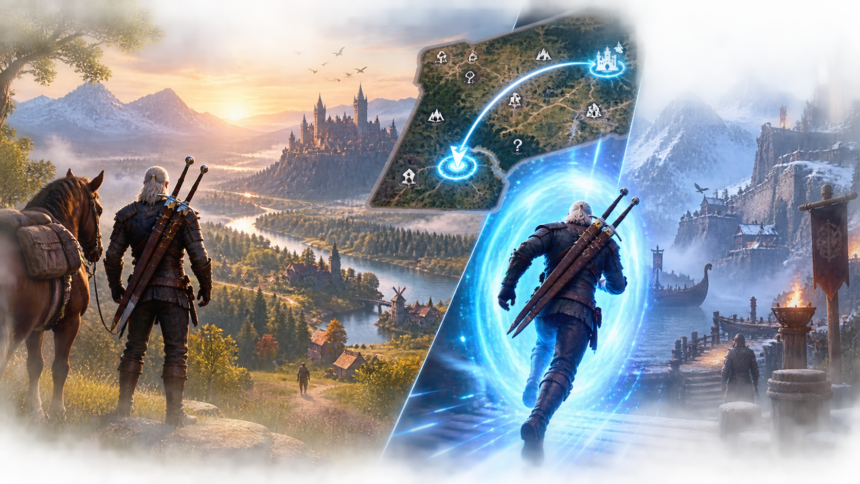

Open a map in almost any modern open-world game and you’ll find it covered in icons: fast travel points, waypoints, unlockable shrines that double as teleporters. Press a button, watch a loading screen, and the forty-minute walk across a mountain range collapses into four seconds. Nobody complains. Most players ask for more of it, not less.
- The Original Deal: A World You Had to Cross
- What Fast Travel Actually Removes
- Convenience Is Not Neutral
- The Games That Said No
- The Middle Path: Earned Fast Travel
- What Research on Spatial Memory Suggests
- Why Designers Keep Adding It Anyway
- Rethinking the Map as a Design Tool
- Frequently Asked Questions
- Conclusion
And yet something changes when a world stops requiring travel through it. The map becomes a menu. The landscape becomes a backdrop you select rather than a place you pass through. This essay looks at how fast travel quietly rewired the relationship between players and the worlds designers spend years building, why the feature is nearly universal despite that cost, and what a handful of games have discovered by refusing to include it at all.
The Original Deal: A World You Had to Cross
Early open-world and RPG design didn’t offer a choice about traversal. If your destination was on the other side of the map in the original The Elder Scrolls games or in Dragon Quest, you walked, rode, or sailed there, and the journey itself was where most of the game actually happened. Random encounters, unexpected landmarks, the slow accumulation of a mental map built from memory rather than a marker — all of it lived inside the travel, not around it.
This wasn’t purely a design philosophy; it was partly a technical constraint. Hardware limitations, slow load times, and smaller budgets made instant travel between arbitrary points difficult to implement cleanly. But constraint and philosophy reinforced each other. A world you had to cross on foot felt larger, more contiguous, and more consequential than one you could summon a shortcut through. The player’s sense of scale was built directly out of the time and effort travel required.
That baseline is worth remembering, because most of what follows is really a conversation about what happened once that constraint disappeared — and developers had to decide, on purpose, whether to keep the friction or remove it.
What Fast Travel Actually Removes
It’s tempting to describe fast travel as simply cutting “dead time,” but that framing assumes travel time was always dead. In practice, unstructured movement through a game world does several things at once that a loading screen can’t replicate.
It builds spatial memory. Walking or riding the same route repeatedly teaches a player the actual geography of a world — which valley connects to which town, where the dangerous area sits relative to the safe one. Teleporting between two points on a map skips that construction process entirely. The world remains a collection of pins rather than a place the player could describe from memory.
It creates unplanned encounters. A monster ambush, a wandering merchant, a strange structure glimpsed off the main path — these moments depend on the player physically passing through the space where they’re placed. Skip the travel and you skip everything a designer seeded along the way that wasn’t important enough to earn its own waypoint.
It reinforces stakes. A dangerous journey back to town with low health and a bag full of loot means something specific: you might not make it. Remove that journey and the loot is simply banked the moment you press the fast travel button, with no risk attached to actually getting it home. This connects to a broader idea covered in our essay on difficulty and what “hard” games actually ask of us — friction isn’t automatically punishment; it’s frequently where the meaning of an in-game risk actually lives.
It paces emotional beats. A slow ride back from a devastating story moment gives a player time to sit with what just happened before the game moves on to the next objective. Compress that into an instant cut and the emotional beat gets flattened by the very next prompt on screen.
None of this means fast travel is a mistake. It means it’s a trade, and most games never make the trade-off explicit to the player choosing to use it.
Convenience Is Not Neutral
There’s a reason fast travel spread so quickly once technology allowed it: players use it, almost universally, the moment it’s available. Given the option between a five-minute ride and a five-second warp, most people take the warp, every time, regardless of how much they might say they value exploration in a survey.
This is where the feature gets philosophically interesting. Fast travel isn’t forced on players in most games — it’s offered, and they choose it, repeatedly, even in games explicitly built around the pleasure of exploring a hand-crafted world. That’s not a contradiction so much as a demonstration of how convenience operates on human behavior generally: given a shortcut, people take it, even when the longer path was the one they’d say, after the fact, that they enjoyed more.
This mirrors a pattern discussed in our essay on the gaming backlog and how we “owe” our games: players routinely act against their own stated preferences when a lower-effort option is sitting right next to a higher-effort one, and the presence of the easy option changes behavior even for people who never intended to use it going in. Fast travel is a small, repeated version of that same dynamic, running dozens of times inside a single playthrough.
The design lesson isn’t “remove convenience.” It’s that convenience quietly edits the experience a game was built to offer, and very few games are honest with players about what that edit costs.
The Games That Said No
A small number of high-profile games have refused fast travel entirely, and the resulting player commentary is unusually consistent regardless of genre.
Death Stranding is probably the most deliberate example. The entire game is structured around the physical difficulty of crossing terrain — traversal isn’t a means to an end, it is the game’s central mechanical and thematic idea. Removing fast travel wasn’t an oversight; the whole design exists because of that removal. Players routinely describe the game’s world as feeling unusually “real” in scale, precisely because every location was reached the hard way.
Kenshi and other systemic survival RPGs lean on the same principle from a different angle: a journey across dangerous territory is itself a source of narrative, because anything can happen along the way, and what happens is never scripted. The absence of fast travel turns ordinary movement into a source of emergent stories that a warp point would have erased.
Even Journey — a much shorter, more contained experience — makes its case for uninterrupted traversal explicit. The entire arc of the game is built around a slow, continuous walk toward a mountain visible from the very beginning. As explored in our piece on Journey and the quiet grief of playing with a stranger, the emotional weight of that game depends entirely on the player experiencing the distance, not skipping it. A fast travel button in Journey wouldn’t just remove convenience; it would remove the game.
What these examples share isn’t a rejection of accessibility for its own sake. It’s a recognition that in games built around a specific relationship to space and time, fast travel doesn’t just streamline the experience — it deletes the thing the experience was actually about.
The Middle Path: Earned Fast Travel
Most games don’t go as far as removing fast travel outright, and a large middle ground has emerged that tries to keep some of the benefits of both approaches. Rather than offering instant travel between arbitrary points from the start, these games gate the feature behind exploration: a shrine has to be found and activated on foot, a tower has to be climbed and its map data unlocked, a waypoint has to be manually discovered before it becomes a fast travel option.
This design pattern — common across the Assassin’s Creed, Elden Ring, and modern Zelda series, among many others — tries to have it both ways. Early exploration still requires genuine traversal, spatial memory still gets built during the discovery phase, and the eventual convenience is framed as something the player earned rather than something handed to them by default. Once a location is unlocked, later trips there compress, but the first trip — the one where the world is actually being learned — still has to happen the slow way.
It’s a reasonable compromise, and it’s popular for good reason. But it’s worth noting what it doesn’t solve: once a fast travel point is unlocked, the world instantly becomes just as skippable as it would be in any other game. The “earned” framing changes the first visit, not the fiftieth, and by the midpoint of most open-world games, the vast majority of traversal happens through unlocked shortcuts rather than genuine movement through space.
What Research on Spatial Memory Suggests
The psychological literature on how humans build mental maps of physical space offers a useful lens here, even though most of it predates video games entirely. Research on cognitive mapping has long established that spatial knowledge is built primarily through active navigation — physically moving through an environment, making wayfinding decisions, and encountering landmarks in sequence — rather than through passive exposure to a static map.
This matters directly for how players actually come to know a game world. A player who fast-travels everywhere from the first hour may be able to recognize location names and recall which icon corresponds to which town, without ever building the kind of connected, navigable mental map that comes from repeatedly walking or riding the same routes. The world becomes a list rather than a geography — recognizable, but not truly known.
Separately, research on the psychology of effort and reward — sometimes discussed under the umbrella of the “IKEA effect,” where people value things more when they’ve put labor into producing them — offers a plausible explanation for why players so often describe hard-won locations and long journeys as more memorable than convenient ones, even when the destination itself is mechanically identical either way. The value isn’t purely in what’s found. Some of it is manufactured by the getting there.
Neither line of research proves fast travel is bad design. It does suggest that the feature isn’t simply removing “friction” in some neutral sense — it’s specifically removing one of the primary mechanisms by which players build a durable, personal relationship with a game’s world.
Why Designers Keep Adding It Anyway
None of this makes fast travel a mistake, and it’s worth being direct about why the feature isn’t going anywhere. Modern open-world games are enormous, frequently spanning dozens of hours of critical path content before side activities are even considered. Without some form of compressed travel, simply returning to finish a quest picked up hours earlier can become a genuine barrier to completing a game at all, especially for players balancing limited free time against a large backlog — a tension our essay on the gaming backlog covers in more depth.
There’s also a completion-rate argument that publishers take seriously: games that respect a player’s time tend to get finished, reviewed, and recommended more often than games that don’t, regardless of how beautifully realized their world is. A gorgeous, hand-crafted map that most players abandon halfway through because backtracking became tedious isn’t accomplishing what it was built for, no matter how much design intention went into every hillside.
And practically, most players genuinely do want the choice. The healthiest version of this design conversation isn’t “fast travel is bad,” but “fast travel should be a choice the player makes deliberately, rather than the default behavior a game trains into them within the first hour.” A world worth walking through occasionally is a world players will choose to walk through, at least sometimes, if the option to do so remains genuinely appealing rather than simply slower.
Rethinking the Map as a Design Tool
Some of the more interesting recent design conversations aren’t about removing fast travel, but about making the choice to use it more meaningful. A handful of games now build systems where traveling on foot has its own distinct rewards — resources only found along routes, weather and lighting that change what a familiar path looks like, random events tuned to reward players who choose the scenic route over the instant one. This turns the map from a binary (walk or warp) into a genuine decision with trade-offs on both sides, closer in spirit to the kind of meaningful choice explored in our essay on why choice in games often feels more real than in movies.
This approach doesn’t ask players to give anything up. It asks designers to make the slower option worth choosing on its own merits, rather than treating traversal as a tax to be minimized. That reframing — from obstacle to genuine option — may be the most promising direction for a feature that isn’t disappearing, but doesn’t have to keep quietly eroding what made these worlds worth building in the first place.
Frequently Asked Questions
Does fast travel ruin immersion?
Not automatically, and the effect varies significantly by game and by player. Fast travel tends to have the biggest impact on immersion in games where the world itself — its geography, danger, and scale — is central to the experience the designers intended. In games where the world is primarily a backdrop for other systems, like combat or crafting, fast travel’s cost to immersion is much smaller.
Why do players use fast travel even in games they say they love exploring?
Convenience shapes behavior more reliably than stated preference does. Given a faster option, most players take it by default, even when they later report enjoying the slower alternative more. This is a well-documented pattern in behavioral research generally, not something unique to games.
Is earned fast travel a good compromise?
It’s a reasonable one. Gating fast travel behind exploration preserves spatial learning during a player’s first visit to an area, while still offering convenience for repeat trips later. Its main limitation is that it only affects early exploration — once most of a map is unlocked, later playthroughs behave much like a game with unrestricted fast travel from the start.
Are there games that got criticized for removing fast travel?
Yes. Some open-world games without fast travel, or with heavily restricted versions of it, have drawn criticism for pacing issues, particularly in genres where backtracking for side content is common. The feature’s absence works best when the whole game is designed around it, as in Death Stranding, rather than bolted onto a structure that assumes convenient travel elsewhere.
Conclusion
Fast travel didn’t remove anything players noticed losing in the moment — that’s precisely what made it spread so quickly and so completely across the genre. But worlds that can be skipped are, quietly, worlds that stop being learned. The handful of games willing to make players walk have shown what that difference actually feels like: a world remembered as a place rather than recalled as a list of icons on a map. Most games will keep the shortcut, and most players will keep taking it. The more interesting design question isn’t whether to offer fast travel, but whether the walk it replaces was ever given a real chance to be worth taking.
Sources and further reading:
- Cognitive Maps in Rats and Men — Psychological Review (Tolman, foundational spatial cognition research)
- The IKEA Effect: When Labor Leads to Love — Harvard Business School Working Paper
- Death Stranding and the Design of Traversal as Theme — Game Developer
- On Open World Fatigue and Player Time — Game Developer
Disclaimer: This article reflects the opinions and analysis of the author based on publicly available design writing and research. It is intended for informational and editorial purposes as part of The Ludic Mind’s ongoing coverage of game design and gaming culture, and does not represent the views of any game studio, publisher, or the individuals cited above. Game titles, characters, and franchises referenced are the property of their respective owners and are mentioned for commentary and analysis purposes only.