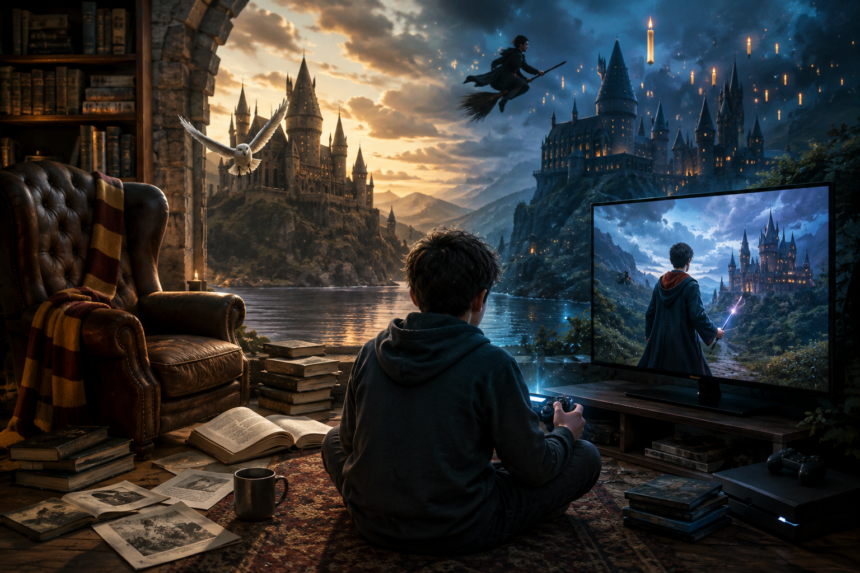

For ten years, an entire generation didn’t just read about Harry Potter or watch him on screen. They walked him through the Forbidden Forest, cast Wingardium Leviosa on stray objects in empty corridors, ducked behind statues from Death Eaters, and pressed a button to make him wave a wand at Draco Malfoy’s smug face. Between 2001 and 2011, Electronic Arts released a game for every film in the series, and across that decade the games quietly built a second, interactive version of Harry Potter that existed alongside the one J.K. Rowling wrote and the one Daniel Radcliffe played. He is one of the strangest cases in gaming: a protagonist whose personality is almost entirely fixed by the source material, yet whose meaning to millions of players was shaped less by what he said in a book and more by what they made him do with a control pad.
- A Silent Protagonist in a World That Wouldn’t Stop Talking
- Philosopher’s Stone and Chamber of Secrets: Puzzle-Box Hogwarts
- Prisoner of Azkaban and Goblet of Fire: Growing Teeth
- Order of the Phoenix: The Castle Finally Opens Up
- Half-Blood Prince: Dueling, Potions, and a Softer Kind of Power Fantasy
- Deathly Hallows: When Harry Stopped Being a Student and Became a Soldier
- What Changes When You Play Harry Instead of Watching Him
- Why These Games Still Matter After Hogwarts Legacy
- Conclusion
- Frequently Asked Questions
If character studies like this are your thing, you’ll find more of them on The Ludic Mind’s Characters section, where we regularly dig into the protagonists who shaped how a generation understood their favorite stories.
A Silent Protagonist in a World That Wouldn’t Stop Talking
Harry Potter presents an odd challenge for game designers that most video game protagonists never face: he already has a fully formed personality before a single line of code is written. He is stubborn, self-doubting, quick to anger, fiercely loyal, and burdened by a fame he never asked for. Unlike a blank-slate hero built for player projection, Harry arrives in every EA game already written, already cast, already performed on screen by an actor whose face becomes his in-game model. The games could not let players decide who Harry was. What they could do, and did with increasing confidence across the decade, was let players decide how Harry moved through his own story: which secrets he uncovered, which shortcuts he found through the castle, which of his classmates he bothered to talk to on the way to Potions class.
This is a strange kind of authorship. Reading the books or watching the films puts you in Harry’s head through narration or performance. Playing the games puts you in Harry’s hands. You aren’t interpreting his choices; you’re executing his footsteps. That distinction shaped the entire decade of games, and it’s worth tracing how differently each installment handled it as the technology, the films, and the story itself grew darker.
Philosopher’s Stone and Chamber of Secrets: Puzzle-Box Hogwarts
The earliest games, released alongside the first two films, treat Hogwarts less like a world to inhabit and more like a series of levels to solve. Harry Potter and the Philosopher’s Stone, developed by Argonaut Games for the original PlayStation, sends players through the Forbidden Forest, the Hogwarts greenhouses, and the corridors leading to the Mirror of Erised as an action-adventure puzzle game, collecting Bertie Bott’s Every Flavour Beans and dueling the poltergeist Peeves, a character invented for the game and never present in the film it was based on.
What’s notable about this early version of playable Harry is how much agency he’s given over mundane, almost domestic tasks that the books and films skip entirely. You aren’t just watching Harry attend Herbology; you’re personally repotting Mandrakes. You aren’t hearing about detention; you’re solving a puzzle to get out of it. This texture, small and forgettable as it can feel in retrospect, did something the films structurally couldn’t: it let an eleven-year-old audience live inside the mundane rhythms of a magical school year rather than only its plot highlights. Chamber of Secrets followed the same puzzle-adventure formula a year later, adding the Polyjuice Potion and the Basilisk’s rampage as set pieces, but keeping Harry firmly in the role of an obedient student solving one contained problem at a time.
Prisoner of Azkaban and Goblet of Fire: Growing Teeth
By the third and fourth games, the tone visibly shifts to match a Harry who is, in the books, growing more anxious, more isolated, and more aware of the danger closing in around him. Prisoner of Azkaban introduces the Marauder’s Map as an actual gameplay tool, letting players track hidden secrets across the grounds, a clever bit of design that turns a beloved artifact from the books into a mechanic rather than just a prop. Goblet of Fire, releasing alongside the film that first shows a major character’s death on screen, restructures its gameplay entirely around the Triwizard Tournament’s three tasks: the dragon, the underwater rescue, and the maze, forcing Harry into direct, high-stakes competition rather than classroom puzzle-solving.
This is also the point where the games start experimenting with co-operative play, letting a second player control Ron or Hermione alongside Harry, an acknowledgment that Harry’s story was never really a solo act. The trio dynamic that defines the books, three friends who succeed because they cover each other’s weaknesses, finally had a mechanical expression rather than just a narrative one.
Order of the Phoenix: The Castle Finally Opens Up
The fifth game, released in 2007, marks the single biggest structural change in the entire decade. Where every previous title moved Harry through a sequence of discrete, linear levels, Order of the Phoenix threw open the doors of Hogwarts and let players roam its grounds freely for the first time, exploring the castle’s towers, dungeons, and courtyards at their own pace between story missions. It was, as several retrospectives have noted since, an early and imperfect ancestor of the kind of free-roaming Hogwarts that Hogwarts Legacy would eventually deliver with fifteen more years of technology behind it.
This shift mattered for how Harry felt to control. A linear puzzle-adventure game makes its protagonist an instrument for solving the level in front of him. An open, explorable Hogwarts makes Harry something closer to a resident, a fifth-year student with a locker, a common room, and hundreds of interactive objects scattered across a castle he actually lives in. Players could earn “discovery points” simply by casting non-combat spells on doors, portraits, and furniture, an activity with no narrative weight whatsoever but enormous value in making Hogwarts feel less like a set and more like a place. It’s also the point where the games began building Harry’s model from Daniel Radcliffe’s likeness with a dedicated voice actor, Adam Sopp, performing lines in Radcliffe’s cadence rather than relying on the actor himself, since Radcliffe’s schedule rarely allowed him to record for the games directly.
The Weight of Free Roam
What’s easy to miss about Order of the Phoenix’s open-world turn is how well it matched the book’s central theme. The fifth novel is fundamentally about Harry being disbelieved, isolated, and denied the freedom to act on what he knows to be true, while the Ministry of Magic tightens its grip on Hogwarts through Dolores Umbridge. Letting players wander the castle at will, learning defensive spells in secret through Dumbledore’s Army, created a strange but fitting parallel: the game’s newfound freedom of movement mirrored the story’s insistence that freedom, of information and of action, was exactly what its characters were fighting to protect. It’s a similar trick to how other games use structural choices to reinforce a story’s themes rather than simply illustrate them, the kind of design decision we’ve explored in essays like Why Choice in Games Often Feels More Real Than in Movies, which looks at how interactivity itself can carry meaning that a passive medium can’t replicate.
Half-Blood Prince: Dueling, Potions, and a Softer Kind of Power Fantasy
The sixth game refined rather than reinvented the open-Hogwarts formula, giving players a somewhat smaller but denser castle to explore alongside an expanded dueling system that let Harry face off against classmates and Death Eaters in more tactical, spell-countering combat. Potion-brewing, a skill that matters enormously in the book thanks to the mysterious annotated textbook Harry inherits, became an actual in-game activity, tasking players with balancing ingredients and timing rather than just watching a cutscene explain Harry’s newfound aptitude.
It’s a small but telling design choice. The book’s version of Harry succeeds at Potions almost by accident, coasting on someone else’s genius rather than his own effort, which is part of the story’s quiet commentary on inherited advantage and shortcuts. The game, by necessity, has to let the player actually perform the brewing, turning an act of borrowed brilliance into something the player earns through their own hands on the controls. That’s an interesting tension worth sitting with: games often can’t preserve a character’s flaws or shortcuts the way prose can, because the player has to actually do the thing, competently, for the game to function. Harry’s video game self is, almost by the medium’s nature, a slightly more capable and self-sufficient version of his novel counterpart.
Deathly Hallows: When Harry Stopped Being a Student and Became a Soldier
Nothing captures the arc of playable Harry Potter better than the final two games, based on the two-part conclusion of the film series. Deathly Hallows: Part 1 abandons the open-Hogwarts formula entirely. There is no free-roaming castle, no potion-brewing, no discovery points. Instead, EA rebuilt the game as a cover-based third-person shooter, complete with a spell-based targeting system, an experience-and-upgrade progression loop, and lengthy stealth sequences played from a first-person perspective while Harry hides beneath the Invisibility Cloak, his frightened breathing audible in the player’s ear.
It’s a jarring shift, and critics at the time were split on whether it honored or betrayed what the series had built. What can’t be disputed is how precisely the mechanical shift tracks the story’s own transformation. The book strips Harry of Hogwarts, of his safety net, of nearly everyone he trusts, and sends him into hiding with only Ron and Hermione for company while Death Eaters and Snatchers hunt them across the country. A game about wandering a castle solving puzzles could never have represented that. The shooter reinvention, however clumsy some of its execution, gave players an unmistakable, bodily sense of a world that had run out of safe rooms.
Deathly Hallows: Part 2 kept the same combat structure for the Battle of Hogwarts, letting players fight through a version of the castle now transformed into a warzone, its familiar corridors littered with rubble and dueling wizards rather than students hurrying to class. It’s a haunting inversion of Order of the Phoenix’s free-roaming Hogwarts: the same halls, the same courtyards, now serving as a battlefield instead of a home. Playing through that destruction, rather than simply watching it in the film, gives the ending of Harry’s story a physical, almost mournful weight that the movies, for all their scale, can only gesture at from a fixed camera angle.
What Changes When You Play Harry Instead of Watching Him
Across a decade of these games, a pattern becomes clear: playing Harry Potter doesn’t change who he is, but it changes what his story asks of you. Reading the books, you sympathize with Harry’s fear, his grief, his fury at being lied to by the adults meant to protect him. Playing the games, you have to physically perform his survival, timing a Protego shield at the right moment, sneaking past a Death Eater’s patrol route, casting the correct counter-curse before your health bar empties. That shift from empathy to execution doesn’t replace the emotional core of the story, but it layers a second kind of investment onto it, the investment of competence, of getting it right, of not letting Harry die on your watch even though you already know, from the books, that he won’t.
This is part of why long, character-driven franchises translate so unevenly to games, and also why the ones that succeed tend to matter so much to the people who played them growing up. A character whose arc unfolds over real years of a player’s own life, the way Harry’s did across a full decade of EA releases, ends up occupying a strange dual space: half a character you’re reading about, half a role you’re performing. It’s a dynamic that echoes through other franchises where a protagonist visibly ages alongside the audience controlling them, something we’ve traced in pieces like our look at Clementine and growing up in a world that won’t slow down, where a similarly long-running, interactive coming-of-age story blurs the same line between watching a character mature and helping shape that maturity yourself.
Why These Games Still Matter After Hogwarts Legacy
It would be easy to write off the EA Harry Potter games as a footnote now that Hogwarts Legacy exists, a far more technically ambitious and fully open-world take on the same castle. But the earlier games did something Hogwarts Legacy structurally cannot: they let you play as Harry Potter himself, inside his actual story, at the exact moments the books and films made famous. Hogwarts Legacy, set a century before Harry was born, can only gesture at his world from a distance. The EA games put his wand in your hand during the Triwizard Tournament, during the Battle of the Department of Mysteries, during the fall of Hogwarts itself.
That’s a trade-off worth acknowledging rather than dismissing. Hogwarts Legacy offers freedom and scale that the older games could never match, but it does so by inventing an entirely new protagonist and a new story, because the real one was never designed to be replayed from the inside by just anyone. The EA decade, flawed and uneven as individual entries were, remains the only place where “being Harry Potter” was ever actually possible to experience firsthand, rather than admired from the outside. For an entire generation of players, that decade of games is where Harry Potter stopped being someone they read about and started being, if only for a few hours at a time, someone they were.
Conclusion
Across ten years and eight games, EA’s Harry Potter series charted an unusually honest evolution: from a curious eleven-year-old solving puzzle-box mysteries in a Hogwarts built for exploration at a careful pace, through a teenager finally given the freedom to roam his own school, to a young man forced out of that school entirely and into a war fought with cover systems and stealth meters instead of house points. The games never had the freedom to reinvent who Harry was, but they found real, meaningful ways to let players inhabit what happened to him, and in doing so, they built a second, interactive layer onto a story that millions of people already thought they knew by heart.
If this piece left you thinking about other characters whose meaning changed depending on whether you read them, watched them, or played them yourself, you’ll find more analyses like it over on The Ludic Mind.
Frequently Asked Questions
How many Harry Potter video games did EA make between 2001 and 2011?
EA released a game to accompany every film in the original series: Philosopher’s Stone (2001), Chamber of Secrets (2002), Prisoner of Azkaban (2004), Goblet of Fire (2005), Order of the Phoenix (2007), Half-Blood Prince (2009), and Deathly Hallows split into Part 1 (2010) and Part 2 (2011), for a total of eight main titles across various platforms.
Did Daniel Radcliffe voice Harry Potter in the video games?
Radcliffe’s likeness was used for Harry’s in-game model from Order of the Phoenix onward, but his actual voice was rarely available due to filming schedules. Actor Adam Sopp performed as Harry’s voice double across most of the later games, closely matching Radcliffe’s cadence and delivery.
Which Harry Potter game first let players freely explore Hogwarts?
Harry Potter and the Order of the Phoenix, released in 2007, was the first in the series to feature a fully open, explorable version of Hogwarts Castle and its grounds, letting players wander between story missions rather than progressing through fixed, linear levels.
Why did the gameplay change so drastically in Deathly Hallows?
The final two games abandoned the open-Hogwarts, puzzle-adventure format for a cover-based third-person shooter with stealth sequences, reflecting the story’s shift away from school life and into Harry, Ron, and Hermione’s fugitive hunt for Voldemort’s Horcruxes. Developers felt the darker, more adult tone of the source material called for a more action-driven approach.
How do the classic EA games compare to Hogwarts Legacy?
Hogwarts Legacy offers a much larger, more technically advanced open world, but it takes place roughly a century before Harry Potter’s birth and follows an original protagonist. The EA games, despite their technical limitations, remain the only titles that let players directly control Harry Potter through the actual events of his own story.
Disclaimer
This article is an editorial, interpretive analysis written for informational and entertainment purposes for the gaming community. All references to the Harry Potter series, its characters, games, and imagery are the property of J.K. Rowling, Warner Bros., Electronic Arts, and their respective rights holders. This piece is not affiliated with, sponsored by, or officially endorsed by these companies. The opinions expressed reflect the author’s personal interpretation and are not intended as an official or definitive representation of the original works.