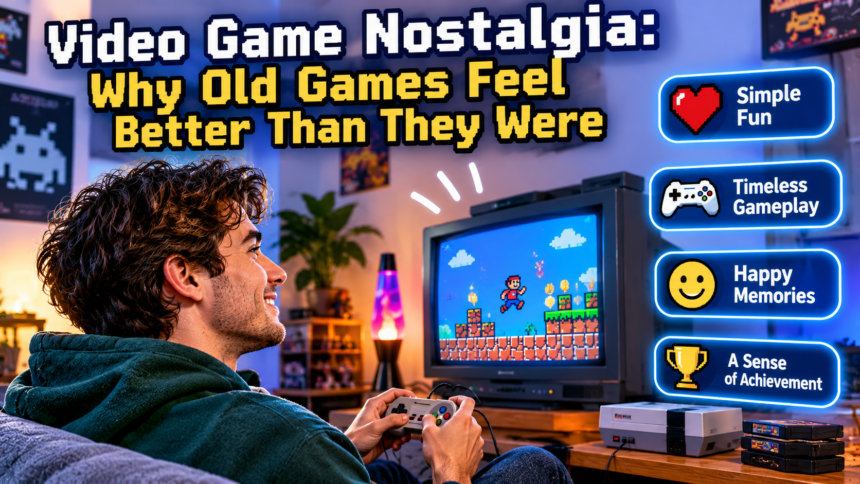

Video game nostalgia is the warm, slightly distorted memory of the games we loved when we were younger. Old games feel better than they were because memory edits out the flaws and keeps the feeling. Here is how that process works and how to use it well.
- What Is Video Game Nostalgia?
- The Psychology Behind Nostalgia in Gaming
- Why Old Games Feel Better Than They Were
- How the Industry Turns Nostalgia Into a Business
- Is Nostalgia Good or Bad for Gamers?
- How to Revisit Old Games Without Being Disappointed
- Frequently Asked Questions About Video Game Nostalgia
- Conclusion: Keep the Memory, Meet the Present
What Is Video Game Nostalgia?
Most people have one. A cartridge in a drawer, a memory card long since lost, a menu theme that still sounds like a Saturday morning. You hear four notes and you are eleven years old again, cross-legged on a carpet, a few feet too close to the television.
That pull is what we mean by video game nostalgia. It is not simply liking old games. It is a feeling about a version of yourself, a house, a friend group and a time of life, with the game acting as the doorway.
A Simple Definition
Nostalgia, in psychology, is a sentimental longing for the past, usually a blend of happiness and a small ache. It looks backward, but it tends to leave people feeling more connected and more optimistic rather than sadder.
Video game nostalgia is that same emotion with a controller attached. The game is rarely the whole subject. It is the container for everything that surrounded it.
Why Games Hold Memories So Well
Games are unusual memory anchors for three reasons:
- You were an active participant. You did not watch a story, you performed it, and actions stick harder than observations.
- They took a long time. Forty hours with one world creates far more material for memory than a two-hour film.
- They were social. Trading tips at school, passing a controller to a sibling, arguing over who was next.
The result is that a game becomes a shelf on which a whole period of life is stored.
The Psychology Behind Nostalgia in Gaming
The feeling is not random sentimentality. Several well-known ideas from memory research explain why it hits so hard and why it can mislead us at the same time.
The Reminiscence Bump
Researchers who study autobiographical memory have long noticed that adults recall a disproportionate number of vivid memories from roughly adolescence to early adulthood. This is often called the reminiscence bump.
That window is when we form our identity, our tastes and our first strong attachments. It is also, for many people, when the games that mattered most arrived. Those titles did not just entertain us, they helped us become someone.
Rosy Retrospection
Memory is not a recording. It is a reconstruction, and it tends to be kind. Psychologists describe a pattern, sometimes called rosy retrospection, in which we remember past experiences as more pleasant than we rated them at the time.
The long loading screens, the unfair checkpoints, the camera that fought you in every corridor, they fade. The moment you finally beat the boss stays bright.
Sensory Triggers and Muscle Memory
Sound, in particular, is a powerful trigger. A startup jingle or a looping town theme can bring back a whole afternoon instantly. Smell and touch work the same way, think of the click of a particular controller or the plastic smell of a game case.
Muscle memory adds another layer. Some people pick up an old controller and their thumbs still know the combination for a special move after fifteen years. The body remembers, and that physical certainty feels like proof that the past was real and good.
Why Old Games Feel Better Than They Were
Plenty of people replay a childhood favourite and feel a small drop in the stomach. The game is slower, clunkier or plainer than they remembered. Three forces explain the gap.
Imagination Filled the Gaps
Early 3D games were built from blocky shapes and low-resolution textures. A child looking at a handful of polygons did not see polygons. They saw a castle, a forest, a monster with a personality.
The limits of the hardware handed part of the design job to the player’s imagination. Modern games leave less room for that, because they show you nearly everything. When you return as an adult, your imagination no longer does the free work, and the game looks smaller than the one in your head.
Fewer Choices Meant Deeper Attachment
If you owned three games, you played those three games to death. You learned every secret and every shortcut because there was nothing else to do. That repetition builds familiarity, and familiarity feels like love.
Today a library can hold hundreds of unplayed titles. Attention is spread thin, and few games get the sustained focus that makes a memory permanent. Our attachment to old games may say as much about scarcity as about quality.
We Had More Time and Fewer Worries
A twelve-year-old on a summer holiday can spend six hours inside a game with no guilt. An adult squeezes an hour in after work and judges the experience against everything else competing for their evening.
Part of what we miss is not the game at all. It is the unstructured time, the lack of responsibility and the ability to be completely absorbed. The game gets the credit for a feeling that childhood supplied.
Quick Comparison: Memory vs Reality
| What we remember | What was often true |
|---|---|
| Seamless, immersive worlds | Short draw distances and heavy fog |
| Perfect controls | Awkward cameras and stiff movement |
| Epic length | Padding, grinding and repeated content |
| Brilliant difficulty | Trial and error, sometimes simply unfair |
| Friends around the screen | A shared moment that no remake can restore |
The table is not an argument that old games were bad. Many were extraordinary. It is a reminder that our memories blend the game with its context.
How the Industry Turns Nostalgia Into a Business
Publishers noticed long ago that the games people loved at fifteen are the games they will pay for again at thirty-five. Nostalgia is now a major commercial strategy, and it takes several forms.
Remasters, Remakes and Reboots
These three terms are often confused, so here is a clear way to separate them:
- Remaster: the same game with improved resolution, frame rate and polish.
- Remake: the game rebuilt from the ground up, often with new systems and visuals.
- Reboot: a fresh version of a franchise that keeps the name and themes but not the exact story.
Each one promises to give you the old feeling without the old friction. When they succeed, it is because the team understood what players actually remembered rather than what was literally on screen.
Retro Consoles, Mini Systems and Subscription Libraries
Small plug-and-play consoles packed with classic titles, back-catalogue subscription services and collections of old arcade games all rely on the same appeal. They let you press play on a memory.
They also solve a practical problem. Original hardware ages, cables break and old televisions vanish. Making the past easy to reach is a way of keeping it alive.
Familiar Sounds, Familiar Faces
Nostalgia marketing often leans on music and characters more than on gameplay. A trailer that opens with a famous theme can make a player feel something before a single mechanic is shown.
That is powerful, and it is worth noticing. When you feel a rush at a trailer, ask whether you are excited about the game or about the version of yourself it reminds you of.
Is Nostalgia Good or Bad for Gamers?
The honest answer is both. It is a tool, and like most tools it depends on how you use it.
The Benefits
- Comfort. Returning to a familiar world can calm anxiety and lower stress on a hard week.
- Connection. Shared memories give people something to talk about, from old friends to new colleagues.
- Continuity. Recalling who you used to be helps you see how far you have come.
- Discovery. Nostalgia often leads people to explore the history of the medium, and to find great games they missed.
The Risks
- Unfair comparisons. Judging new games against an idealised past can make you miss what is good right now.
- Gatekeeping. “Games were better then” can become a way of dismissing newer players and newer genres.
- Overspending. Buying the same title for the fourth time because of a feeling is not always a good deal.
- Stagnation. If you only ever replay the past, you stop meeting games that could become your next favourites.
A Healthy Middle Ground
The healthiest approach is to treat nostalgia as one flavour among many. Enjoy it deliberately, without using it as a measuring stick for everything else. Old and new games can both be great, and they can be great for different reasons.
How to Revisit Old Games Without Being Disappointed
If you want to go back, you can improve the odds. A little preparation protects the memory and lets you enjoy what is really there.
Step-by-Step Approach
- Lower the stakes. Expect a visit, not a rebirth. You are checking in on an old friend, not proving that your childhood was perfect.
- Pick the right version. A well-made remaster can remove the worst friction, such as awkward controls, while keeping the spirit intact.
- Play in short sessions. An hour at a time lets the charm land before frustration builds.
- Skip the grind. Using a guide to bypass a padded section is not cheating. It is respecting your adult schedule.
- Notice what you actually enjoy. Is it the music, the exploration, the characters, the pace? That answer tells you what to look for in new games.
- Share it. Playing with a sibling, partner or friend recreates the social side that made the memory special.
What to Do If the Magic Is Gone
It happens, and it is not a failure. Sometimes the game has aged badly, and sometimes you have simply changed.
The memory is still yours. A disappointing replay does not erase the real joy you felt at the time, it only shows that joy was partly made of its surroundings. Put the game back on the shelf and let the original memory stay as it was.
Using Nostalgia to Find New Favourites
Here is a practical trick. Write down three things you loved about a childhood game, for example a sense of exploration, a strong soundtrack or a quiet, lonely atmosphere. Then search for modern games built around those same qualities.
Many recent independent titles are designed by people who grew up on the same classics. They often capture the feeling you are chasing without the technical baggage.
Frequently Asked Questions About Video Game Nostalgia
Why do I feel emotional when I hear old game music?
Music is tightly linked to memory and emotion. A theme you heard hundreds of times during formative years becomes attached to everything happening around you at that moment, so hearing it again can bring back the whole scene at once.
Are old games actually better than modern ones?
Not as a rule. Some older games had design ideas that are rarely seen today, and some modern games are far more polished and inventive. Quality depends on the individual title. Nostalgia simply makes the past look more consistent than it was.
Why do remasters and remakes sell so well?
They combine proven stories with improved technology, and they speak directly to adults who now have disposable income. They also lower the risk for publishers, since an existing audience already cares.
Is nostalgia a sign that I am getting old?
No. People of many ages feel nostalgia, and younger players already feel it for games from only a few years ago. It is a normal feature of human memory, not a symptom of ageing.
Can nostalgia ruin new games for me?
It can if you let it set an impossible standard. If you notice yourself saying “it is not as good as the original” about everything, try judging each game on its own terms before comparing.
How can I enjoy retro games without buying old hardware?
Legal options include official re-releases, subscription catalogues and licensed mini consoles. These are usually the simplest way to play classic titles on modern equipment.
Conclusion: Keep the Memory, Meet the Present
Video game nostalgia is not a mistake in our memory. It is memory doing what it is built to do, keeping the feeling and letting the friction fade. Old games feel better than they were because they came wrapped in imagination, free time and the people we shared them with.
The practical takeaway: enjoy the past on purpose, play it with realistic expectations, and use what you loved about it as a compass for what to play next. The best old games deserve respect, and the best new ones are waiting to become someone else’s favourite memory.