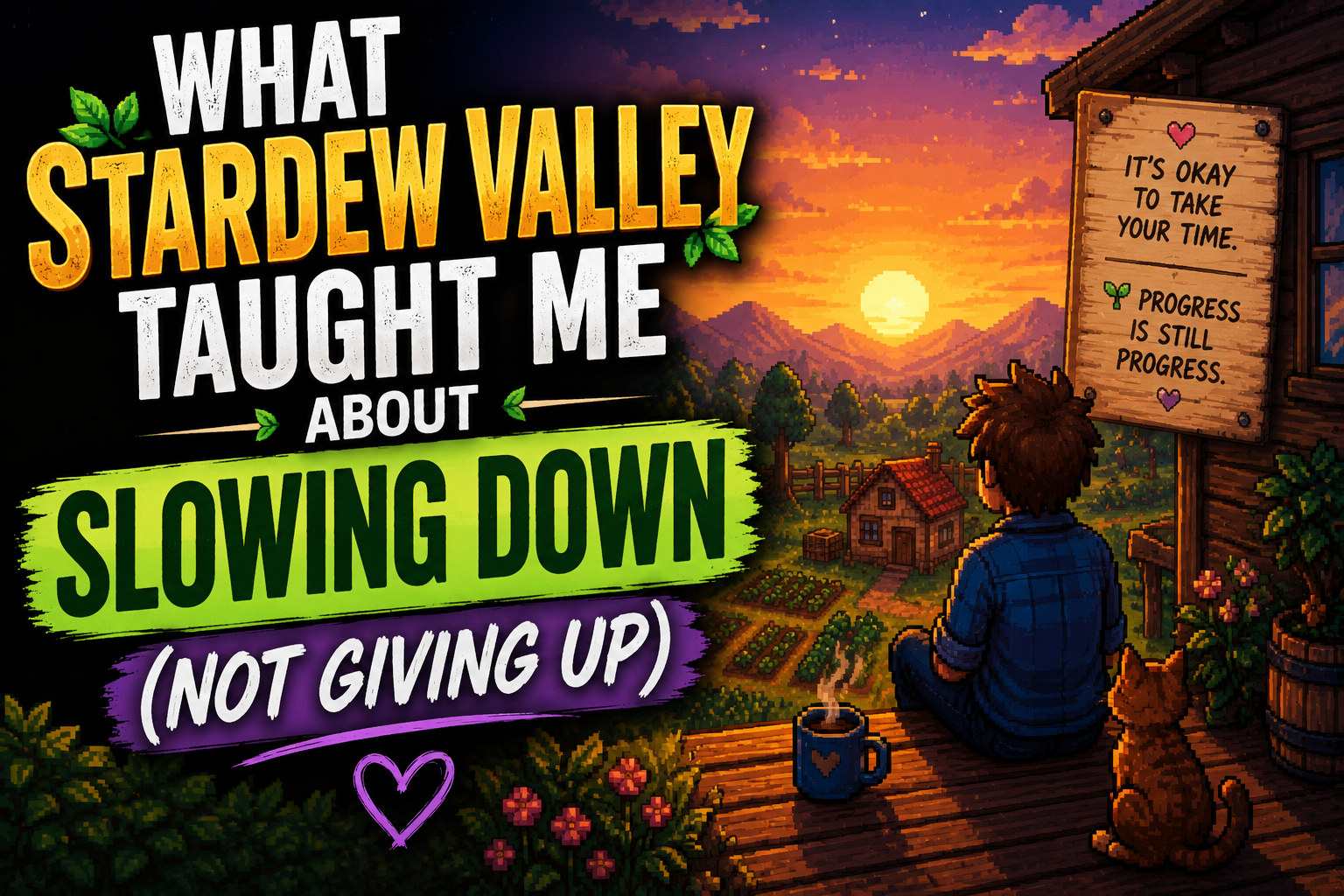

What if the thing making you exhausted isn’t the amount of work in front of you, but the voice insisting you should be doing more of it, faster, right now?
- A Game That Refuses to Rush You
- The Farm You’re “Supposed” to Be Optimizing
- The Trap of “Resting Is Falling Behind”
- Missing a Festival Isn’t Failing the Game
- The Energy Bar That Isn’t Punishing You
- There’s No Ending That Rewards Exhaustion
- Slowness as Part of the Design, Not a Failure to Design Faster
- It’s Not a Game “About” Burnout — It Feels Like Recovering From It
- Final Thoughts: What I Took Into Real Life
That question sat with me for months after I started playing Stardew Valley, a farming and life-simulation game where you inherit a rundown plot of land and, in theory, build it into a thriving farm. I say “in theory” because the game spends most of its runtime quietly undermining the idea that building something thriving requires constant motion. I didn’t expect a pixel-art farming game to change how I thought about rest. But it did — not by lecturing me about self-care, but by handing me a farm, a clock, and enough rope to either sprint myself into the ground or learn, slowly, that I didn’t have to.
This article is part of an ongoing series exploring what video games can teach us about real life. If you’re interested in gaming and philosophy, in the psychology of games, or in why some titles stay with us long after the credits roll, Stardew Valley is one of the clearest examples of a game whose central lesson lives entirely in its pacing.
A Game That Refuses to Rush You
On the surface, Stardew Valley looks like it should reward speed. Each in-game day is a ticking clock. Crops need planting and watering. Animals need feeding. There are mines to explore, relationships to build, a community center to restore, seasons that cycle whether you’re ready or not. Every system in the game seems, at first glance, built to punish anyone who moves too slowly.
Except it isn’t, and the longer you play, the more that becomes obvious. There’s no game-over screen for a farm that grows slowly. No penalty, beyond your own expectations, for spending an entire in-game day fishing instead of farming. No character who scolds you for skipping a mine expedition to sit at the beach and watch the tide come in. The game gives you a clock and a to-do list that never actually ends, and then, almost sneakily, refuses to punish you for not clearing it.
Why Removing Urgency Changes Everything
Most games that hand the player a clock use it as pressure — a countdown, a deadline, a reason to move fast or lose something. Stardew Valley hands you a clock and lets you discover, slowly, that the urgency you feel around it was never coming from the game itself. It was coming from you, imported from everywhere else you’d learned that unused time is wasted time.
This is a useful distinction for anyone thinking seriously about the philosophy of video games: sometimes the message isn’t in what the game demands of you, but in what it very deliberately never asks for, even when every instinct you’ve built up elsewhere insists it must be asking.
The Farm You’re “Supposed” to Be Optimizing
Here is where Stardew Valley becomes genuinely interesting as a piece of design. There is, undeniably, an optimal way to play it — a most efficient crop rotation, a fastest path to a fully upgraded farmhouse, a min-maxed route through every relationship and every mine level. Entire wikis and spreadsheets exist to help players extract maximum output from every single in-game day.
And the game lets you find all of that, if you want it. But it never once implies, through its own design, that you’re required to. There’s no achievement for “efficient farm.” No character comments on how much slower your crops came in than they theoretically could have. The optimal path exists as something players bring to the game from outside it, not something the game itself is quietly grading you against.
A Rare Kind of Honesty in Game Design
Very few systems — in games or in life — are willing to hand you a genuinely open-ended structure and then mean it when they say there’s no wrong way to move through it. Most either hide a scoring system under the surface or design their pacing so tightly that “slow” quietly becomes synonymous with “behind.” Stardew Valley refuses that framing almost entirely. It suggests, through years of patches and design choices rather than a single explicit statement, that a farm tended slowly and a farm tended obsessively are simply two different farms — not a lesser one and a better one.
This is where Stardew Valley quietly aligns itself with something close to real psychological insight, without ever using clinical language. It’s not selling productivity as the measure of a life well spent, even inside a game literally built around production.
The Trap of “Resting Is Falling Behind”
We live surrounded by a well-intentioned but corrosive idea about time: that any hour not spent moving something forward is an hour lost. Working overtime treated as dedication. A weekend with nothing scheduled treated as wasted rather than restorative. Rest, when it happens at all, often has to be earned first, justified after the fact, squeezed into whatever’s left once the real obligations are cleared.
Stardew Valley rejects that framing, subtly but consistently. A day spent fishing instead of farming isn’t flagged by the game as a missed opportunity. The crops that would have grown either way still grow. The animals still get fed if you remember, and forgive you, gently, if you occasionally don’t. The game simply doesn’t treat rest as time subtracted from productivity. It treats rest as one of the things you’re allowed to spend a day doing, exactly like farming or mining or fishing, with no asterisk attached.
There’s a meaningful difference — and I think this is the philosophical core of the game — between productivity and progress. Productivity is how much visible output you generated today. Progress is whatever actually moved you closer to the life you’re building, which sometimes looks like a full barn and sometimes looks like an afternoon that simply let you recover enough to keep going tomorrow. Stardew Valley keeps insisting, gently, that these are not the same measurement, and that we default to confusing them far too often.
Practical Example: The Day I Did Nothing But Fish
There’s a stretch, maybe forty in-game hours into a typical playthrough, when the initial rush of establishing the farm settles into something closer to routine, and the temptation to treat every single day as a fresh optimization puzzle starts to fade. I remember the first day I deliberately ignored my crops, walked to the beach, and just fished for the entire afternoon. Nothing about my farm objectively improved. And it was, without exaggeration, one of the more genuinely relaxing hours I’d spent with a controller in years — not despite accomplishing nothing by the farm’s metrics, but because the game never once implied I should feel bad about it.
Anyone who has taken an actual day off and spent the first half of it mentally drafting the to-do list waiting on the other side of it will recognize the emotional logic here immediately. Stardew Valley arrives at this insight through gameplay, not through a character explaining rest to you. It just makes the day off feel, mechanically, exactly as valid as the day of work.
Missing a Festival Isn’t Failing the Game
Another mechanical detail that becomes philosophical: Stardew Valley is built around seasonal festivals — the Egg Festival, the Luau, the Flower Dance — one-time yearly events that offer unique dialogue, items, and community moments. If you’re busy mining, or you forget, or you simply decide to stay home and water your crops instead, you miss it. Permanently, for that year.
This sounds, described flatly, like exactly the kind of punishing time pressure the rest of this essay has been arguing the game avoids. But the way it actually plays out is different: missing a festival isn’t treated as a failure state. No character brings it up disapprovingly. The game doesn’t pause to make sure you’ve registered the loss. You simply notice, next season, that you weren’t there for that one — and life in the valley continues regardless, exactly as unbothered by your absence as it would have been by your presence.
Real-Life Parallel: The Things We Treat as Deadlines That Aren’t
Think about how many things in daily life get quietly upgraded, in our own heads, from “opportunities” to “deadlines with real consequences” — a networking event, a social plan, an optional obligation that somehow starts to feel mandatory the moment it’s on the calendar. Stardew Valley teaches, one missed Luau at a time, that some things genuinely were opportunities and nothing more: worth attending if you can, worth grieving mildly if you can’t, but never actually worth the anxious, disproportionate weight we tend to assign them in the moment. The game doesn’t lecture you about this directly. It just lets the season turn regardless of your choice, and trusts you to notice how little actually broke.
This is one of the clearer examples of how video games and mental health intersect in ways that go beyond “relaxing” or “escapist” entertainment. Some games actively rehearse a healthier relationship with missed opportunities, one skipped festival at a time.
The Energy Bar That Isn’t Punishing You
Stardew Valley‘s energy system deserves its own mention, because it’s one of the more quietly compassionate mechanics in modern game design. Every action — farming, mining, fishing, chopping wood — costs energy. Run out, and your character doesn’t collapse or take damage in any dramatic sense. They simply become slower and less effective, gently nudging you toward heading home and going to bed.
Compare this to how exhaustion tends to get treated in real life, where running on empty is often worn as a badge of commitment rather than treated as a signal to stop. Stardew Valley‘s energy bar doesn’t moralize about rest. It just makes continuing to push through exhaustion visibly, mechanically worse than stopping — a small design choice that ends up modeling something a lot of players, myself included, have a much harder time accepting about their own bodies outside the game.
There’s No Ending That Rewards Exhaustion
Without spoiling the specifics of how a playthrough can conclude, it’s worth noting something about the overall structure of Stardew Valley: there’s no ending state that specifically rewards having pushed yourself the hardest. A farm built slowly, over three in-game years of leisurely afternoons and the occasional missed festival, is not treated by the game as an inferior outcome to a farm built by someone who min-maxed every single day since year one. Both are simply farms. Both are simply valid ways of having spent the time.
This can sound like a small, almost obvious observation when read too quickly, but I think it’s one of the more quietly radical ideas a farming simulator has ever handed me: you don’t need to have extracted the maximum possible value from your time in order for that time to have counted.
Why This Matters for the Philosophy of Games as a Genre
This is exactly the kind of insight that separates surface-level “games as art” arguments from genuinely thoughtful video game philosophy. It’s not enough for a game to include a message about rest in its marketing copy. The message has to live in the systems — in what the player is and isn’t punished for — for the philosophical weight to actually land. Stardew Valley is one of the clearer modern examples of this principle done well, alongside titles like Spiritfarer (grief and letting go) or Outer Wilds (making peace with a deadline you can’t outrun), each of which uses mechanics, not just narrative, to carry its meaning.
Slowness as Part of the Design, Not a Failure to Design Faster
One more choice worth highlighting before wrapping up: Stardew Valley could easily have been designed with tighter loops, sharper punishments for inefficiency, competitive leaderboards for fastest farm completion. Plenty of successful games in adjacent genres make exactly those choices, and there’s nothing wrong with that design philosophy. Stardew Valley deliberately didn’t go that direction, and the slowness isn’t an oversight or a limitation of the genre. It’s the entire point.
This restraint is, in itself, a philosophical stance, one with real precedent outside of games — in various contemplative and slow-living traditions that treat unhurried attention, rather than maximum output, as the marker of a life well lived. You can read a hundred articles about the value of slowing down, and few of them will land the way a full in-game season spent wandering the valley without a fixed agenda actually does. The game trusts unhurried time to make its own case, rather than a character stopping to explain why it matters.
It’s Not a Game “About” Burnout — It Feels Like Recovering From It
It’s worth being precise here, because it’s easy to oversimplify this reading: Stardew Valley isn’t a wellness pamphlet disguised as a farming game. There’s no single closed lesson, no one definitive takeaway everyone is meant to extract. What’s remarkable is that the structure of the game itself — the absence of a scoring system for busyness, the missed festivals that cost nothing but a mild pang, the energy bar that nudges rather than punishes — makes the experience feel similar to what many people describe when they finally, after a long stretch of running on empty, let themselves slow down without something breaking as a result.
That, to me, is the real achievement here: not illustrating an idea from the outside, like a wellness infographic, but making the player inhabit it from the inside, one unhurried afternoon at a time, until the absence of urgency stops feeling suspicious and starts feeling like the actual point.
Final Thoughts: What I Took Into Real Life
After enough hours in Stardew Valley, I noticed something shift in how I treated my own downtime outside the game. I stopped treating a quiet, unproductive weekend as a debt I owed my future self an explanation for. I stopped assuming that slower necessarily meant worse, or that a day spent doing the equivalent of fishing instead of farming was a day quietly wasted. Instead, I started thinking in seasons rather than deadlines. A farm — or a life — built a little more slowly isn’t a lesser version of the fast one. It’s just a different rhythm, and the valley, unlike most of the voices telling me to hurry, never once seemed to mind which one I chose.
I don’t know if this is exactly what the developer intended when he built the game largely alone, over four years, at what by his own account was a genuinely unhurried pace. But that origin feels fitting. A game about learning that slowness isn’t failure was, itself, built slowly, by someone apparently willing to live out the same lesson before handing it to the rest of us.
The farm will still be there either way, whichever pace you choose to tend it at. The question was never really how fast you could grow it. It’s whether you let yourself enjoy the seasons it took.
This article is part of a series exploring the philosophy of video games — how stories, characters, and mechanics reflect real questions about identity, power, mortality, and the choices that define us. If gaming and philosophy is a topic you enjoy, more essays are on the way.