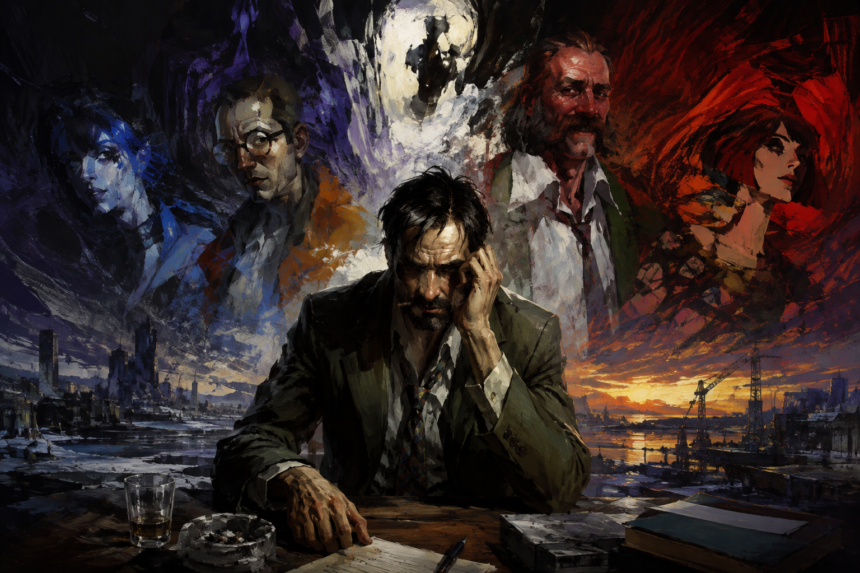

The first thing Disco Elysium does is put you inside a mind that is falling apart. You wake up in a trashed hostel room with no name, no memory, and a headache that talks back. Long before you understand the murder you are supposed to be solving, you understand something more unsettling: that a person is not a single voice giving orders, but a crowded room of competing impulses, each certain it knows best. That is the real subject of the game, and it is why people who finish it often describe the experience less as playing a detective story and more as being introduced to themselves.
- Key Takeaways
- A Detective Story That Is Really About Identity
- The Skills Are Voices, and the Voices Are You
- The Thought Cabinet: How Beliefs Actually Form
- Politics, Grief, and a World Worth Caring About
- The Writing Itself Is Doing the Heavy Lifting
- Why This Design Still Feels Radical Years Later
- What the Game Teaches About Living With Yourself
- A Few Questions Worth Sitting With After You Finish It
- Conclusion
- Frequently Asked Questions
This piece is about what Disco Elysium actually means once you look past the plot, why its unusual design makes it feel so intimate, and what it quietly teaches about living with a mind you did not choose and cannot fully control. If you’re the kind of player who finishes a game and immediately wants to talk about what it did to your head rather than just what happened in it, you’re in the right place — it’s the same instinct behind pieces like what Hades understands about trying again or why we keep returning to games we’ve already beaten.
Key Takeaways
- Disco Elysium’s meaning centers on identity: you are not solving only a murder, you are deciding who your amnesiac detective becomes.
- The 24 skills act as inner voices, turning personality into a cast of characters that argue, lie, and occasionally save your life.
- The Thought Cabinet reframes beliefs as things you internalize over time, with real costs and benefits, mirroring how convictions actually form.
- Failure is written content, not punishment, so the game treats a broken, flawed person as worthy of a full story.
- Its world-building refuses to separate the political from the personal, treating ideology the same way it treats addiction: seductive, clarifying, and dangerous all at once.
- Its lasting lesson is that self-knowledge is a practice, not a destination, and that you can rebuild a life without ever fully “fixing” yourself.
A Detective Story That Is Really About Identity
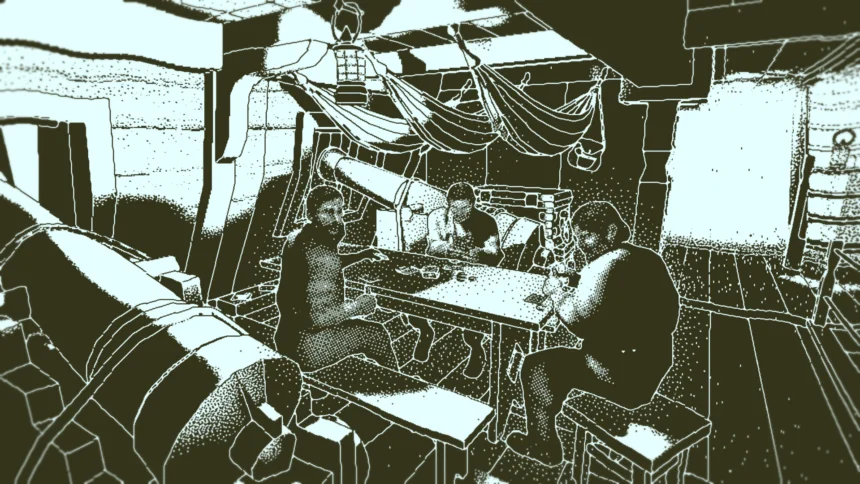
On the surface, Disco Elysium is a detective RPG set in the run-down district of Martinaise, in a city still scarred by a failed revolution. A man has been found hanging from a tree behind the hostel, and you, together with your steadfast partner Kim Kitsuragi, must find out who killed him. It is a genuine mystery with suspects, evidence, and a solution — and it rewards the same kind of patient, observational thinking that made Return of the Obra Dinn’s deduction-driven detective work so satisfying, even though the two games could not look more different.
But the murder is scaffolding. The question the game keeps returning to is not “who did it” but “who are you.” Because your detective has lost his memory, every conversation becomes an opportunity to define him. Do you rebuild yourself as a disciplined professional, a washed-up wreck leaning into the chaos, a wannabe rock star, a cold rationalist, or a bleeding-heart idealist? Nobody assigns you an identity. You assemble one out of thousands of small choices, and the game remembers.
This is why the amnesia device, usually a lazy trope, feels earned here. It literalizes something true about all of us: we wake up each day as the accumulation of yesterday’s choices, largely unable to remember why we became who we are, free in theory to change and yet dragged by habit. The detective’s blank slate is our own, exaggerated for effect.
The Skills Are Voices, and the Voices Are You
The most famous innovation in Disco Elysium is that its 24 skills are not silent stats. They talk. Each one is a distinct personality that chimes in during scenes, and together they form the internal chorus that any thinking person will recognize.
The four attributes and their factions
The skills are grouped under four attributes, and each group has a temperament. Intellect gives you the analytical voices, like Logic and Encyclopedia, that want to understand. Psyche gives you the emotional and social voices, like Empathy, Inland Empire, and Volition, that feel and intuit. Physique gives you the bodily voices, like Endurance, Pain Threshold, and the alarming Electrochemistry that begs for one more drink. Motorics gives you the quick, coordinated voices, like Perception, Composure, and Savoir Faire.
What makes this brilliant is that a high skill is not simply good. A towering Electrochemistry makes you perceptive about pleasure and addiction, but it also whispers that every substance in Martinaise is a good idea. A maxed Inland Empire lets you talk to a necktie and receive genuinely useful intuition, but it also blurs the line between insight and delusion. The voices help you and mislead you in the same breath, which is exactly how a real mind works.
When your own mind fails a check
Every skill check draws on these voices, and here the game does something quietly radical. When you fail, the failure is often more interesting than success. A blown check can send the story down a stranger, funnier, or more tragic path. The design decision underneath is a philosophy: your flaws are not dead ends, they are content. A person who fails is still a person with a story worth telling.
This is worth sitting with, because most games still treat failure as a wall — a red screen, a reload, a wasted attempt. Disco Elysium treats it more like Hades treats a death in the underworld: not an ending, but a new branch of the same story, one that reveals something the “correct” path never would have.
The Thought Cabinet: How Beliefs Actually Form
If the skills are your temperament, the Thought Cabinet is your worldview under construction. As you play, you pick up “thoughts,” half-formed ideas triggered by things you say and do. You can slot a thought into your cabinet and let it “internalize” over a number of in-game hours, after which it becomes a permanent part of you, granting bonuses and penalties.
This is one of the most honest mechanics in any game. It says that a conviction is not something you simply decide to have. It is something you sit with, that occupies mental space while it forms, that changes you once it settles, and that is often awkward or costly to remove later. Internalizing a thought about, say, your political idealism or your ruined marriage genuinely alters how the detective moves through the world. Beliefs, the game argues, are not accessories. They are load-bearing.
The Thought Cabinet also captures how ideas can trap us. Some thoughts give a penalty while they internalize and a reward once complete, mirroring the discomfort of growth. Others are simply bad ideas that feel good, and the game lets you commit to them, because people do.
There’s a quiet structural parallel here to how checkpoints work in other games — the way a save point marks not just progress but a kind of psychological “this is who I am now” moment. It’s a comparison The Quiet Art of the Save Point explores from a different angle: both mechanics are about the game deciding, on your behalf, what gets to become permanent.
Politics, Grief, and a World Worth Caring About
It would be a mistake to treat Disco Elysium as purely internal. Martinaise is soaked in politics and history. The failed communist revolution, the occupying coalition, the union and the strike-breaking company, the poverty and the faded grandeur all press on every conversation. The game lets you lean into political identities, communist, fascist, ultraliberal, moralist, and it refuses to flatter any of them. It treats ideology the way it treats the skills: as something that can give you clarity and blind you at once.
Underneath the politics runs grief. The detective’s breakdown is tied to a loss he cannot face, and the whole game is, in a sense, the slow work of turning back toward a life he tried to drink out of existence. This is where the writing earns its emotional weight. It is willing to sit with a ruined man without either mocking him or pretending he can be easily saved. In that sense, Disco Elysium belongs in the same conversation as what Spiritfarer teaches about saying goodbye rather than getting over it — both games understand that grief is not a boss fight you defeat, it’s a weather system you learn to live inside.
The Writing Itself Is Doing the Heavy Lifting
It’s worth stopping to actually credit the prose, because Disco Elysium’s ideas would collapse without the sentence-level craft carrying them. This is a game built almost entirely out of text, and it never reads like a wall of exposition. The internal voices have distinct rhythms — Logic is clipped and clinical, Inland Empire drifts and half-rhymes with itself, Electrochemistry sounds like it’s trying to sell you something. That variety is what makes the “crowd in your head” feeling land; if every skill spoke in the same cadence, the illusion would break instantly.
The humor matters just as much as the heaviness. Disco Elysium is frequently, deliberately hilarious — a man can literally have a breakdown in front of a mirror and still crack a joke about his own tie. That tonal whiplash isn’t sloppy writing; it’s accurate writing. Real despair rarely stays despairing for a full scene. It gets interrupted by something absurd, and the game trusts you to hold both at once, the way Firewatch trusts a player to sit with someone running from their life without turning it into melodrama.
Why This Design Still Feels Radical Years Later
Plenty of narrative games let you make choices. Very few make the act of choosing itself the subject of the game. Disco Elysium doesn’t ask “what does your character do next,” it asks “what kind of internal argument does your character keep having with himself,” and it externalizes that argument so you can actually watch it happen. That’s a much harder thing to build than a dialogue tree, because it requires the writers to imagine a dozen internally consistent voices that can each plausibly be “right” in a given moment.
It also means the game resists a clean walkthrough in a way most RPGs don’t. You can’t really look up “the correct way to play Disco Elysium,” because the correctness isn’t about optimal stats, it’s about which version of a broken man you’re willing to spend thirty hours being. That’s part of why the game rewards replaying it almost immediately after finishing — a completely different build of the same detective produces what feels like a different novel.
What the Game Teaches About Living With Yourself
So what does Disco Elysium actually teach? A few things that have stayed with players long after the credits.
First, that the self is plural. The voices never fully agree, and the game never resolves them into one clean identity. Maturity, it suggests, is not silencing the chorus but learning to listen to it without being ruled by any single voice.
Second, that you can rebuild without being fixed. The detective can end the game healthier, more connected, doing his job, and still be fundamentally the same flawed person. The game offers recovery without a magic cure, which is both more honest and more hopeful than a tidy redemption.
Third, that failure deserves a story. By making failed checks into rich content, the game insists that the broken, the embarrassing, and the wrong turns are part of a life worth narrating. For anyone who has felt like their mistakes disqualify them from a good story, that is a quietly radical message.
Fourth, that conviction is a process, not a switch. The Thought Cabinet’s slow internalization mirrors the actual, unglamorous way people change their minds — not in a single epiphany, but through a stretch of discomfort that eventually settles into something they didn’t fully choose and can’t easily undo.
A Few Questions Worth Sitting With After You Finish It
Disco Elysium is unusually good at leaving you with questions rather than answers, and part of its lasting power is how well those questions travel outside the game. A few worth carrying with you:
- Which of your own “skills” — your inner voices — do you trust the most, and has that trust ever led you badly astray?
- What’s a belief you’re currently “internalizing,” in the Thought Cabinet sense — something you haven’t fully committed to yet, but can feel settling in?
- Is there a version of yourself you’ve quietly decided not to become, the way the detective can close off certain paths early? What did you lose by closing it?
Conclusion
The lasting power of Disco Elysium is that it makes the inside of a mind into a place you can walk around in. By turning skills into voices, beliefs into things you internalize, and failures into stories, it dramatizes the ordinary, exhausting, occasionally beautiful work of being a person. You leave Martinaise having solved a murder, but the thing you actually take with you is a slightly kinder, more curious relationship with the crowded room inside your own head. That is a rare thing for any work of art to offer, let alone a video game about a detective who talks to his necktie.
Frequently Asked Questions
What is the main meaning of Disco Elysium?
At its core, Disco Elysium is about identity and self-knowledge. The murder mystery is a frame for a deeper question: who does your amnesiac detective choose to become? The game argues that the self is plural, that beliefs are built over time, and that a flawed person still deserves a full and meaningful story.
Why do the skills in Disco Elysium talk to you?
The 24 skills are designed as inner voices representing different parts of your personality, from cold Logic to reckless Electrochemistry. They comment on scenes, offer advice, and sometimes mislead you. This turns your character sheet into a living internal monologue and makes your personality feel like a cast of arguing characters.
What is the Thought Cabinet and how does it work?
The Thought Cabinet is where you internalize “thoughts,” or ideas and beliefs you pick up through play. Slotting a thought lets it develop over several in-game hours, after which it becomes permanent and grants bonuses and penalties. It models how real convictions form slowly, occupy mental space, and change how we see the world.
Is failing skill checks in Disco Elysium bad?
Not usually. Failure often leads to some of the game’s best writing, sending the story down funnier, stranger, or more tragic paths. The design treats flaws and mistakes as content rather than punishment, reinforcing the theme that a broken person is still worthy of a compelling story.
Do you have to understand the politics to enjoy Disco Elysium?
No. The political and historical setting of Martinaise adds enormous depth, but the game is just as rewarding as a character study and mystery. You can engage with the ideologies as much or as little as you like, and the game treats every political stance with the same mix of empathy and skepticism.
Is Disco Elysium a good game for people who do not usually play RPGs?
Yes, with one caveat: it is almost entirely reading and dialogue, with no combat in the traditional sense. If you enjoy strong writing, character-driven stories, and meaningful choices, it is one of the most accessible and rewarding RPGs ever made, even if you have never touched the genre before.
Should you replay Disco Elysium with a different build?
If the first playthrough hooked you, yes — a second run built around a different attribute (leaning into Physique instead of Intellect, for instance) can feel like reading a different book set in the same city, since so much of the dialogue and available paths shift with your skills.
If Disco Elysium’s take on failure and identity stayed with you, you might also like what Hades understands about trying again, Return of the Obra Dinn and the pleasure of being the detective, or what Spiritfarer taught me about saying goodbye — three more reflections from Game Reflections on what our games are quietly trying to tell us.