

Playdead’s Inside tells one of the most disturbing stories in modern games without speaking a single word. There is no dialogue, no text, no exposition of any kind. A nameless boy runs, climbs, and swims through a bleak, controlled world, and by the end you have witnessed something genuinely horrifying, yet the game never once tells you what it means. This is not laziness or vagueness. It is the entire design philosophy, and it is why Inside lingers in the mind long after clearer games have faded.
This Playdead Inside analysis looks at how the game builds meaning without language, what its shocking ending might signify, how it refines the ideas of its predecessor Limbo, and why its refusal to explain is precisely what makes it so powerful.
Key Takeaways
- Inside tells a complete, harrowing story with zero dialogue or text, relying entirely on environment, animation, and player action.
- Its themes include control, conformity, and dehumanization, shown through mind-controlled crowds and faceless authority.
- The ending is deliberately ambiguous, inviting multiple interpretations rather than a single official answer.
- It refines the formula of Playdead’s earlier game Limbo with richer atmosphere, deeper themes, and more inventive puzzles.
- The absence of explanation is the point: ambiguity forces players to feel and interpret rather than simply receive a message.
Storytelling Without a Single Word

From the first seconds, Inside commits to showing rather than telling. A boy slides down a forested hillside in the dark, and immediately there are men with flashlights hunting him, dogs that will tear him apart, and trucks loading up captured people. You are never told who these men are, why they are chasing the boy, or where he is going. You simply understand, through image and motion alone, that this is a world of pursuit and danger.
This is environmental storytelling in its purest form. Everything the game wants you to know is embedded in what you see and do. The oppressive grey palette, the distant machinery, the lines of blank-faced people marching in unison all communicate a totalitarian nightmare without a word of explanation. The player’s imagination fills the silence, and because you are doing the interpretive work, the story feels more personal and more unsettling than any voiceover could make it.
The Themes: Control and Conformity
The clearest thread in Inside is control. Throughout the game the boy encounters crowds of mind-controlled humans, shambling drones who move only when commanded. In one of the game’s most brilliant sequences, the boy gains the ability to control these drones himself using a helmet-like device, making them mimic his every movement to solve puzzles.
This mechanic is also the theme. The game makes you, the player, into a controller of mindless bodies, quietly implicating you in the very system of domination the story depicts. You want to escape the faceless authority hunting the boy, and yet to do so you must exert the same kind of control over others. It is an uncomfortable mirror, and it deepens the game’s meditation on power, obedience, and what it means to move other people like puppets.
Around this run images of conformity and experimentation: rows of identical figures, testing chambers, shockwave machines that force crowds to leap in unison. The world of Inside is one where individuality has been engineered out of people, and the lone boy running through it is the last flicker of something the system wants to extinguish.
The Ending, and Why It Refuses to Resolve
Late in the game, Inside takes a turn so strange and grotesque that it reframes everything before it. Without spoiling every detail, the boy merges into a massive, writhing mass of bodies known to fans as the Huddle, and the perspective shifts as this creature breaks free and rampages through the facility, pursued and then oddly assisted by the very scientists who created this world.
The final image, the Huddle coming to rest on a distant shore in a beam of sunlight, offers no clear resolution. Is this escape or death? Freedom or a final experiment gone as planned? Was the boy ever in control, or was he always being steered toward this outcome? The game provides no answer.
The hidden ending deepens the mystery
There is also a secret alternate ending, hidden behind a set of concealed orbs, that some read as a comment on the boy being unplugged from control, possibly suggesting the whole journey was itself directed. But even this does not resolve the story. It adds another layer of ambiguity rather than closing the case. Inside is a game with theories, not answers, and it is built that way on purpose.
How Inside Improves on Limbo
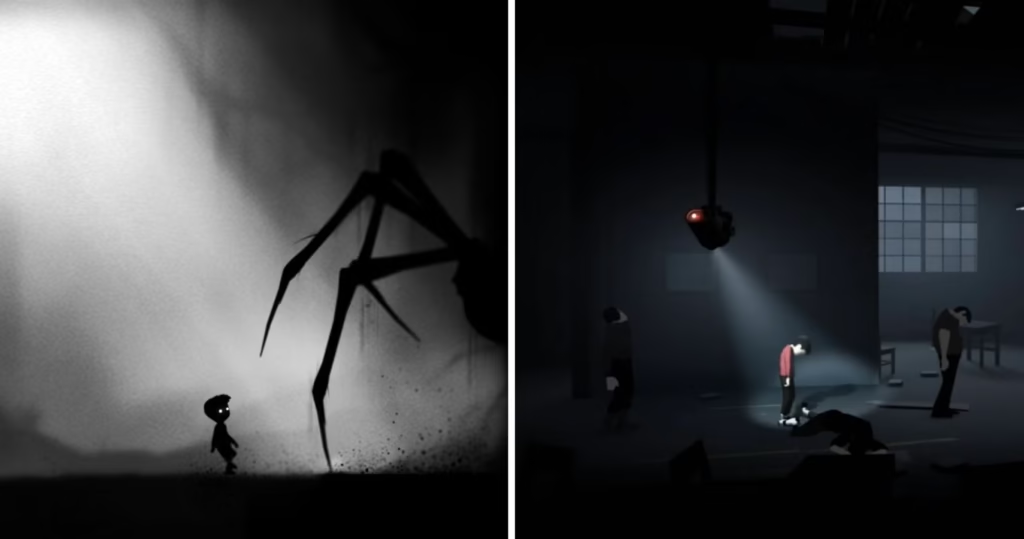
Playdead’s first game, Limbo, established the studio’s signature: a small, silent boy moving through a hostile monochrome world of deadly puzzles. Inside is clearly its successor, but it is a significant evolution.
Where Limbo was starkly abstract, Inside is richer and more suggestive, hinting at a coherent, if unexplained, dystopian society rather than a dreamlike void. The muted color, subtle sound design, and smoother, more physical animation give it a heavier sense of place. Its puzzles are more varied and more integrated with its themes, and its story, though still wordless, has a clearer sense of dread and direction. If Limbo was a haunting sketch, Inside is a fully realized nightmare, and most players consider it the stronger of the two.
Why Ambiguity Is the Point
It would have been easy for Playdead to add a few lines of explanation, a note, a recording, a final title card telling you what it all meant. The decision to withhold that is what makes the game endure. Because Inside never explains itself, it becomes a space for interpretation. Players write essays, argue over the ending, and return years later with new readings. The game refuses to become a solved thing.
This is a lesson about a certain kind of art. Ambiguity, done well, is not confusion; it is generosity. By leaving the meaning open, Inside hands the story to the player and trusts them to sit with the discomfort, the horror, and the questions. The unease it produces is real precisely because it is never resolved into a tidy explanation you can file away and forget.
Conclusion
Inside proves that a game can tell a devastating story with no words and no answers, and be more memorable for it. Through pure environmental storytelling, a theme of control that implicates the player, and an ending that refuses to resolve, it becomes something closer to a nightmare you interpret than a plot you follow. Its silence is not empty. It is full of everything the game trusts you to feel and figure out for yourself, and that trust is exactly why it works.
Frequently Asked Questions
What is the game Inside about?
Inside is a wordless puzzle-platformer about a nameless boy fleeing through a bleak, dystopian world of pursuers, mind-controlled crowds, and secret experiments. Without any dialogue, it explores themes of control, conformity, and dehumanization, letting the player interpret the story through environment and action alone.
What does the ending of Inside mean?
The ending is deliberately ambiguous. The boy merges into a mass of bodies called the Huddle, which breaks free and comes to rest on a sunlit shore. It can be read as escape, death, or a controlled experiment reaching its intended end. The game offers no definitive answer, inviting multiple interpretations.
Is Inside connected to Limbo?
They are not connected in story, but Inside is the spiritual successor to Playdead’s earlier game Limbo. It shares the silent-boy premise and monochrome-influenced style while offering richer atmosphere, deeper themes, more varied puzzles, and a stronger sense of a coherent dystopian world.
Why does Inside have no dialogue?
The lack of dialogue is a deliberate design choice. By telling its story purely through visuals, animation, and player action, the game forces players to interpret events themselves, which makes the experience more personal and unsettling than explicit narration would allow.
What is the secret ending in Inside?
Inside has a hidden alternate ending unlocked by finding and deactivating a series of concealed orbs. It is often interpreted as the boy being disconnected from an external control, hinting the whole journey may have been directed. Rather than resolving the story, it adds another layer of ambiguity.
How long does it take to beat Inside?
Most players finish Inside in around three to four hours. It is a tightly designed, uninterrupted experience meant to be played in one or two sittings, which helps maintain its oppressive atmosphere and emotional momentum from start to finish.