
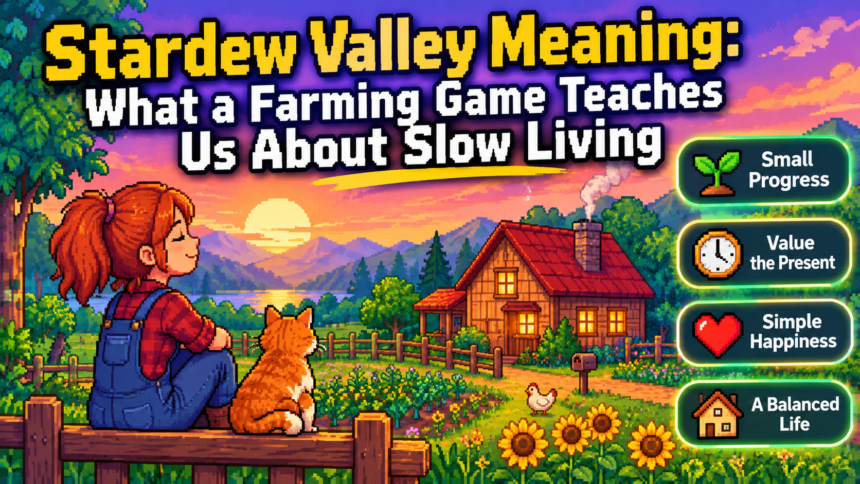

Stardew Valley looks like a cozy farming game, but its real subject is how to live a meaningful life at a gentler pace. It argues that routine, community and small daily care can matter more than ambition. Here is what the game quietly says, and why it resonates so strongly.
- What Is Stardew Valley Really About?
- The Central Conflict: Community vs Corporation
- How Stardew Valley Teaches Slow Living
- Relationships and the Heart of the Valley
- Nature, Work and the Meaning of Effort
- The Darker Edges: Loneliness, Loss and Time
- Why Stardew Valley Still Matters Today
- How to Get More Out of Playing Stardew Valley
- Frequently Asked Questions About Stardew Valley
- Conclusion: A Small Valley With a Large Idea
What Is Stardew Valley Really About?
On the surface the premise is simple. You inherit a rundown farm, plant crops, befriend villagers and slowly rebuild a neglected corner of the countryside. Nothing about that sounds profound.
Yet millions of players describe the game as comforting, even healing. That reaction points to something deeper than farming mechanics. The game is built around an emotional question: what would it feel like to step off the treadmill and start again?
The Premise: Leaving the Office Behind
The opening sets the tone. Your character works in a grey corporate job, staring at screens, living on autopilot. A letter from a late grandfather offers an escape: a plot of land in a small valley.
The game does not present this as a fantasy of laziness. It presents it as a decision to trade one kind of work for another, from work that drains you to work you can see and touch.
A Game Built by One Person
The game was created largely by a single developer, Eric Barone, who works under the name ConcernedApe. That fact matters for how it feels.
The world carries a personal, handmade warmth. Details are chosen with care instead of calculated for scale, and that intimacy mirrors the values the story promotes: patience, craft and attention to small things.
Why It Struck a Nerve
The game arrived for an audience weary of constant notifications, deadlines and productivity pressure. It offered the opposite experience, a world where effort is visible, rewards are steady and nobody is shouting.
That contrast explains much of its lasting appeal. It is less an escape from reality than a rehearsal of a calmer way of living.
The Central Conflict: Community vs Corporation
Underneath the pastel visuals sits a clear moral structure. The game sets two ways of organising a town against each other, and the player is asked to choose.
Joja and the Cost of Convenience
A large corporation, Joja, has opened a store in the village. It is efficient, cheap and bland. Choosing its path means accepting a membership, paying for progress and watching the town slowly lose its character.
The game does not demonise convenience, but it does show what is traded away for it. A place can become cheaper and emptier at the same time.
The Community Center and the Value of Slow Work
The alternative is to restore the old community centre by hand. You gather crops, fish, forage items and rare goods across the seasons, and each completed bundle brings the building back to life.
This route is slower and more demanding. It is also the one the game treats as richer, because the result belongs to everyone and your effort is woven into it.
A Choice About Values, Not Just Rewards
What makes this effective is that neither option is secretly a trick. You are allowed to pick the corporate path. The game simply lets you see the consequences.
That honesty is rare. Instead of lecturing, it lets players feel the difference between a place built by many hands and one built by a balance sheet.
How Stardew Valley Teaches Slow Living
Many games reward speed and efficiency. This one quietly rewards the opposite, or at least offers a different definition of success.
The Rhythm of Seasons
The calendar structures everything. Spring, summer, autumn and winter each bring different crops, festivals and rhythms. You cannot rush a plant, and you cannot skip the seasons.
That built-in patience is a lesson in itself. Growth takes time, some periods are quiet, and rest is part of the cycle instead of a failure.
Routine as Comfort
Watering crops, feeding animals and checking the mailbox become a daily ritual. Repetition is usually a flaw in game design, but here it creates calm.
Psychologists often note that predictable routines can reduce stress by giving structure to the day. The game turns that idea into a pleasure. You always know what comes next, and you are free to do it well.
Small Wins, Frequently
A new sprout, a caught fish, a friendly greeting. The reward system is built from tiny, frequent victories instead of rare dramatic ones.
This changes how progress feels. You are not waiting for a distant climax. You are collecting satisfaction in daily portions, which is closer to how contentment works in real life.
A Gentle Relationship With Failure
If you push too hard and run out of energy, you simply collapse and wake up the next day with a minor penalty. Nobody punishes you harshly.
This softness encourages experimentation. You can try, misjudge and recover without shame, which is a healthier model than the all-or-nothing pressure of many competitive games.
Relationships and the Heart of the Valley
Farming may be the activity, but people are the point. The villagers are what turn a pretty map into a home.
Friendship as Attention
You build relationships by remembering birthdays, giving thoughtful gifts and returning to talk. The system is simple, yet it expresses a real truth: closeness grows from paying attention repeatedly.
There is no shortcut. Showing up consistently is what the game rewards, and the villagers respond with trust and warmth.
Characters With Hidden Depth
Many residents begin as cheerful stereotypes and reveal vulnerability over time. Some struggle with loneliness, grief, addiction, family pressure or lost ambitions.
These stories are handled quietly. The game does not treat them as problems for the player to solve, but as parts of people to understand. Listening becomes the main action.
The Town as a Support Network
By the later years, the valley feels interconnected. Festivals gather everyone, and your presence matters in small ways. The game suggests that belonging is not given, it is built through participation.
Quick Overview: What the Game Rewards
| Game activity | What it rewards in real terms |
|---|---|
| Daily farming | Consistency and patience |
| Seasonal planning | Foresight and acceptance of cycles |
| Gifting and talking | Attention and empathy |
| Community bundles | Cooperation over competition |
| Exploring caves | Courage balanced with rest |
| Festivals | Belonging and shared joy |
Nature, Work and the Meaning of Effort
The game takes labour seriously. It also reframes it, showing work as something that can be satisfying when it has purpose and a visible result.
Work You Can See
In many modern jobs, effort disappears into abstract systems. Here, you plant a seed and weeks later you hold a crop. The line between action and result is clear.
That clarity is deeply satisfying. It speaks to a common modern longing, to make something tangible instead of moving information around a screen.
Respecting the Land
The farm is not a machine to be exploited without limit. Weather matters, seasons matter and the ecosystem responds to your choices. Caring for the land becomes part of the story.
The game does not need to preach about the environment. By placing you in a daily relationship with soil, water and animals, it makes the idea feel personal.
Ambition Without Burnout
You can still chase big goals, such as optimising a farm, completing every collection or delving deep into the mines. The game lets ambition coexist with calm.
The difference is that you set the pace. You are never forced to treat leisure as another form of work, although the game does let you do exactly that if you wish.
The Darker Edges: Loneliness, Loss and Time
The warmth of the valley would feel thin without contrast. Beneath the sunshine are quieter themes that give the game weight.
The Grandfather and the Weight of Legacy
The inherited farm carries emotion. Your grandfather’s letter hints at regret and hope, and the land becomes a link between generations.
The lesson is subtle. We inherit places, habits and stories, and we choose what to do with them.
Loneliness and Connection
The early days can feel isolating. You arrive as a stranger, with a blank field and no friends. The game acknowledges that starting over is lonely before it becomes rewarding.
That honesty makes the eventual sense of community feel earned instead of automatic.
The Passing of Time
Each day ends, and each year turns. Villagers age in their routines, festivals return and the valley changes slowly. The game is aware that time is both a gift and a limit.
This awareness gives the cozy surface a gentle melancholy. It reminds players that the quiet moments they are enjoying are, like all moments, temporary.
Why Stardew Valley Still Matters Today
Years after release, the game remains a reference point for a whole genre of calm, community-focused titles. Its influence says something about what players want.
The Rise of Cozy Gaming
The popularity of gentle, low-pressure games has grown steadily. Players increasingly use games to decompress, and this title proved that a quiet experience could be a major success.
It also showed that cozy does not mean shallow. A game can be soothing and still explore loss, community and purpose.
Healing Without Preaching
Many players speak of the game as a source of comfort during stressful periods. It is important not to overstate this. A game is not a replacement for professional support when someone is struggling.
But as a place to rest, reflect and feel capable, it clearly offers something valuable.
Lessons Players Take Into Real Life
- Start small. A single plot of land is enough to begin.
- Show up regularly. Consistency beats intensity.
- Value people. Relationships are the real harvest.
- Accept seasons. Not every period is meant to be productive.
- Choose your pace. Success can be defined on your own terms.
How to Get More Out of Playing Stardew Valley
If you want to experience the game as more than a checklist, a few habits help.
Step-by-Step Approach
- Play without a guide at first. Discovery is part of the charm, and mistakes are forgiving.
- Talk to everyone. Visit villagers regularly and pay attention to what they say.
- Follow the seasons. Plan around the calendar instead of fighting it.
- Take time for festivals and fishing. These moments are not distractions, they are the point.
- Choose a path deliberately. Think about what you want your town to become before deciding between the corporate and community routes.
- Stop when you feel like it. The game will wait, and it is designed for short, comfortable sessions.
Avoiding the Optimisation Trap
It is easy to turn the farm into a spreadsheet. Efficiency can be fun, but if you notice the game feeling like work, step back. The whole experience is built to resist that mindset.
Frequently Asked Questions About Stardew Valley
What is the main message of Stardew Valley?
The game suggests that a fulfilling life can come from patience, community and small daily care, instead of constant ambition and speed. It treats slow, visible effort as meaningful.
Is Stardew Valley a game about escaping reality?
In part, but it is more accurate to call it a rehearsal of a different way of living. It acknowledges loneliness, loss and hard work, and it asks what a more balanced life might feel like.
What do the Joja and Community Center routes represent?
They represent two ways of organising a place. One prioritises convenience and corporate efficiency, the other values cooperation, craft and shared history. The game lets you experience the trade-offs.
Why is Stardew Valley so relaxing?
Its predictable routines, gentle failure states, seasonal rhythm and frequent small rewards combine to reduce pressure. There is always something simple and satisfying to do.
Is there a right way to play?
No. You can farm, fish, explore caves or focus on friendships. The game responds to all of them, and its design encourages you to play at a comfortable speed.
Does Stardew Valley have a deeper story?
Yes. Beneath the cheerful surface are themes of legacy, loneliness, community and the passage of time. Much of it is told through small character moments instead of dramatic scenes.
Conclusion: A Small Valley With a Large Idea
Stardew Valley endures because it takes a modest setting and gives it emotional weight. It shows that routine can be comforting, that work can be meaningful, and that community is built through steady attention.
The practical takeaway: play it slowly, notice the people, and let the seasons set the rhythm. The game’s biggest lesson is that a good life is often assembled from small, repeated acts of care.